
SECURITIES AND EXCHANGE COMMISSION
WASHINGTON, DC 20549
FORM 10-K
FOR THE TRANSITION PERIOD FROM TO
Commission File Number:001-39558
PERELLA WEINBERG PARTNERS
(Exact Name of Registrant as Specified in its Charter)
Registrant’s telephone number, including area code: (212 ) 287-3200
Securities registered pursuant to Section 12(b) of the Act:
Securities registered pursuant to the Section 12(g) of the Act: None
| (Mark One) | |||||
| ANNUAL REPORT PURSUANT TO SECTION 13 OR 15(d) OF THE SECURITIES EXCHANGE ACT OF 1934 | |||||
FOR THE FISCAL YEAR ENDED | |||||
| OR | |||||
| TRANSITION REPORT PURSUANT TO SECTION 13 OR 15(d) OF THE SECURITIES EXCHANGE ACT OF 1934 | |||||
Commission File Number:
(Exact Name of Registrant as Specified in its Charter)
( State or other jurisdiction of incorporation or organization) | (I.R.S. Employer Identification No.) | ||||
| (Address of principal executive offices) | (Zip Code) | ||||
| Title of each class | Trading Symbol(s) | Name of each exchange on which registered | ||||||||||||
Securities registered pursuant to the Section 12(g) of the Act: None
Indicate by check mark if the registrant is a well-known seasoned issuer, as defined in Rule 405 of the Securities Act. Yes ☐
Indicate by check mark if the registrant is not required to file reports pursuant to Section 13 or 15(d) of the Act. Yes ☐
Indicate by check mark whether the registrant (1) has filed all reports required to be filed by Section 13 or 15(d) of the Securities Exchange Act of 1934 during the preceding 12 months (or for such shorter period that the registrant was required to file such reports), and (2) has been subject to such filing requirements for the past 90 days.
Indicate by check mark whether the registrant has submitted electronically every Interactive Data File required to be submitted pursuant to Rule 405 of Regulation S-T (§232.405 of this chapter) during the preceding 12 months (or for such shorter period that the registrant was required to submit such files).
Indicate by check mark whether the registrant is a large accelerated filer, an accelerated filer, a non-accelerated filer, smaller reporting company, or an emerging growth company. See the definitions of “large accelerated filer,” “accelerated filer,” “smaller reporting company,” and “emerging growth company” in Rule 12b-2 of the Exchange Act.
| ☒ | Accelerated filer | ☐ | Non-accelerated filer | ☐ | Smaller reporting company | Emerging growth company | ||||||||||||||||||||||||||
If an emerging growth company, indicate by check mark if the registrant has elected not to use the extended transition period for complying with any new or revised financial accounting standards provided pursuant to Section 13(a) of the Exchange Act. ☐
Indicate by check mark whether the registrant has filed a report on and attestation to its management’s assessment of the effectiveness of its internal control over financial reporting under Section 404(b) of the Sarbanes-Oxley Act (15 U.S.C. 7262 (b)) by the registered public accounting firm that prepared or issued its audit report.
If securities are registered pursuant to Section 12(b) of the Act, indicate by check mark whether the financial statements of the registrant included in the filing reflect the correction of an error to previously issued financial statements.
Indicate by check mark whether any of those error corrections are restatements that required a recovery analysis of incentive-based compensation received by any of the registrant’s executive officers during the relevant recovery period pursuant to §240.10D-1(b). ☐
Indicate by check mark whether the registrant is a shell company (as defined in Rule 12b-2 of the Exchange Act). Yes ☐ No
The aggregate market value of the common stock of the registrant held by non-affiliates, based on the closing price on the Nasdaq Global Select Market as of June 30, 2024 was $
As of February 24, 2025, the registrant had
DOCUMENTS INCORPORATED BY REFERENCE
Portions of Perella Weinberg Partners’ Proxy Statement for the 2025 Annual Meeting of Stockholders to be filed with the Securities and Exchange Commission within 120 days after December 31, 2024 are incorporated by reference into Part III of this Form 10-K.
Perella Weinberg Partners
Table of Contents
| Page | ||||||||
On June 24, 2021 (the “Closing Date” or the “Closing”), Perella Weinberg Partners consummated a business combination pursuant to that certain Business Combination Agreement, dated as of December 29, 2020 (the “Business Combination Agreement”). As contemplated by the Business Combination Agreement, (i) Perella Weinberg Partners acquired certain partnership interests in PWP Holdings LP (“PWP OpCo”), (ii) PWP OpCo became jointly-owned by Perella Weinberg Partners, PWP Professional Partners LP (together with its successors (including pursuant to the Division (as defined below)) and assigns, as applicable, “Professional Partners”) and certain existing partners of PWP OpCo, and (iii) PWP OpCo serves as Perella Weinberg Partners’ operating partnership as part of an umbrella limited partnership C-corporation (Up-C) structure (collectively with the other transactions contemplated by the Business Combination Agreement, the “Business Combination”). On December 31, 2023 and as part of an internal reorganization, Professional Partners was divided into three partnerships pursuant to a plan of division (the “Division”), which, among other things, provided that (i) all of its limited partnership interests in PWP OpCo were allocated to one of the divided partnerships, PWP AdCo Professionals LP (“AdCo Professionals”), (ii) all of its shares of Class B-1 common stock of Perella Weinberg Partners were allocated to another divided partnership, PWP VoteCo Professionals LP (“VoteCo Professionals”) and (iii) PWP Professional Partners LP changed its name to PWP AmCo Professional Partners LP. On April 1, 2024, as part of this internal reorganization, AdCo Professionals merged with and into PWP OpCo (the “Merger”). Unless the context otherwise requires, all references to the “Company,” “we,” “us” or “our” refer to Perella Weinberg Partners and its consolidated subsidiaries following the Business Combination, other than certain historical information which refers to the business of PWP OpCo prior to the consummation of the Business Combination.
CAUTIONARY STATEMENT REGARDING FORWARD-LOOKING STATEMENTS
Certain statements made in this Annual Report on Form 10-K are “forward looking statements” within the meaning of the federal securities laws, including the Private Securities Litigation Reform Act of 1995, Section 27A of the Securities Act of 1933, as amended (the “Securities Act”), and Section 21E of the Securities Exchange Act of 1934, as amended (the “Exchange Act”). Statements regarding the expectations regarding the combined business are “forward-looking statements.” In addition, words such as “estimates,” “projected,” “expects,” “estimated,” “anticipates,” “forecasts,” “plans,” “intends,” “believes,” “seeks,” “may,” “will,” “would,” “future,” “propose,” “target,” “goal,” “objective,” “outlook” and variations of these words or similar expressions (or the negative versions of such words or expressions) are intended to identify forward-looking statements. These forward-looking statements are not guarantees of future performance, conditions or results, and involve a number of known and unknown risks, uncertainties, assumptions and other important factors, many of which are outside the control of the parties, that could cause actual results or outcomes to differ materially from those discussed in the forward-looking statements.
Important factors, among others, that may affect actual results or outcomes include (but are not limited to): changing market conditions; the Company's ability to execute on its growth initiatives, business strategies or operating plans; the Company's ability to successfully identify, recruit, develop and retain talent; the Company's dependence on its fee-paying clients and fluctuating revenues from its non-exclusive, engagement-by-engagement business model; the high volatility of the Company's revenue as a result of its reliance on advisory fees that are largely contingent on the completion of events which may be out of its control; the Company's ability to appropriately manage conflicts of interest and tax and other regulatory factors relevant to the Company's business, including actual, potential or perceived conflicts of interest and other factors that may damage its business and reputation; substantial litigation risks in the financial services industry; cybersecurity and other operational risks; extensive regulation of the corporate advisory industry and U.S. and foreign regulatory developments relating to, among other things, financial institutions and markets, government oversight, fiscal and tax policy and laws; and other risks and uncertainties described under “Part I—Item 1A. Risk Factors.”
The forward-looking statements contained in this Annual Report on Form 10-K are based on current expectations and beliefs concerning future developments and their potential effects on the Company. There can be no assurance that future developments affecting the Company will be those that the Company has anticipated. The Company undertakes no obligation to update or revise any forward-looking statements, whether as a result of new information, future events or otherwise, except as may be required under applicable securities laws.
Website Disclosure
We file annual, quarterly and current reports, proxy statements and other information with the Securities and Exchange Commission (the “SEC”). The SEC maintains an internet site where reports, proxy and information statements, and other information regarding issuers that file electronically with the SEC are available. Our SEC filings are available to the public over the Internet at the SEC’s website at www.sec.gov and on our website at https://investors.pwpartners.com/ free of charge as soon as reasonably practicable after such reports are electronically filed with or furnished to the SEC. Our website is https://pwpartners.com/. Although we refer to our website in this report, the contents of our website are not included or incorporated by reference into this report. All references to our website in this report are intended to be inactive textual references only.
1
PART I.
Item 1. Business
General
We are a leading global independent advisory firm that provides strategic and financial advice to clients across the most active industry sectors and international markets. Our wide range of global clients include large public multinational corporations, mid-sized public and private companies, financial sponsors, individual entrepreneurs, private and institutional investors, creditor committees and government institutions.
We were founded in June 2006 with the opening of offices in New York and London, led by a team of ten seasoned advisory partners who previously held senior management positions at large global investment banks. The foundation of our Company was rooted in a belief, among other considerations, that clients would increasingly seek out deeply experienced advisors who offer independent strategic thinking and who are not burdened by the complicated conflicts that large investment banking institutions may face due to their various businesses. The 2008 global financial crisis reinforced this hypothesis and contributed to the early growth of our Company. Today, we believe that our independence is even more important. For clients and for us, independence means freedom from the distractions that dilute strategic thinking and a willingness and candor to share an honest opinion, even if at times it is contrary to our clients’ point of view. We believe that our clients choose to engage us because they value our unbiased perspective and expert advice regarding complex financial and strategic matters.
Our business provides services to multiple industry sectors, geographic markets and advisory offerings. We believe that our collaborative partnership and integrated approach combining deep industry insights, significant technical, product and transactional expertise, and rigorous work ethic create a significant opportunity for our Company to realize sustainable growth. We seek to advise clients throughout their evolution, with the full range of our advisory capabilities including, among other things, advice related to strategic and financial decisions, mergers and acquisitions (“M&A”) execution, shareholder engagement advisory, financing and capital solutions advice with a focus on restructuring and liability management, capital markets advisory, and private capital placement, as well as specialized underwriting and research services primarily for the energy and related industries.
Since our inception, we have experienced significant growth in our business, driven by hiring professionals who are highly regarded in their fields of expertise, expanding the scope and geographic reach of our advisory services, deepening and expanding our client relationships and maintaining a firm culture that attracts, develops and retains talented people. As of December 31, 2024, we serve our clients with 511 advisory professionals, including 66 advisory partners and 48 advisory managing directors, based in ten offices, located in five countries around the world.
For the years ended December 31, 2024, 2023, and 2022, we achieved revenues of $878.0 million, $648.7 million, and $631.5 million, respectively, and operating losses of $78.5 million, $115.1 million, and $47.7 million, respectively. These operating losses were largely due to the amortization of equity-based compensation awards granted by Professional Partners in connection with the Business Combination and a related internal reorganization of Professional Partners (the “Professional Partners Awards”), which were fully amortized in 2024, and the amortization of equity-based compensation awards granted in connection with the Business Combination. These awards have been and will be recorded as an equity-based compensation expense at PWP OpCo pursuant to generally accepted accounting principles in the United States (“U.S. GAAP”). As a result (or due to other factors), we may continue to experience operating losses in future periods. We believe we have established leading franchises in each of our areas of focus, as evidenced by the lead role we often command among advisors, the complexity of the situations in which we advise clients and our clients’ reputation as leaders in their respective industries.
Our Market Opportunity
We founded our Company with the objective of providing strategic and financial advice to business leaders that is critical to the success of their businesses throughout their corporate evolution. We believe that clients are increasingly looking for an independent advisor who can serve as an unbiased sounding board, work with them in genuine partnership and be by their side as they navigate mission-critical and complex issues.
2
Our Key Competitive Strengths
When we founded the Company, we saw a compelling market opportunity to create a platform with deeply experienced, senior advisory professionals from the most reputable institutions around the world to focus solely on advising clients. We have built a leading global independent advisory platform offering a range of advisory services. Our success has been driven by the trust bestowed upon us by our clients, the high-caliber professionals who have joined the Company, and the continued growth in demand for independent advice.
We believe that our integrated approach and our partnership culture in how we work with each other and our clients provides an ideal platform to deliver the strategic and financial advice sought by our clients.
Our Growth Strategy
Our growth strategy centers on increasing the depth and breadth of our advisory business in both current and potential future markets. This expansion will be driven by our ability to attract and develop outstanding professionals who complement or expand our market presence or broaden our advisory product offerings and help us attain scale. As we execute on our growth strategy, we expect to strengthen our relationships with clients and the capabilities we can offer them, which will enhance our position as a leading independent advisory firm.
Our Advisory Offerings
Our Clients
Our business provides services to multiple industry sectors and geographic markets through a broad range of advisory service offerings, which we believe offer us an opportunity to realize sustainable growth. Our primary areas of industry focus include: Consumer & Retail; Energy & Energy Transition; Financial Services & FinTech; Healthcare; Industrials & Infrastructure; and Technology, Telecom & Media.
We complement our industry focus with extensive advisory expertise in the largest international advisory markets. We operate out of ten offices in the United States, Canada, the United Kingdom, France and Germany, and we have deep international experience that has enabled us to work extensively with clients worldwide. Since our inception, we have advised over 1,300 clients on transactions in over 45 countries.
Our Advisory Services
We seek to advise our clients throughout their corporate evolution, with the full range of our advisory capabilities. Those services include advice related to strategic and financial decisions, M&A execution, shareholder engagement advisory, financing and capital solutions advice with a focus on restructuring and liability management, capital markets advisory, and private capital placement, as well as specialized underwriting and research services primarily for the energy and related industries.
M&A and Strategic Advisory: We have established a leading M&A and strategic advisory practice, advising clients on a range of strategic issues, risks and opportunities impacting their businesses. In these advisory relationships, we work closely with our clients through all stages of their assessment and evaluation of a range of strategic opportunities. Often, such situations can be complex and are mission-critical to the success of our client's businesses. In these situations, we believe we have built a reputation for providing valuable insights, experience, deep strategic thinking, rigor, technical expertise and a personalized approach in our partnerships with our clients to thoughtfully achieve their objectives.
Financing and Capital Solutions Advisory: We have built, and are continuing to invest in, a leading franchise advising clients on capital markets matters, both in transaction-related and ordinary course financing execution. We provide comprehensive capital structure advice and help our clients develop financing solutions tailored to their specific needs. We believe our independence and objectivity, coupled with our deep experience in complex financial matters, inform our market views and enhance the likelihood of a successful transaction, and in turn have helped us develop trusted and long-lasting relationships with our clients. Moreover, we believe the dramatic shift towards private credit is a once-in-a-generation move. It has been, and we believe will continue to be, a tailwind for our business, both for our corporate clients as well as for financial sponsors.
3
Our Commitment to Environmental, Social and Governance Leadership
We believe that leadership in Environmental, Social and Governance (“ESG”) issues is a central element of our Company's mission because our success is tied to how responsibly and sustainably we run our business. Over the past few years, we have taken steps to oversee and manage business-relevant ESG factors that impact the long-term interests of our stakeholders, such as engaging our employees and promoting a diverse and inclusive workplace, safeguarding our data through a cybersecurity program, and adhering to what we consider to be best practices in corporate governance and risk assessment and mitigation. Our board of directors, as well as our management team, provide direction and oversight with respect to the evolving priorities of our Company's ESG initiatives, organized into three pillars, which, in turn, contain focus areas for our attention and action:
•Environmental. The Environmental pillar is focused on assessing and monitoring our environmental footprint, and proactively raising our firm-wide awareness of environmental risk and opportunity by committing to sustainable practices to oversee environmental aspects in our business activities.
•Social. The Social pillar is focused on reinforcing our commitment to engage, develop and motivate our employees, and maintaining a rigorous cybersecurity program to protect our valuable data.
•Governance. The Governance pillar is focused on upholding our commitment to ethical business conduct, professional integrity and corporate responsibility by integrating strong governance and enterprise risk management oversight across all aspects of our business.
Our People and Inclusive Culture
We believe that our people are our most valuable asset. Our goal is to attract, develop and retain the best and brightest talent in our industry across all levels. We strive to foster a collaborative environment, and we seek individuals who are deeply committed to their clients, passionate about our business and additive to our culture.
The drivers of the growth of the Company include a combination of internal promotions and lateral recruiting in our areas of focus. In addition to this promotion and addition of external hires, we have also maintained significant discipline in how we assess our advisory professionals within our culture and our strategic and financial objectives. Today, we believe we have established a rigorous recruiting and review process that ensures that we maintain consistently high levels of performance and of quality among our advisors, which best positions us to serve our clients and their growing advisory needs.
Our senior professionals are compensated based on their overall contribution to value creation for our Company. Contribution includes, among other things, the quality of advice and execution provided to clients, intellectual content and thought leadership, the financial contribution to the Company, the commitment made to recruiting new talent, the creation of an inclusive work environment and the overall spirit of partnership they demonstrate in working with their colleagues and their clients. We do not compensate on a commission-based pay model, whereby bankers are rewarded solely based upon financial contribution. We believe that our compensation model encourages a collaborative environment and attracts talented advisory professionals to join our Company.
We recruit our junior professionals from the world's leading undergraduate and graduate programs. We devote significant time and resources to attracting, training and mentoring our employees. This starts with positioning our Company to attract competitive, high caliber talent and providing a hands-on development platform from day one through our global internship program and early careers curriculum. We are committed to talent retention, and our goal is to develop our brightest and most ambitious junior professionals into successful partners. To this end, as of December 31, 2024, 25 of our 66 advisory partners and 37 of our 48 advisory managing directors were promoted internally.
In addition to recruiting and developing advisory professionals, we have also entered into formal relationships with certain senior advisors who work with our advisory professionals to augment our overall advisory services to our clients.
Employees
As of December 31, 2024, we had 691 employees.
4
Our Focus on Cybersecurity
We strive to protect the reputation of our Company by establishing, protecting and defending our data and systems in a number of ways through a combination of processes, tools, and awareness-building. We aim to adhere to the best practices outlined in the National Institute of Standards and Technology (“NIST”) and International Organization for Standardization (“ISO”) frameworks, and our policies and procedures in managing personally identifiable information (“PII”) are in compliance with General Data Protection Regulation (“GDPR”) requirements.
We maintain a process to enhance security and optimize our IT systems, and regularly conduct security assessments and testing of our systems to verify our systems' integrity to protect against being compromised from both internal and external sources. In addition to identifying information security risks, we have established robust controls to seek to reduce or mitigate such risks. Cybersecurity training for employees is conducted regularly and we maintain system logs of user activities, exceptions, and security events for a period consistent with industry best practices unless otherwise required by law, regulation or contractual obligation.
We employ rigorous measures to appropriately handle and protect sensitive and confidential data. We take precautionary measures to minimize, to the extent possible, the use of PII and the electronic or courier-based transmission of sensitive and confidential data, relying instead on approved and secured digital data transfer services which are designed to provide tightly controlled and selective access to such information. We have mechanisms in place to help ensure that our data is secured when at-rest or in-transit, and industry standard encryption is used to the maximum extent possible. We also take steps to help ensure our ability to restore data in the event of data failure, corruption, accidental deletion, or malicious tampering.
Organizational Structure
We are a holding company and our only material assets are our partnership interests in PWP OpCo and our equity interest in the general partner of PWP OpCo, PWP GP, LLC (“PWP GP”). We operate and control all of the business and affairs of our advisory business, as run by PWP OpCo and its operating entity subsidiaries, indirectly through our equity interest in PWP GP.
Competition
The financial services industry is intensely competitive, and we expect it to remain so. Our competitors are other investment banking and financial advisory firms. We compete on both a global and a regional basis, and on the basis of a number of factors, including our reputation, depth of client relationships, industry knowledge and insights, transaction execution skills, our range of products and services, innovation and price.
We compete for business as well as to attract and retain qualified employees. Our ability to continue to compete effectively in our business will depend upon our ability to attract new employees and retain and motivate our existing employees who are essential to our ability to serve clients.
Regulation
Our business, as well as the financial services industry generally, is subject to extensive regulation in the United States and abroad. As a matter of public policy, regulatory bodies in the United States and foreign jurisdictions are charged with safeguarding the integrity of their home country’s securities and other financial markets and with protecting the interests of clients participating in those markets.
In the United States, the SEC is the federal agency responsible for the administration of the federal securities laws. Perella Weinberg Partners LP, through which we (i) conduct strategic advisory and restructuring services in the United States, (ii) engage in private placements of securities and investment banking mergers and acquisitions advisory services, (iii) conduct equity research and sales in the United States, is registered as a broker-dealer with, and is subject to regulation and oversight by, the SEC. In addition, the Financial Industry Regulatory Authority (“FINRA”), a self-regulatory organization that is subject to oversight by the SEC, adopts and enforces rules governing the conduct, and examines the activities of, its member firms, including Perella Weinberg Partners LP. State securities regulators also have regulatory or oversight authority over Perella Weinberg Partners LP.
5
Broker-dealers are subject to regulations that cover all aspects of the securities business, including anti-money laundering, handling of material non-public information, safeguarding data, reporting, record retention, market access and the conduct and qualifications of its officers, directors, employees and other associated persons. In particular, as registered broker-dealers and members of a self-regulatory organization, our U.S. broker-dealer subsidiaries are subject to the SEC's uniform net capital rule, Rule 15c3-1. Rule 15c3-1 specifies the minimum level of net capital a broker-dealer must maintain and also requires that a significant part of a broker-dealer's assets be kept in relatively liquid form. The SEC and various self-regulatory organizations impose rules that require notification when net capital falls below certain predefined criteria, limit the ratio of subordinated debt to equity in the regulatory capital composition of a broker-dealer and constrain the ability of a broker-dealer to expand its business under certain circumstances. Additionally, the SEC's uniform net capital rule imposes certain requirements that may have the effect of prohibiting a broker-dealer from distributing or withdrawing capital and requiring prior notice to the SEC for certain withdrawals of capital. Any failure to comply with applicable broker-dealer rules or regulations could have a material adverse effect on the operation of our business, financial condition and operating results.
In addition to the regulation, we are subject to in the United States, we are also subject to regulation internationally. Perella Weinberg UK Limited (“PWP U.K.”) is authorized and regulated by the Financial Conduct Authority (“FCA”) as a Small Non-Interconnected investment firm. Perella Weinberg Partners France SAS (“PWP France”) is authorized and regulated by the Authorite de Controle Prudentiel (“ACPR”) and the Authorite des Marches Financiers (“AMF”) as a class 3 investment firm. Both PWP U.K. and PWP France are subject to regulations applicable to investment firms respectively in the U.K. and in France, including market abuse and insider dealing regulation, anti-money laundering, conflicts management, business conduct, regulatory reporting and minimum regulatory capital requirements. Tudor, Pickering, Holt & Co. Securities - Canada, ULC (“TPH Canada”) is registered as an investment dealer with the provincial securities regulators in the Canadian provinces of Alberta, British Columbia, Manitoba, Ontario, Québec and Saskatchewan, with the Alberta Securities Commission being TPH Canada's principal regulator under the passport system adopted by Canada's provincial and territorial securities regulators. TPH Canada is also a dealer member of the Canadian Investment Regulatory Organization (“CIRO”), which adopts and enforces rules overseeing the capital, business conduct, record keeping, individual registration and proficiency, governance, and examines the activities of, its member firms. Per CIRO’s rules, TPH Canada is required to maintain certain minimum capital, with additional capital requirements when TPH Canada participates in deal financings outside of its carrying broker relationship.
Certain parts of our business are subject to compliance with laws and regulations of U.S. federal and state governments, non-U.S. governments, their respective agencies and/or various self-regulatory organizations relating to, among other things, the privacy of client information, and any failure to comply with these regulations could expose us to liability and/or reputational damage.
Failure to comply with any laws, rules or regulations could result in administrative or court proceedings, censures, fines, penalties, judgments, disgorgement, restitution and censures, suspension or expulsion from a certain jurisdiction, self-regulatory organization or market, the revocation or limitation of licenses, the issuance of cease-and-desist orders or injunctions or the suspension or disqualification of the entity and/or its officers, employees or other associated persons. The U.S. and non-U.S. government agencies and self-regulatory organizations, as well as state securities commissions in the United States, are empowered to conduct periodic examinations and initiate administrative proceedings that can result in censure, fines, the issuance of cease-and-desist orders or the suspension or expulsion of a broker-dealer or its directors, officers or employees. These administrative or court proceedings, whether or not resulting in adverse findings, can require substantial expenditures of time and money and can have an adverse impact on a firm's reputation, customer relationship and profitability. Our U.S. broker-dealer subsidiaries, like most other broker-dealers, have from time to time been the subject of requests for information and documents from the SEC, FINRA and other regulators. We have cooperated and complied in all material respects with any such requests for information and documents.
The Bank Secrecy Act (the “BSA”), as amended by the USA PATRIOT Act of 2001, the Anti-Money Laundering Act of 2021, and the Treasury Department's and FINRA's implementing regulations require Perella Weinberg Partners LP, as a broker-dealer, to establish and maintain an anti-money laundering program, file suspicious activity and other reports, and comply with certain record-keeping requirements. Under the BSA, a financial institution's anti-money laundering program must include policies, procedures and controls, employee training, the designation of an anti-money laundering compliance officer, periodic independent testing and customer due diligence and monitoring. PWP's non-U.S. subsidiaries are required to comply with similar non-U.S. laws and regulations designed to deter and detect money laundering and the financing of terrorism. Failure to comply with these requirements may result in reputational damage as well as monetary, regulatory and, in certain cases, criminal penalties.
6
In support of U.S. foreign policy and national security goals, the Treasury Department's Office of Foreign Assets Control (“OFAC”), administers and enforces economic and trade sanctions against targeted foreign countries and regimes, terrorists, international narcotics traffickers, and those engaged in activities related to the proliferation of weapons of mass destruction and other threats to the national security, foreign policy or economy of the United States. Among other OFAC sanctions programs, comprehensive sanctions and embargoes target certain countries and geographic regions (“Sanctioned Countries”) and their governments. We are generally prohibited from engaging in transactions involving any Sanctioned Country, its government or entities owned or controlled by a Sanctioned Country's government or persons or entities located in a Sanctioned Country, unless such activity is licensed or otherwise permissible. OFAC's “list-based” sanctions are imposed on individuals and entities designated under various programs for certain activities, including those referenced above. The names of individuals and entities designated under OFAC's list-based sanctions programs are generally placed on OFAC's List of Specially Designated Nationals and Blocked Persons (parties included on such list, “SDNs”) or similar lists. Assets of SDNs are blocked, and we are generally prohibited from dealing with them. In addition, any property, including a company that is 50 percent or more owned, directly or indirectly, by one or more SDNs in the aggregate, is blocked property. We must also comply with the economic sanctions and embargo programs administered by the United Nations Security Council and certain governmental agencies outside the United States. A violation of a sanctions or embargo program could subject us, and individual employees, to reputational damage and regulatory enforcement actions as well as significant civil and criminal penalties.
The Foreign Corrupt Practices Act (“FCPA”), the UK Bribery Act 2010 (the “UK Bribery Act”) and other applicable laws and regulations prohibit the payment of bribes to foreign government officials and political figures. The FCPA prohibits us from making or offering to make any payment, or giving anything of value, to a foreign official for the purpose of influencing that official to assist us in obtaining or retaining an improper business advantage. The FCPA has a broad reach, covering all U.S. companies and citizens doing business abroad, among others, and defining as foreign officials not only those holding public office but also individuals acting in an official capacity for or on behalf of foreign government-run, -owned or -controlled organizations or public international organizations. The FCPA also requires issuers of U.S. securities to maintain accurate books and records and adequate internal controls to prevent and detect possible FCPA violations. The UK Bribery Act prohibits us from bribing, accepting bribes or making other prohibited payments to government officials or other persons (i.e., within the public or private sector) in order to obtain or retain business or gain some other business advantage. These offenses under the UK Bribery Act apply to acts or omissions that take place in the United Kingdom (“U.K.”) or outside the U.K., where the person's act or omission would constitute an offense if carried out in the U.K. and the person has a close connection with the U.K. The UK Bribery Act also establishes a corporate offense of failing to prevent bribery by an associated party, which can be committed regardless of where the offense takes place. We maintain policies and procedures designed to prevent bribery, but such policies and procedures may not be effective in all instances to prevent violations. A violation could subject us, and individual employees, to reputational damage and regulatory enforcement actions as well as significant civil and criminal penalties. We can incur higher costs and face greater compliance risks in structuring and operating our businesses to comply with any of the foregoing regulatory requirements.
Item 1A. Risk Factors
Risk Factor Summary
The principal risks and uncertainties affecting our business include (but are not limited to) the following: changing market conditions; the Company's ability to execute on its growth initiatives, business strategies or operating plans; the Company's ability to successfully identify, recruit, develop and retain talent; the Company's dependence on its fee-paying clients and fluctuating revenues from its non-exclusive, engagement-by-engagement business model; the high volatility of the Company's revenue as a result of its reliance on advisory fees that are largely contingent on the completion of events which may be out of its control; the Company's ability to appropriately manage conflicts of interest and tax and other regulatory factors relevant to the Company's business, including actual, potential or perceived conflicts of interest and other factors that may damage its business and reputation; substantial litigation risks in the financial services industry; cybersecurity and other operational risks; extensive regulation of the corporate advisory industry and U.S. and foreign regulatory developments relating to, among other things, financial institutions and markets, government oversight, fiscal and tax policy and laws; and other risks and uncertainties described below.
7
Risks Related to Our Business
Changing market conditions can adversely affect our business in many ways, including by reducing the volume and value of the transactions involving our business, which could materially reduce our revenue.
As a financial services firm, we are materially affected by conditions in the global financial markets and economic conditions throughout the world. Financial markets and economic conditions can be negatively impacted by many factors beyond our control, such as the inability to access credit markets, rising interest rates or inflation, pandemics, terrorism, international hostilities, including the current hostilities between Russia and Ukraine and the conflict between Israel and Hamas, political uncertainty, uncertainty in U.S. federal fiscal, monetary, tax or regulatory policy and the fiscal, monetary, tax or regulatory policy of foreign governments and the timing and nature of such reform. For example, our revenue is related to the volume and value of the transactions in which we are involved. During periods of unfavorable market or economic conditions, the volume and value of M&A transactions may decrease, thereby reducing the demand for our M&A advisory services and increasing price competition among financial services companies seeking such engagements. We may face a similar reduction in demand for our M&A services when the prices of certain commodities, including oil, are suppressed or experience volatility for an extended period of time. In addition, during periods of strong market and economic conditions, the volume and value of other advisory services, including recapitalization and restructuring transactions, may decrease, thereby reducing demand for those services on our platform and increasing price competition among financial services companies seeking such engagements. Our results of operations could be adversely affected by any such reduction in the volume or value of such advisory transactions. Revenue improvements in our M&A practice in strong economic conditions could be offset in whole or in part by any related revenue declines in such other areas. Further, in the period following an economic downturn, the volume and value of M&A transactions typically take time to recover and lag behind a recovery in market and economic conditions. These trends are cyclical in nature and subject to periodic reversal.
Furthermore, rapid increases in equity valuations and market volatility can negatively impact M&A activity. Our clients engaging in M&A transactions often rely on access to the credit and/or equity markets to finance such transactions. The uncertain availability of credit and the volatility of equity markets can adversely affect the size, volume, timing and ability of our clients to successfully complete M&A transactions and adversely affect our advisory business. Market volatility also affects our clients’ ability and willingness to engage in stock-for-stock transactions.
Changes in market and economic conditions can also impact other aspects of our business in different ways. For example, our profitability may be adversely affected by our fixed costs and the possibility that we would be unable to scale back other costs within a time frame sufficient to match any decreases in revenue relating to changes in market and economic conditions. While we operate in North America and Europe, our operations in the United States have historically provided most of our revenues and earnings. Consequently, our revenues and profitability are particularly affected by market conditions in the United States.
We may be unable to execute on our growth initiatives, business strategies or operating plans.
We are executing on a number of growth initiatives, strategies and operating plans designed to enhance our business. The anticipated benefits from these efforts are based on several assumptions that may prove to be inaccurate. Moreover, we may not be able to successfully complete these growth initiatives, strategies and operating plans and realize all or any of the expected benefits, including growth targets and margin expansion, we expect to achieve or it may be more costly to do so than we anticipate. A variety of factors could cause us not to realize some or all of the expected benefits. These factors include, among others: delays in the anticipated timing of activities related to such growth initiatives, strategies and operating plans; difficulty in competing in certain industries, product areas and geographies in which we have less experience than others; negative attention from any failed initiatives; and increased or unexpected costs in implementing these efforts.
Our future growth will depend on, among other things, our ability to successfully identify, recruit, develop and retain talent and will require us to commit additional resources.
We have experienced significant growth over the past several years, which may be difficult to sustain at the same rate. Our business objectives are dependent, in part, on our ability to further grow our business to gain benefits related to scale. In addition, our business involves the delivery of professional services and is largely dependent on the talents and efforts of highly skilled individuals. Accordingly, our future growth will depend on, among other things, our ability to successfully identify and recruit individuals to join our Company. It typically takes time for these professionals to become profitable and effective. During that time, we may incur significant expenses and expend significant time and resources toward training, integration and business development aimed at developing this new talent. If we are unable to recruit and develop such professionals, we will not be able to implement our growth strategy and gain benefits related to scale, and our financial results could be materially adversely affected.
8
In addition, sustaining growth will require us to commit additional management, operational and financial resources and to maintain appropriate operational and financial systems to adequately support expansion, especially in instances when we open new offices that may require additional resources before they become profitable. There can be no assurance that we will be able to manage our expanding operations effectively, and any failure to do so could materially adversely affect our ability to grow revenue and control our expenses.
Furthermore, we have grown, and in the future we may continue to grow, by strategic investment or acquisition, which would expose us to numerous risks and uncertainties similar to those of hiring and developing our current professionals. Additionally, there are challenges related to integrating a large number of personnel into our global organization and ensuring a proper cultural fit. Management and other existing personnel have spent, and may in the future spend, considerable time and resources working to integrate any acquired business or strategic investment, which may distract them from other business operations.
We may not be successful in our efforts to retain the required personnel as the market for qualified advisory professionals is extremely competitive. Working partners and other senior professionals have left us in the past and others may do so in the future. Our senior personnel possess substantial experience and expertise and have strong relationships with our advisory clients. As a result, the loss of these professionals could jeopardize our relationships with clients and result in the loss of client engagements. For example, if any of our senior professionals, including our executive officers, or groups of professionals, were to join or form a competing firm, some of our current clients could choose to use the services of that competitor rather than our services. There is no guarantee that our compensation and non-competition arrangements with our senior professionals provide sufficient incentives or protections to prevent our working partners from resigning to compete with our Company or join our competitors. We may be unable to implement or enforce adequate restrictive covenants, including non-competition arrangements, due to legal and regulatory constraints in the jurisdictions in which we operate, which may currently or in the future apply to our senior professionals.
Our ability to successfully operate our business will depend upon the efforts of certain key personnel, including key personnel of PWP. The unexpected loss of key personnel may adversely affect our operations and profitability. In addition, our future success depends in part on our ability to identify and retain key personnel to succeed senior management. Furthermore, while we have closely scrutinized the skills, abilities and qualifications of the key personnel, our assessment may not prove to be correct. If such personnel do not possess the skills, qualifications or abilities we expect or those necessary to manage a public company, the operations and profitability of our business may be negatively impacted.
Our inability to successfully identify, consummate and integrate strategic transactions, such as joint ventures, strategic investments and acquisitions, may result in additional risks and uncertainties in our business.
In addition to recruiting and internal promotions, we may grow our business through strategic transactions, including joint ventures, strategic investments or acquisitions.
We regularly evaluate opportunities to acquire other businesses. Unless and until acquisitions of other businesses generate meaningful revenues, the purchase prices or consideration we pay to acquire such businesses could have a material adverse effect on our business, financial condition and results of operations. If we acquire a business, we may be unable to manage it profitably or successfully integrate its operations with our own. Additionally, acquisitions may have “earn-out” provisions that could result in large costs after the closing of the acquisition, some or all of which could be dilutive of the holders of our Class A common stock. Moreover, we may be unable to realize the financial, operational, and other benefits we anticipate from acquisitions. Competition for future acquisition opportunities in our markets could increase the price we pay for businesses we acquire and could reduce the number of potential acquisition targets. Further, acquisitions may involve a number of special legal, regulatory, financial and business risks. If we are unable to successfully manage these risks, we will not be able to implement our growth strategy, which could ultimately materially adversely affect our business, financial condition and results of operations.
Our revenue in any given period is dependent on the number of fee-paying clients in such period, and a significant reduction in the number of fee-paying clients in any given period could reduce our revenue and adversely affect our operating results in such period.
Our revenue in any given period is dependent on the number of fee-paying clients in such period. For the year ended December 31, 2024, we earned revenues from 221 advisory clients, 141 of which generated fees equal to or greater than $1.0 million. For the year ended December 31, 2023 we earned revenues from 202 advisory clients, 123 of which generated fees equal to or greater than $1.0 million. For the year ended December 31, 2022, we earned revenues from 200 advisory clients, 127 of which generated fees equal to or greater than $1.0 million. We may lose clients as a result of the sale or merger of a client, a change in a client's senior management, competition from other financial advisors and financial institutions and other causes. A significant reduction in the number of fee-paying clients in any given period could reduce our revenue and adversely affect our operating results for such period. There was one individual client that accounted for more than 10% of aggregate revenues for the year ended December 31, 2024, while no individual client accounted for more than 10% of aggregate revenues for the years ended December 31, 2023 and 2022.
9
In addition, the composition of the group comprising our largest clients varies significantly from year to year, and a relatively small number of clients may account for a significant portion of our revenues in any given period. As a result, our business, financial condition, results of operations and liquidity may be significantly affected by the loss of a relatively small number of mandates or the failure of a relatively small number of assignments to be completed.
We have recorded operating losses in the past and may experience operating losses in the future.
For the years ended December 31, 2024, 2023, and 2022, we recorded operating losses of $78.5 million, $115.1 million, and $47.7 million, respectively. These operating losses were largely due to the amortization of the Professional Partners Awards, which were fully amortized in 2024, and the amortization of equity-based compensation awards granted in connection with the Business Combination. These awards have been and will be recorded as equity-based compensation expense at PWP OpCo pursuant to U.S. GAAP. We need to continue to compensate personnel competitively in order to continue building our business and as a result, we may again experience operating losses in future periods.
Substantially all of our revenue is derived from advisory fees, including fees that are largely contingent upon the completion of events which may be out of our control, such as the completion of a transaction and, as a result, our revenue and profits are highly volatile on a quarterly basis.
Our revenue and profits can be highly volatile. Unlike diversified investment banks, which generate revenues from commercial lending, securities trading and retail banking, or other advisory firms, which have asset management and other recurring revenue businesses, our generation of revenues from sources other than advisory fees is minimal. Our advisory fees are generally derived from a limited number of engagements that generate significant fees contingent on key transaction milestones, the timing and conditions of which are outside of our control. We expect that we will continue to rely on advisory fees for most of our revenue for the foreseeable future. Accordingly, a decline in our advisory engagements or the market for advisory services would adversely affect our business. In addition, our financial results will likely fluctuate from quarter to quarter based on the timing of when fees are earned, and high levels of revenue in one quarter will not necessarily be predictive of continued high levels of revenue in future periods.
Because in many cases revenue is not recognized until the successful consummation of the underlying transaction, our revenue is highly dependent on market conditions and the decisions and actions of our clients, interested third parties and governmental authorities. For example, we may be engaged by a client in connection with a sale or divestiture, but the transaction may not occur or be consummated because, among other things, anticipated bidders may not materialize, no bidder is prepared to pay our client's price or because our client's business experiences unexpected operating or financial problems. We may be engaged by a client in connection with an acquisition, but the transaction may not occur or be consummated for a number of reasons, including because our client may not be the winning bidder, failure to agree upon final terms with the counterparty, failure to obtain necessary regulatory consents or board or stockholder approvals, failure to secure necessary financing, adverse market conditions or because the target's business experiences unexpected operating or financial problems. Additionally, a client may not receive bids acceptable to it in connection with a restructuring transaction or may not be able to restructure its operations or indebtedness due to a failure to reach an agreement with its principal creditors or the court. In such circumstances, we often do not receive advisory fees, despite having devoted considerable resources to these transactions.
In addition, our engagements are often singular in nature and do not provide for subsequent engagements, which could cause our revenues to fluctuate materially from period to period. As a result, high activity levels in any period are not indicative of high activity levels in the next-succeeding or any future period, and the successful completion of a previous engagement does not guarantee that we will be engaged by the same client in the future on the same terms or at all.
Further, we have in the past and may in the future face the risk that certain clients may not have the financial resources to pay our agreed-upon fees. Certain clients may also be unwilling to pay our fees in whole or in part, in which case we may have to incur significant costs to bring legal action to enforce our engagement agreements to obtain such fees. On occasion, some of our clients have entered bankruptcy, which has prevented us from collecting amounts owed to us.
If the number of debt defaults, bankruptcies or other factors affecting demand for our recapitalization and restructuring advisory services declines, our business related to such services could suffer.
We provide various financial recapitalization and restructuring and related advice to companies in financial distress or to their creditors or other stakeholders. A number of factors affect demand for these advisory services, including general economic conditions, the availability and cost of debt and equity financing, governmental policy and changes to laws, rules and regulations, including those that protect creditors. In addition, providing recapitalization and restructuring advisory services entails the risk that the transaction will be unsuccessful or take considerable time and can be subject to a bankruptcy court's authority to disallow or discount our fees in certain circumstances, including after payment of our fees. If the number of debt defaults, bankruptcies or other factors affecting demand for our advisory services related to recapitalization and restructuring activity declines, our business could be adversely affected.
10
Our failure to deal appropriately with actual, potential or perceived conflicts of interest could damage our reputation and materially adversely affect our business.
We confront actual, potential or perceived conflicts of interest in our business. Appropriately identifying and managing actual, potential or perceived conflicts of interest is complex and difficult. Accordingly, we face the risk that our policies, controls and procedures may not timely identify or appropriately manage such conflicts of interest. If we fail, or appear to fail, to timely identify or appropriately manage one or more potential or actual conflicts of interest, we could face client dissatisfaction, damage to our reputation, or regulatory or legal risk. Regulatory scrutiny of, or litigation in connection with, conflicts of interest could have a material adverse effect on our reputation which could materially adversely affect our business in a number of ways, including as a result of a reluctance of some potential clients and counterparties to do business with us.
Further, certain members of our management team oversee or are otherwise involved in PWP Capital Holdings LP’s (“PWP Capital”) asset management business or other businesses, which could divert their time and attention away from running our advisory business and create, or appear to create, potential conflicts of interest when they are faced with decisions that could have different implications for us and PWP Capital’s asset management business or other businesses that they may manage or otherwise be involved with.
We may implement or may be required to implement additional policies, controls and procedures to address additional regulatory requirements, including as a result of additional foreign jurisdictions in which we operate, or to mitigate actual or potential conflicts of interest, which could limit our activities, result in increased costs, including for additional personnel and infrastructure and information technology improvements, or reduce the positive synergies that we seek to cultivate across our businesses.
Employee misconduct, which is difficult to detect and deter, and other labor-related issues could harm us by impairing our ability to attract and retain clients and talent and by subjecting us to legal liability and reputational harm.
There is a risk that our employees could engage in misconduct that would adversely affect our business. For example, our business often requires that we deal with confidential matters of great significance to our clients. If our employees were to improperly use or disclose confidential information provided by our clients, we could be subject to legal sanctions and suffer serious harm to our reputation, financial position, current client relationships and ability to attract future clients. In addition, our financial professionals and other employees are responsible for following proper measures to maintain the confidentiality of information we hold. If an employee's failure to do so results in the improper release of confidential information, we could be subject to reputational harm and legal liability, which could impair our ability to attract and retain clients and/or personnel and in turn materially adversely affect our business. We also face the risk that our employees engage in work place misconduct, such as sexual harassment or discrimination, despite our implementation of policies and training to prevent and detect misconduct. In addition to impairing our ability to attract and retain clients, such misconduct may also impair our ability to attract and retain talent resulting in a materially adverse effect on our business. Furthermore, as we continue to increase the size of our workforce, the risk of potential employment-related claims will also increase. As such, we may be subject to legal proceedings related to employment matters including, but not limited to, discrimination, harassment (sexual or otherwise), wrongful termination and local, state or federal labor law violations. It is not always possible to deter employee misconduct, and the precautions we take to detect and prevent misconduct may not be effective in all cases. If our employees engage in misconduct or fail to follow appropriate security measures, our business could be materially adversely affected.
The U.S. Department of Justice and the SEC continue to devote significant resources to the enforcement of the FCPA. In addition, the U.K. and other jurisdictions have significantly expanded the reach of their anti-bribery laws. While we have developed and implemented policies and procedures that we believe are reasonably designed to ensure compliance by us and our personnel with the applicable laws, such policies and procedures may not be effective in all instances to prevent violations. Any determination that we have violated the FCPA or other applicable anti-corruption laws could subject us to, among other things, reputational damage, regulatory enforcement, civil and criminal penalties, material fines, profit disgorgement, injunctions on future conduct, securities litigation and/or a general loss of client or investor confidence, any one of which could adversely affect our business.
We may face damage to our professional reputation if our services are not regarded as satisfactory or for other reasons.
As an advisory service firm, we depend to a large extent on our relationships with our clients and reputation for integrity and high caliber professional services to attract and retain clients. Our ability to secure new engagements is substantially dependent on our reputation and the individual reputations of our financial professionals. Any factor that diminishes our reputation or that of our financial professionals, including not meeting client expectations or actual or alleged misconduct by our financial professionals, including misuse of confidential information or mishandling actual or perceived conflicts, could make it substantially more difficult for us to attract new engagements and clients or retain existing clients. As a result, if a client is not satisfied with our services, it may be more damaging in our field of business than in other business fields.
11
In addition, we may face reputational damage from, among other things, litigation against us, actual or perceived conflicts of interest, our failure to protect confidential information and/or breaches of our cybersecurity protections or other inappropriate disclosure of confidential information, including inadvertent disclosures.
We face strong competition from other financial advisory firms, many of which have the ability to offer clients a wider range of products and services than those we can offer, which could cause us to lose engagements to competitors, fail to win advisory mandates and subject us to pricing pressures that could materially adversely affect our revenue and profitability.
The financial services industry is intensely competitive, highly fragmented and subject to rapid change and we expect it to remain so. Our competitors are other investment banking and financial advisory firms. We compete on both a global and a regional basis, and on the basis of a number of factors, including depth of client relationships, industry knowledge, transaction execution skills, our range of products and services, innovation, reputation and price. In addition, in our business there are usually no long-term contracted sources of revenue. Each revenue generating engagement typically is separately solicited, awarded and negotiated.
We have experienced competition in obtaining advisory mandates, including with respect to pricing, and we may experience further pricing pressures in our business in the future as some of our competitors may seek to obtain increased market share by reducing fees.
Our competitors include large financial institutions, many of which have far greater financial and other resources than we do. Unlike us, these large financial institutions have the ability to support investment banking, including financial advisory services, with commercial lending and other financial services and products we do not offer in an effort to gain market share. This may put us at a competitive disadvantage and could result in pricing pressures or loss of opportunities, which could materially adversely affect our revenue and profitability. These larger and better capitalized competitors may also be better able to respond to changes in the financial services industry.
In addition to our larger competitors, we also compete with a number of independent investment banks that offer independent advisory services. There are relatively few barriers to entry impeding the launch of new financial advisory firms, including a relatively low cost of entering this business, and the success of new entrants into our lines of business, including major banks and other financial institutions, have resulted in increased competition. As these independent firms or new entrants into the market seek to gain market share there could be pricing pressures, which would adversely affect our revenue and earnings.
If we are unable to compete successfully with our existing competitors or with any new competitors, we will not be able to implement our growth strategy, which ultimately could materially adversely affect our business.
As a member of the financial services industry, we face substantial litigation risks.
Our business is subject to various U.S. and international laws and regulations that could lead to enforcement actions, fines, civil or criminal penalties or the assertion of litigation claims and damages. In addition, improper conduct by our employees, agents or other related parties could damage our reputation and/or lead to litigation or legal proceedings that could result in civil or criminal penalties, including substantial monetary fines. In certain circumstances it may not be economical to defend against such matters and/or our legal strategy may not ultimately result in us prevailing in a matter. Such events could lead to an adverse impact on our financial condition or results of operations.
Our role as advisor to our clients on important transactions involves complex analysis and the exercise of professional judgment, including rendering “fairness opinions” in connection with mergers and other transactions. Our activities may subject us to the risk of significant legal liabilities to our clients and affected third parties, including shareholders of our clients who could bring securities class actions against us. In recent years, the volume of claims and amount of damages claimed in litigation and regulatory proceedings against financial services companies have been increasing. These risks often may be difficult to assess or quantify and their existence and magnitude often remain unknown for substantial periods of time.
From time to time, we act as an underwriter in public offerings and other distributions of securities. Therefore, we are subject to risks associated with underwriting activity, including liability for material misstatements or omissions in prospectuses and other offering documents relating to offerings we underwrite. In such cases, any indemnification provisions in the applicable underwriting agreement may not be available to us or may not be sufficient to protect us against losses arising from such liability.
12
Our engagements typically include broad indemnities from our clients and provisions to limit our exposure to legal claims relating to our services, but these provisions may not protect us in all cases, including when we perform below our agreed standard of care or a client does not have the financial capacity to pay for its obligations under any such indemnity. As a result, we may incur significant legal expenses in defending against or settling litigation. In addition, we may not have, and may not in the future choose to obtain, insurance with respect to any or all potential claims and, if desirable, we may have to spend a significant amount to adequately insure against these potential claims, and such insurance coverage may not be available on commercial terms or at all. Substantial legal liability or significant regulatory action against us or significant criticism by a court of our performance or activities could have material adverse financial effects or cause significant reputational harm to us, which could materially harm our business prospects, financial condition and results of operations.
Our business is subject to various cybersecurity and other operational risks.
We face various cybersecurity and other operational risks related to our business on a day-to-day basis. We rely heavily on financial, accounting, communication and other information technology systems and the people who operate them. These systems, including the systems of third parties on whom we rely, may fail to operate properly or become disabled as a result of tampering or a breach of our or such third parties' network security systems or otherwise, including for reasons beyond our control. Our clients typically provide us with sensitive and confidential information. We are dependent on information technology networks and systems to securely process, transmit and store such information and to communicate among our locations around the world and with our clients, alliance partners and vendors. We may be subject to attempted security breaches and cyber-attacks and a successful breach could lead to shutdowns or disruptions of our systems or third-party systems on which we rely and potential unauthorized disclosure of sensitive or confidential information. Breaches of our system or the third party network security systems on which we rely could involve attacks that are intended to obtain unauthorized access to our proprietary information, destroy data or disable, degrade or sabotage our systems, often through the introduction of computer viruses and the mounting of cyber-attacks and other means and could originate from a wide variety of sources, including employees, contractors, foreign governments and other unknown third parties outside the Company. If our or the third-party systems on which we rely are compromised, do not operate properly or are disabled, we could suffer a disruption of our business, financial losses, liability to clients, regulatory sanctions and damage to our reputation. In addition, our financial professionals and other employees are responsible for following proper measures to maintain the confidentiality of information we hold. If an employee's failure to do so results in the improper release of confidential information, we could be subject to reputational harm and legal liability, which could impair our ability to attract and retain clients and in turn materially adversely affect our business. The increased use of mobile technologies can heighten these and other operational risks. There can be no assurance that we or the third parties on whom we rely will be able to anticipate, detect or implement effective preventative measures against frequently changing cyber threats.
We operate a business that is highly dependent on information systems and technology. Any failure to keep accurate books and records can render us liable to disciplinary action by governmental and self-regulatory authorities, as well as to claims by our clients. We rely on third party service providers for certain aspects of our business. Any interruption or deterioration in the performance of these third parties or failures of their information systems and technology could impair our operations, affect our reputation and adversely affect our business.
In addition, a disaster or other business continuity problem, such as a pandemic, other man made or natural disaster or disruption involving electronic communications or other services used by us or third parties with whom we conduct business, could lead us to experience operational challenges. Our continued success will depend, in part, on the availability of our personnel and office facilities and the proper functioning of our computer, software, telecommunications, transaction processing and other related systems and operations, as well as those of third parties on whom we rely. In particular, we depend on our headquarters in New York City, where a large number of our personnel are located, for the continued operation of our business. A disaster or a disruption in the infrastructure that supports our businesses, a disruption involving electronic communications or other services used by us or third parties with whom we conduct business, or a disruption that directly affects our headquarters or other major offices in Houston or the U.K., could have a material adverse impact on our ability to continue to operate our business without interruption. The incidence and severity of disasters or other business continuity problems are inherently unpredictable, and our inability to timely and successfully recover could materially disrupt our business and cause material financial loss, regulatory actions, reputational harm or legal liability.
13
Our international operations are subject to certain risks, which may affect our revenue.
For the years ended December 31, 2024, 2023, and 2022, we earned approximately 14.2%, 18.2%, and 24.3%, respectively, of our revenues from our international operations. We intend to grow our non-U.S. business, including growth into new regions with which we have less familiarity and experience, and this growth is important to our overall success. Our international operations carry special financial and business risks, which could include the following: greater difficulties in managing and staffing foreign operations; language barriers and cultural differences, including the need to adopt different business practices in different geographic areas; fluctuations in foreign currency exchange rates that could adversely affect our results; unexpected, additional and/or costly changes in trading policies, regulatory requirements, tariffs and other barriers; restrictions on travel; longer transaction cycles; higher operating costs; local labor conditions and regulations; adverse consequences or restrictions on the repatriation of earnings; potentially adverse tax consequences, such as trapped foreign losses or profits; potentially less stable political and economic environments; terrorism, international hostilities, war and other civil disturbances or other catastrophic events that reduce business activity; different fee structures for our advisory services; and difficulty collecting fees.
Further, as part of our day-to-day operations outside the United States, we are required to create compensation programs, employment policies, compliance policies and procedures and other administrative programs that comply with the laws of multiple countries. We also must communicate and monitor standards and directives across our geographically dispersed operations.
Any payment of distributions, loans or advances to and from our subsidiaries could be subject to restrictions on or taxation of, dividends or repatriation of earnings under applicable local law, monetary transfer restrictions, foreign currency exchange regulations in the jurisdictions in which our subsidiaries operate or other restrictions imposed by current or future agreements, including debt instruments, to which our non-U.S. subsidiaries may be a party. Our business, financial condition and/or results of operations could be adversely impacted, possibly materially, if we are unable to successfully manage these and other risks of international operations.
If our international business increases relative to our total business, the materialization of these risks could have a more pronounced effect on our operating results or growth prospects.
We may enter into new lines of business which may result in additional risks and uncertainties in our business.
We currently generate substantially all of our revenue from advisory engagements. However, we may grow our business by entering into new lines of business. Moreover, we currently derive a small portion of revenue through equity research and underwriting services. To the extent we enter into new lines of business or increase our focus on existing lines of business other than our advisory engagements, we will face numerous risks and uncertainties, including risks associated with actual or perceived conflicts of interest because we would no longer be limited to the advisory business, the possibility that we have insufficient expertise to engage in such activities profitably or without incurring inappropriate amounts of risk, the required investment of capital and other resources, diversion of management’s time and attention and the loss of clients due to the perception that we are no longer focusing on our business.
We may in the future also invest in companies, including our clients, or enter into new lines of business, including alongside our clients, employees, officers and directors. To the extent that we enter into new business lines or we make such investments, we may cover costs and expenses, including with respect to broken deals. In addition, there can be no assurances that such investments will be successful or that we will not lose the entire amount of our investment.
Further, entry into certain new lines of business may subject us to new laws and regulations with which we are not familiar, or from which we are currently exempt, and may lead to increased litigation and regulatory risk. In addition, certain aspects of our cost structure, such as costs for compensation, occupancy, communication and information technology services, and depreciation and amortization will be largely fixed, and we may not be able to timely adjust these costs to match fluctuations in revenue related to our entering into new lines of business. If a new business generates insufficient revenues or if we are unable to efficiently manage our expanded operations, our business could be materially adversely affected.
14
Fluctuations in foreign currency exchange rates could adversely affect our results.
Because our financial statements are denominated in U.S. dollars and we receive a portion of our revenue in other currencies (including the Euro, pound sterling and Canadian dollars), we are exposed to fluctuations in foreign currencies. During the years ended December 31, 2024, 2023, and 2022, 11.8%, 16.9%, and 19.2%, respectively, of revenue was denominated in currencies other than the U.S. dollar. In addition, we pay certain of our expenses in such currencies. Additionally, entering into transactions and holding monetary assets and liabilities that are not denominated in the functional currency of our foreign subsidiaries exposes the Company to exchange rate fluctuations which can result in foreign currency related transaction gains and losses. An appreciation or depreciation of any of these currencies relative to the U.S. dollar could result in an adverse or beneficial impact, respectively, to our financial results. We have not entered into any transactions to hedge our exposure to these foreign exchange fluctuations through the use of derivative instruments or otherwise.
Restrictions in the Credit Agreement (as defined below) governing our Revolving Credit Facility (as defined below) may impair our ability to finance our future operations or capital needs or engage in other business activities that may be in our interests.
We have access to a revolving credit facility (the “Revolving Credit Facility”) through an amended and restated credit agreement with Cadence Bank, dated December 11, 2018 (as amended on December 11, 2018, November 11, 2020, December 28, 2020, June 15, 2021, June 30, 2023, and January 24, 2025, the “Credit Agreement”), which provides for a $50.0 million unsecured revolving credit facility that matures on July 1, 2028, and contains a number of significant covenants that, among other things, require PWP OpCo and certain of its subsidiaries (the “Loan Parties”) to maintain (on a consolidated basis) minimum liquidity levels, a minimum debt service coverage ratio and a maximum leverage ratio and restrict the ability of the Loan Parties to: incur liens; dispose of assets; incur additional indebtedness; make certain restricted payments; engage in business mergers or consolidations; and engage in certain transactions with subsidiaries and affiliates.
These restrictions (and similar restrictions under any replacement credit facility) could impair our ability to finance our future operations or capital needs or engage in other business activities that may be in our interests. The ability of the Loan Parties to comply with these financial ratios and covenants may be affected by events beyond our control. A breach of the provisions of the Revolving Credit Facility (or any replacement credit facility) or the inability of any Loan Party to comply with the required financial ratios or covenants included therein could result in a default thereunder. In the event of any such default, the administrative agent under the Revolving Credit Facility (or any replacement credit facility) could elect to: declare the commitments of all of the lenders under the Revolving Credit Facility (or any replacement credit facility) to be terminated; and declare all outstanding debt, accrued interest and fees to be due and immediately payable.
We may not be able to generate sufficient cash to service any indebtedness.
Our ability to make scheduled payments on or to refinance any debt obligations, including borrowings under the Revolving Credit Facility or any replacement credit facility, depends on our financial condition and operating performance. We cannot provide assurance that we will maintain a level of cash flows from operating activities sufficient to permit us to pay the principal of, and interest on, any existing or future indebtedness. If our cash flows and capital resources are insufficient to fund any future debt service obligations, we may be forced to reduce or delay investments and capital expenditures, seek additional capital or restructure or refinance such indebtedness, and we may not be able to pursue any of these options on commercially reasonable terms or at all. This could also result in us lowering or eliminating future undeclared dividend payments. Any such transactions could also involve significant expense and management attention.
A change in relevant income tax laws, regulations, or treaties, or an adverse interpretation of these items by tax authorities, could result in an audit adjustment or revaluation of our deferred tax assets that may cause our effective tax rate and tax liability to be higher than what is currently presented on the Consolidated Statements of Financial Condition.
As part of the process of preparing our consolidated statements of financial condition, we are required to estimate income taxes in each of the jurisdictions in which we operate. Significant management judgment is required in determining our provision for income taxes, our deferred tax assets and liabilities, and any valuation allowance recorded against our deferred tax assets. This process requires us to estimate our actual current tax liability and to assess temporary differences resulting from differing book versus tax treatment. Our effective tax rate and tax liability is based on the application of current income tax laws, regulations, and treaties. These laws, regulations, and treaties are complex, and the manner in which they apply to our facts and circumstances is sometimes open to interpretation. We believe our application of current laws, regulations, and treaties to be correct and sustainable upon examination by the tax authorities. However, the tax authorities could challenge our interpretation resulting in additional tax liability or adjustment to our income tax provision that could increase our effective tax rate. In addition, tax laws, regulations, or treaties enacted in the future may cause us to revalue our net deferred tax assets and have a material change to our effective tax rate.
15
Risks Related to Regulation
Extensive and evolving regulation of our business and the business of our clients exposes us to the potential for significant penalties and fines due to compliance failures, increases our costs and may result in limitations on the manner in which our business is conducted.
As a participant in the financial services industry, we are subject to extensive regulation in the United States and internationally, including regulatory capital and other requirements imposed on our SEC-registered broker-dealer, Perella Weinberg Partners LP. We are subject to regulatory restrictions and requirements imposed by applicable statutes, regulations and policies in the jurisdictions in which we operate. U.S. and non-U.S. government agencies and self-regulatory organizations, including the SEC, FINRA and U.S. state securities commissions, are empowered to enforce the regulatory restrictions and requirements applicable to us and conduct administrative proceedings that can result in censure, fine, the issuance of cease-and-desist orders or the suspension or expulsion of a broker-dealer from registration or membership.
The statutes, regulations and policies to which we are subject may change at any time. Extensive legislation and implementing regulation affecting the financial services industry continue to be adopted in regions that directly or indirectly affect our business, including the United States, the U.K., Canada, France and Germany, and the manner in which those laws and related regulations are applied to our operations is still evolving. For example, in the United States, several states and municipalities, including, but not limited to, California, Illinois, New York State and New York City have adopted “pay-to-play” rules which, in addition to imposing registration and reporting requirements, limit our ability to charge fees in connection with certain engagements of our advisory business. Any legislative or regulatory actions and any required changes to our business operations resulting from such legislation and regulations, as well as any deficiencies in our compliance with such legislation and regulation, could result in significant loss of revenue, limit our ability to pursue business opportunities in which we might otherwise consider engaging, or otherwise adversely affect our businesses.
Our ability to conduct business and our operating results may also be adversely affected as a result of any new requirements imposed by, or changes in, the interpretation or enforcement of existing laws and rules by the SEC, FINRA, the FCA, the Canadian Securities Administrators, CIRO, the ACPR, the AMF or other U.S. or foreign governmental regulatory authorities or self-regulatory organizations that regulate financial services firms or supervise financial markets. In addition, some of our clients or prospective clients may adopt policies that exceed regulatory requirements and impose additional restrictions affecting their dealings with us. Accordingly, we may incur significant costs, including compliance costs, to comply with U.S. and international applicable statutory, regulatory and other requirements.
New laws or regulations or changes in enforcement of existing laws or regulations applicable to our clients may also adversely affect our business. For example, changes in antitrust enforcement or the focus of the Committee for Foreign Investment in the United States could affect the level of M&A activity and changes in applicable regulations could restrict the activities of our clients and their need for the types of advisory services that we provide to them.
Failure to comply with applicable laws or regulations could result in sanctions being levied against us, including fines, penalties, judgments, disgorgement, restitution and censures, suspension or expulsion from a certain jurisdiction, self-regulatory organization or market or the revocation or limitation of licenses. Failure to comply with applicable laws or regulations could also result in adverse publicity and reputational harm and could impair executive retention or recruitment. In addition, any changes in the regulatory framework could impose additional expenses or capital requirements on us, result in limitations on the manner in which our business is conducted, have a material adverse impact upon our business and financial condition and require substantial attention by senior management. In addition, our business is subject to periodic examination by various regulatory authorities, and we cannot predict the timing or the outcome of any such examinations.
The cost of compliance with international broker dealer, employment, labor, benefits and tax regulations may adversely affect our business and hamper our ability to expand internationally.
Since we operate our business both in the United States and internationally, we are subject to many distinct broker dealer, employment, labor, benefits and tax laws in each country in which we operate, including regulations affecting our employment practices and our relations with our employees and service providers. In addition, the data privacy and security framework of the European Union. and the U.K., the GDPR and the U.K. GDPR, took effect on May 25, 2018. As we engage in significant business in Europe and in the U.K., we are subject to the GDPR's requirements. If we are required to comply with new regulations or new interpretations of existing regulations, or if we are unable to comply with these regulations or interpretations, our business could be adversely affected or the cost of compliance may make it difficult to expand into new international markets. Additionally, our competitiveness in international markets may be adversely affected by regulations requiring, among other things, the awarding of contracts to local contractors, the employment of local citizens and/or the purchase of services from local businesses or favoring or requiring local ownership.
16
Risks Related to our Organizational Structure
Our only material assets are our partnership interests in PWP OpCo and our equity interest in the general partner of PWP OpCo, PWP GP, and we are accordingly dependent upon distributions from PWP OpCo to pay dividends, taxes, make payments under the TRA (as defined below) and pay other expenses.
We are a holding company, and our only material assets are our partnership interests in PWP OpCo and our equity interest in PWP GP, the general partner of PWP OpCo. We have no independent means of generating revenue. We are accordingly dependent upon, and intend to cause PWP OpCo to make, distributions to our partners in an amount sufficient to cover all applicable taxes payable, other expenses, payments under the TRA (as defined below), Professional Partners' indemnification claims with respect to the advisory business and dividends, if any, declared by us.
PWP OpCo is generally prohibited under Delaware law from making a distribution to a partner to the extent that, at the time of the distribution, after giving effect to the distribution, liabilities of PWP OpCo (with certain exceptions) exceed the fair value of its assets. Furthermore, certain subsidiaries of PWP OpCo may be subject to similar legal limitations on their ability to make distributions to PWP OpCo. Moreover, our regulated subsidiaries may be subject to regulatory capital requirements that limit the distributions that may be made by those subsidiaries.
Deterioration in the financial condition, earnings or cash flow of PWP OpCo and its subsidiaries for any reason could limit or impair its ability to pay such distributions. PWP OpCo's ability to make distributions to us will be dependent on our subsidiaries' ability to pay dividends to it. Certain of its subsidiaries are SEC-registered broker-dealers and subject to regulatory capital requirements, which may restrict their ability to make distributions unless specified levels of regulatory capital are maintained. To the extent that we require funds and PWP OpCo is restricted from making such distributions under applicable law or regulation or under the terms of financing arrangements, or is otherwise unable to provide such funds, our liquidity and financial condition could be materially adversely affected.
We are required to pay our ILPs (as defined below) and/or Limited Partners (as defined below) for certain tax benefits we may claim as a result of the tax basis step-up we received in connection with the Business Combination and related transactions and that we may receive in connection with subsequent exchanges of PWP OpCo Class A partnership units for cash or our Class A common stock. In certain circumstances, payments under the TRA (as defined herein) may be accelerated and/or significantly exceed the actual tax benefits we realize.
Our acquisition of PWP OpCo Class A partnership units in connection with the Business Combination or pursuant to future exchanges of PWP OpCo Class A partnership units for shares of our Class A common stock or cash, and certain other transactions, have or are expected to result in increases in the tax basis of the assets of PWP OpCo and other deductions that otherwise would not have been available to us. Such increases in tax basis and other deductions are expected to reduce the amount of cash tax that we would otherwise have to pay in the future due to increases in depreciation and amortization deductions (for tax purposes). These increases in tax basis may also decrease gain (or increase loss) on future dispositions of certain assets of PWP OpCo to the extent the increased tax basis is allocated to those assets. The IRS may challenge all or part of these tax basis increases, and a court could sustain such a challenge.
Our tax receivable agreement (the “TRA” or “Tax Receivable Agreement”) generally provides for payment by us to Investor Limited Partners (the “ILPs” or “ILP”) and certain Partners (as defined therein) (the “TRA Parties” and individually, a “TRA Party”) of 85% of the cash tax savings, if any, in U.S. federal, state, local and foreign income taxes and related interest realized (or deemed realized) in periods after the Closing as a result of (a) the Business Combination and related transactions, (b) exchanges of interests in PWP OpCo for cash or stock of the Company and certain other transactions and (c) payments made under the TRA. We expect to retain the benefit of the remaining 15% of these cash tax savings. While the actual increase in tax basis, as well as the amount and timing of any payments under the TRA, will vary depending upon a number of factors, including the timing of exchanges, the price of shares of our Class A common stock at the time of the exchange, the extent to which such exchanges are taxable, future tax rates and the amount and timing of our income, we expect that, as a result of the size of the increases in the tax basis of the tangible and intangible assets of PWP OpCo attributable to our prior and future acquisition of interests in PWP OpCo, during the expected term of the TRA, the payments that we may make under the TRA could be substantial.
The payment obligation under the TRA is our obligation and not an obligation of PWP OpCo. In addition, although we are not aware of any issue that would cause the IRS to challenge a tax basis increase or other benefits, the relevant ILPs and/or limited partners of Professional Partners (“Limited Partners”) will not reimburse us for any payments that may previously have been made under the TRA if such basis increases or other benefits are subsequently disallowed. As a result, in certain circumstances we could make payments to the relevant ILPs and/or Limited Partners under the TRA in excess of our cash tax savings. Our ability to achieve benefits from any tax basis increase or other benefits, and the payments to be made under the TRA, will depend upon a number of factors, as discussed above, including the timing and amount of our future income.
17
The TRA also provides that, upon a merger, asset sale or other form of business combination or certain other changes of control, our (or our successor’s) obligations with respect to exchanged or acquired Class A partnership units (whether exchanged or acquired before or after such change of control) would be based on certain assumptions, including that we would have sufficient taxable income to fully utilize the deductions arising from the increased tax deductions and tax basis and other benefits related to entering into the TRA, that certain loss carryforwards will be used within 15 years, and that any non-amortizable assets are deemed disposed of at the earlier of (i) when the relevant asset is sold or (ii) within 15 years.
Furthermore, upon a material breach of our obligations under the TRA that is not cured within the time period specified by the TRA or if, at any time, we elect an early termination of the TRA, we shall pay to each ILP and/or Limited Partner the present value, discounted at the Secured Overnight Financing Rate plus 310 basis points as of such date, of all tax benefit payments due to such partner as of either the date of delivery of the early termination notice, in the case of an early termination, or as of the date of such breach, in the case of a material breach. The calculation of payments in such circumstances would also be based on certain assumptions, including, in addition to those described above with respect to a change of control, that federal, state, local, and foreign income tax rates will remain the same as those specified for such taxable year by the Internal Revenue Code of 1986, as amended (the “Code”), and other laws on the date of such breach or the early termination payment, that any non-amortizable assets shall be deemed disposed of within 15 years of the earlier of the basis adjustment for such asset or the date of breach or delivery of the early termination notice, and that any PWP OpCo Class A partnership units that have not been exchanged will be deemed exchanged for the market value of our Class A common stock at the time of termination or material breach. Consequently, it is possible, in the case of a change of control, early termination, or material breach, that the actual cash tax savings realized by us may be significantly less than the corresponding TRA payments.
PWP OpCo may make distributions of cash to us substantially in excess of the amounts we use to make distributions to our shareholders and to pay our expenses (including our taxes and payments under the TRA). To the extent we do not distribute such excess cash as dividends on our Class A common stock, the holders of PWP OpCo Class A partnership units would benefit from any value attributable to such cash as a result of their ownership of our Class A common stock upon a redemption or exchange of their PWP OpCo Class A partnership units.
Under the amended and restated agreement of limited partnership of PWP OpCo (the “PWP OpCo LPA”), we have the right (through our control of PWP GP, the general partner of PWP OpCo), subject to applicable law, to determine when distributions will be made to the partners of PWP OpCo and the amount of any such distributions. If we authorize a distribution, such distribution will be made to the partners of PWP OpCo pro rata in accordance with their respective ownership of partnership units. In accordance with the PWP OpCo LPA, we intend to use best efforts to cause PWP OpCo to make sufficient cash distributions to the holders of partnership units of PWP OpCo to fund their tax obligations in respect of the income of PWP OpCo that is allocated to them.
If we accumulate cash received as distributions from PWP OpCo in excess of the amounts that we need to pay any cash dividends declared by our board of directors, taxes and other expenses (including payments under the TRA), neither our organizational documents nor the PWP OpCo LPA will require us to distribute such excess cash to our stockholders. Our board of directors may, in its sole discretion, choose to use such excess cash for any purpose, including (i) to make additional distributions to the holders of our Class A common stock, (ii) to acquire additional newly-issued PWP OpCo Class A partnership units, and/or (iii) to repurchase outstanding shares of our Class A common stock. Unless and until our board of directors chooses, in its sole discretion, to make a distribution to our stockholders, we will have no obligation to distribute such cash (or other available cash other than any declared dividend) to our stockholders. No adjustments to the redemption or exchange ratio of PWP OpCo Class A partnership units for shares of our Class A common stock will be made as a result of either (i) any cash distribution by us or (ii) any cash that we retain and do not distribute to our shareholders, in each case, to the extent such cash was received pursuant to a pro rata distribution by PWP OpCo. To the extent we do not distribute such cash as dividends on our Class A common stock or otherwise use such cash as described and instead, for example, hold such cash balances or lend them to PWP OpCo, this may result in shares of our Class A common stock increasing in value relative to the PWP OpCo Class A partnership units (the “PWP OpCo Units”). The holders of PWP OpCo Units may benefit from any value attributable to such cash balances or loans to PWP OpCo if they acquire shares of our Class A common stock in exchange for their Class A partnership units or if we acquire additional PWP OpCo Class A partnership units (whether from PWP OpCo or from holders of PWP OpCo Class A partnership units) at a price based on the market price of shares of our Class A common stock at the time.
18
PWP OpCo and PWP Capital have entered into various arrangements, including a master separation agreement, which contain cross-indemnification obligations of us and PWP Capital.
The master separation agreement that we entered into with PWP Capital, which holds the former asset management business of PWP OpCo prior to the separation of our advisory business from the asset management business of PWP OpCo in February 2019 (the “PWP Separation”), provides, among other things, that PWP Capital generally will indemnify us for losses that we incur relating to, arising out of or resulting from the business of PWP Capital and any payments with respect to joint liabilities to the extent they exceed 81.304% of such joint liabilities. In addition, we generally will indemnify PWP Capital for losses that PWP Capital incurs relating to our business and any payments with respect to joint liabilities to the extent they exceed 18.696% of such joint liabilities. We may not be able to recover any or all of the amount of any indemnified losses from PWP Capital should it be financially unable to perform under its indemnification obligations. In addition, we may be required to make substantial payments under our indemnity obligations to PWP Capital, which could materially adversely affect our results of operations and the price of our securities.
Our Restated Certificate of Incorporation could prevent us from benefiting from corporate opportunities that might have otherwise been available to us.
Our Restated Certificate of Incorporation, which is subject to the terms and provisions of the Stockholders Agreement (as defined below), contains provisions related to corporate opportunities that may be of interest to us and our subsidiaries and Perella Weinberg Partners LLC (“Professionals GP”) and Professional Partners and their respective subsidiaries. It provides that Professional Partners and its subsidiaries and any of their respective affiliates (excluding us or any of our subsidiaries) (collectively, the “PWP Partner Group”) and their respective affiliates will not have any duty (fiduciary or otherwise) to refrain from engaging, directly or indirectly, in the same or similar business activities or lines of business as us or any of our subsidiaries or PWP OpCo or any of its subsidiaries and in the event that the PWP Partner Group acquires knowledge of a potential transaction or matter which may be a corporate opportunity for us or any of our subsidiaries or PWP OpCo or any of its subsidiaries and the PWP Partner Group or any of their respective affiliates, none of us or any of our subsidiaries or PWP OpCo or any of its subsidiaries shall have any expectancy in such corporate opportunity and the PWP Partner Group shall not have any duty to communicate or offer such corporate opportunity to us or any of our subsidiaries or PWP OpCo or any of its subsidiaries and may pursue such corporate opportunities for themselves or direct such corporate opportunity to another person, including one of their affiliates, in each case, to the fullest extent permitted by law. Furthermore, to the fullest extent permitted by law, in the event that any of our directors or officers or a director or officer of any or our subsidiaries, PWP OpCo or any of its subsidiaries who is also a partner, principal, director, officer, member, manager, employee, consultant, independent contractor and/or other service provider of any of the PWP Partner Group acquires knowledge of a potential transaction or matter which may be a corporate opportunity for us or any of our subsidiaries or PWP OpCo or any of its subsidiaries and the PWP Partner Group or any of their respective affiliates, none of us or any of our subsidiaries or PWP OpCo or any of its subsidiaries shall have any expectancy in such corporate opportunity unless such corporate opportunity has expressly been offered to such person in his or her capacity as our director or officer in which case such opportunity shall belong to us. By becoming our stockholder, you will be deemed to have notice of and have consented to these provisions of our Restated Certificate of Incorporation.
If PWP OpCo were to become a publicly traded partnership taxable as a corporation for U.S. federal income tax purposes, we and PWP OpCo could be subject to potentially significant tax inefficiencies, and we would not be able to recover payments previously made by us under the TRA even if the corresponding tax benefits were subsequently determined to have been unavailable due to such status.
We intend to operate such that PWP OpCo is treated as a partnership for U.S. federal income tax purposes and does not become a publicly traded partnership taxable as a corporation. A “publicly traded partnership” is a partnership the interests of which are traded on an established securities market or readily tradable on a secondary market or the substantial equivalent thereof. Under certain circumstances, exchanges of PWP OpCo Class A partnership units pursuant to the PWP OpCo LPA or other transfers of PWP OpCo Units could cause PWP OpCo to be treated as a corporation. We intend to operate such that transfers of PWP OpCo Units will not cause PWP OpCo to be treated as other than a partnership by providing for limitations on the ability of partners to exchange or otherwise transfer PWP OpCo Units and providing our board of directors and the board of directors of PWP GP with certain rights to further limit exchanges or other transfers of PWP OpCo Units as necessary to maintain the partnership status of PWP OpCo. However, there can be no assurance that this treatment will be respected.
If PWP OpCo were to become a publicly traded partnership taxable as a corporation for U.S. federal income tax purposes, significant tax inefficiencies could result for us and PWP OpCo, including as a result of our inability to file a consolidated U.S. federal income tax return with PWP OpCo. In addition, we may not be able to realize tax benefits covered under the TRA and would not be able to recover any of our previously made payments under the TRA, even if the corresponding tax benefits (including any claimed increase in the tax basis of PWP OpCo's assets) were subsequently determined to have been unavailable.
19
The use of certain of our licensed trademarks by PWP Capital and its subsidiaries may expose us to reputational harm that could adversely affect our business should they take actions that damage the brand name.
We have licensed to PWP Capital and its subsidiaries the use of certain trademarks owned by us and our subsidiaries for use in connection with its asset management business that were in use by the PWP Capital business prior to the PWP Separation. As a result, there is a risk of reputational harm to us if PWP Capital and its subsidiaries use such trademarks and engage in poor business practices, experience adverse results or otherwise damage the reputational value of the “Perella Weinberg Partners” or “TPH&Co.” brand names. These risks could impair our operations, affect our reputation and adversely affect our business.
Our voting control is concentrated among the holders of our Class B-1 common stock. As a result, the market price of our securities may be materially adversely affected by such disparate voting rights.
VoteCo Professionals beneficially owns all of the outstanding shares of our Class B-1 common stock, representing approximately 82.3% of our total voting power, and holders of Class A common stock own shares of our Class A common stock, representing approximately 17.7% of our total voting power (in each case as of December 31, 2024). As long as VoteCo Professionals beneficially owns a majority of our total voting power, it will have the ability, without the consent of the public holders of our Class A common stock, to elect all of the members of our board of directors and to control our management and affairs. In addition, it will be able to determine the outcome of matters submitted to a vote of our stockholders for approval and will be able to cause or prevent a change of control of us.
The holders of our Class A common stock and Class B common stock have substantially identical rights, except that holders of Class A common stock and Class B-2 common stock are entitled to one vote per share, while holders of Class B-1 common stock are entitled to 10 votes per share on all matters to be voted on by stockholders in general. This differential in the voting rights of our Class B-1 common stock could adversely affect the market price of our Class A common stock.
20
VoteCo Professionals’ control over us may give rise to actual or perceived conflicts of interest with the Limited Partners who manage VoteCo Professionals.
We are controlled by VoteCo Professionals, which is ultimately managed by a committee of Limited Partners that manages Professionals GP, the general partner of VoteCo Professionals. The interests of the Limited Partners who manage VoteCo Professionals may differ from those of our other stockholders. For example, the Limited Partners who manage VoteCo Professionals may have a different tax position from us, which could influence their decisions regarding whether and when we should dispose of assets or incur new or refinance existing indebtedness, especially in light of the TRA, and whether and when we should undergo certain changes of control within the meaning of the TRA or terminate the TRA. In addition, the structuring of future transactions may take into consideration these tax or other considerations even where no similar benefit would accrue to us. VoteCo Professionals, which is ultimately managed by a committee of Limited Partners that manages Professionals GP, the general partner of VoteCo Professionals, holds all outstanding shares of Class B-1 common stock and thereby control approximately 82.3% of the voting interest in us as of December 31, 2024. The shares of Class B-1 common stock will entitle VoteCo Professionals to (i) for so long as the condition that Professional Partners or its Limited Partners as of the date of Closing or its or their respective successors or assigns maintain, directly or indirectly, ownership of PWP OpCo Class A partnership units that represent at least ten percent (10%) of our issued and outstanding Class A common stock (calculated, without duplication, on the basis that all issued and outstanding PWP OpCo Class A partnership units not held by us or our subsidiaries had been exchanged for our Class A common stock) (the “Class B Condition”) is satisfied, 10 votes per share for each share held of record on all matters submitted to a vote of stockholders and (ii) after the Class B Condition ceases to be satisfied, one vote per share for each share held of record on all matters submitted to a vote of stockholders. In addition, we are party to the Stockholders Agreement with VoteCo Professionals (the “Stockholders Agreement”), pursuant to which, for so long as the Class B Condition is satisfied, VoteCo Professionals will have certain approval rights over certain transactions, including the right to designate a number of nominees to our board of directors equal to a majority thereof. For so long as the Class B Condition is no longer satisfied and the condition that Professional Partners or its Limited Partners as of the date of Closing or its or their respective successors or assigns maintain, directly or indirectly, ownership of PWP OpCo Class A partnership units that represent at least five percent (5%) of our issued and outstanding Class A common stock (calculated, without duplication, on the basis that all issued and outstanding PWP OpCo Class A partnership units not held by us or our subsidiaries had been exchanged for our Class A common stock) (the “Secondary Class B Condition”) is satisfied, VoteCo Professionals will have the right to designate a number of directors (rounded up to the nearest whole number) equal to one third of our board of directors. As a result, because the Limited Partners who manage VoteCo Professionals have a majority of the voting power in us through their control of VoteCo Professionals, and our Restated Certificate of Incorporation does not provide for cumulative voting, they will have the ability to elect all of the members of our board of directors and thereby to control our management and affairs, including determinations with respect to acquisitions, dispositions, borrowings, issuances of our Class A common stock or other securities, and the declaration and payment of dividends. The Limited Partners who manage VoteCo Professionals are able to determine the outcome of all matters requiring stockholder approval and are able to cause or prevent a change of control of us or a change in the composition of our board of directors and could preclude any unsolicited acquisition of us. The voting power of the Limited Partners who manage VoteCo Professionals could deprive our stockholders of an opportunity to receive a premium for their Class A common stock as part of a sale of us and might ultimately affect the market price of our Class A common stock. As a result of the control exercised by the Limited Partners who manage VoteCo Professionals over us, none of our agreements with them have been negotiated on “arm’s length” terms. We cannot assure you that we would not have received more favorable terms from an unaffiliated party.
Risks Related to Our Securities
If our performance does not meet market expectations, the price of our securities may decline.
If our performance does not meet market expectations, the price of our securities may decline.
In addition, fluctuations in the price of our Class A common stock could contribute to the loss of all or part of your investment. The trading price of our Class A common stock could be volatile and subject to wide fluctuations in response to various factors, some of which are beyond our control. Any of the factors listed below could have a material adverse effect on your investment in our Class A common stock and our Class A common stock may trade at prices significantly below the price you paid for your shares.
21
Factors affecting the trading price of our Class A common stock may include: actual or anticipated fluctuations in our quarterly financial results or the quarterly financial results of companies perceived to be similar to us; changes in the market's expectations about our operating results; our operating results failing to meet market expectations in a particular period; changes in financial estimates and recommendations by securities analysts concerning us or the online automobile sales industry and market in general; operating and stock price performance of other companies that investors deem comparable to us; changes in laws and regulations affecting our business; commencement of, or involvement in, litigation involving us; changes in our capital structure, such as future issuances of securities or the incurrence of additional debt; the volume of shares of our Class A common stock available for public sale; any significant change in our board or management; sales of substantial amounts of Class A common stock by our directors, executive officers or significant stockholders or the perception that such sales could occur; and general economic and political conditions such as recessions, interest rates, fuel prices, international currency fluctuations, international hostilities and acts of war or terrorism.
Broad market and industry factors may depress the market price of our securities irrespective of our operating performance. The stock market in general and Nasdaq have experienced price and volume fluctuations that have often been unrelated or disproportionate to the operating performance of the particular companies affected. The trading prices and valuations of these stocks, and of our securities, may not be predictable. A loss of investor confidence in our market or the stocks of other companies which investors perceive to be similar to us could depress our stock price regardless of our business, prospects, financial conditions or results of operations. A decline in the market price of our securities also could adversely affect our ability to issue additional securities and our ability to obtain additional financing in the future.
Our stockholders may be diluted by the future issuance of common stock, preferred stock or securities convertible or exchangeable into common or preferred stock, in connection with our incentive plans, acquisitions, capital raises or otherwise.
As of December 31, 2024, we had 1,500,000,000 shares of Class A common stock authorized, of which 72,544,696 had been issued and 59,181,721 are outstanding. Our Restated Certificate of Incorporation authorizes us to issue these shares of common stock and options, rights, warrants and appreciation rights relating to common stock for the consideration and on the terms and conditions established by our board of directors in its sole discretion, whether in connection with acquisitions or otherwise.
Subject to the exchange procedures and restrictions set forth in the PWP OpCo LPA, and any other procedures or restrictions imposed by us, holders of PWP OpCo Class A partnership units (other than Perella Weinberg Partners) may exchange these units for (i) shares of Class A common stock on a one-for-one basis (subject to customary conversion rate adjustments for stock splits, stock dividends and reclassifications) or (ii) cash from an offering of shares of Class A common stock (based on the net proceeds received by us for such shares in such offering) with the form of consideration determined by us. We have reserved approximately 46.3 million shares of Class A common stock for issuance from time to time in exchange for PWP OpCo Class A partnership units. We may in the future cause PWP OpCo to issue additional PWP OpCo Class A partnership units that would also be exchangeable for shares of Class A common stock. Simultaneously with an exchange by a PWP OpCo unitholder who holds shares of Class B common stock, a number of shares of Class B common stock held by such unitholder equal to the number of PWP OpCo Class A partnership units exchanged by such unitholder will be automatically converted into shares of Class A common stock or cash which will be delivered to the exchanging holder (at Perella Weinberg Partners' option) at a conversion rate of 1:1000 (or 0.001). We have reserved approximately 46,320 shares of Class A common stock for issuance from time to time in respect of conversion of shares of Class B-1 or Class B-2 common stock into Class A common stock.
In the future, we expect to obtain financing or to further increase our capital resources by issuing additional shares of our capital stock or offering debt or other equity securities, including senior or subordinated notes, debt securities convertible into equity, or shares of preferred stock. Issuing additional shares of our capital stock, other equity securities, or securities convertible into equity may dilute the economic and voting rights of our existing stockholders, reduce the market price of our securities, or both. The amount of cash available per share including for payment of dividends in the future may also decrease. Debt securities convertible into equity could be subject to adjustments in the conversion ratio pursuant to which certain events may increase the number of equity securities issuable upon conversion. Preferred stock, if issued, could have a preference with respect to liquidating distributions or a preference with respect to dividend payments that could limit our ability to pay dividends to the holders of our Class A common stock. Our decision to issue securities in any future offering will depend on market conditions and other factors beyond our control, which may adversely affect the amount, timing, or nature of our future offerings. As a result, holders of our Class A common stock bear the risk that our future offerings may reduce the market price of our securities and dilute their percentage ownership.
Future sales of our Class A common stock may reduce the market price of our Class A common stock.
The registration and availability of a significant number of shares of Class A common stock for trading in the public market may increase the volatility in the price of our Class A common stock or put significant downward pressure on the price of our Class A common stock. In addition, we may use shares of our Class A common stock as consideration for future acquisitions, which could further dilute our stockholders.
22
Risks Related to Being a Public Company
If we are unable to maintain effective internal control over financial reporting, this could have a material adverse effect on our business.
As a public company, we are required to maintain internal control over financial reporting and to report any material weaknesses in such internal controls. Section 404 of the Sarbanes-Oxley Act of 2002 (the “Sarbanes-Oxley Act”) requires our management report upon the effectiveness of our internal control over financial reporting, and our independent registered public accounting firm is required to attest to the effectiveness of our internal control over financial reporting. If we are not able to adequately comply with Section 404 of the Sarbanes-Oxley Act or if our management or auditors are unable to conclude that our internal control over financial reporting is effective, we may become subject to adverse regulatory consequences and/or investors could lose confidence in the accuracy and completeness of our financial reports and that could lead to a decrease in the market price of our Class A common stock.
Any failure to maintain effective internal controls could adversely impact our ability to report our financial position and results from operations on a timely and accurate basis. If our financial statements are not accurate, investors may not have a complete understanding of our operations. Likewise, if our financial statements are not filed on a timely basis, we could be subject to sanctions or investigations by the stock exchange on which our Class A common stock is listed, the SEC or other regulatory authorities. We may also be subject to litigation or other disputes which may include, among others, claims invoking the federal and state securities laws, contractual claims or other claims relating to our financial statements or any material weaknesses in our internal control over financial reporting. In either case, there could result a material adverse effect on our business.
We can give no assurance that material weaknesses or restatements of financial results will not arise in the future due to a failure to maintain adequate internal control over financial reporting or circumvention of these controls, or that any measures we take will be sufficient to remediate such material weaknesses. In addition, even if we are successful in maintaining our controls and procedures, in the future those controls and procedures may not be adequate to prevent or identify irregularities or errors or to facilitate the fair presentation of our financial statements.
Risks Related to Our Governance and Governance Documents
We are a “controlled company” within the meaning of the rules of Nasdaq and, as a result, qualify for, and rely on, exemptions from certain corporate governance requirements. You will not have the same protections afforded to stockholders of companies that are subject to such requirements.
VoteCo Professionals holds more than 50% of the voting power of our shares eligible to vote. As a result, we are a “controlled company” under the rules of Nasdaq. Under these rules, a company of which more than 50% of the voting power in the election of directors is held by an individual, group or another company is a “controlled company” and may elect not to comply with certain corporate governance requirements, including the requirements that (i) a majority of the board of directors consist of independent directors and (ii) the board of directors have compensation and nominating and corporate governance committees composed entirely of independent directors.
We currently utilize these exemptions. As a result, we do not have a majority of independent directors on our board of directors and do not have a nominating and governance committee. Accordingly, although we may transition to a board with a majority of independent directors prior to the time we cease to be a “controlled company,” for such period of time you will not have the same protections afforded to stockholders of companies that are subject to all of the corporate governance requirements set by Nasdaq. In the event that we cease to be a “controlled company” and our shares continue to be listed on Nasdaq, we will be required to comply with these provisions within the applicable transition periods. These exemptions do not modify the independence requirements for our audit committee, and we intend to comply with the applicable requirements of the SEC and Nasdaq with respect to our audit committee.
The classification of our board of directors may have anti-takeover effects, including discouraging, delaying or preventing our change of control.
Our board of directors is currently divided into three classes of directors with staggered, three-year terms. The presence of a classified board could have anti-takeover effects, including discouraging a third party from making a tender offer for our shares or attempting to obtain control of us, even when stockholders may consider such a takeover to be in their best interests. It could also delay stockholders who disapprove of the performance of our board of directors from changing a majority of the composition of our board of directors through a single proxy contest.
23
Anti-takeover provisions in our charter documents and Delaware law, as well as the rules of FINRA, the FCA, the Alberta Commission, CIRO, ACPR and other U.S. or foreign governmental regulatory authorities or self-regulatory organizations, could delay or prevent a change in control, limit the price investors may be willing to pay in the future for our Class A common stock and could entrench management.
Our Restated Certificate of Incorporation and Amended and Restated Bylaws may delay or prevent a merger or acquisition that a stockholder may consider favorable by permitting our board of directors to issue one or more series of preferred stock, requiring advance notice for stockholder proposals and nominations and placing limitations on convening stockholder meetings. In addition, there will be no cumulative voting in the election of directors, and our Restated Certificate of Incorporation will provide that, subject to the rights, if any, of the holders of shares of preferred stock then outstanding, directors may be removed from office at any time, with or without cause, by the affirmative vote of at least two-thirds (2/3) of the voting power of the shares entitled to vote in connection with the election of our directors; provided, that at any time the Class B Condition is satisfied, any or all of our directors may be removed from office at any time, with or without cause, by the affirmative vote of the holders of a majority of the voting power of the shares entitled to vote in connection with the election of our directors. These provisions may also discourage acquisition proposals or delay or prevent a change in control, which could harm our stock price.
Further, our two U.S. broker-dealer subsidiaries are members of FINRA and subject to FINRA's rules, which could impede or delay a change of control. FINRA Rule 1017 generally provides that FINRA approval must be sought in connection with any transaction resulting in a single person or entity acquiring or controlling, directly or indirectly, twenty-five percent (25%) or more of a FINRA member firm's or its parent company's equity for the first time.
Similarly, our U.K. subsidiary, PWP U.K., is regulated by the FCA and is, therefore, an FCA authorized person, acquisitions of interests in which are subject to change in control rules. Prior FCA approval must be obtained for any transaction that would result in a single person or entity acquiring, directly or indirectly, 10% or more of PWP U.K.'s voting rights or share capital, including through ownership of the equity of any of its parent undertakings.
Our Restated Certificate of Incorporation provides that the Court of Chancery of the State of Delaware will be the sole and exclusive forum for certain stockholder limitation matters, subject to limited exceptions, which could discourage stockholder lawsuits or limit our stockholders' ability to bring a claim in any judicial forum that they find favorable for disputes against our directors, officers, other employees or stockholders.
Our Restated Certificate of Incorporation provides that, unless we consent in writing to the selection of an alternative forum, the Court of Chancery of the State of Delaware will, to the fullest extent permitted by law, be the sole and exclusive forum for any stockholder to bring (i) any derivative action or proceeding brought on our behalf, (ii) any action asserting a claim of breach of a fiduciary duty owed by any of our directors, officers or other employees or to us or our stockholders, (iii) any action asserting a claim against us, our directors, officers or employees arising pursuant to any provision of the Delaware General Corporation Law or our charter or bylaws, or (iv) any action asserting a claim against us, our directors, officers or employees governed by the internal affairs doctrine, and, if brought outside of Delaware, the stockholder bringing the suit will be deemed to have consented to service of process on such stockholder's counsel, except (a) any action (A) as to which the Court of Chancery in the State of Delaware determines that there is an indispensable party not subject to the jurisdiction of the Court of Chancery (and the indispensable party does not consent to the personal jurisdiction of the Court of Chancery within ten days following such determination), (B) which is vested in the exclusive jurisdiction of a court or forum other than the Court of Chancery, (C) for which the Court of Chancery does not have subject matter jurisdiction, or (D) any action arising under the federal securities laws, as to which the Court of Chancery and the federal district court for the District of Delaware shall have concurrent jurisdiction, and (b) in the event that the Court of Chancery of the State of Delaware lacks jurisdiction over any such action or proceeding, the sole and exclusive forum for such action or proceeding shall be another state or federal court located within the State of Delaware. Notwithstanding the foregoing, the choice of forum provisions do not apply to suits brought to enforce any liability or duty created by the Exchange Act or any other claim for which the federal district courts of the United States of America shall be the sole and exclusive forum. Any person or entity purchasing or otherwise acquiring any interest in shares of our capital stock shall be deemed to have notice of and consented to the forum provisions in our Restated Certificate of Incorporation. However, no such person or entity shall be deemed to have waived any right of action against us or our officers or directors pursuant to the federal securities laws. If any action the subject matter of which is within the scope of the choice of forum provision is filed in a court other than a court located within the State of Delaware (a “foreign action”) in the name of any stockholder, such stockholder shall be deemed to have consented to: (x) the personal jurisdiction of the state and federal courts located within the State of Delaware in connection with any action brought in any such court to enforce the choice of forum provision (an “enforcement action”), and (y) having service of process made upon such stockholder in any such enforcement action by service upon such stockholder's counsel in the foreign action as agent for such stockholder.
24
This choice of forum provision may limit a stockholder's ability to bring a claim in a judicial forum that it finds favorable for disputes with us or any of our directors, officers, other employees or stockholders, which may discourage lawsuits with respect to such claims. Alternatively, if a court were to find the choice of forum provision contained in our Restated Certificate of Incorporation to be inapplicable or unenforceable in an action, we may incur additional costs associated with resolving such action in other jurisdictions, which could harm our business, operating results and financial condition.
Item 1B. Unresolved Staff Comments
None.
Item 1C. Cybersecurity
Risk Management and Strategy
We also have a security incident response plan, with defined roles and responsibilities that are intended to address notification obligations and incident response procedures in the event of a data security breach. We are dedicated to business continuity and resiliency and have strategies, policies, and procedures in place that are designed to protect employee, business, and client data in the event of an emergency or natural disaster.
25
In addition to identifying information security risks, we have established robust controls to seek to reduce or mitigate such risks. Cybersecurity training for employees is conducted regularly and we maintain system logs of user activities, exceptions, and security events for a period consistent with industry best practices, unless otherwise required by law, regulation or contractual obligation. We employ rigorous measures to appropriately handle and protect sensitive and confidential data, particularly in light of increased use of remote access technology. We take precautionary measures to minimize, to the extent possible, the use of personally identifiable information and the electronic or courier-based transmission of sensitive and confidential data, relying instead on approved and secured digital data transfer services, which are designed to provide tightly controlled and selective access to such information. We have mechanisms in place to help ensure that our data is secured when at-rest or in-transit, and industry standard encryption is used to the maximum extent possible. We also take steps to help ensure our ability to restore data in the event of data failure, corruption, accidental deletion, or malicious tampering.
Governance
We take a risk-based approach to cybersecurity and have implemented cybersecurity policies throughout our operations that are designed to address cybersecurity threats and incidents. Our dedicated Information Security Team is responsible for identifying, assessing, detecting, and responding to any threats and vulnerabilities. The team routinely collects and processes information from a variety of sources, including from media reporting, commercial threat intelligence providers (FSARC, FS-ISAC), the Federal Bureau of Investigation and other government and law enforcement agencies. The team provides global mitigation of known cybersecurity threats to help ensure that our data and systems are protected.
Item 2. Properties
Our principal executive offices are located in leased office space at 767 Fifth Avenue, New York, NY, 10153. We also lease office space for our offices in Calgary, Chicago, Denver, Houston, London, Los Angeles, Munich, Paris and San Francisco. We do not own any real property. We consider these arrangements to be adequate for our present needs.
Item 3. Legal Proceedings
On October 20, 2015, Professionals GP, PWP MC LP, PWP Equity I LP and Perella Weinberg Partners Group LP (collectively, the “PWP Plaintiffs”), filed a complaint against Michael A. Kramer, Derron S. Slonecker, Joshua S. Scherer, Adam W. Verost (collectively, the “Individual Defendants”) and Ducera Partners LLC (together with the Individual Defendants, the “Defendants”) in New York Supreme Court, Commercial Division (the “Court”). The complaint alleges that the Individual Defendants, three former partners and one former employee of the PWP Plaintiffs, entered into a scheme while at PWP to lift out the PWP Plaintiffs’ restructuring group to form a new competing firm that they were secretly forming in breach of their contractual and fiduciary duties to the PWP Plaintiffs. The complaint contains 14 causes of action, and seeks declaratory relief as well as damages resulting from the Individual Defendants’ contractual and fiduciary breaches and from Defendants’ unfair competition and tortious interference with the PWP Plaintiffs’ contracts and client relationships.
26
On November 9, 2015, the Defendants filed an Answer, Counterclaims, Cross-claims and a Third-Party Complaint, which contained 14 causes of action. On July 17, 2016, the Court issued a decision, dismissing half of the Defendants’ -claims with prejudice. On August 18, 2016, the Defendants filed an Amended Answer, Counterclaims, Cross-claims and Third-Party Complaint, with seven counterclaims and cross-claims to the New York Appellate Division, First Department (the “First Department”). On August 29, 2017, the First Department issued a decision denying the Defendants’ appeal other than allowing one Defendant to proceed with his breach of fiduciary duty counterclaim. On October 27, 2017, the Defendants moved the First Department for leave to appeal its decision to the New York Court of Appeals. On December 28, 2017, the First Department denied the Defendants’ motion for leave. On April 24, 2018, the Defendants filed a Second Amended Answer, Counterclaims, Cross-claims and Third-Party Complaint, which contains eight counterclaims and cross-claims. Defendants are seeking declaratory relief and damages of no less than $60.0 million, as well as statutory interest. In addition, on January 19, 2022, Defendants filed a motion for leave to renew their New York Labor Law counterclaim that the Court dismissed in 2016. On June 30, 2023, the Court issued a decision denying Defendants’ motion for leave. On January 29, 2024, Defendants appealed to the First Department the June 30, 2023 decision denying their motion for leave. On April 16, 2024, the First Department denied Defendants’ appeal.
After the completion of discovery, both the PWP Plaintiffs and the Defendants subsequently moved for summary judgment. On March 20, 2020 the parties completed briefing of their respective motions (the “Summary Judgment Decision”). The Court granted the PWP Plaintiffs motion with respect to the restrictive covenants in the PWP Plaintiffs’ agreements, finding that they are valid and enforceable, and otherwise denied the motion. The Court denied Defendants’ motion in its entirety. On July 25, 2023, Defendants appealed parts of the Summary Judgment Decision. On August 30, 2024, the First Department issued a decision granting in part and denying in part Defendants’ appeal. The First Department granted Defendants’ appeal only to the extent it found that the PWP Plaintiffs could not pursue a client solicitation claim against two specific clients. The First Department denied Defendants’ appeal to the extent it found that the PWP Plaintiffs’ restrictive covenants were reasonable and enforceable, and Defendants’ counterclaim for deferred compensation needed to be decided at trial.
Trial started on January 24, 2025 and is scheduled to end on March 7, 2025.
We believe that our 14 causes of action are meritorious. Further, we believe that we have meritorious defenses to Defendants’ remaining counterclaims and cross-claims and plan to vigorously contest them. Litigation, however, can be uncertain and there can be no assurance that any judgment for one or more of Defendants or other outcome of the case would not have a material adverse effect on us. Additionally, even if we prevail in the litigation and are awarded damages, we do not know if we will be able to fully collect on any judgment against any or all Defendants.
We are now, and from time to time may in the future be, named as a defendant in legal actions relating to transactions conducted in the ordinary course of business. We may also become involved in other judicial, regulatory and arbitration proceedings concerning matters arising in connection with the conduct of our businesses. Some of these matters may involve claims of substantial amounts.
For details on the current legal proceedings, refer to Note 16—Commitments and Contingencies in the notes to the consolidated financial statements included elsewhere in this Form 10-K.
Item 4. Mine Safety Disclosures
Not applicable.
27
PART II.
Item 5. Market for Registrant's Common Equity, Related Stockholder Matters and Issuer Purchases of Equity Securities
Our Class A common stock is listed and traded on the Nasdaq Global Select Market under the stock symbol “PWP.” As of February 24, 2025, there were approximately 12 holders of record of our Class A common stock and 1 holder of record of our Class B common stock. This does not include the number of shareholders that hold shares in “street name” through banks or broker-dealers. Our Class B common stock is not listed or quoted on any exchange and is not transferable by the holders, subject to certain limited exceptions.
We intend to pay dividends quarterly to our common stockholders. For the year ended December 31, 2024, cash dividends of $0.28 per outstanding share of Class A common stock were paid to our stockholders. The declaration of any future cash dividends and, if declared, the amount of any such dividends, will be subject to our financial condition, earnings, capital requirements, financial covenants, applicable law and other factors our board of directors deems relevant. Therefore, there can be no assurance as to what level of dividends, if any, will be paid in the future.
Stock Performance
The following performance graph and related information shall not be deemed “soliciting material” or to be “filed” with the SEC, nor shall such information be incorporated by reference into any future filing under the Securities Act of 1933, as amended, or the Exchange Act except to the extent we specifically incorporate it by reference into such filing. Our stock price performance shown in the graph below is not indicative of future stock price performance.
The stock performance graph below compares the performance of an investment in our Class A common stock, from June 25, 2021 through December 31, 2024, with that of the S&P 500 Index and the S&P Financials Index. The graph assumes $100 was invested at the close of business on June 25, 2021. It also assumes that dividends were reinvested on the date of payment without payment of any commissions. The performance shown in the graph represents past performance and should not be considered an indication of future performance.
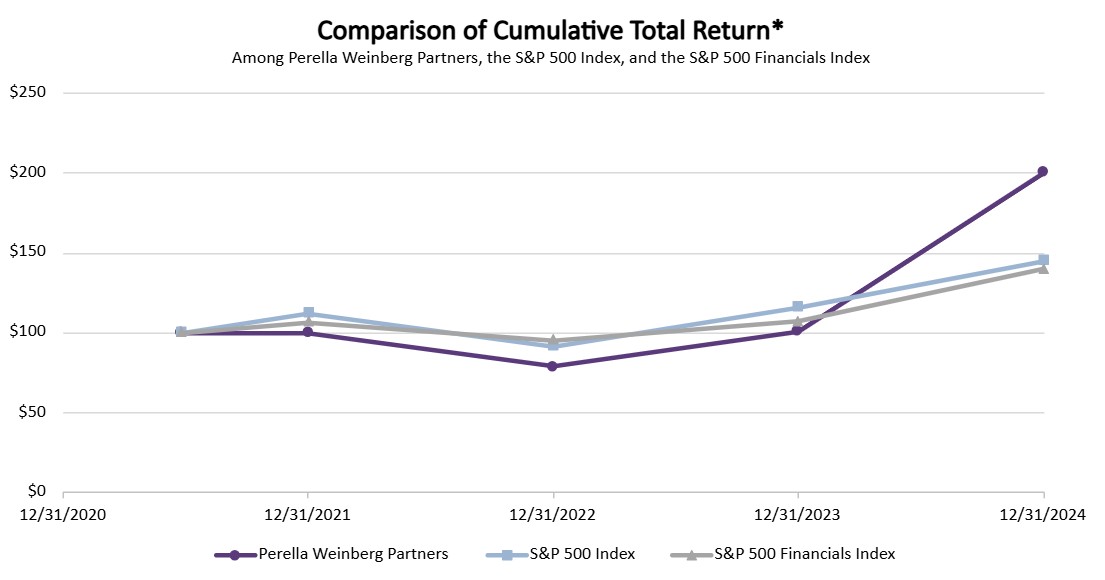
28
Unregistered Sales of Equity Securities and Use of Proceeds
None.
Repurchase of Equity Securities
The following table summarizes our repurchases of equity securities during the three months ended December 31, 2024:
| Period | Total Number of Shares Repurchased | Average Price Paid per Unit | Total Number of Shares Purchased as Part of Publicly Announced Program | Dollar Value of Shares that may yet to be Purchased Under the Publicly Announced Program(1) | ||||||||||||||||||||||
October 1, 2024 - October 31, 2024 | $ | — | $ | — | — | $ | 93,823,525 | |||||||||||||||||||
November 1, 2024 - November 30, 2024 | $ | — | $ | — | — | $ | 93,823,525 | |||||||||||||||||||
December 1, 2024 - December 31, 2024 | $ | — | $ | — | — | $ | 93,823,525 | |||||||||||||||||||
| Total | — | $ | — | — | ||||||||||||||||||||||
__________________
(1) On February 16, 2022, the Company’s Board of Directors initially approved a stock repurchase program and the authorized amounts under such program was increased on February 8, 2023 such that the Company is authorized to repurchase up to $200.0 million of the Company’s Class A common stock.
Item 6. [Reserved]
29
Item 7. Management’s Discussion and Analysis of Financial Condition and Results of Operations
The following discussion and analysis of our financial condition and results of operations should be read in conjunction with our Consolidated Financial Statements and related notes included elsewhere in this Annual Report on Form 10-K.
Executive Overview
We are a leading global independent advisory firm that provides strategic and financial advice to clients across some of the most active industry sectors and international markets. Our wide range of global clients include large public multinational corporations, mid-sized public and private companies, individual entrepreneurs, private and institutional investors, creditor committees and government institutions.
For further information regarding our business, refer to “Part I. Item 1. Business” and “Part I. Item 1A. Risk Factors” of this filing.
Business Environment
Economic and global financial market conditions impact our financial performance. The market environment for advisory services is improving, driving increased dialogue and activity levels across the traditional M&A markets.
Our core advisory services benefit from macroeconomic changes that impact our client base and lead them to consider business combinations, acquisitions and divestitures, capital raises and restructurings. We continue to invest in our platform to achieve scale, accelerate growth, and deliver value.
See “Part I — Item 1A. Risk Factors” included elsewhere in this Form 10-K for a discussion of some of the factors that can affect our performance.
Key Financial Measures
Revenues
We operate in a highly competitive environment, and each revenue-generating engagement is separately solicited and negotiated. Our fee-paying client engagements are not predictable, and we may experience fluctuations in revenues from quarter to quarter. To develop new business, we maintain an active business dialogue with existing and potential clients, and we expect to add new clients each year through expanding our relationships, hiring senior advisory professionals, and receiving introductions from our relationship network. However, we also lose clients each year due to various factors, such as sales or mergers, changes in clients’ senior management, and competition from other financial services firms.
Our revenue recognition is often tied to the completion of a transaction, which can be delayed or terminated due to various reasons, including failure to obtain regulatory or board approval, failure to secure financing, or adverse market conditions. Larger transactions may take longer to close, adding unpredictability to the timing of revenues. Despite our efforts, we may receive lower advisory fees or no fee at all if a transaction is not completed. Other barriers to the completion of restructuring transactions include a lack of anticipated bidders, failure to obtain court approval, or a failure to reach an agreement with creditors. In such cases, our advisory fees may be limited to monthly retainer fees plus the reimbursement of expenses.
We do not present our revenue by the type of advice we provide because of the complexity of the transactions on which we may earn revenue and our holistic approach to client service. For instance, a traditional M&A engagement may require additional advisory services, such as capital markets or capital solutions advice or a private capital raise, which may call for cross-functional expertise from our professionals. We focus on dedicating the necessary resources and expertise to each engagement, regardless of product lines, to achieve the desired outcome for our clients. Consequently, tracking the type of advisory service offered in each instance is not practical.
30
Operating Expenses
Our operating expenses are classified as (i) total compensation and benefits expenses including equity-based compensation, and (ii) non-compensation expenses.
Compensation and Benefits Expenses
Our compensation and benefits expenses consist of salaries, bonuses (discretionary awards and guaranteed amounts), severance, payroll and related taxes, benefits, and the amortization of equity-based compensation awards that are subject to a service-based vesting condition, and in some cases, a market-based performance vesting condition. These expenses also include signing bonuses and compensation paid pursuant to guarantees for new hires.
Compensation is determined by management based on revenues earned, headcount, labor market conditions, and anticipated compensation requirements for our employees. Such factors can fluctuate, including headcount and revenues earned, and as a result, our compensation expenses may fluctuate materially in any particular period.
At the time of the Merger, the Company entered into vesting acceleration agreements with certain holders of Professional Partners Awards to accelerate vesting for all Professional Partners Awards during the second quarter of 2024 (the “Vesting Acceleration”). Prior to the Merger, the amortization expense for the Professional Partners Awards was allocated fully to non-controlling interests. As a result of the Merger, these awards are considered granted by PWP OpCo and PWP OpCo as a whole bore the cost of the cash settlement feature of the awards, which was added in conjunction with the Merger. As a result, subsequent to the Merger, the Company allocated the costs associated with these awards between Perella Weinberg Partners and non-controlling interests in proportion to their ownership interests, which is consistent with the allocation of the other profit and loss activity of PWP OpCo.
Non-Compensation Expenses
Our non-compensation expenses include the costs of professional fees, technology and infrastructure, rent and occupancy, travel and related expenses, depreciation and amortization and general, administrative and other expenses. Our non-compensation expenses also include certain expenses reimbursed by our clients. Overall, our non-compensation expenses are subject to variability due to multiple factors, including headcount, business needs, and inflation.
Non-Operating Income (Expenses)
Non-operating income (expenses) includes the impact of income and expense items that we consider to be non-operational in nature, which typically includes interest income and expense and other non-operating gains (losses), including the impact of foreign exchange rate fluctuations.
Non-Controlling Interests
Non-controlling interests represent the ownership interests in PWP OpCo held by holders other than Perella Weinberg Partners, which are current and former working partners. Profits and losses of PWP OpCo are allocated to the non-controlling interests in proportion to their ownership interest regardless of their basis, with an exception for certain equity-based compensation expense which was fully attributed to non-controlling interests prior to the Merger.
31
Results of Operations
The following is a discussion of our results of operations for the years ended December 31, 2024 and 2023. For a discussion of the year ended December 31, 2023 versus 2022, refer to Item 7, “Management’s Discussion and Analysis of Financial Condition and Results of Operations – Results of Operations” in our Form 10-K for the year ended December 31, 2023.
| Year Ended December 31, | ||||||||||||||||||||||||||||||||
| (Dollars in thousands) | 2024 | 2023 | 2022 | 2024 vs. 2023 | 2023 vs. 2022 | |||||||||||||||||||||||||||
Revenues | $ | 878,039 | $ | 648,652 | $ | 631,507 | 35 | % | 3 | % | ||||||||||||||||||||||
Expenses | ||||||||||||||||||||||||||||||||
Compensation and benefits | 525,941 | 426,572 | 391,333 | 23 | % | 9 | % | |||||||||||||||||||||||||
Equity-based compensation | 258,296 | 182,375 | 154,158 | 42 | % | 18 | % | |||||||||||||||||||||||||
Total compensation and benefits | 784,237 | 608,947 | 545,491 | 29 | % | 12 | % | |||||||||||||||||||||||||
Non-compensation expenses | 172,334 | 154,805 | 133,749 | 11 | % | 16 | % | |||||||||||||||||||||||||
Total operating expenses | 956,571 | 763,752 | 679,240 | 25 | % | 12 | % | |||||||||||||||||||||||||
Operating income (loss) | (78,532) | (115,100) | (47,733) | 32 | % | (141) | % | |||||||||||||||||||||||||
Non-operating income (expenses) | ||||||||||||||||||||||||||||||||
Related party income | — | 932 | 2,805 | (100) | % | (67) | % | |||||||||||||||||||||||||
Other income (expense) | 10,277 | 1,348 | 7,702 | 662 | % | (82) | % | |||||||||||||||||||||||||
Change in fair value of warrant liabilities | — | — | 15,806 | — | % | (100) | % | |||||||||||||||||||||||||
Total non-operating income (expenses) | 10,277 | 2,280 | 26,313 | 351 | % | (91) | % | |||||||||||||||||||||||||
Income (loss) before income taxes | (68,255) | (112,820) | (21,420) | 40 | % | (427) | % | |||||||||||||||||||||||||
Income tax expense (benefit) | 21,089 | (980) | 10,327 | NM | NM | |||||||||||||||||||||||||||
Net income (loss) | $ | (89,344) | $ | (111,840) | $ | (31,747) | 20 | % | (252) | % | ||||||||||||||||||||||
Less: Net income (loss) attributable to non-controlling interests | (24,616) | (94,617) | (49,625) | 74 | % | (91) | % | |||||||||||||||||||||||||
Net income (loss) attributable to Perella Weinberg Partners | $ | (64,728) | $ | (17,223) | $ | 17,878 | (276) | % | NM | |||||||||||||||||||||||
| NM = Not meaningful | ||||||||||||||||||||||||||||||||
32
Revenues
The following table provides revenue statistics for the years ended December 31, 2024, 2023, and 2022:
| Year Ended December 31, | |||||||||||||||||||||||||||||
| 2024 | 2023 | 2022 | 2024 vs. 2023 | 2023 vs. 2022 | |||||||||||||||||||||||||
| Total Advisory Clients | 221 | 202 | 200 | 19 | 2 | ||||||||||||||||||||||||
| Total Clients with Fees Greater than $1.0 million | 141 | 123 | 127 | 18 | (4) | ||||||||||||||||||||||||
Revenues were $878.0 million for the year ended December 31, 2024 as compared with $648.7 million for the year ended December 31, 2023, representing an increase of 35%. The increase was attributable to increased mergers and acquisition and financing and capital solutions activity, driven by larger transactions in size and number across the business.
Compensation and Benefits Expenses
For the year ended December 31, 2024, total compensation and benefits expenses were $784.2 million, an increase of 29% compared with $608.9 million for the year ended December 31, 2023. The increase in total compensation and benefits expenses was primarily the result of a higher bonus accrual in the current year period due to a higher revenue base, despite a lower compensation margin. The increase was also driven by higher equity-based compensation expense from the phase-in of our annual incentive award grants, as well as the Vesting Acceleration, which resulted in $144.2 million of equity-based compensation expense for the Professional Partners Awards in the current year period as compared to $68.5 million in the prior year period for the same awards. The increase in total compensation and benefits was partially offset by higher costs incurred in the prior year related to headcount reductions associated with a business realignment.
Non-Compensation Expenses
For the year ended December 31, 2024, total non-compensation expenses were $172.3 million, an increase of 11% compared with $154.8 million for the year ended December 31, 2023. The increase in non-compensation expenses was primarily the result of an increase in professional fees, including consulting fees tied to revenue contribution, bad debt write-offs, and higher depreciation expense due to new assets being placed in service subsequent to the second quarter of 2023 related to the renovation of the New York office space and relocation of the London office space. These increases were partially offset by reduced rent and occupancy costs.
Non-Operating Income (Expenses)
For the year ended December 31, 2024, non-operating income was $10.3 million compared with non-operating income of $2.3 million for the year ended December 31, 2023. In the current period, non-operating income primarily included interest income, which increased from the prior year due to higher interest rates and larger interest-bearing cash balances, and a net gain from foreign exchange rate fluctuations, compared to a net loss in the prior year. For both periods, foreign exchange rate fluctuations largely related to U.S. dollar-denominated cash and intercompany balances held by our foreign subsidiaries, including the settlement of such balances. The year ended December 31, 2023 also included a non-operating loss on investment that did not recur in the current year.
Income Tax Expense (Benefit)
The Company’s income tax expense and effective tax rate were $21.1 million and (30.9)%, respectively, for the year ended December 31, 2024 compared to an income tax benefit and an effective tax rate of $1.0 million and 0.9%, respectively, for the year ended December 31, 2023. The change in the effective tax rate was primarily due to the relative size of our permanent differences in relation to the pre-tax loss in the respective periods, the Vesting Acceleration, and the recognition of tax benefits associated with the appreciation in our share price upon vesting of RSUs above the original grant price during the year ended December 31, 2024.
33
Liquidity and Capital Resources
General
We regularly monitor our liquidity position, including cash and cash equivalents, working capital assets and liabilities, commitments and other liquidity requirements. Our primary sources of liquidity are generally our cash and cash equivalent balances, investments in short-term marketable debt securities, the net cash generated from operations, and the available borrowing capacity under our Revolving Credit Facility. Our primary cash needs are for working capital, operating expenses (including cash compensation for our employees), repurchasing shares of the Company’s Class A common stock, withholding tax payments for vested incentive compensation awards, including restricted stock units and performance stock units (the “PWP Incentive Plan Awards”), cash-settled exchanges of PWP OpCo Units, income taxes, dividends and distributions, capital expenditures, making payments pursuant to the tax receivable agreement, commitments, and strategic investments. We generally pay a significant portion of our annual cash incentive compensation during the first quarter of each calendar year with respect to the prior year’s results. Therefore, levels of cash and cash equivalents and/or investments in short-term marketable debt securities generally decline during the first quarter and build over the remainder of the year.
Our current assets are primarily composed of cash and cash equivalents, investments in short-term marketable debt securities, receivables related to fees earned from providing advisory services, certain prepaid expenses and certain amounts due from related parties. Our current liabilities are primarily composed of accrued employee compensation, accounts payable and other accrued expenses. Cash and cash equivalents include cash held at banks, including interest-bearing money market accounts, and short-term highly liquid investments that have original maturities of three months or less from the date of purchase. We had cash balances of $331.6 million and $247.2 million as of December 31, 2024 and 2023, respectively, and cash equivalents of $20.2 million as of December 31, 2024, which included investments in U.S. Treasury securities. As of December 31, 2023, we held no cash equivalents. Additionally, as of December 31, 2024 and 2023, we held U.S. Treasury securities of $75.8 million and $91.2 million, respectively, which are classified as Investments in short-term marketable debt securities within the consolidated financial statements.
Our liquidity is highly dependent upon cash receipts from clients, which generally require the successful completion of transactions. Accounts receivable typically have net terms of 30 days. Accounts receivable, net of allowance for credit losses, were $73.3 million and $47.8 million as of December 31, 2024 and 2023, respectively.
We have a Revolving Credit Facility with Cadence Bank with an available line of credit of $50.0 million. Additionally, up to $20.0 million of incremental revolving commitments above the $50.0 million commitment amount may be incurred under the Credit Agreement. As of December 31, 2024 and 2023, we had no outstanding balance related to the Revolving Credit Facility and no incremental revolving commitments were incurred. For further information on the Revolving Credit Facility, refer to Note 9—Debt in the notes to consolidated financial statements included elsewhere in this Form 10-K.
On March 1, 2024, we issued and sold 5,750,000 shares of Class A common stock at a price of $12.00 per share for net proceeds of $66.0 million after deducting underwriting discounts and offering costs.
During the second quarter of 2024, we paid or accrued a combined $86.6 million in settlement of certain Professional Partners Awards in connection with the Vesting Acceleration. Refer to Note 11—Equity-Based Compensation in the notes to the consolidated financial statements for further information regarding the Vesting Acceleration. Also during the year ended December 31, 2024, we elected to settle exchanges of certain PWP OpCo Units and corresponding shares of Class B common stock for $63.4 million in cash.
During the year ended December 31, 2024, we made $70.4 million of withholding tax payments for vested PWP Incentive Plan Awards. Withholding tax payments for vested equity-classified Professional Partners Awards are included in the above-disclosed amount paid or accrued in settlement of certain Professional Partners Awards in connection with the Vesting Acceleration.
Based on current market conditions, we believe that our cash on hand, cash equivalents, investments in short-term marketable debt securities, net cash generated from operations, and the available borrowing capacity under our Revolving Credit Facility will be sufficient to meet our operating needs and commitments for the next twelve months; however, if these sources of liquidity are not sufficient, we may seek additional debt or equity financing.
34
Cash Flows
A summary of our operating, investing and financing cash flows is as follows:
| Year Ended December 31, | |||||||||||||||||
| (Dollars in thousands) | 2024 | 2023 | 2022 | ||||||||||||||
Cash Provided By (Used In) | |||||||||||||||||
Operating Activities | |||||||||||||||||
Net income (loss) | $ | (89,344) | $ | (111,840) | $ | (31,747) | |||||||||||
Non-cash charges and other operating activity adjustments | 224,073 | 213,224 | 162,414 | ||||||||||||||
Other operating activities | 88,630 | 44,499 | (148,440) | ||||||||||||||
Total operating activities | 223,359 | 145,883 | (17,773) | ||||||||||||||
Investing Activities | (98) | (5,818) | (166,231) | ||||||||||||||
Financing Activities | (137,252) | (67,018) | (136,768) | ||||||||||||||
Effect of exchange rate changes on cash, cash equivalents and restricted cash | (3,340) | 2,889 | (9,837) | ||||||||||||||
Net increase (decrease) in cash, cash equivalents and restricted cash | 82,669 | 75,936 | (330,609) | ||||||||||||||
Cash, cash equivalents and restricted cash, beginning of period | 250,102 | 174,166 | 504,775 | ||||||||||||||
Cash, cash equivalents and restricted cash, end of period | $ | 332,771 | $ | 250,102 | $ | 174,166 | |||||||||||
Year Ended December 31, 2024
Operating activities resulted in a net cash inflow of $223.4 million primarily attributable to cash collections from clients, net of cash operating expense outflows, including the settlement of liability-classified Professional Partners Awards during the second quarter and discretionary bonuses paid during the first quarter of 2024 with respect to prior year compensation expense.
Investing activities resulted in a net cash outflow of $0.1 million attributable to the purchase of investments in U.S. Treasury securities and payments for additional investments and capital expenditures related to office space renovations, which was almost fully offset by a cash inflow from the maturation of investments in U.S. Treasury securities.
Financing activities resulted in a net cash outflow of $137.3 million primarily due to withholding tax payments for vested PWP Incentive Plan Awards and equity-classified Professional Partners Awards, the cash settlement of exchanges of PWP OpCo Units, share repurchases, dividend payments, and distributions to partners, all of which was partially offset by the issuance of 5,750,000 shares of Class A common stock for net proceeds of $66.0 million.
Year Ended December 31, 2023
Operating activities resulted in a net cash inflow of $145.9 million primarily attributable to cash collected from clients, net of cash operating expense outflows, including discretionary bonuses paid during the first quarter of 2023 with respect to prior year compensation expense.
Investing activities resulted in a net cash outflow of $5.8 million largely attributable to the purchase of investments in U.S. Treasury securities and the purchase of leasehold improvement fixed assets associated with the renovation of the New York office space and relocation of the London office space, partially offset by a cash inflow from the maturation of investments in U.S. Treasury securities.
Financing activities resulted in a net cash outflow of $67.0 million primarily related to withholding tax payments for vested PWP Incentive Plan Awards, the repurchase of shares pursuant to the stock repurchase program, dividend payments, and distributions to partners.
For a discussion of the year ended December 31, 2022, refer to Item 7, “Management’s Discussion and Analysis of Financial Condition and Results of Operations – Cash Flows” in our Form 10-K for the year ended December 31, 2023.
35
Share Repurchase Program
Our board of directors approved a stock repurchase program under which we are authorized to repurchase up to $200.0 million of our Class A common stock with no requirement to purchase any minimum number of shares. During the year ended December 31, 2024, we repurchased 1,000,000 founder shares at a purchase price of $15.00 per share. As of December 31, 2024, $93.8 million remains of the $200.0 million authorized for share repurchases.
Exchange Rights
In accordance with the limited partnership agreement of PWP OpCo, holders of PWP OpCo Units (other than the Company) may exchange these units for (i) shares of Class A common stock on a one-for-one basis or (ii) cash from an offering of shares of Class A common stock and (iii) subsequent to the Merger, cash from any other source. Whether future exchanges are settled in cash or shares of Class A common stock is at our discretion and will depend on our liquidity and capital resources, market conditions, the timing and concentration of exchange elections and other factors. See Note 10—Stockholders’ Equity and Redeemable Non-Controlling Interests in the notes to consolidated financial statements included elsewhere in the Form 10-K for further information.
Regulatory Capital
We actively monitor our regulatory capital base. Our principal subsidiaries are subject to regulatory requirements in their respective jurisdictions to ensure general financial soundness and liquidity. This requires, among other things, that we comply with certain minimum capital requirements, record-keeping, reporting procedures, experience and training requirements for employees and certain other requirements and procedures. These regulatory requirements may restrict the flow of funds to and from affiliates. Refer to Note 6—Regulatory Requirements in the notes to consolidated financial statements included elsewhere in this Form 10-K for further information. These regulations differ in the United States, United Kingdom, Canada, France and other countries in which we operate a registered broker-dealer or regionally similar construct. The license or regulatory framework under which we operate in each such country is meant to comply with applicable laws and regulations to conduct an advisory business. We believe that we provide each of our subsidiaries with sufficient capital and liquidity, consistent with their business and regulatory requirements to effectively operate in each jurisdiction.
Tax Receivable Agreement
As of December 31, 2024, we had an amount due of $65.5 million pursuant to the tax receivable agreement, which represents management’s best estimate of the amounts currently expected to be owed in connection with the tax receivable agreement for the Business Combination and subsequent exchanges made to date. See Note 15—Related Party Transactions in the notes to consolidated financial statements included elsewhere in this Form 10-K for further information as well as the expected timing of payments.
Leases
We have various non-cancelable operating leases for our office space and certain equipment. As of December 31, 2024, we had $187.3 million of operating lease liabilities. See Note 4—Leases in the notes to consolidated financial statements included elsewhere in this Form 10-K for further information as well as the expected timing of payments.
36
Market Risk and Credit Risk
Our business is not capital-intensive and we do not invest in derivative instruments. We are not subject to significant market risk (including interest rate risk and commodity price risk) or significant credit risk.
Risks Related to Cash and Cash Equivalents
Our cash and cash equivalents include any short-term highly liquid investments that are readily convertible to known amounts of cash and have original maturities of three months or less from the date of purchase. Cash is maintained in U.S. and non-U.S. bank accounts. Most account balances exceed U.S. Federal Deposit Insurance Corporation (FDIC) coverage limits or the coverage limits of the relevant foreign deposit insurance system, as applicable. We believe our cash and cash equivalents are not subject to any material interest rate risk, equity price risk, credit risk or other market risk.
Credit Risk
We regularly review our accounts receivable and allowance for credit losses by considering factors such as historical experience, credit quality, age of the accounts receivable, and the current economic conditions that may affect a client’s ability to pay such amounts owed to us. We maintain an allowance for credit losses that, in our opinion, provides for an adequate reserve to cover current expected credit losses. Refer to Note 2—Summary of Significant Accounting Policies in the notes to consolidated financial statements included elsewhere in this Form 10-K for further information.
When we invest our excess cash, we manage our credit risk exposure by holding investments primarily with investment grade credit quality. As of December 31, 2024, the Company held investments of $96.0 million in U.S. Treasury securities with maturities of less than 12 months. Of this amount, $20.2 million is presented in Cash and cash equivalents and $75.8 million is presented in Investments in short-term marketable debt securities on the Consolidated Statements of Financial Condition.
Exchange Rate Risk
We are exposed to exchange rate risk as a result of having foreign subsidiaries with non-U.S. dollar functional currencies as well as from entering into transactions and holding monetary assets and liabilities that are not denominated in the functional currency of its operating subsidiaries. Specifically, the reported amounts in our consolidated financial statements may be affected by movements in the rate of exchange between the pound sterling, euro, and Canadian dollar and our reporting currency, the U.S. dollar. For the years ended December 31, 2024 and 2023, the net impact of non-functional currency-related transaction gains and losses recorded in Other income (expense) on our Consolidated Statements of Operations was a $1.3 million gain and a $3.3 million loss, respectively, primarily related to U.S. dollar-denominated cash and intercompany receivables held by our foreign subsidiaries as the strength of the U.S. dollar fluctuated. For the years ended December 31, 2024 and 2023, the net impact from the fluctuation of foreign currencies recorded in Foreign currency translation gain (loss) on our Consolidated Statements of Comprehensive Income (Loss) was a $2.5 million loss and a $4.1 million gain, respectively. We have not entered into any transactions to hedge our exposure to these foreign currency fluctuations using derivative instruments or other methods but may do so if we deem appropriate in the future. As of December 31, 2024, we held cash balances of $37.7 million in non-U.S. dollar currencies, composed of pound sterling, euros, and Canadian dollars.
37
Critical Accounting Estimates
The preparation of our consolidated financial statements and related disclosures in conformity with U.S. GAAP requires management to make estimates and assumptions that affect the reported amounts of assets, liabilities, revenues, expenses, and the disclosure of contingent assets and liabilities. The following are our critical accounting estimates and judgments used in the preparation of our consolidated financial statements. We believe that these critical accounting estimates represent those that are most important to the presentation of our financial condition and results of operations and require management's most difficult, subjective and complex judgment. Due to their subjectivity, actual results could differ from those estimates. Estimates and the assumptions underlying these estimates are reviewed periodically, and the effects of revisions are reflected in the period in which they are determined to be necessary.
Revenue Recognition
The services provided under contracts with clients include transaction-related advisory services, fairness opinion services, research, and underwriting services. The fee structures for the Company’s transaction-related advisory services often involve an “all or nothing” consideration amount and the associated fees are predominantly considered variable as they are often based on the ultimate transaction value or the outcome ultimately achieved and/or are susceptible to factors outside of the Company’s influence, such as third-party negotiations, regulatory approval, court approval, and shareholder votes. Accordingly, a large portion of the fees associated with these services is constrained until substantially all services have been provided, specified conditions have been met and/or certain milestones have been achieved, and it is probable that a significant revenue reversal will not occur in a future period, the determination of which may require significant judgment, especially when assessed near the end of a reporting period, and/or involve material amounts. Due to this constraint, a significant portion of revenue recognized for advisory services in any given period often relates to services performed in prior periods.
The Company records deferred revenue when it receives fees from clients that have not yet been earned or when the Company has an unconditional right to consideration before all performance obligations are complete (e.g., when announcement fees are received but additional services are expected to be provided between transaction announcement and transaction close). In these cases, the deferred amount is often based on an estimate of the services remaining to be completed, if any. The determination of when and to what extent to subsequently recognize deferred variable fees may require significant judgment, particularly when milestones are met near the end of a reporting period and in cases where additional services are expected to be provided subsequent to the achievement of the milestone.
Certain fixed fees specified in the Company’s contracts, which may include upfront fees and retainers, are recognized on a systematic basis over the estimated period in which the related services are performed. Estimating contract terms may require significant judgment and often change over the course of an engagement.
Income Taxes
We regularly assess the likelihood that we will be able to recover our deferred tax assets. We believe that we will ultimately recover the deferred tax assets recorded on our Consolidated Statements of Financial Condition. However, should there be a change in the likelihood of our ability to recover our deferred tax assets, our tax provision would increase with the recording of a valuation allowance in the period in which we determined that the recovery is not likely. In evaluating our ability to recover our deferred tax assets in the jurisdiction from which they arise, we consider all available positive and negative evidence, including projected future taxable income. In projecting future taxable income, we begin with historical results and incorporate certain assumptions, including revenue growth and operating margin. The assumptions about future taxable income require the use of significant judgment and are consistent with the plans and estimates we are using to manage the underlying business.
The calculation of our tax liabilities involves dealing with uncertainties in the application of complex tax laws and regulations. We record unrecognized tax benefits based on whether it is more-likely-than-not that uncertain tax positions will be sustained on the basis of the technical merits of the position. If it is determined an uncertain tax position is more-likely-than-not to be sustained, we recognize the largest amount of tax benefit that is more than 50% likely to be realized upon ultimate settlement with the related tax authority. It is inherently difficult and subjective to estimate such amounts, as we must determine the probability of various possible outcomes.
Refer to Note 8—Income Taxes in the notes to the consolidated financial statements.
38
Equity Compensation
A portion of the PWP Incentive Plan Awards granted to certain employees vest upon the occurrence of both service and market conditions being achieved. Compensation expense is recognized for these equity-based awards over the requisite vesting period in an amount equal to the fair value of the awards at the grant date, provided the requisite service period is completed, irrespective of whether the market condition is satisfied. The effect of the market condition is reflected in the grant date fair value of the award. The Company utilized a Monte-Carlo simulation valuation model to determine the grant date fair value which required significant judgment for various inputs including the risk-free interest rate, dividend yield and the volatility factor.
Refer to Note 11—Equity-Based Compensation in the notes to the consolidated financial statements.
Item 7A. Quantitative and Qualitative Disclosures About Market Risk
Quantitative and qualitative disclosures about market risk are set forth above in “Item 7—Management’s Discussion and Analysis of Financial Condition and Results of Operations—Market Risk and Credit Risk.”
39
Item 8. Financial Statements and Supplementary Data
Index to Consolidated Financial Statements
Report of Independent Registered Public Accounting Firm (PCAOB ID: | |||||
Consolidated Statements of Financial Condition as of December 31, 2024 and 2023 | |||||
Consolidated Statements of Operations for the Years Ended December 31, 2024, 2023, and 2022 | |||||
Consolidated Statements of Comprehensive Income (Loss) for the Years Ended December 31, 2024, 2023, and 2022 | |||||
Consolidated Statements of Changes in Equity and Redeemable Non-Controlling Interests for the Years Ended December 31, 2024, 2023, and 2022 | |||||
Consolidated Statements of Cash Flows for the Years Ended December 31, 2024, 2023, and 2022 | |||||
40
Report of Independent Registered Public Accounting Firm
To the Shareholders and the Board of Directors of Perella Weinberg Partners
Opinion on the Financial Statements
We have audited the accompanying consolidated statements of financial condition of Perella Weinberg Partners (the “Company”) as of December 31, 2024 and 2023, the related consolidated statements of operations, comprehensive income (loss), changes in equity and redeemable non-controlling interests and cash flows for each of the three years in the period ended December 31, 2024, and the related notes (collectively referred to as the “consolidated financial statements”). In our opinion, the consolidated financial statements present fairly, in all material respects, the financial position of the Company at December 31, 2024 and 2023, and the results of its operations and its cash flows for each of the three years in the period ended December 31, 2024, in conformity with U.S. generally accepted accounting principles.
We also have audited, in accordance with the standards of the Public Company Accounting Oversight Board (United States) (PCAOB), the Company's internal control over financial reporting as of December 31, 2024, based on criteria established in Internal Control-Integrated Framework issued by the Committee of Sponsoring Organizations of the Treadway Commission (2013 framework) and our report dated February 27, 2025, expressed an unqualified opinion thereon.
Basis for Opinion
These financial statements are the responsibility of the Company's management. Our responsibility is to express an opinion on the Company’s financial statements based on our audits. We are a public accounting firm registered with the PCAOB and are required to be independent with respect to the Company in accordance with the U.S. federal securities laws and the applicable rules and regulations of the Securities and Exchange Commission and the PCAOB.
We conducted our audits in accordance with the standards of the PCAOB. Those standards require that we plan and perform the audit to obtain reasonable assurance about whether the financial statements are free of material misstatement, whether due to error or fraud. Our audits included performing procedures to assess the risks of material misstatement of the financial statements, whether due to error or fraud, and performing procedures that respond to those risks. Such procedures included examining, on a test basis, evidence regarding the amounts and disclosures in the financial statements. Our audits also included evaluating the accounting principles used and significant estimates made by management, as well as evaluating the overall presentation of the financial statements. We believe that our audits provide a reasonable basis for our opinion.
Critical Audit Matters
The critical audit matters communicated below are matters arising from the current period audit of the consolidated financial statements that were communicated or required to be communicated to the audit committee and that: (1) relate to accounts or disclosures that are material to the consolidated financial statements and (2) involved our especially challenging, subjective, or complex judgments. The communication of critical audit matters does not alter in any way our opinion on the consolidated financial statements, taken as a whole, and we are not, by communicating the critical audit matters below, providing separate opinions on the critical audit matters or on the accounts or disclosures to which they relate.
41
| Transaction-related Advisory Service Revenue | |||||
| Description of the Matter | For the year ended December 31, 2024, the Company’s revenues totaled $878.0 million, a portion of which resulted from transaction-related advisory services. As explained in Note 2 to the consolidated financial statements, the Company provides transaction-related advisory services to its clients to assist with corporate finance activities that include, but are not limited to, mergers and acquisitions, reorganizations, tender offers, leveraged buyouts, and the pricing of securities to be issued. The Company recognizes revenue from transaction-related advisory services when or as its performance obligations are fulfilled. The recognition of transaction-related advisory services is often constrained until substantially all services have been provided, specified conditions have been met and/or certain milestones have been achieved, and it is probable that a significant revenue reversal will not occur in a future period. The determination of when and to what extent to recognize transaction-related advisory service revenues may require judgment, particularly when milestones are met near the end of a reporting period and in cases where additional services are expected to be provided subsequent to the achievement of the milestone. Auditing transaction-related advisory services revenue involved significant effort and was especially challenging due to the judgment involved to assess whether (1) all services have been provided, specified conditions have been met and/or certain milestones have been achieved and (2) it is probable a significant revenue reversal will not occur in a future period. | ||||
| How We Addressed the Matter in Our Audit | We obtained an understanding, evaluated the design and tested the operating effectiveness of the Company's controls over transaction-related advisory services revenue. This included, among others, testing management’s controls over the assessment of the fulfillment of its performance obligations and the evaluation of the revenue constraint for transactions that closed subsequent to the reporting period. To test the Company’s transaction-related advisory service revenue, our procedures included, among others, testing a sample of revenue transactions, including transactions occurring near the end of the reporting period to evaluate management’s assessment that it had met the conditions for revenue recognition. We made inquiries of management relating to their assessment of the satisfaction of performance obligations pursuant to the terms of the engagement letter and the probability of a significant revenue reversal in the future. We obtained and read the engagement letters and identified the services to be provided and the compensation to be received. We inspected relevant documentation such as transaction close documents, press releases, court approvals, executed agreements and correspondence between third parties and the Company. | ||||
42
| Internal Reorganization Accounting and Reporting | |||||
| Description of the Matter | On April 1, 2024, as part of an internal reorganization, PWP AdCo Professionals LP (“AdCo Professionals”) merged with and into PWP Holdings LP (“PWP OpCo”) (the “Merger”). As a result of the Merger, (i) the partnership units of AdCo Professionals were converted into an equivalent number of partnership units of PWP OpCo, (ii) the net assets of AdCo Professionals became the net assets of PWP OpCo and (iii) PWP OpCo adopted an amended and restated limited partnership agreement that permits the Company to settle quarterly exchanges in cash or shares at the Company’s discretion. As disclosed in notes 1 and 11 to the consolidated financial statements, at the time of the Merger, the Company entered into vesting acceleration agreements with certain holders of AdCo Professionals partnership units which accelerated the vesting. The Merger and accelerated vesting resulted in certain of these partnership unit awards being modified from equity-classified to liability-classified awards with changes in fair value generally recorded as incremental equity-based compensation expense through the date of vesting. For the year ended December 31, 2024, the Company recorded $130.3 million of equity-based compensation expense related to the acceleration of these partnership unit awards. Of that amount, $69.5 million was related to liability-classified awards. In addition, as disclosed in Note 10 to the consolidated financial statements as a result of the Merger, the Non-controlling interests on the Company’s Consolidated Statements of Financial Condition were reclassified to Redeemable non-controlling interests within temporary equity. Further, subsequent to the Merger, the Company began allocating the remaining expense associated with these partnership unit awards between Perella Weinberg Partners and Non-controlling interests in proportion to their ownership interests of PWP OpCo, which is consistent with the allocation of the other profit and loss activity. Auditing the internal reorganization was especially challenging because of the complexity of the transaction and the related accounting guidance and reporting considerations. | ||||
| How We Addressed the Matter in Our Audit | We obtained an understanding, evaluated the design and tested the operating effectiveness of the Company's controls related to the internal reorganization. This included, among others, testing management’s controls over the evaluation and application of accounting and reporting guidance in recording and reporting the financial statement impacts of the internal reorganization. To test the Company’s evaluation of and accounting and reporting for the internal reorganization, our procedures included, among others, obtaining and reading the amended and restated PWP OpCo limited partnership agreement, vesting acceleration agreements and other relevant documents, assessing settlement and acceleration provisions, considering management’s conclusions regarding the accounting and reporting, and evaluating the Company’s financial statement presentation and disclosures, including equity-based compensation expense and non-controlling interest classification and measurement. | ||||
/s/ | ||||||||
| We have served as the Company’s auditor since 2007. | ||||||||
| February 27, 2025 | ||||||||
43
Perella Weinberg Partners
Consolidated Statements of Financial Condition
(Dollars in Thousands, Except Per Share Amounts)
| December 31, | |||||||||||
| 2024 | 2023 | ||||||||||
Assets | |||||||||||
Cash and cash equivalents | $ | $ | |||||||||
Restricted cash | |||||||||||
| Investments in short-term marketable debt securities | |||||||||||
Accounts receivable, net of allowance | |||||||||||
Fixed assets, net of accumulated depreciation and amortization | |||||||||||
Intangible assets, net of accumulated amortization | |||||||||||
Goodwill | |||||||||||
Prepaid expenses and other assets | |||||||||||
Right-of-use lease assets | |||||||||||
Deferred tax asset, net | |||||||||||
Total assets | $ | $ | |||||||||
Liabilities, Redeemable Non-Controlling Interests, and Equity | |||||||||||
Accrued compensation and benefits | $ | $ | |||||||||
Accounts payable, accrued expenses and other liabilities | |||||||||||
Lease liabilities | |||||||||||
| Amount due pursuant to tax receivable agreement | |||||||||||
Total liabilities | |||||||||||
Commitments and Contingencies (Note 16) | |||||||||||
Redeemable non-controlling interests, | |||||||||||
Equity | |||||||||||
Class A common stock, par value $ | |||||||||||
Class B common stock, par value $ | |||||||||||
Preferred stock, par value $ | |||||||||||
| Additional paid-in-capital | |||||||||||
| Retained earnings (accumulated deficit) | ( | ( | |||||||||
Accumulated other comprehensive income (loss) | ( | ( | |||||||||
Treasury stock, at cost ( | ( | ( | |||||||||
Total Perella Weinberg Partners equity | ( | ||||||||||
Non-controlling interests | |||||||||||
| Total equity | ( | ||||||||||
Total liabilities, redeemable non-controlling interests, and equity | $ | $ | |||||||||
The accompanying notes are an integral part of these consolidated financial statements.
44
Perella Weinberg Partners
Consolidated Statements of Operations
(Dollars in Thousands, Except Per Share Amounts)
| Year Ended December 31, | |||||||||||||||||
| 2024 | 2023 | 2022 | |||||||||||||||
Revenues | $ | $ | $ | ||||||||||||||
Expenses | |||||||||||||||||
Compensation and benefits | |||||||||||||||||
Equity-based compensation | |||||||||||||||||
Total compensation and benefits | |||||||||||||||||
Professional fees | |||||||||||||||||
Technology and infrastructure | |||||||||||||||||
Rent and occupancy | |||||||||||||||||
Travel and related expenses | |||||||||||||||||
General, administrative and other expenses | |||||||||||||||||
Depreciation and amortization | |||||||||||||||||
Total expenses | |||||||||||||||||
Operating income (loss) | ( | ( | ( | ||||||||||||||
Non-operating income (expenses) | |||||||||||||||||
Related party income | |||||||||||||||||
Other income (expense) | |||||||||||||||||
| Change in fair value of warrant liabilities | |||||||||||||||||
Total non-operating income (expenses) | |||||||||||||||||
Income (loss) before income taxes | ( | ( | ( | ||||||||||||||
Income tax expense (benefit) | ( | ||||||||||||||||
Net income (loss) | ( | ( | ( | ||||||||||||||
Less: Net income (loss) attributable to non-controlling interests | ( | ( | ( | ||||||||||||||
| Net income (loss) attributable to Perella Weinberg Partners | $ | ( | $ | ( | $ | ||||||||||||
Net income (loss) per share attributable to Class A common shareholders | |||||||||||||||||
| Basic | $ | ( | $ | ( | $ | ||||||||||||
| Diluted | $ | ( | $ | ( | $ | ( | |||||||||||
Weighted-average shares of Class A common stock outstanding | |||||||||||||||||
| Basic | |||||||||||||||||
| Diluted | |||||||||||||||||
The accompanying notes are an integral part of these consolidated financial statements.
45
Perella Weinberg Partners
Consolidated Statements of Comprehensive Income (Loss)
(Dollars in Thousands)
| Year Ended December 31, | |||||||||||||||||
| 2024 | 2023 | 2022 | |||||||||||||||
| Net income (loss) | $ | ( | $ | ( | $ | ( | |||||||||||
| Foreign currency translation gain (loss), net of tax | ( | ( | |||||||||||||||
| Comprehensive income (loss) | ( | ( | ( | ||||||||||||||
| Less: Comprehensive income (loss) attributable to non-controlling interests | ( | ( | ( | ||||||||||||||
| Comprehensive income (loss) attributable to Perella Weinberg Partners | $ | ( | $ | ( | $ | ||||||||||||
The accompanying notes are an integral part of these consolidated financial statements.
46
Perella Weinberg Partners
Consolidated Statements of Changes in Equity and Redeemable Non-Controlling Interests
(Dollars in Thousands, Except Per Share Amounts)
| Shares | |||||||||||||||||||||||||||||||||||||||||||||||||||||||||||||||||||||||
| Class A Common Stock | Class B Common Stock | Treasury Stock | Class A Common Stock | Class B Common Stock | Treasury Stock | Additional Paid-In Capital | Retained Earnings (Accumulated Deficit) | Accumulated Other Comprehensive Income (Loss) | Non- Controlling Interests | Total Equity | Redeemable Non-Controlling Interests | ||||||||||||||||||||||||||||||||||||||||||||||||||||||||||||
| Balance at December 31, 2021 | ( | $ | $ | $ | ( | $ | $ | ( | $ | ( | $ | $ | $ | ||||||||||||||||||||||||||||||||||||||||||||||||||||||||||
| Net income (loss) | — | — | — | — | — | — | — | — | ( | ( | — | ||||||||||||||||||||||||||||||||||||||||||||||||||||||||||||
| Equity-based awards | — | — | — | — | — | — | — | — | — | ||||||||||||||||||||||||||||||||||||||||||||||||||||||||||||||
| Distributions to partners | — | — | — | — | — | — | — | — | — | ( | ( | — | |||||||||||||||||||||||||||||||||||||||||||||||||||||||||||
| Issuance of Class A common stock for vested PWP Incentive Plan Awards | — | — | — | ( | — | — | — | — | |||||||||||||||||||||||||||||||||||||||||||||||||||||||||||||||
| Withholding tax payments on vested PWP Incentive Plan Awards | — | — | — | — | — | — | ( | — | — | — | ( | — | |||||||||||||||||||||||||||||||||||||||||||||||||||||||||||
Dividends declared ($ | — | — | — | — | — | — | ( | — | — | ( | — | ||||||||||||||||||||||||||||||||||||||||||||||||||||||||||||
| Foreign currency translation gain (loss) | — | — | — | — | — | — | — | — | ( | ( | ( | — | |||||||||||||||||||||||||||||||||||||||||||||||||||||||||||
| Other | — | — | — | — | — | — | — | — | — | ||||||||||||||||||||||||||||||||||||||||||||||||||||||||||||||
Issuance of Class A common stock and exchange of PWP OpCo Units with corresponding Class B common stock for cash using 2022 Offering proceeds (Note 10—Stockholders’ Equity and Redeemable Non-Controlling Interests) | ( | — | — | — | ( | — | — | — | ( | — | |||||||||||||||||||||||||||||||||||||||||||||||||||||||||||||
Exchange of PWP OpCo Units and corresponding Class B common stock for Class A common stock (Note 10—Stockholders’ Equity and Redeemable Non-Controlling Interests) | ( | — | — | ( | — | — | — | — | — | ||||||||||||||||||||||||||||||||||||||||||||||||||||||||||||||
| Warrant exchange for Class A common stock | — | — | — | — | — | — | — | — | — | ||||||||||||||||||||||||||||||||||||||||||||||||||||||||||||||
| Treasury stock purchases | — | — | ( | — | — | ( | — | — | — | — | ( | — | |||||||||||||||||||||||||||||||||||||||||||||||||||||||||||
| Change in ownership interests | — | — | — | — | — | — | ( | — | — | — | — | ||||||||||||||||||||||||||||||||||||||||||||||||||||||||||||
Balance at December 31, 2022 | ( | $ | $ | $ | ( | $ | $ | ( | $ | ( | $ | $ | $ | ||||||||||||||||||||||||||||||||||||||||||||||||||||||||||
| Net income (loss) | — | — | — | — | — | — | — | ( | — | ( | ( | — | |||||||||||||||||||||||||||||||||||||||||||||||||||||||||||
| Equity-based awards | — | — | — | — | — | — | — | — | — | ||||||||||||||||||||||||||||||||||||||||||||||||||||||||||||||
| Distributions to partners | — | — | — | — | — | — | — | — | — | ( | ( | — | |||||||||||||||||||||||||||||||||||||||||||||||||||||||||||
| Issuance of Class A common stock for vested PWP Incentive Plan Awards | — | — | ( | ( | — | — | — | ||||||||||||||||||||||||||||||||||||||||||||||||||||||||||||||||
| Withholding tax payments on vested PWP Incentive Plan Awards | — | — | — | — | — | — | ( | — | — | — | ( | — | |||||||||||||||||||||||||||||||||||||||||||||||||||||||||||
Dividends declared ($ | — | — | — | — | — | — | ( | — | — | ( | — | ||||||||||||||||||||||||||||||||||||||||||||||||||||||||||||
| Foreign currency translation gain (loss) | — | — | — | — | — | — | — | — | — | ||||||||||||||||||||||||||||||||||||||||||||||||||||||||||||||
| Other | — | — | — | — | — | — | — | — | — | ||||||||||||||||||||||||||||||||||||||||||||||||||||||||||||||
Exchange of PWP OpCo Units and corresponding Class B common stock for Class A common stock (Note 10—Stockholders’ Equity and Redeemable Non-Controlling Interests) | ( | — | — | — | — | — | — | — | — | ||||||||||||||||||||||||||||||||||||||||||||||||||||||||||||||
| Treasury stock purchase | — | — | ( | — | — | ( | — | — | — | — | ( | — | |||||||||||||||||||||||||||||||||||||||||||||||||||||||||||
| Change in ownership interests | — | — | — | — | — | — | ( | — | — | — | — | ||||||||||||||||||||||||||||||||||||||||||||||||||||||||||||
Balance at December 31, 2023 | ( | $ | $ | $ | ( | $ | $ | ( | $ | ( | $ | $ | $ | ||||||||||||||||||||||||||||||||||||||||||||||||||||||||||
| Net income (loss) | — | — | — | — | — | — | — | ( | — | ( | ( | ||||||||||||||||||||||||||||||||||||||||||||||||||||||||||||
| Effect of the Merger and related transactions | — | ( | — | — | ( | — | — | — | ( | ( | |||||||||||||||||||||||||||||||||||||||||||||||||||||||||||||
| Reclassification of liability-classified equity-based awards | — | — | — | — | — | — | — | — | — | — | — | ||||||||||||||||||||||||||||||||||||||||||||||||||||||||||||
| Equity-based awards | — | — | — | — | — | — | — | — | |||||||||||||||||||||||||||||||||||||||||||||||||||||||||||||||
| Distributions to partners | — | — | — | — | — | — | — | — | — | ( | ( | ( | |||||||||||||||||||||||||||||||||||||||||||||||||||||||||||
| Issuance of Class A common stock for vested PWP Incentive Plan Awards | — | — | — | ( | ( | — | — | — | |||||||||||||||||||||||||||||||||||||||||||||||||||||||||||||||
Withholding tax payments on vested PWP Incentive Plan Awards and equity-classified ACUs | — | — | — | — | — | — | ( | — | — | — | ( | ( | |||||||||||||||||||||||||||||||||||||||||||||||||||||||||||
Dividends declared ($ | — | — | — | — | — | — | ( | — | — | ( | — | ||||||||||||||||||||||||||||||||||||||||||||||||||||||||||||
| Foreign currency translation gain (loss) | — | — | — | — | — | — | — | — | ( | ( | ( | ( | |||||||||||||||||||||||||||||||||||||||||||||||||||||||||||
| Other | — | — | — | — | — | — | — | — | ( | ||||||||||||||||||||||||||||||||||||||||||||||||||||||||||||||
Issuance of Class A common stock in public offering (Note 10—Stockholders’ Equity and Redeemable Non-Controlling Interests) | — | — | — | — | — | — | — | — | |||||||||||||||||||||||||||||||||||||||||||||||||||||||||||||||
Exchange of PWP OpCo Units and corresponding Class B common stock for cash (Note 10—Stockholders’ Equity and Redeemable Non-Controlling Interests) | — | ( | — | — | — | — | ( | — | — | ( | ( | ( | |||||||||||||||||||||||||||||||||||||||||||||||||||||||||||
Exchange of PWP OpCo Units and corresponding Class B common stock for Class A common stock (Note 10—Stockholders’ Equity and Redeemable Non-Controlling Interests) | ( | — | — | — | — | — | — | — | — | ||||||||||||||||||||||||||||||||||||||||||||||||||||||||||||||
| Treasury stock purchase | — | — | ( | — | — | ( | — | — | — | — | ( | — | |||||||||||||||||||||||||||||||||||||||||||||||||||||||||||
| Change in ownership interests | — | — | — | — | — | — | ( | — | — | ( | |||||||||||||||||||||||||||||||||||||||||||||||||||||||||||||
| Changes in redemption value of redeemable non-controlling interests | — | — | — | — | — | — | ( | ( | — | — | ( | ||||||||||||||||||||||||||||||||||||||||||||||||||||||||||||
Balance at December 31, 2024 | ( | $ | $ | $ | ( | $ | $ | ( | $ | ( | $ | $ | ( | $ | |||||||||||||||||||||||||||||||||||||||||||||||||||||||||
The accompanying notes are an integral part of these consolidated financial statements.
47
Perella Weinberg Partners
Consolidated Statements of Cash Flows
(Dollars in Thousands)
| Year Ended December 31, | |||||||||||||||||
| 2024 | 2023 | 2022 | |||||||||||||||
| Cash flows from operating activities | |||||||||||||||||
Net income (loss) | $ | ( | $ | ( | $ | ( | |||||||||||
Adjustments to reconcile net loss to net cash provided by (used in) operating activities: | |||||||||||||||||
Equity-based awards vesting expense | |||||||||||||||||
Depreciation and amortization | |||||||||||||||||
| Change in fair value of warrant liabilities | ( | ||||||||||||||||
| Foreign currency revaluation | ( | ||||||||||||||||
Non-cash operating lease expense | |||||||||||||||||
| Deferred taxes | ( | ( | ( | ||||||||||||||
| Bad debt expense | |||||||||||||||||
Other | ( | ||||||||||||||||
Decrease (increase) in operating assets: | |||||||||||||||||
Accounts receivable, net of allowance | ( | ( | |||||||||||||||
Due from related parties | ( | ||||||||||||||||
Prepaid expenses and other assets | ( | ||||||||||||||||
Increase (decrease) in operating liabilities: | |||||||||||||||||
Accrued compensation and benefits | ( | ||||||||||||||||
Accounts payable, accrued expenses and other liabilities | ( | ( | |||||||||||||||
Lease liabilities | ( | ||||||||||||||||
Net cash provided by (used in) operating activities: | ( | ||||||||||||||||
| Cash flows from investing activities | |||||||||||||||||
Purchases of fixed assets | ( | ( | ( | ||||||||||||||
| Purchases of investments in short-term marketable debt securities | ( | ( | ( | ||||||||||||||
| Maturities of investments in short-term marketable debt securities | |||||||||||||||||
Other | ( | ||||||||||||||||
Net cash provided by (used in) investing activities | ( | ( | ( | ||||||||||||||
| Cash flows from financing activities | |||||||||||||||||
Proceeds from issuance of Class A common stock in public offering, net of underwriting discount and offering costs | |||||||||||||||||
| Exchange of PWP OpCo Units and corresponding Class B common stock for cash | ( | ( | |||||||||||||||
Distributions to partners | ( | ( | ( | ||||||||||||||
| Dividends paid on Class A and Class B common stock | ( | ( | ( | ||||||||||||||
| Withholding tax payments for vested PWP Incentive Plan Awards and equity-classified ACUs | ( | ( | ( | ||||||||||||||
| Treasury stock purchases | ( | ( | ( | ||||||||||||||
| Payments pursuant to tax receivable agreement | ( | ( | |||||||||||||||
| Other | ( | ||||||||||||||||
Net cash provided by (used in) financing activities | ( | ( | ( | ||||||||||||||
| Effect of exchange rate changes on cash, cash equivalents and restricted cash | ( | ( | |||||||||||||||
| Net increase (decrease) in cash, cash equivalents and restricted cash | ( | ||||||||||||||||
| Cash, cash equivalents and restricted cash, beginning of period | |||||||||||||||||
| Cash, cash equivalents and restricted cash, end of period | $ | $ | $ | ||||||||||||||
The accompanying notes are an integral part of these consolidated financial statements.
48
Perella Weinberg Partners
Consolidated Statements of Cash Flows – Continued
(Dollars in Thousands)
| Year Ended December 31, | |||||||||||||||||
| 2024 | 2023 | 2022 | |||||||||||||||
| Supplemental disclosures of non-cash activities | |||||||||||||||||
Lease liabilities arising from obtaining right-of-use lease assets | $ | $ | $ | ||||||||||||||
Accrued distributions to partners | $ | $ | $ | ||||||||||||||
| Accrued capital expenditures | $ | $ | $ | ||||||||||||||
Accrued dividend equivalents and dividend equivalent units on unvested PWP Incentive Plan Awards | $ | $ | $ | ||||||||||||||
| Non-cash paydown of Partner promissory notes | $ | $ | $ | ||||||||||||||
Deferred tax effect resulting from changes in ownership and exchanges of PWP OpCo Units, net of amounts payable under tax receivable agreement | $ | $ | $ | ||||||||||||||
| Accrued treasury stock purchases | $ | $ | $ | ||||||||||||||
| Reclassification of liability-classified equity-based awards | $ | $ | $ | ||||||||||||||
| Supplemental disclosures of cash flow information | |||||||||||||||||
Cash paid for income taxes | $ | $ | $ | ||||||||||||||
The accompanying notes are an integral part of these consolidated financial statements.
49
Perella Weinberg Partners
Notes to Consolidated Financial Statements
(Dollars in Thousands, Except Per Share Amounts and Where Otherwise Noted)
Note 1—Organization and Nature of Business
Perella Weinberg Partners and its consolidated subsidiaries, including PWP Holdings LP (“PWP OpCo”) (collectively, “PWP” and the “Company”), is a global independent advisory firm that provides strategic and financial advice to a wide range of clients. The Company’s activities constitute a single business segment that provides a range of advisory services, including advice related to strategic and financial decisions, mergers and acquisitions (“M&A”) execution, shareholder engagement advisory, financing and capital solutions advice with a focus on restructuring and liability management, capital markets advisory, and private capital placement, as well as specialized underwriting and research services primarily for the energy and related industries.
On June 24, 2021, the Company consummated a business combination pursuant to a Business Combination Agreement that resulted in PWP OpCo becoming jointly-owned by Perella Weinberg Partners, PWP Professional Partners LP (together with its successors (including pursuant to the Division and Merger (each as defined below)) and assigns, as applicable, “Professional Partners”) and certain existing partners of PWP OpCo as part of an umbrella limited partnership C-corporation (Up-C) structure (the “Business Combination”).
On December 31, 2023, as part of an internal reorganization, Professional Partners was divided into three partnerships pursuant to a plan of division (the “Division”), which, among other things, provided that (i) all of its limited partnership interests in PWP OpCo were allocated to one of the divided partnerships, PWP AdCo Professionals LP (“AdCo Professionals”), (ii) all of its shares of Class B-1 common stock of the Company were allocated to another divided partnership, PWP VoteCo Professionals LP (“VoteCo Professionals”) and (iii) PWP Professional Partners LP changed its name to PWP AmCo Professionals LP.
On April 1, 2024, as part of this internal reorganization, AdCo Professionals merged with and into PWP OpCo (the “Merger”). At the time of the Merger, (i) the original capital units (“OCUs”), value capital units (“VCUs”), and alignment capital units (“ACUs”) of AdCo Professionals were converted into an equivalent number of newly created OCUs, VCUs and ACUs of PWP OpCo, (ii) the net assets of AdCo Professionals became the net assets of PWP OpCo and (iii) PWP OpCo adopted an amended and restated limited partnership agreement (the “PWP OpCo LPA”) that permits the Company to settle quarterly exchanges in cash or shares at the Company’s discretion. The principal purpose of the internal reorganization was to simplify the structure for the partners in Professional Partners with respect to their indirect interests in PWP OpCo. There was no consideration exchanged in connection with the Division or the Merger, and neither the Division nor the Merger affected the respective rights or economic interests of the Company, PWP GP LLC (“PWP GP”), or any limited partner with respect to PWP OpCo. Refer to Note 10—Stockholders’ Equity and Redeemable Non-Controlling Interests and Note 11—Equity-Based Compensation for additional information on the Merger and related transactions.
The operations of PWP OpCo are conducted through a wholly-owned subsidiary, Perella Weinberg Partners Group LP, and its subsidiaries which are consolidated in these financial statements. PWP GP is the general partner that controls PWP OpCo. The limited partner interests of PWP OpCo are held by the Company and certain current and former working partners. The Company shareholders are entitled to receive a portion of PWP OpCo’s economics through their direct ownership interests in shares of Class A common stock of PWP. The non-controlling interest owners of PWP OpCo receive economics through ownership of PWP OpCo Class A partnership units (“PWP OpCo Units”).
Note 2—Summary of Significant Accounting Policies
Basis of Presentation
The consolidated financial statements of the Company have been prepared in accordance with generally accepted accounting principles in the United States (“U.S. GAAP”) and all intercompany balances and transactions have been eliminated.
Use of Estimates
The preparation of the consolidated financial statements and related disclosures in accordance with U.S. GAAP requires management to make estimates and assumptions that affect the reported amounts of assets and liabilities and disclosure of contingent assets and liabilities at the date of the consolidated financial statements, and the reported amounts of revenues and expenses during the reporting period. Actual results could differ from those estimates. Estimates and the assumptions underlying these estimates are reviewed periodically, and the effects of revisions are reflected in the period in which they are determined to be necessary.
50
Perella Weinberg Partners
Notes to Consolidated Financial Statements
(Dollars in Thousands, Except Per Share Amounts and Where Otherwise Noted)
Cash, Cash Equivalents and Restricted Cash
Cash and cash equivalents include cash held at banks, including interest-bearing money market accounts, and any highly liquid investments with original maturities of three months or less from the date of purchase. Cash account balances often exceed federally insured limits. Restricted cash represents cash that is not readily available for general purpose cash needs. As of December 31, 2024 and 2023, the Company had restricted cash of $1.2 million and $2.9 million, respectively, maintained as collateral for letters of credit related to certain office leases. As of December 31, 2024, the company held cash equivalents of $20.2 million, which included investments in U.S. Treasury securities with an original maturity from the date of purchase of three months or less. The Company held no cash equivalents as of December 31, 2023. The sum of Cash and cash equivalents and Restricted cash on the Consolidated Statements of Financial Condition corresponds to the total cash, cash equivalents, and restricted cash presented on the Consolidated Statements of Cash Flows.
Investments in Short-Term Marketable Debt Securities
The Company invests in short-term marketable debt securities to manage excess liquidity. In general, these investments are recorded on the Consolidated Statements of Financial Condition within Cash and cash equivalents for investments with an original maturity from the date of purchase of three months or less, and within Investments in short-term marketable debt securities for those with original maturities longer than three months but less than one year. As of December 31, 2024 and 2023, Investments in short-term marketable debt securities on the Consolidated Statements of Financial Condition consist solely of U.S. Treasury securities held by a consolidated broker-dealer subsidiary. The investments are carried at fair value as is required for broker-dealers.
Accounts Receivable, Net of Allowance
Fixed Assets
Goodwill and Intangible Assets
Goodwill is recorded for the excess of the fair value of consideration transferred over the fair value of identifiable net assets, including other intangibles, acquired at the time of an acquisition. Goodwill is periodically reviewed, and tested at least annually, for impairment, and when certain events or circumstances indicate impairment may exist. Goodwill is tested for impairment at the reporting unit level. A reporting unit is a component of an operating segment for which discrete financial information is available that is regularly reviewed by management. Intangible assets are derived from customer relationships, trade names and trademarks. Identifiable finite-lived intangible assets are amortized on a straight-line basis over the estimated useful lives of ten years , reflecting the average time over which such intangible assets are expected to contribute to cash flow. The Company tests intangible assets for impairment whenever events or circumstances indicate that the carrying amount of such assets may not be recoverable.
51
Perella Weinberg Partners
Notes to Consolidated Financial Statements
(Dollars in Thousands, Except Per Share Amounts and Where Otherwise Noted)
Prepaid Expenses and Other Assets
Generally, prepaid expenses comprise the majority of Prepaid expenses and other assets on the Consolidated Statements of Financial Condition and represent upfront payments for various services, including subscriptions, cloud computing arrangements, software licenses and insurance, which are amortized over the related service period or policy term. Income tax receivables and expected insurance reimbursements related to litigation costs are other key components of Prepaid expenses and other assets.
Leases
The Company leases office space and certain office equipment, which are classified as operating leases. Right-of-use assets represent the Company’s right to use the underlying assets for their lease terms and lease liabilities represent the Company’s obligation to make lease payments arising from these leases. Certain non-U.S. lease payments are variable as they are subject to change based on the prevailing applicable index. The Company does not recognize right-of-use assets and lease liabilities for short-term leases with a lease term of 12 months or less. The Company elected the practical expedient not to separate lease components and non-lease components in calculating the net present value of its lease payments; thus, the measurement of the right-of-use asset and corresponding lease obligation uses one single combined component. Lease expense is recognized on a straight-line basis over the lease term. The Company subleased certain portions its office space through October 2023 and such income was recognized on a straight-line basis over the term of the lease.
Tax Receivable Agreement
In connection with the Business Combination, the Company entered into a tax receivable agreement with PWP OpCo, Professional Partners and Investor Limited Partners that provides for payment of 85 % of the amount of cash savings, if any, in U.S. federal, state and local and foreign income taxes that the Company is deemed to realize as a result of (a) each exchange of interests in PWP OpCo for cash or stock of the Company and certain other transactions and (b) payments made under the tax receivable agreement. Management’s best estimate of the amounts expected to be owed in connection with the tax receivable agreement at each reporting date are reported within Amount due pursuant to tax receivable agreement on the Consolidated Statements of Financial Condition.
Consolidation
Fair Value of Financial Instruments
The Company’s financial instruments are generally recorded at fair value or at amounts that approximate fair value. The carrying values of cash, restricted cash, accounts receivable, amounts due from related parties, accounts payable and certain accrued liabilities approximate their fair values due to the short-term nature of these items.
52
Perella Weinberg Partners
Notes to Consolidated Financial Statements
(Dollars in Thousands, Except Per Share Amounts and Where Otherwise Noted)
Contingencies and Litigation
The Company records loss contingencies if (i) information available prior to issuance of the consolidated financial statements indicates that it is probable that an asset had been impaired or a liability had been incurred at the date of the consolidated financial statements; and (ii) the amount of loss can be reasonably estimated. If one or both criteria for accrual are not met, but there is at least a reasonable possibility that a loss will occur, no accrual for a loss contingency is recorded. However, the Company describes the contingency and provides detail, when possible, of the estimated potential loss or range of loss. If an estimate cannot be made, a statement to that effect is made. Costs incurred with defending matters are expensed as incurred. Accruals related to loss contingencies are recorded in Other income (expenses) on the Consolidated Statements of Operations.
Redeemable Non-Controlling Interests
For entities that are consolidated but not 100% owned, a portion of the income (loss) and equity is allocated to holders of the non-controlling interest. Profits and losses of PWP OpCo are allocated to the non-controlling interests in proportion to their ownership interest regardless of their basis, with an exception for certain equity-based compensation expense which was fully attributed to non-controlling interests prior to the Merger. Refer to Note 11—Equity-Based Compensation for further information.
As a result of the Merger, Non-controlling interests presented within equity on the Consolidated Statements of Financial Condition were reclassified to Redeemable non-controlling interests within temporary equity. Redeemable non-controlling interests are recorded at the higher of: (i) their redemption value as of the reporting date, which corresponds to the price of the Company’s Class A common stock, or (ii) their measurement pursuant to Accounting Standards Codification (“ASC” or the “Codification”) Topic 810, Consolidation. Changes in the current redemption value are recorded to Additional paid-in capital, or Retained earnings (deficit) to the extent there is insufficient Additional paid-in capital, immediately as they occur. When the Company has an unconditional obligation to purchase the Redeemable non-controlling interests for cash, the mandatorily redeemable interests are reclassified from temporary equity to a liability with changes in fair value recorded to Other income (expense) on the Consolidated Statements of Operations. As of December 31, 2024, there were no non-controlling interests considered mandatorily redeemable.
Repurchases of Common Stock
Shares of the Company’s Class A common stock may be repurchased from time to time in open market transactions, in privately negotiated transactions or otherwise. The Company may structure such repurchases as either a purchase of treasury stock or a retirement of shares. The Company records its purchases of treasury stock at cost as a separate component of equity. The Company may re-issue treasury stock using the first-in-first-out method.
Revenue Recognition
The services provided under contracts with clients include transaction-related advisory services, fairness opinion services, research, and underwriting services, each of which are typically identified as a separate performance obligation in contracts that contain more than one type of service. As discussed in detail below, each performance obligation meets the criteria for either over time or point in time revenue recognition.
Transaction-Related Advisory Services
The Company provides transaction-related advisory services to its clients to assist with corporate finance activities that include, but are not limited to, mergers and acquisitions, reorganizations, tender offers, leveraged buyouts, and the pricing of securities to be issued. In most circumstances, the Company considers the nature of the promises in its advisory contracts to comprise of a single performance obligation of providing advisory services to its clients. Although there may be many individual services provided in a typical contract, the individual services are not distinct within the context of the contract; rather the performance of these individual services helps to fulfill one overall performance obligation to deliver advisory services to the client.
53
Perella Weinberg Partners
Notes to Consolidated Financial Statements
(Dollars in Thousands, Except Per Share Amounts and Where Otherwise Noted)
The Company recognizes revenue from providing advisory services when or as its performance obligations are fulfilled. The majority of the Company’s advisory revenue is recognized over time since the Company provides most of its advisory services on an ongoing basis, which, for example, may include evaluating and selecting one of multiple strategies. During such engagements, the Company’s clients continuously benefit from the ongoing financial and strategic advice throughout the engagement. The fee structures often involve an “all or nothing” consideration amount and the associated fees are predominantly considered variable as they are often based on the ultimate transaction value or the outcome ultimately achieved and/or are susceptible to factors outside of the Company’s influence, such as third-party negotiations, regulatory approval, court approval, and shareholder votes. Accordingly, these fees are often constrained until substantially all services have been provided, specified conditions have been met and/or certain milestones have been achieved, and it is probable that a significant revenue reversal will not occur in a future period, the determination of which may require significant judgment and/or involve material amounts. Due to this constraint, a significant portion of revenue recognized for advisory services in any given period often relates to services performed in prior periods. In some cases, a portion of the variable fees received may be deferred and recognized as a contract liability based on an estimate of the services remaining to be completed, if any (e.g., when announcement fees are earned but additional services are expected to be provided between transaction announcement and transaction close). The determination of when and to what extent to subsequently recognize deferred variable fees may require significant judgment, particularly when milestones are met near the end of a reporting period and in cases where additional services are expected to be provided subsequent to the achievement of the milestone. Certain fixed fees specified in the Company’s contracts, which may include upfront fees and retainers, are recognized on a systematic basis over the estimated period in which the related services are performed. Payments for transaction-related advisory services are generally due upon completion of a specified event or, for retainer fees, periodically over the course of the engagement.
Fairness Opinion Services
Although the Company usually provides fairness opinion services in conjunction with and in the same contract as other transaction-related advisory services, fairness opinion services are considered to be a separate performance obligation in such contracts because they could be obtained separately, and the Company is able to fulfill its promise to transfer transaction-related advisory services independent from its promise to provide fairness opinion services. The Company typically charges a separate, fixed fee associated with fairness opinion services that represents the standalone selling price of the fairness opinion services. The fee is recognized at the point in time that the fairness opinion is delivered at which time the client receives the benefit of the fairness opinion services.
Research and Underwriting Services
The Company provides research on the energy and related industries and associated equity and commodity markets. The Company’s research clients continuously benefit from the research provided throughout arrangements between the Company and such clients, and, accordingly, over time revenue recognition matches the transfer of such benefits. Research clients compensate the Company via direct payment or commission sharing agreements.
Revenue associated with underwriting services includes management fees, selling concessions and underwriting fees attributable to public and private offerings of equity and debt securities. The nature of the Company’s underwriting services is raising capital on behalf of an issuer and therefore is typically accounted for as a single performance obligation. The Company recognizes underwriting revenue at a point in time, typically on the pricing date of the offering.
Contract Costs and Contract Balances
Incremental costs of obtaining a contract are expensed as incurred as such costs are generally not recoverable. Costs to fulfill contracts consist of out-of-pocket expenses that are part of performing transaction-related advisory services and are typically expensed as incurred as these costs are related to performance obligations that are satisfied over time. The Company is reimbursed by the client for certain of these out-of-pocket expenses, which are recognized over time and recorded within Revenues on the Consolidated Statements of Operations.
The timing of revenue recognition may differ from the timing of payment. The Company records a receivable when revenue is recognized prior to payment and the Company has an unconditional right to payment. The Company records deferred revenue (otherwise known as contract liabilities) when it receives fees from clients that have not yet been earned or when the Company has an unconditional right to consideration before all performance obligations are complete (e.g., receipt of certain announcement, retainer or upfront fees before the performance obligation has been fully satisfied).
54
Perella Weinberg Partners
Notes to Consolidated Financial Statements
(Dollars in Thousands, Except Per Share Amounts and Where Otherwise Noted)
Equity-Based Compensation
Equity-based compensation relates to equity-based awards granted to employees and partners of the Company. Equity-based compensation expense is recognized over the requisite vesting period or requisite service period in an amount equal to the grant date fair value (for equity-classified awards) or the settlement fair value (for liability-classified awards). Equity-based compensation expense for employees and partners is included in Equity-based compensation on the Consolidated Statements of Operations and equity-based compensation expense for non-employees is included in Professional fees on the Consolidated Statements of Operations. The Company accounts for forfeitures of awards as they occur rather than applying an estimated forfeiture rate. For an award with service-only conditions that has a graded vesting schedule, the Company recognizes the compensation cost for the entire award on a straight-line basis over the requisite service period, ensuring that the amount recognized is at least equal to the vested portion of the award at each reporting date.
Compensation and Benefits
Compensation and benefits expense consists of salaries, bonuses (discretionary awards and guaranteed amounts), severance, as well as payroll and related taxes and benefits for the Company’s employees. In all instances, compensation expense is accrued over the requisite service period.
Interest Income
The Company typically earns interest on cash at banks and short-term investments, which is recorded on an accrual basis. The Company earned $10.3 million, $7.4 million, and $2.3 million of interest income, inclusive of net unrealized gains (losses) on U.S. Treasury securities, during the years ended December 31, 2024, 2023, and 2022, respectively, which is presented within Other income (expense) on the Consolidated Statements of Operations.
Foreign Currencies
In the normal course of business, the Company and its subsidiaries may enter into transactions denominated in a non-functional currency. The Company recognized net foreign exchange gains (losses) arising from such transactions of $1.3 million, $(3.3 ) million, and $6.8 million during the years ended December 31, 2024, 2023, and 2022, respectively, which are included in Other income (expense) on the Consolidated Statements of Operations. In addition, the Company consolidates its foreign subsidiaries that have non-U.S. dollar functional currencies. Non-U.S. dollar denominated assets and liabilities are translated to U.S. dollars at the exchange rate prevailing at the reporting date and profit and loss activity is generally translated using the average exchange rate throughout the period. Cumulative translation adjustments arising from the translation of non-U.S. dollar denominated operations are included as a component of Accumulated other comprehensive income (loss) on the Consolidated Statements of Changes in Equity and Redeemable Non-Controlling Interests.
Income Taxes
Prior to the Business Combination, the Company operated as a partnership, and therefore, was generally not subject to U.S. federal or state corporate income taxes. Subsequent to the Business Combination, PWP is a corporation and is subject to U.S. federal and state corporate income taxes on its proportionate share of taxable income generated by the operating partnership, PWP OpCo, as well as any standalone income (or loss) generated at the PWP entity level. PWP OpCo is treated as a partnership, and as a result, taxable income (or loss) generated by PWP OpCo flows through to its limited partners, including PWP, and is generally not subject to U.S. federal or state income tax at the partnership level. Certain non-U.S. subsidiaries are subject to income taxes in their respective local jurisdictions.
The Company accounts for income taxes using the asset and liability method, which requires the recognition of deferred tax assets and liabilities for the expected future tax consequences of differences between the financial reporting bases of assets and liabilities and their respective tax bases, using tax rates in effect for the year in which the differences are expected to reverse. The effect of a change in tax rates on deferred tax assets and liabilities is recognized in Income tax expense (benefit) in the period when the change is enacted. Deferred tax assets are reduced by a valuation allowance when it is more-likely-than-not that some portion or all of the deferred tax assets will not be realized. The realization of deferred tax assets is dependent on the amount, timing and character of the Company’s future taxable income. When evaluating the realizability of deferred tax assets, all evidence – both positive and negative – is considered. This evidence includes, but is not limited to, expectations regarding future earnings, future reversals of existing taxable temporary differences and tax planning strategies.
55
Perella Weinberg Partners
Notes to Consolidated Financial Statements
(Dollars in Thousands, Except Per Share Amounts and Where Otherwise Noted)
The Company analyzes its tax positions for all U.S. federal, state and local and foreign tax jurisdictions where it is required to file income tax returns. The Company records unrecognized tax benefits based on whether it is more-likely-than-not that the uncertain tax position will be sustained based on the technical merits of the position. If it is determined that an uncertain tax position is more-likely-than-not to be sustained, the Company records the largest amount of tax benefit that is more than 50% likely to be realized upon ultimate settlement with the related tax authorities. The Company recognizes interest and penalties, if any, related to unrecognized tax benefits in Income tax expense (benefit) on the Consolidated Statements of Operations.
Net Income (Loss) Per Share
Basic net income (loss) per share is calculated by dividing net income (loss) attributable to Class A common shareholders by the weighted-average shares of Class A common stock outstanding without the consideration for potential dilutive securities. Diluted net income (loss) per share represents basic net income (loss) per share adjusted to include the potentially dilutive effect of outstanding unvested share awards, warrants, and PWP OpCo Units that are exchangeable into shares of Class A common stock on a one-for-one basis. Diluted net income (loss) per share is computed by dividing the net income attributable to Class A common shareholders by the weighted-average number of shares of Class A common stock outstanding for the period determined using the treasury stock method and if-converted method, as applicable.
Comprehensive Income (Loss)
Comprehensive income (loss) consists of Net income (loss) and Other comprehensive income (loss). The Company’s Other comprehensive income (loss) is composed of foreign currency translation gains and losses.
Recently Adopted Accounting Pronouncements
Segment Reporting—Effective for the year ended December 31, 2024, the Company retrospectively adopted Accounting Standards Update 2023-07, Improvements to Reportable Segment Disclosures (“ASU 2023-07”), which amends the guidance in ASC Topic 280, Segment Reporting (“ASC 280”). ASU 2023-07 requires enhanced disclosures about reportable segments on an annual and interim basis and clarifies that an entity with a single reportable segment is subject to all existing and amended disclosure requirements in ASC 280. Refer to Note 17—Segment and Geographic Information for the Company’s segment disclosures.
Future Adoption of Accounting Pronouncements
Income Taxes—In December 2023, the Financial Accounting Standards Board (“FASB”) issued Accounting Standards Update 2023-09, Improvements to Income Tax Disclosures (“ASU 2023-09”), which amends the guidance in ASC Topic 740, Income Taxes (“ASC 740”), to improve the transparency of income tax disclosures by requiring (1) consistent categories and greater disaggregation of information in the rate reconciliation and (2) income taxes paid disaggregated by jurisdiction. The amendments in ASU 2023-09 are effective for the Company beginning with the annual period ended December 31, 2025. The amendments are to be applied prospectively with both retrospective application and early adoption permitted. The Company does not expect the adoption of ASU 2023-09 to have a material impact on the consolidated financial statements.
Expense Disaggregation—In November 2024, the FASB issued Accounting Standards Update 2024-03, Disaggregation of Income Statement Expenses (“ASU 2024-03”), which amends the guidance in ASC Topic 220, Income Statement—Reporting Comprehensive Income (“ASC 220”), to improve the transparency of expense disclosures by requiring more detailed information about the types of expenses in commonly presented expense captions. The amendments in ASU 2024-03 are effective for the Company beginning with the annual period ended December 31, 2027. The amendments are to be applied prospectively with both retrospective application and early adoption permitted. The Company does not expect the adoption of ASU 2024-03 to have a material impact on the consolidated financial statements.
Note 3—Revenue and Receivables from Contracts with Customers
The following table disaggregates the Company’s revenue between over time and point in time recognition:
| Year Ended December 31, | |||||||||||||||||
| 2024 | 2023 | 2022 | |||||||||||||||
| Over time | $ | $ | $ | ||||||||||||||
| Point in time | |||||||||||||||||
| Total revenues | $ | $ | $ | ||||||||||||||
56
Perella Weinberg Partners
Notes to Consolidated Financial Statements
(Dollars in Thousands, Except Per Share Amounts and Where Otherwise Noted)
Reimbursable expenses billed to clients were $7.4 million, $6.2 million, and $3.2 million for the years ended December 31, 2024, 2023, and 2022, respectively.
Performance Obligations and Contract Balances
As of December 31, 2024, the aggregate amount of the transaction price, as defined in the Codification, allocated to performance obligations yet to be satisfied was $0.5 million and the Company generally expects to recognize this revenue within the next twelve months . Such amounts primarily relate to the Company’s performance obligations of providing transaction-related advisory services. A significant portion of total revenues in any given period often relates to performance obligations that were satisfied or partially satisfied in prior periods. These amounts are recognized upon the resolution of revenue constraints and uncertainties in the relevant period and are generally related to transaction-related advisory services.
As of December 31, 2024 and 2023, the Company recorded $0.6 million and $0.9 million, respectively, for contract liabilities which are presented within Accounts payable, accrued expenses and other liabilities on the Consolidated Statements of Financial Condition. The Company recognized previously deferred revenue of $0.7 million, $4.6 million, and $5.6 million for the years ended December 31, 2024, 2023, and 2022, respectively, which was primarily related to transaction-related advisory services that are recognized over time.
Accounts Receivable and Allowance for Credit Losses
As of December 31, 2024 and 2023, $13.3 million and $7.1 million, respectively, of accrued revenue was included in Accounts receivable, net of allowance on the Consolidated Statements of Financial Condition. These amounts have been recognized as revenue in accordance with the Company’s revenue recognition policies but remained unbilled at the end of the period. As of December 31, 2024, certain accounts receivable in the aggregate amount of $23.9 million were individually greater than 10% of the Company’s gross accounts receivable and were concentrated with two clients. Of that amount, all was subsequently received after year end. As of December 31, 2023, certain accounts receivable in the aggregate amount of $17.3 million were individually greater than 10% of the Company’s gross accounts receivable and were concentrated with two clients. Of that amount, all was subsequently received after year end.
The allowance for credit losses activity for the years ended December 31, 2024, 2023, and 2022 was as follows:
| Year Ended December 31, | |||||||||||||||||
| 2024 | 2023 | 2022 | |||||||||||||||
Beginning balance | $ | $ | $ | ||||||||||||||
| Bad debt expense | |||||||||||||||||
| Write-offs | ( | ( | ( | ||||||||||||||
| Recoveries | |||||||||||||||||
| Foreign currency translation and other adjustments | ( | ( | |||||||||||||||
Ending balance | $ | $ | $ | ||||||||||||||
57
Perella Weinberg Partners
Notes to Consolidated Financial Statements
(Dollars in Thousands, Except Per Share Amounts and Where Otherwise Noted)
Note 4—Leases
The Company leases office space and equipment under operating lease agreements. During the year ended December 31, 2022, the Company entered into certain significant lease agreements and amendments related to its New York, Los Angeles, and London office leases, which resulted in a combined $128.6
The following is information related to the Company’s operating leases:
| Year Ended December 31, | |||||||||||
| 2024 | 2023 | ||||||||||
Weighted-average discount rate – operating leases | % | % | |||||||||
Weighted-average remaining lease term – operating leases | |||||||||||
| Year Ended December 31, | |||||||||||||||||
| 2024 | 2023 | 2022 | |||||||||||||||
| Operating lease cost | $ | $ | $ | ||||||||||||||
| Variable lease cost | |||||||||||||||||
Sublease income – operating leases | ( | ( | |||||||||||||||
| Total net lease cost | $ | $ | $ | ||||||||||||||
Net cash outflows (inflows) on operating leases(1) | $ | $ | ( | $ | |||||||||||||
(1)Presented net of lease incentives received, including landlord contributions to tenant improvements.
As of December 31, 2024, the maturities of undiscounted operating lease liabilities of the Company are as follows:
| Years Ending: | Operating Leases | ||||
2025 | $ | ||||
2026 | |||||
2027 | |||||
2028 | |||||
2029 | |||||
| Thereafter | |||||
Total lease payments(1) | |||||
Less: Imputed interest | ( | ||||
| Total lease liabilities | $ | ||||
(1)Total future lease payments are presented net of expected lease incentives.
58
Perella Weinberg Partners
Notes to Consolidated Financial Statements
(Dollars in Thousands, Except Per Share Amounts and Where Otherwise Noted)
Note 5—Goodwill and Intangible Assets
In connection with a business combination in 2016, the Company recorded goodwill in the amount of $34.4 million. Based on the Company’s quantitative assessment for impairment, no
The following table provides the detail of the Company’s intangible assets:
| December 31, 2024 | |||||||||||||||||
| Gross Amount | Accumulated Amortization | Net Carrying Amount | |||||||||||||||
| Customer relationships | $ | $ | ( | $ | |||||||||||||
| Trade names and trademarks | ( | ||||||||||||||||
Total | $ | $ | ( | $ | |||||||||||||
| December 31, 2023 | |||||||||||||||||
| Gross Amount | Accumulated Amortization | Net Carrying Amount | |||||||||||||||
| Customer relationships | $ | $ | ( | $ | |||||||||||||
| Trade names and trademarks | ( | ||||||||||||||||
Total | $ | $ | ( | $ | |||||||||||||
Note 6—Regulatory Requirements
The Company has a number of consolidated subsidiaries registered as broker-dealers with regulatory agencies in their respective countries. None of the SEC regulated subsidiaries hold funds or securities for, or owe money or securities to, clients or carry accounts of or for clients, and as such are all exempt from the SEC Customer Protection Rule (Rule 15c3-3). As of December 31, 2024 and 2023, all regulated subsidiaries had capital in excess of their applicable minimum capital requirements. As a result of the minimum capital requirements and various regulations on these broker dealers, a portion of the capital of each subsidiary of the Company is restricted and may be unavailable to pay its creditors.
Note 7—Fixed Assets
Fixed assets are recorded at cost less accumulated depreciation and amortization and consist of the following as of December 31, 2024 and 2023:
| December 31, | |||||||||||
| 2024 | 2023 | ||||||||||
| Leasehold improvements | $ | $ | |||||||||
| Furniture and fixtures | |||||||||||
| Equipment | |||||||||||
| Software | |||||||||||
Total | |||||||||||
| Less: Accumulated depreciation and amortization | ( | ( | |||||||||
Fixed assets, net | $ | $ | |||||||||
Depreciation expense related to fixed assets was $13.7 million, $7.8 million, and $3.1 million for the years ended December 31, 2024, 2023, and 2022, respectively. Amortization expense related to software costs was $0.1 million, $0.3 million, and $1.0 million for the years ended December 31, 2024, 2023, and 2022, respectively.
59
Perella Weinberg Partners
Notes to Consolidated Financial Statements
(Dollars in Thousands, Except Per Share Amounts and Where Otherwise Noted)
During the year ended December 31, 2024, the Company disposed of certain technology equipment, substantially all of which were fully depreciated.
Note 8—Income Taxes
The Company’s operations are generally composed of entities that are organized as limited liability companies and limited partnerships. For U.S. federal income tax purposes, taxes related to income earned by these entities represent obligations of their interest holders. The Company is subject to certain foreign, state and local entity-level taxes (for example, the New York City Unincorporated Business Tax). These taxes have been reflected in the Company’s consolidated financial statements and allocated between the Company and the non-controlling interest holders. In addition, the Company is subject to U.S. corporate federal, state and local income tax on its allocable share of results of operations from PWP OpCo.
The Company’s income (loss) before income taxes is associated with activities in domestic and international jurisdictions, as follows:
| Year Ended December 31, | |||||||||||||||||
| 2024 | 2023 | 2022 | |||||||||||||||
Domestic | $ | ( | $ | ( | $ | ( | |||||||||||
International | ( | ||||||||||||||||
Income (loss) before income taxes | $ | ( | $ | ( | $ | ( | |||||||||||
The components of Income tax expense (benefit) consist of the following:
| Year Ended December 31, | |||||||||||||||||
| 2024 | 2023 | 2022 | |||||||||||||||
| Current | |||||||||||||||||
Federal income tax | $ | $ | $ | ||||||||||||||
State and local income tax | |||||||||||||||||
Foreign income tax | ( | ( | |||||||||||||||
Total current income tax expense (benefit) | |||||||||||||||||
| Deferred | |||||||||||||||||
Federal income tax | ( | ( | |||||||||||||||
State and local income tax | ( | ( | |||||||||||||||
Foreign income tax | ( | ||||||||||||||||
Total deferred income tax expense (benefit) | ( | ( | ( | ||||||||||||||
Income tax expense (benefit) | $ | $ | ( | $ | |||||||||||||
60
Perella Weinberg Partners
Notes to Consolidated Financial Statements
(Dollars in Thousands, Except Per Share Amounts and Where Otherwise Noted)
The following table reconciles the U.S. federal statutory tax rate to the effective income tax rate:
| Year Ended December 31, | |||||||||||||||||
| 2024 | 2023 | 2022 | |||||||||||||||
| Expected income tax expense at the federal statutory rate | % | % | % | ||||||||||||||
| Partnership income not subject to U.S. corporate income taxes | ( | % | ( | % | ( | % | |||||||||||
| Foreign income taxes, net of federal benefit | ( | % | % | ( | % | ||||||||||||
| State and local income taxes, net of federal benefit | ( | % | ( | % | ( | % | |||||||||||
| Non-deductible compensation expense | ( | % | ( | % | ( | % | |||||||||||
| Unrecognized tax benefits, net of federal benefit | % | % | % | ||||||||||||||
Non-deductible expenses | ( | % | ( | % | ( | % | |||||||||||
| Change in fair value of warrant liabilities | % | % | % | ||||||||||||||
| Other, net | ( | % | % | % | |||||||||||||
| Effective income tax rate | ( | % | % | ( | % | ||||||||||||
The Company’s overall effective income tax rate is dependent on many factors, including the amount of income subject to tax. Consequently, the effective income tax rate can vary from period to period.
Current tax receivables and payables are included in Prepaid expenses and other assets and Accounts payable, accrued expenses and other liabilities, respectively, on the Consolidated Statements of Financial Condition.
Deferred income taxes reflect the net effect of temporary differences between the tax basis of an asset or liability and its reported amount on the Company’s Consolidated Statements of Financial Condition. These temporary differences result in taxable or deductible amounts in future years.
The significant components of deferred tax assets and liabilities included on the Company’s Consolidated Statements of Financial Condition are as follows:
| December 31, | |||||||||||
| 2024 | 2023 | ||||||||||
| Deferred tax asset | |||||||||||
| Step-up in tax basis in PWP OpCo assets | $ | $ | |||||||||
Operating lease liabilities | |||||||||||
| RSU amortization | |||||||||||
Deferred compensation | |||||||||||
Other | |||||||||||
Deferred tax assets before valuation allowance | |||||||||||
Valuation allowance | ( | ( | |||||||||
Total deferred tax assets | |||||||||||
| Deferred tax liability | |||||||||||
Operating right-of-use lease assets | ( | ( | |||||||||
| Intangible assets | ( | ( | |||||||||
| Fixed assets | ( | ( | |||||||||
| Anticipatory foreign tax credit | ( | ( | |||||||||
Other | ( | ( | |||||||||
Total deferred tax liabilities | ( | ( | |||||||||
Deferred tax asset, net(1) | $ | $ | |||||||||
__________________
(1)Pursuant to the netting requirements of ASC 740, $0.6 million and $0.7 million of deferred tax liabilities are presented within Accounts payable, accrued expenses and other liabilities on the Consolidated Statements of Financial Condition as of December 31, 2024 and 2023.
61
Perella Weinberg Partners
Notes to Consolidated Financial Statements
(Dollars in Thousands, Except Per Share Amounts and Where Otherwise Noted)
The Company evaluates the realizability of deferred tax assets on a jurisdictional basis at each reporting date. ASC Topic 740 requires that a valuation allowance be established when it is more likely than not that all or a portion of the deferred tax assets will not be realized. As of December 31, 2024 and 2023, the Company recognized a full valuation allowance of $2.0 million and $1.5 million, respectively, related to tax credits and capital losses that the Company does not expect to realize. No deferred tax asset has been recorded for the excess tax over book outside basis difference related to the Company’s investment in PWP OpCo as the deferred tax asset is not expected to reverse. The Company believes it is more-likely-than-not that the remaining net deferred tax asset recorded as of December 31, 2024 will be recovered in the future based on all available positive and negative evidence.
For the years ended December 31, 2024, 2023, and 2022, the Company recorded an increase to the deferred tax asset of $42.3 million, $9.9 million, and $9.5 million, respectively, related to the step-up in tax basis of PWP OpCo assets in connection with the exchanges of PWP OpCo units for cash or stock of the Company during the year. In connection with the step-up in tax basis generated from the exchanges, the Company increased the Amount due pursuant to tax receivable agreement on the Consolidated Statements of Financial Condition by $35.7 million, $8.4 million, and $8.9 million for the years ended December 31, 2024, 2023, and 2022, respectively. The remaining tax benefit is allocable to the Company and is recorded within additional paid-in-capital.
The Company does not have excess book over tax basis in its foreign investments and has therefore not provided a deferred tax liability with respect to an outside basis difference in its investment in foreign subsidiaries.
A reconciliation of the changes in tax positions for the years ended December 31, 2024, 2023, and 2022 is as follows:
| Year Ended December 31, | |||||||||||||||||
| 2024 | 2023 | 2022 | |||||||||||||||
| Beginning unrecognized tax benefit | $ | $ | $ | ||||||||||||||
| Additions for tax positions of prior years | |||||||||||||||||
| Reductions for tax positions of prior years | ( | ( | ( | ||||||||||||||
| Additions for tax positions of current year | |||||||||||||||||
| Foreign currency translation | ( | ( | |||||||||||||||
| Ending unrecognized tax benefit | $ | $ | $ | ||||||||||||||
The Company classifies interest relating to tax matters and tax penalties as components of Income tax expense (benefit) on its Consolidated Statements of Operations. As of December 31, 2024, 2023, and 2022, there were $1.0 million, $2.8 million, and $4.7 million, respectively, of unrecognized tax benefits that, if recognized, would affect the effective income tax rate. For the years ended December 31, 2024, 2023, and 2022, $0.3 million, $0.4 million, and $0.2 million, respectively, of interest and penalties were recognized with respect to unrecognized tax benefits.
The Company is subject to taxation in the United States and various state, local and foreign jurisdictions. As of December 31, 2024, the Company is not subject to examination by the tax authorities in these jurisdictions for years before 2018.
Note 9—Debt
62
Perella Weinberg Partners
Notes to Consolidated Financial Statements
(Dollars in Thousands, Except Per Share Amounts and Where Otherwise Noted)
Note 10—Stockholders’ Equity and Redeemable Non-Controlling Interests
Common Stock and Preferred Stock
Holders of Class A common stock are entitled to one vote for each share on all matters submitted to the stockholders for their vote or approval. Prior to December 31, 2024, the Company had two classes of Class B common stock: Class B-1 common stock and Class B-2 common stock, the latter of which is no longer outstanding as of December 31, 2024. Each share of Class B-1 common stock, held by VoteCo Professionals subsequent to the Division, is entitled to ten votes per share for so long as Professional Partners or its Limited Partners as of the date of Closing or its or their respective successors or assigns maintain, directly or indirectly, ownership of PWP OpCo Units that represent at least ten percent (10%) of the Company’s issued and outstanding Class A common stock (calculated, without duplication, on the basis that all issued and outstanding PWP OpCo Units not held by the Company or its subsidiaries had been exchanged for Class A common stock) (the “Class B Condition”). After the Class B Condition ceases to be satisfied, each share of Class B-1 common stock is entitled to one vote.
On March 1, 2024, the Company issued and sold 5,750,000 shares of Class A common stock at a price of $12.00 per share for net proceeds of $66.0 million after deducting underwriting discounts and offering costs. During the year ended December 31, 2022, an exchange was settled through a follow-on public offering of 3,502,033 shares of Class A common stock (the “2022 Offering”) at a price of $10.75 per share for net proceeds of $35.2 million after deducting underwriting discounts and offering costs.
The Company currently does not have any preferred stock issued and outstanding, but the Board of Directors maintains the right to establish preferred stock in the future.
Dividends and Distributions
Holders of Class A and Class B common stock are entitled to receive ratably, in proportion to the number of shares held, dividends and other distributions when declared, with holders of Class B common stock entitled to receive an amount equal to such dividends or other distributions as would be made on 0.001 shares of Class A common stock. During the years ended December 31, 2024 and 2023, the Company’s Board of Directors declared cash dividends of $0.28 22.6 million and $19.3 million, respectively, including dividends paid, accrued dividend equivalents, and dividend equivalent units on unvested PWP Incentive Plan Awards (as defined in Note 11—Equity-Based Compensation). Dividends on Class B common stock (equal to the amount of dividends declared on 0.001 shares of Class A common stock) are included in the aforementioned total dividends declared.
In accordance with the PWP OpCo LPA, the Company uses best efforts to make sufficient quarterly cash distributions to the holders of the PWP OpCo Units (the “PWP OpCo Unitholders”) to fund their tax obligations in respect of the income of PWP OpCo that is allocated to them.
Share Repurchases
On February 16, 2022, the Company’s Board of Directors initially approved a stock repurchase program and the authorized amount under such program was increased on February 8, 2023 such that the Company is authorized to repurchase up to $200.0 million of the Company’s Class A common stock. On June 3, 2024, the Company repurchased 1,000,000 founder shares at a purchase price of $15.00 per share for a total purchase price of $15.0 million. Since inception of the share repurchase program, 12,920,699 shares have been purchased at an average price per share of $8.22 through December 31, 2024 for a total purchase price of $106.2 million. Prior to the implementation of the stock repurchase program, on August 9, 2021, the Company repurchased 1,000,000 founder shares at a purchase price of $12.00 per share for a total purchase price of $12.0 million.
Redeemable Non-Controlling Interests
As a result of the Merger, the Non-controlling interests on the Consolidated Statements of Financial Condition were reclassified to Redeemable non-controlling interests within temporary equity. Redeemable non-controlling interests are presented at their redemption value as of the reporting date and represent the ownership interests in PWP OpCo held by holders other than Perella Weinberg Partners. As of December 31, 2024, the current and former working partners collectively own 27,460,600 PWP OpCo Units, which represents a 31.7 % non-controlling ownership interest in PWP OpCo.
63
Perella Weinberg Partners
Notes to Consolidated Financial Statements
(Dollars in Thousands, Except Per Share Amounts and Where Otherwise Noted)
Stockholder Agreement
A Stockholders Agreement between PWP and Professional Partners (the “Stockholders Agreement”) allows Professional Partners (including its successors (by merger, division or otherwise) and assigns) to maintain control over the Company’s significant corporate transactions even if it holds less than a majority of the combined total voting power of the Class A and Class B common stock. The Stockholders Agreement was allocated to VoteCo Professionals in connection with the Division, and will terminate once Professional Partners or its limited partners no longer hold PWP OpCo Units that (assuming such units were fully exchanged for Class A common stock) represent at least five percent of the Company’s outstanding Class A common stock.
Exchange Rights
PWP OpCo Unitholders (other than the Company) may exchange their units for (i) shares of Class A common stock on a one -for-one basis or (ii) cash from an offering of shares of Class A common stock, and (iii) subsequent to the Merger, cash from any other source. Concurrently with an exchange, such PWP OpCo Unitholder is required to surrender shares of Class B common stock for additional shares of Class A common stock or cash at a conversion rate of 0.001 . Whether the exchanging PWP OpCo Unitholder receives cash or Class A common stock in exchange for their PWP OpCo Units and Class B common stock is at the Company’s discretion. Working partners are restricted in their ability to exchange PWP OpCo Units for a period between to five years after the Business Combination. PWP GP may waive, and in certain cases has waived, the foregoing restrictions for any holder with respect to all or a portion of such holder’s units, with no obligation to do so for any other holder. For the years ended December 31, 2024, 2023, and 2022, the Company settled exchanges of certain PWP OpCo Units and certain shares of Class B common stock for 4,779,321 , 2,977,506 , and 2,093,874 shares of Class A common stock, respectively. Separately, during the year ended December 31, 2024, the Company elected to settle exchanges of 3,204,979 PWP OpCo Units and corresponding shares of Class B common stock at an average price of $20.98 per PWP OpCo Unit for $63.4 million in cash as well as the non-cash settlement of certain partner promissory notes (refer to Note 15—Related Party Transactions for more information). Furthermore, during the year ended December 31, 2022, an exchange of 3,498,534 PWP OpCo Units and corresponding shares of Class B common stock was settled in cash with proceeds from the 2022 Offering. To the extent an exchange creates a step-up in tax basis, the Company records an increase in Deferred tax assets, net, Amounts due pursuant to tax receivable agreement, and Additional paid-in-capital.
Warrants Exchange Offer
On August 23, 2022, the Company concluded an offer to holders of its then-outstanding warrants which provided the opportunity to receive shares of the Company’s Class A common stock in exchange for warrants tendered. This offer coincided with a solicitation of consents from holders of the public warrants to amend the warrant agreement (together, the “Warrant Exchange Offer”). As a result of the Warrant Exchange Offer, all public and private warrants were exchanged, collectively, for 1,565,948 shares of the Company’s Class A common stock, with a minimal cash settlement in lieu of partial shares. No 1.3 million of costs directly related to the Warrant Exchange Offer, which were recorded in Professional fees on the Consolidated Statements of Operations. Prior to the Warrant Exchange Offer, the warrants were recognized as liabilities with changes in fair value presented within Change in fair value of warrant liabilities on the Consolidated Statements of Operations.
Note 11—Equity-Based Compensation
PWP Omnibus Incentive Plan Awards
Concurrent with the Business Combination, the Company adopted the Perella Weinberg Partners 2021 Omnibus Incentive Plan (the “PWP Incentive Plan”), which establishes a plan for the granting of various forms of incentive compensation awards, including restricted stock units (“RSUs”) and performance restricted stock units (“PSUs”), measured by reference to PWP Class A common stock (“PWP Incentive Plan Awards”). The PWP Incentive Plan established a reserve for a one-time grant of awards in connection with the Business Combination as well as a reserve for general purpose grants (the “General Share Reserve”). Grantees have rights to dividends declared during the vesting period and receive such dividends only upon vesting in the form of cash or dividend equivalent units. The Company uses newly issued shares of Class A common stock to satisfy vested awards, with the exception of shares issued out of treasury stock for vested awards (and related dividend equivalent units) held by French employees. Pursuant to the PWP Incentive Plan, the number of shares of Class A common stock reserved for issuance from the General Share Reserve increases each year. As of December 31, 2024, 9,515,113 total shares remained reserved and available for future issuance.
In connection with the Business Combination, the Company granted awards in the form of (a) RSUs that vest upon the achievement of service conditions (“Transaction RSUs”) and (b) PSUs that only vest upon the achievement of both service and market conditions, including certain long-term incentive awards granted to management (“Transaction PSUs”).
64
Perella Weinberg Partners
Notes to Consolidated Financial Statements
(Dollars in Thousands, Except Per Share Amounts and Where Otherwise Noted)
The following table summarizes the activity related to the Transaction RSUs and Transaction PSUs during the year ended December 31, 2024:
Transaction RSUs | Transaction PSUs | ||||||||||||||||||||||
Number of Shares | Weighted Average Grant Date Fair Value Per Share | Number of Shares | Weighted Average Grant Date Fair Value Per Share | ||||||||||||||||||||
Balance at January 1, 2024 | $ | $ | |||||||||||||||||||||
Granted(1) | $ | $ | |||||||||||||||||||||
| Vested | ( | $ | ( | $ | |||||||||||||||||||
| Forfeited | ( | $ | ( | $ | |||||||||||||||||||
Balance at December 31, 2024 | $ | $ | |||||||||||||||||||||
__________________
(1)After the Business Combination, grants of Transaction RSUs and Transaction PSUs include only dividend equivalent units that have been awarded in the form of additional units that were granted from the General Share Reserve.
The Transaction RSUs generally vest in equal annual installments over the requisite service period of to five years from the date of grant. The total fair value of Transaction RSUs that vested during the years ended December 31, 2024, 2023, and 2022 was $32.0 million, $10.9 million, and $16.2 million, respectively. As of December 31, 2024, total unrecognized compensation expense related to unvested Transaction RSUs was $6.1 million, which is expected to be recognized over a weighted average period of 1.3 years.
The service condition requirement with respect to the Transaction PSUs is generally satisfied over to five years from the date of grant. The market condition requirement is satisfied in various increments upon the shares of Class A common stock achieving closing prices ranging from $12.00 to $30.00 . As of December 31, 2024, the price targets ranging from $12.00 and $20.00 were satisfied.
The total fair value of Transaction PSUs that vested during the year ended December 31, 2024 was $61.8 million, and was nominal for the years ended 2023 and 2022. During the year ended December 31, 2023, the Company modified certain Transaction PSUs held by one employee to remove the market conditions, which resulted in a modification of the awards under ASC Topic 718, Compensation—Stock Compensation. Incremental compensation cost of $10.2 million related to the modification will be recognized over the remaining requisite service period. As of December 31, 2024, total unrecognized compensation expense related to unvested Transaction PSUs was $17.4 million, which is expected to be recognized over a weighted average period of 1.5 years.
General Awards
The Company grants units from the General Share Reserve from time to time in the ordinary course of business in the form of (a) RSUs that vest upon the achievement of service conditions (“General RSUs”) and (b) PSUs that only vest upon the achievement of both service and market conditions (“General PSUs”).
65
Perella Weinberg Partners
Notes to Consolidated Financial Statements
(Dollars in Thousands, Except Per Share Amounts and Where Otherwise Noted)
The following table summarizes the activity related to the General RSUs and General PSUs during the year ended December 31, 2024:
| General RSUs | General PSUs | ||||||||||||||||||||||
| Number of Shares | Weighted Average Grant Date Fair Value Per Share | Number of Shares | Weighted Average Grant Date Fair Value Per Share | ||||||||||||||||||||
Balance at January 1, 2024 | $ | $ | |||||||||||||||||||||
Granted(1) | $ | $ | |||||||||||||||||||||
| Vested | ( | $ | $ | ||||||||||||||||||||
| Forfeited | ( | $ | $ | ||||||||||||||||||||
Balance at December 31, 2024 | $ | $ | |||||||||||||||||||||
__________________
(1)Includes dividend equivalent units that have been awarded in the form of additional General RSUs that were granted from the General Share Reserve.
General RSUs vest over a requisite service period, which is generally to three years from the date of grant. The weighted-average grant date fair value of the General RSUs granted during the years ended December 31, 2023 and 2022 was $10.23 and $9.82 per award, respectively, which was based on the PWP stock price on the date of grant. The total fair value of General RSUs that vested during the years ended December 31, 2024, 2023, and 2022 was $62.0 million, $28.9 million, and $6.5 million, respectively. As of December 31, 2024, total unrecognized compensation expense related to unvested General RSUs was $95.6 million, which is expected to be recognized over a weighted average period of 1.8 years.
During the year ended December 31, 2023, the Company made a grant of General PSUs with a service condition requirement satisfied over to five years from the date of grant and a market condition requirement satisfied in various increments upon the shares of Class A common stock achieving closing prices ranging from $15.00 to $30.00 . No 15.00 and $20.00 price targets were met for the General PSUs. As of December 31, 2024, total unrecognized compensation expense related to unvested General PSUs was $3.0 million, which is expected to be recognized over a weighted average period of 2.4 years. The Company estimated the fair value of the General PSUs on the grant date using a Monte-Carlo simulation valuation model with the following assumptions:
| Risk-free interest rate | % | ||||
| Dividend yield | % | ||||
Volatility factor(1) | % | ||||
________________
(1)Based on historical peer company volatility.
Legacy Awards and Professional Partners Awards
Prior to the Business Combination, Professional Partners granted certain equity-based awards to partners providing services to PWP OpCo (the “Legacy Awards”). In connection with the Business Combination and a related internal reorganization of Professional Partners, existing Legacy Awards were canceled and replaced by converting each limited partner’s capital interests in Professional Partners attributable to PWP OpCo into OCUs, VCUs, and/or ACUs. The OCUs were fully vested upon recapitalization. The VCUs and ACUs (collectively, “Professional Partners Awards”) were held by current working partners and required services to be performed on behalf of PWP OpCo. The Professional Partners Awards were generally subject to a service-based graded vesting schedule over a to five-year requisite service period. Once vested, the Professional Partners Awards became OCUs, other than the cash-settled ACUs referenced below, and are eligible for the same exchange rights as other PWP OpCo Units, subject to certain lock-up periods. Refer to Note 10—Stockholders’ Equity and Redeemable Non-Controlling Interests for more information on exchange rights.
At the time of the Merger, the Company entered into vesting acceleration agreements with certain holders of Professional Partners Awards (the “Accelerated Units”) to accelerate vesting during the second quarter of 2024 (the “Vesting Acceleration”). The Accelerated Units are generally subject to a lock-up period that is identical to the lockup period applicable to such units prior to the Vesting Acceleration. The Company also provided each holder of Accelerated Units that are ACUs the ability to convert a portion of such holder’s ACUs into cash upon vesting in an aggregate amount up to such holder’s estimated tax liability. The principal purpose of the Vesting Acceleration was to facilitate the payment of taxes associated with ACU vesting to align with the treatment of vested restricted stock units of the Company.
66
Perella Weinberg Partners
Notes to Consolidated Financial Statements
(Dollars in Thousands, Except Per Share Amounts and Where Otherwise Noted)
As a result of the Merger and Vesting Acceleration, certain Professional Partners Awards were modified from equity-classified to liability-classified awards with changes in fair value generally recorded as incremental equity-based compensation expense through the date of vesting. During the year ended December 31, 2024, the Company recorded $130.3 million of equity-based compensation expense related to the acceleration of the Professional Partners Awards. Of that amount, $69.5 million was related to liability-classified awards.
In connection with the Vesting Acceleration, the Company paid or accrued a combined $86.6 million in settlement of 6,149,211 ACUs and corresponding shares of Class B common stock. Of that amount, the Company paid $60.6 million in settlement of liability-classified ACUs and $15.7 million for withholding tax payments on equity-classified ACUs and the settlement of other liabilities. These amounts are included within cash flows from operating activities and financing activities, respectively, on the Consolidated Statement of Cash Flows for the year ended December 31, 2024. As of December 31, 2024, $10.3 million of withholding taxes payable is included in Accounts payable, accrued expenses and other liabilities on the Consolidated Statement of Financial Condition.
Prior to the Merger, all of the compensation expense and corresponding capital contribution associated with the Legacy Awards and Professional Partners Awards were allocated to Non-controlling interests on the Consolidated Statements of Operations and Consolidated Statements of Financial Condition as the granting of the Professional Partners Awards did not change Professional Partners’ interest in PWP OpCo and did not economically dilute Perella Weinberg Partners shareholders relative to Professional Partners. As a result of the Merger, the Professional Partners Awards are held directly at PWP OpCo and PWP OpCo as a whole bears the cost of the cash settlement feature of the awards. As a result, subsequent to the Merger, the Company allocated the remaining cost associated with the Professional Partners Awards between Perella Weinberg Partners and non-controlling interests in proportion to their ownership interests, which is consistent with the allocation of the other profit and loss activity of PWP OpCo.
The following table presents the expense related to equity-based awards that were recorded in Professional fees and components of Equity-based compensation included on the Consolidated Statements of Operations:
| Year Ended December 31, | |||||||||||||||||
| 2024 | 2023 | 2022 | |||||||||||||||
| Professional fees | |||||||||||||||||
| PWP Incentive Plan Awards | $ | $ | $ | ||||||||||||||
| Equity-based compensation | |||||||||||||||||
| PWP Incentive Plan Awards | $ | $ | $ | ||||||||||||||
Legacy Awards | |||||||||||||||||
| Professional Partners Awards (equity-classified) | |||||||||||||||||
| Professional Partners Awards (liability-classified) | |||||||||||||||||
| Total Equity-based compensation | $ | $ | $ | ||||||||||||||
| Income tax benefit of equity-based awards | $ | $ | $ | ||||||||||||||
Note 12—Other Compensation and Benefits
Compensation and benefits expense consists of salaries, bonuses (discretionary awards and guaranteed amounts), severance, as well as payroll and related taxes and benefits for the Company’s employees. In all instances, compensation expense is accrued over the requisite service period.
67
Perella Weinberg Partners
Notes to Consolidated Financial Statements
(Dollars in Thousands, Except Per Share Amounts and Where Otherwise Noted)
Deferred Compensation Programs
From time to time, the Company has offered various deferred compensation plans to certain employees. As of December 31, 2024 and 2023, no 2.9 million and $8.5 million, respectively, was settled, of which $1.5 million and $2.6 million, respectively, was settled through a reduction of certain partners’ outstanding promissory notes and interest receivable. Refer to Note 15—Related Party Transactions for more information. There were no nominal
Benefit Plans
Certain employees participate in employee benefit plans, which consist of defined contribution plans including (i) profit-sharing plans qualified under Section 401(k) of the Internal Revenue Code, (ii) a U.K. pension scheme for U.K. employees and (iii) a German pension plan for employees in Germany. Expenses related to the Company’s employee benefit plans were $7.0 million, $6.7 million, and $5.8 million for the years ended December 31, 2024, 2023, and 2022, respectively, and are included in Compensation and benefits on the Consolidated Statements of Operations.
Business Realignment
During the second quarter of 2023, the Company began a review of the business, which resulted in headcount reductions in order to improve compensation alignment and to provide greater flexibility to advance strategic opportunities (the “Business Realignment”). In conjunction with the Business Realignment and for the years ended December 31, 2024 and 2023, the Company incurred expenses related to separation and transition benefits of $1.8 million and $22.2 million, respectively, and the acceleration of equity-based compensation amortization (net of forfeitures) of $1.5 million and $15.1 million, respectively. Such amounts are presented in Compensation and benefits and Equity-based compensation on the Consolidated Statements of Operations, respectively. All of the expected Business Realignment costs were incurred as of March 31, 2024.
Activity within Accrued compensation and benefits on the Consolidated Statements of Financial Condition related to the Business Realignment was as follows:
| Year Ended December 31, | |||||||||||
| 2024 | 2023 | ||||||||||
Beginning balance | $ | $ | |||||||||
Incurred expenses | |||||||||||
Non-cash expenses | ( | ( | |||||||||
Payments | ( | ( | |||||||||
Ending balance | $ | $ | |||||||||
68
Perella Weinberg Partners
Notes to Consolidated Financial Statements
(Dollars in Thousands, Except Per Share Amounts and Where Otherwise Noted)
Note 13—Net Income (Loss) Per Share Attributable to Class A Common Shareholders
The calculations of basic and diluted net income (loss) per share attributable to Class A common shareholders are presented below:
| Year Ended December 31, | |||||||||||||||||
| 2024 | 2023 | 2022 | |||||||||||||||
| Numerator: | |||||||||||||||||
| Net income (loss) attributable to Perella Weinberg Partners – basic | $ | ( | $ | ( | $ | ||||||||||||
| Dilutive effect from assumed exchange of PWP OpCo Units, net of tax | ( | ( | |||||||||||||||
| Net income (loss) attributable to Perella Weinberg Partners – diluted | $ | ( | $ | ( | $ | ( | |||||||||||
| Denominator: | |||||||||||||||||
| Weighted average shares of Class A common stock outstanding – basic | |||||||||||||||||
| Weighted average number of incremental shares from assumed exchange of PWP OpCo Units | |||||||||||||||||
| Weighted average shares of Class A common stock outstanding – diluted | |||||||||||||||||
| Net income (loss) per share attributable to Class A common shareholders | |||||||||||||||||
| Basic | $ | ( | $ | ( | $ | ||||||||||||
| Diluted | $ | ( | $ | ( | $ | ( | |||||||||||
Basic and diluted net income (loss) per share attributable to Class B common shareholders has not been presented as these shares are entitled to an insignificant amount of economic participation.
The Company uses the treasury stock method to determine the potential dilutive effect of unvested PWP Incentive Plan Awards and the if-converted method to determine the potential dilutive effect of exchanges of PWP OpCo Units into Class A common stock. The Company adjusts net income (loss) attributable to Class A common shareholders under both the treasury stock method and if-converted method for the reallocation of net income (loss) between Class A common shareholders and non-controlling interests that result upon the assumed issuance of dilutive shares of Class A common stock as if the issuance occurred as of the beginning of the applicable period.
The following table presents the weighted average potentially dilutive shares that were excluded from the calculation of diluted net income (loss) per share under the treasury stock method or if-converted method, as applicable, because the effect of including such potentially dilutive shares was antidilutive for the period presented:
| Year Ended December 31, | |||||||||||||||||
| 2024 | 2023 | 2022 | |||||||||||||||
Warrants(1) | n/a | n/a | |||||||||||||||
| PWP OpCo Units | |||||||||||||||||
| PWP Incentive Plan Awards | |||||||||||||||||
| Total | |||||||||||||||||
(1) Prior to the Warrant Exchange Offer on August 23, 2022, the warrants were out-of-the-money which resulted in no potentially dilutive shares under the treasury stock method. For the years ended December 31, 2024 and 2023, the warrants were not outstanding, and thus they are not applicable. Refer to Note 10—Stockholders’ Equity and Redeemable Non-Controlling Interests for further information regarding the Warrant Exchange Offer.
69
Perella Weinberg Partners
Notes to Consolidated Financial Statements
(Dollars in Thousands, Except Per Share Amounts and Where Otherwise Noted)
Note 14—Fair Value Measurements and Investments
Fair value is generally based on quoted prices; however, if quoted market prices are not available, fair value is determined based on other relevant factors, including dealer price quotations, price activity for equivalent instruments and valuation pricing models. The Company established a fair value hierarchy which prioritizes and ranks the level of market price observability used in measuring financial instruments at fair value. Market price observability is affected by a number of factors, including the type of instrument, the characteristics specific to the instrument and the state of the marketplace (including the existence and transparency of transactions between market participants). Financial instruments with readily available, actively quoted prices or for which fair value can be measured from actively quoted prices in an orderly market will generally have a higher degree of market price observability and a lesser degree of judgment used in measuring fair value.
Financial instruments measured and reported at fair value are classified and disclosed in one of the following categories (from highest to lowest) based on inputs:
Level 1—Unadjusted quoted prices are available in active markets for identical financial instruments as of the reporting date.
Level 2—Pricing inputs are observable inputs other than quoted prices included in Level 1, such as quoted prices for similar assets or liabilities in active markets or quoted prices for identical assets or liabilities in inactive markets.
Level 3—Pricing inputs are unobservable for the financial instruments and include situations where there is little, if any, market activity for the financial instrument. The inputs into the determination of fair value require significant management judgment or estimation.
In certain cases, the inputs used to measure fair value may fall into different levels of the fair value hierarchy. In such cases, the determination of which level within the fair value hierarchy is appropriate for any given investment is based on the lowest level of input that is significant to the fair value measurement. The Company’s assessment of the significance of a particular input to the fair value measurement in its entirety requires judgment and considers factors specific to the instrument.
As of December 31, 2024 and 2023, the fair values of cash, restricted cash, accounts receivable, due from related parties, accounts payable and certain accrued liabilities approximate their carrying amounts due to the short-term nature of these items.
Fair Value of Financial Instruments
The following table summarizes the categorization and fair value estimate of the Company’s financial instruments that are measured on a recurring basis pursuant to the above fair value hierarchy levels as of December 31, 2024 and 2023:
| December 31, 2024 | |||||||||||||||||||||||
| Level 1 | Level 2 | Level 3 | Total | ||||||||||||||||||||
Financial asset | |||||||||||||||||||||||
U.S. Treasury securities | $ | $ | $ | $ | |||||||||||||||||||
| December 31, 2023 | |||||||||||||||||||||||
| Level 1 | Level 2 | Level 3 | Total | ||||||||||||||||||||
| Financial assets | |||||||||||||||||||||||
U.S. Treasury securities | $ | $ | $ | $ | |||||||||||||||||||
The Company had no transfers between fair value levels during each of the years ended December 31, 2024 and 2023.
70
Perella Weinberg Partners
Notes to Consolidated Financial Statements
(Dollars in Thousands, Except Per Share Amounts and Where Otherwise Noted)
As of December 31, 2024 and 2023, the Company held investments in U.S. Treasury securities with original maturities greater than three months from the date of purchase, which are presented at fair value as Investments in short-term marketable debt securities on the Consolidated Statements of Financial Condition. These investments had an aggregate cost basis of $74.9 million and $89.3 million as of December 31, 2024 and 2023, respectively. As of December 31, 2024, the Company also held $20.2 million of investments in U.S. Treasury securities with original maturities of three months or less from the date of purchase, which are presented within Cash and cash equivalents on the Consolidated Statements of Financial Condition. The Company had $1.5 million, $2.7 million, and $1.4 million of interest income and net unrealized gains (losses) on these investments for the years ended December 31, 2024, 2023, and 2022, respectively, which is included in Other income (expense) on the Consolidated Statements of Operations.
On December 13, 2022, the Company wrote off its equity method investment in PFAC Holdings I LLC (“PFAC Holdings”), an indirect parent of PWP Forward Acquisition Corp. I (“PFAC”), a special purpose acquisition company. During the year ended December 31, 2022, the Company recorded a $1.3 million net loss from its share of PFAC earnings net of the investment write off. This amount is reported in Other income (expense) on the Consolidated Statements of Operations.
Note 15—Related Party Transactions
PWP Capital Holdings LP
On February 28, 2019, a reorganization of the existing investment banking advisory and asset management businesses of PWP Holdings LP was effected which resulted in the spin-off of its asset management business (the “Separation”). PWP Holdings LP was divided into (i) PWP OpCo, which holds the advisory business and (ii) PWP Capital Holdings LP (“Capital Holdings”), which holds the asset management business. In connection with the Separation, the Company entered into a transition services agreement (the “TSA”) with Capital Holdings under which the Company agreed to provide certain administrative services to Capital Holdings. The TSA was terminated as of January 1, 2024. The Company also subleased certain portions of its office space to Capital Holdings through October 2023. Income earned from Capital Holdings related to the TSA and the sublease is presented within Related party income on the Consolidated Statements of Operations. Amounts due from Capital Holdings are reflected in Due from related parties on the Consolidated Statements of Financial Condition as of December 31, 2023, with no amounts due as of December 31, 2024.
Separately, Capital Holdings entered into an arrangement with certain employees of the Company, including members of management, related to services provided directly to Capital Holdings. With respect to services provided to Capital Holdings, the amounts paid and payable to such employees now and in the future are recognized by Capital Holdings. All compensation related to services these employees provide to the Company are included in Compensation and benefits on the Consolidated Statements of Operations.
71
Perella Weinberg Partners
Notes to Consolidated Financial Statements
(Dollars in Thousands, Except Per Share Amounts and Where Otherwise Noted)
Tax Receivable Agreement
In connection with the Business Combination, the Company entered into a tax receivable agreement with PWP OpCo, Professional Partners and Investor Limited Partners that provides for payment of 85 % of the amount of cash savings, if any, in U.S. federal, state and local and foreign income taxes that the Company is deemed to realize as a result of (a) each exchange of interests in PWP OpCo for cash or stock of the Company and certain other transactions and (b) payments made under the tax receivable agreement. As of December 31, 2024, the Company had an amount due of $65.5 million pursuant to the tax receivable agreement, which represents management’s best estimate of the amounts currently expected to be owed in connection with the tax receivable agreement for the Business Combination and subsequent exchanges made to date and is reported within Amount due pursuant to tax receivable agreement on the Consolidated Statements of Financial Condition. The Company expects to make the following payments with respect to the tax receivable agreement, which are exclusive of potential payments in respect of future exchanges and may differ significantly from actual payments made:
| Years Ending: | Estimated Payments Under Tax Receivable Agreement | ||||
2025 | $ | ||||
2026 | |||||
2027 | |||||
2028 | |||||
2029 | |||||
| Thereafter | |||||
| Total payments | $ | ||||
Partner Promissory Notes and Other Partner Loans
The Company loaned money pursuant to promissory note agreements (the “Partner Promissory Notes”) to certain partners. The Partner Promissory Notes bear interest at a semi-annual rate equal to the Federal Mid-Term Rate. The Partner Promissory Notes are due on various dates or in the event a partner is terminated or leaves at will and are primarily secured by the partner’s equity interests in PWP OpCo or one of its affiliates. As the Partner Promissory Notes and associated interest receivable relate to equity transactions, they have been recognized as a reduction of equity on the Consolidated Statements of Financial Condition in the amounts of $0.1 million and $2.1 million as of December 31, 2024 and 2023, respectively.
From time to time, PWP OpCo and certain of its subsidiaries have agreed to provide loans to certain partners. As of December 31, 2024 and 2023, $0.6 million and $3.5 million, respectively, of outstanding loans to certain partners and related interest receivable are recognized in Due from related parties on the Consolidated Statements of Financial Condition.
During the year ended December 31, 2024, $1.1 million of principal and interest related to these Partner Promissory Notes and other partner loans was repaid with cash and an additional $3.9 million was effectively repaid through the cancellation of PWP OpCo units held by such partners. During the years ended December 31, 2023 and 2022, $1.5 million and $2.6 million, respectively, was effectively repaid by foregoing the amount due to such partners under deferred compensation agreements.
72
Perella Weinberg Partners
Notes to Consolidated Financial Statements
(Dollars in Thousands, Except Per Share Amounts and Where Otherwise Noted)
Other Related Party Transactions
The Merger on April 1, 2024 was effected to simplify the structure for the partners in Professional Partners with respect to their indirect interests in PWP OpCo. The purpose of the related Vesting Acceleration was to facilitate the payment of taxes associated with ACU vesting to align with the treatment of vested restricted stock units of the Company. Certain holders of these interests in PWP OpCo, including holders of Accelerated Units, are directors and officers of the Company. Refer to Note 11—Equity-Based Compensation for additional information on the Merger and related transactions.
Prior to the Merger, the Company’s U.K. subsidiary, Perella Weinberg UK Limited, as well as Professional Partners and certain partners (including one partner who serves as a Company director and president) were party to a reimbursement agreement, pursuant to which such partners directed Professional Partners to pay distributions related to certain of their Professional Partners Awards first to a subsidiary of the Company, so that the subsidiary could make employment income tax payments on such distributions to the appropriate non-U.S. authorities.
Note 16—Commitments and Contingencies
Indemnifications
The Company enters into certain contracts that contain a variety of indemnification provisions. The Company’s maximum exposure under these arrangements is unknown. As of December 31, 2024 and 2023, the Company expects no claims or losses pursuant to these contracts; therefore, no
Legal Contingencies
From time to time, the Company is named as a defendant in legal actions relating to transactions conducted in the ordinary course of business. Some of these matters may involve claims of substantial amounts. Although there can be no assurance of the outcome of such legal actions, in the opinion of management and, after consultation with external counsel, the Company believes it is neither probable nor reasonably possible that any current legal proceedings or claims would individually or in the aggregate have a material adverse effect on the consolidated financial statements of the Company as of December 31, 2024 and 2023 and for the years ended December 31, 2024, 2023, and 2022.
In 2015, the Company filed a complaint against three former partners and one former employee which alleges they entered into a scheme while at PWP to lift out the Company’s restructuring group to form a new competing firm that they were secretly forming in breach of their contractual and fiduciary duties. The complaint contains 14 causes of action and seeks declaratory relief as well as damages. Trial started on January 24, 2025 and is scheduled to end on March 7, 2025.
During the years ended December 31, 2024, 2023, and 2022, the Company incurred $10.2 million, $2.1 million, and $0.6 million, respectively, in legal and professional fees, net of expected insurance reimbursement, related to this litigation. These litigation costs are included in Professional fees on the Consolidated Statements of Operations.
Note 17—Segment and Geographic Information
As a global independent advisory firm, the Company provides a range of advisory services depending on the needs of its clients, including advice related to M&A execution, shareholder engagement advisory, financing and capital solutions, as well as underwriting and research services primarily for the energy and related industries. The Company provides advisory services to multiple industry sectors, geographic markets and clients, but the nature, process, delivery and regulatory complexities of advisory services are similar across the business. The Company is organized under an integrated approach to maximize the value of advice to clients by drawing upon the diversified expertise and broad relationships of its senior professionals. As such, the Company is managed on a consolidated basis, which results in one reportable segment: Advisory.
The Company’s chief operating decision maker (“CODM”), the Chief Executive Officer, evaluates the performance of the Advisory segment and allocates resources based on consolidated net income (loss), as presented on the Consolidated Statements of Operations. The CODM uses consolidated net income (loss) to evaluate the profitability generated by segment assets and personnel and decides whether to reinvest any profits in the Advisory segment, such as through hiring, compensation management, and capital expenditures, or to return value to shareholders and partners, such as through share repurchases, cash-settled exchanges, net-settlement of equity-based awards, distributions, and dividends. The CODM is regularly provided with both actual and budgeted expense information on a consolidated basis that aligns with the expense categories as presented on the Consolidated Statements of Operations.
73
Perella Weinberg Partners
Notes to Consolidated Financial Statements
(Dollars in Thousands, Except Per Share Amounts and Where Otherwise Noted)
The CODM does not review assets of the Advisory segment at a different level or category than what is presented as Total assets on the Consolidated Statements of Financial Condition. The accounting policies of the Company’s Advisory segment are the same as those described in Note 2—Summary of Significant Accounting Policies.
During the year ended December 31, 2024, revenues of $99.9 million from one individual client accounted for more than 10 % of aggregate revenues. There was no individual client that accounted for more than 10% of aggregate revenues for the years ended December 31, 2023 and 2022.
The following tables set forth the geographical distribution of revenues and assets based on the location of the office that generates the revenues or holds the assets and therefore may not be indicative of the geography in which the Company’s clients are located:
| Year Ended December 31, | |||||||||||||||||
| 2024 | 2023 | 2022 | |||||||||||||||
| Revenues | |||||||||||||||||
| United States | $ | $ | $ | ||||||||||||||
| International | |||||||||||||||||
Total | $ | $ | $ | ||||||||||||||
| December 31, | |||||||||||
| 2024 | 2023 | ||||||||||
| Assets | |||||||||||
| United States | $ | $ | |||||||||
| International | |||||||||||
Total | $ | $ | |||||||||
For the years ended December 31, 2024, 2023, and 2022, no country other than the United States had revenues which individually represented more than 10% of the Company’s total revenues.
Note 18—Subsequent Events
The Company has evaluated subsequent events through the issuance date of these consolidated financial statements.
On January 1, 2025, the total shares reserved and available for future issuance under the PWP Incentive Plan increased to 12,996,348 in accordance with the terms of such plan, and on February 14, 2025, the Company granted 5,083,129 RSUs to certain employees and executive officers pursuant to such plan.
On February 5, 2025, the Company’s Board of Directors declared a cash dividend of $0.07 per outstanding share of Class A common stock. This dividend will be paid on March 10, 2025 to Class A common stockholders of record on February 18, 2025. Holders of Class B common stock will also receive dividends equal to the amount of dividends made on 0.001 shares of Class A common stock.
74
Item 9. Changes in and Disagreement with Accountants on Accounting and Financial Disclosure
None.
Item 9A. Controls and Procedures
This Item 9A includes information concerning the controls and controls evaluation referred to in the certifications of our Chief Executive Officer and Chief Financial Officer required by Rule 13a-14 of the Exchange Act included in this Annual Report on Form 10-K as Exhibits 31.1 and 31.2.
Management’s Evaluation of Disclosure Controls and Procedures
Disclosure controls and procedures (as defined in Rules 13a-15(e) and 15d-15(e) under the Exchange Act) are designed to ensure that information required to be disclosed in reports filed or submitted under the Exchange Act is recorded, processed, summarized and reported within the time periods specified in SEC rules and forms, and that such information is accumulated and communicated to management to allow timely decisions regarding required disclosures.
In connection with the preparation of this Annual Report on Form 10-K, our management, under the supervision and with the participation of our principal executive officer and principal financial officer, evaluated the effectiveness of the design and operation of our disclosure controls and procedures as of December 31, 2024. Based on that evaluation, our principal executive officer and principal financial officer concluded that our disclosure controls and procedures were effective to provide reasonable assurance that the information required to be disclosed in reports that we file or submit under the Exchange Act is accumulated and communicated to management, and made known to our principal executive officer and principle financial officer, on a timely basis to ensure that it is recorded, processed, summarized and reported within the time periods specified in the SEC’s rules and forms.
Management's Report on Internal Control Over Financial Reporting
Management is responsible for designing, implementing and maintaining adequate internal control over financial reporting, as such term is defined in Rules 13a-15(f) and 15d-15(f) under the Exchange Act. The Company’s internal control over financial reporting is a process designed to provide reasonable assurance regarding the reliability of financial reporting and the preparation of financial statements for external purposes in accordance with generally accepted accounting principles. Internal control over financial reporting, no matter how well designed, has inherent limitations. Therefore, even those systems determined to be effective can provide only reasonable assurance with respect to financial statement preparation and presentation. Further, because of changes in conditions, the effectiveness of internal control over financial reporting may vary over time.
Management has assessed the effectiveness of its internal control over financial reporting as of December 31, 2024 based on criteria established in Internal Control-Integrated Framework (2013) issued by the Committee of Sponsoring Organizations of the Treadway Commission. Based on that assessment, management believes that, as of December 31, 2024, the Company’s internal control over financial reporting was effective. The Company’s independent registered public accounting firm has issued an audit report on the effectiveness of the Company’s internal control over financial reporting. That report is included below.
Changes in Internal Control over Financial Reporting
There were no changes in our internal control over financial reporting (as defined in Exchange Act Rules 13a-15(f) and 15d-15(f)) during the three months ended December 31, 2024 that materially affected, or are reasonably likely to materially affect, our internal control over financial reporting.
75
Report of Independent Registered Public Accounting Firm
To the Shareholders and the Board of Directors of Perella Weinberg Partners
Opinion on Internal Control Over Financial Reporting
We have audited Perella Weinberg Partners' internal control over financial reporting as of December 31, 2024, based on criteria established in Internal Control—Integrated Framework issued by the Committee of Sponsoring Organizations of the Treadway Commission (2013 framework) (the COSO criteria). In our opinion, Perella Weinberg Partners (the Company) maintained, in all material respects, effective internal control over financial reporting as of December 31, 2024, based on the COSO criteria.
We also have audited, in accordance with the standards of the Public Company Accounting Oversight Board (United States) (PCAOB), the consolidated statements of financial condition of the Company as of December 31, 2024 and 2023, the related consolidated statements of operations, comprehensive income (loss), changes in equity and redeemable non-controlling interests and cash flows for each of the three years in the period ended December 31, 2024, and the related notes, and our report dated February 27, 2025 expressed an unqualified opinion thereon.
Basis for Opinion
The Company’s management is responsible for maintaining effective internal control over financial reporting and for its assessment of the effectiveness of internal control over financial reporting included in the accompanying Management’s Annual Report on Internal Control over Financial Reporting. Our responsibility is to express an opinion on the Company’s internal control over financial reporting based on our audit. We are a public accounting firm registered with the PCAOB and are required to be independent with respect to the Company in accordance with the U.S. federal securities laws and the applicable rules and regulations of the Securities and Exchange Commission and the PCAOB.
We conducted our audit in accordance with the standards of the PCAOB. Those standards require that we plan and perform the audit to obtain reasonable assurance about whether effective internal control over financial reporting was maintained in all material respects.
Our audit included obtaining an understanding of internal control over financial reporting, assessing the risk that a material weakness exists, testing and evaluating the design and operating effectiveness of internal control based on the assessed risk, and performing such other procedures as we considered necessary in the circumstances. We believe that our audit provides a reasonable basis for our opinion.
Definition and Limitations of Internal Control Over Financial Reporting
A company’s internal control over financial reporting is a process designed to provide reasonable assurance regarding the reliability of financial reporting and the preparation of financial statements for external purposes in accordance with generally accepted accounting principles. A company’s internal control over financial reporting includes those policies and procedures that (1) pertain to the maintenance of records that, in reasonable detail, accurately and fairly reflect the transactions and dispositions of the assets of the company; (2) provide reasonable assurance that transactions are recorded as necessary to permit preparation of financial statements in accordance with generally accepted accounting principles, and that receipts and expenditures of the company are being made only in accordance with authorizations of management and directors of the company; and (3) provide reasonable assurance regarding prevention or timely detection of unauthorized acquisition, use, or disposition of the company’s assets that could have a material effect on the financial statements.
Because of its inherent limitations, internal control over financial reporting may not prevent or detect misstatements. Also, projections of any evaluation of effectiveness to future periods are subject to the risk that controls may become inadequate because of changes in conditions, or that the degree of compliance with the policies or procedures may deteriorate.
/s/ Ernst & Young LLP
New York, New York
February 27, 2025
76
Item 9B. Other Information
Insider Trading Arrangements and Policies
During the three months ended December 31, 2024, no director or officer of the Company adopted terminated
Item 9C. Disclosure Regarding Foreign Jurisdictions that Prevent Inspections
Not applicable.
77
PART III.
Item 10. Directors, Executive Officers and Corporate Governance
The information regarding directors and executive officers set forth under the caption “Proposal 1—Election of Directors” and “Executive Officers” in our definitive proxy statement to be filed in connection with our 2025 Annual Meeting of Stockholders (the “Proxy Statement”) is incorporated herein by reference.
The information regarding our Code of Business Conduct and Ethics, our audit committee and our audit committee financial expert under the caption “Corporate Governance” in the Proxy Statement is incorporated herein by reference.
We post our Code of Business Conduct and Ethics on our corporate website at www.pwpartners.com under the “Investor Relations/Corporate Governance/Documents & Charters” section. Our Code of Business Conduct and Ethics applies to all directors, officers and employees, including our chief executive and senior financial officers. We will post any amendments to the Code of Business Conduct and Ethics, and any waivers that are required to be disclosed by the rules of either the SEC or Nasdaq, on our website within the required periods.
The Company has insider trading policies and procedures that govern the purchase, sale and other dispositions of its securities by directors, officers and employees, as well as by the Company itself. We believe these policies and procedures are reasonably designed to promote compliance with insider trading laws, rules and regulations and applicable listing standards. A copy of our Insider Trading Policy is filed with this Annual Report on Form 10-K as Exhibit 19.1.
Item 11. Executive Compensation
The information required by this item is incorporated herein by reference to the sections captioned “Executive Compensation” and “Director Compensation” in the Proxy Statement.
Information regarding our compensation committee and compensation committee interlocks under the caption “Corporate Governance—Board Committees” and “Corporate Governance—Compensation Committee Interlocks and Insider Participation” in the Proxy Statement is incorporated herein by reference.
Item 12. Security Ownership of Certain Beneficial Owners and Management and Related Stockholder Matters
The information required by this item is incorporated by reference to the sections captioned “Executive Compensation—Equity Compensation Plan Information” and “Stock Ownership of Certain Beneficial Owners and Management” in the Proxy Statement.
Item 13. Certain Relationships and Related Transactions, and Director Independence
The information required by this item is incorporated herein by reference to the sections captioned “Certain Relationships and Related Person Transactions” and “Corporate Governance—Director Independence” in the Proxy Statement.
Item 14. Principal Accountant Fees and Services
The information required by this item is incorporated herein by reference to the section captioned “Ratification of Independent Auditor Appointment” in the Proxy Statement.
78
PART IV.
Item 15. Exhibits and Financial Statement Schedules
(a) The following documents are filed as part of this Report:
(1) Financial Statements
The consolidated financial statements filed as part of this report are listed on the Index to Consolidated Financial Statements of this Annual Report on Form 10-K.
(2) Financial Statement Schedules
All other financial statement schedules are omitted because they are not applicable or the amounts are immaterial and not required, or the required information is presented in the consolidated financial statements and notes thereto in Item 8 of Part II above.
(3) Exhibits
We hereby file as part of this report the exhibits listed in the attached Exhibit Index. Exhibits which are incorporated herein by reference can be inspected and copied as the public reference facilities maintained by the SEC, 100 F Street, N.E., Room 1580, Washington, D.C. 20549 at prescribed rates or on the SEC website as www.sec.gov.
| Exhibit Number | Description | |||||||
| 3.1 | ||||||||
| 3.2 | ||||||||
| 4.1 | ||||||||
4.2* | ||||||||
10.1† | ||||||||
10.2† | ||||||||
10.3† | ||||||||
| 10.4† | ||||||||
| 10.5† | ||||||||
10.6 | ||||||||
79
10.7 | ||||||||
10.8* | ||||||||
10.9 | ||||||||
10.10† | ||||||||
10.11† | ||||||||
10.12 | ||||||||
10.13 | ||||||||
10.14* | ||||||||
10.15† | ||||||||
10.16† | ||||||||
19.1* | ||||||||
| 21.1* | ||||||||
| 23.1* | ||||||||
| 24.1* | ||||||||
| 31.1* | ||||||||
| 31.2* | ||||||||
| 32.1** | ||||||||
| 32.2** | ||||||||
97.1 | ||||||||
| 101.INS* | Inline XBRL Instance Document - the instance document does not appear in the Interactive Data File because its XBRL tags are embedded within the Inline XBRL document. | |||||||
| 101.SCH* | Inline XBRL Taxonomy Extension Schema Document. | |||||||
| 101.CAL* | Inline XBRL Taxonomy Extension Calculation Linkbase Document. | |||||||
80
| 101.DEF* | Inline XBRL Taxonomy Extension Definitions Linkbase Document. | |||||||
| 101.LAB* | Inline XBRL Taxonomy Extension Label Linkbase Document. | |||||||
| 101.PRE* | Inline XBRL Taxonomy Extension Presentation Linkbase Document. | |||||||
| 104* | Cover page Interactive Data File (formatted as Inline XBRL and contained in Exhibit 101) | |||||||
__________________
* Filed herewith.
** Furnished herewith.
† Indicates a management or compensatory plan.
+ Certain schedules to this Exhibit have been omitted in accordance with Item 601(b)(2) of Regulation S-K. The Company hereby agrees to hereby furnish supplementally a copy of all omitted schedules to the SEC upon request.
Item 16. Form 10-K Summary
None.
81
SIGNATURES
Pursuant to the requirements of the Securities Exchange Act of 1934, the registrant has duly caused this report to be signed on its behalf by the undersigned, thereunto duly authorized, in New York, New York.
| PERELLA WEINBERG PARTNERS | |||||||||||
| Date: | February 27, 2025 | By: | /s/ ANDREW BEDNAR | ||||||||
| Andrew Bednar | |||||||||||
| Chief Executive Officer | |||||||||||
| Date: | February 27, 2025 | By: | /s/ ALEXANDRA GOTTSCHALK | ||||||||
Alexandra Gottschalk | |||||||||||
| Chief Financial Officer | |||||||||||
82
POWER OF ATTORNEY
KNOW BY ALL PERSONS BY THESE PRESENTS, that each person whose signature appears below constitutes and appoints Andrew Bednar and Alexandra Gottschalk, and each of them, his or her true and lawful attorney-in-fact and agents with full and several power of substitution, for him or her and his or her name, place and stead, in any and all capacities, to sign any and all amendments (including post-effective amendments) to this registration statement, and to file the same, with all exhibits thereto, and all documents in connection therewith, with the Securities and Exchange Commission, granting unto said attorneys-in-fact and agents, and each of them full power and authority to do and perform each and every act and thing requisite and necessary to be done in and about the premises, as fully to all intents and purposes as he or she might or could do in person, hereby ratifying and confirming all that said attorney-in-fact and agents or any of them, or their substitutes, may lawfully do or cause to be done.
Pursuant to the requirements of the Securities Act of 1934, this report has been signed below by the following persons on behalf of the registrant and in the capacities indicated on February 27, 2025.
| Signature | Title | |||||||
| /s/ ANDREW BEDNAR | Chief Executive Officer | |||||||
Andrew Bednar | (Principal Executive Officer) | |||||||
| /s/ ALEXANDRA GOTTSCHALK | Chief Financial Officer | |||||||
Alexandra Gottschalk | (Principal Financial Officer and Principal Accounting Officer) | |||||||
| /s/ PETER A. WEINBERG | Chairman | |||||||
| Peter A. Weinberg | ||||||||
| /s/ JOSEPH R. PERELLA | Chairman Emeritus | |||||||
Joseph R. Perella | ||||||||
| /s/ ROBERT K. STEEL | Vice Chairman | |||||||
Robert K. Steel | ||||||||
| /s/ DIETRICH BECKER | Director | |||||||
Dietrich Becker | ||||||||
/s/ ELIZABETH COGAN FASCITELLI | Director | |||||||
Elizabeth Cogan Fascitelli | ||||||||
| /s/ KRISTIN W. MUGFORD | Director | |||||||
Kristin W. Mugford | ||||||||
| /s/ JORMA OLLILA | Director | |||||||
Jorma Ollila | ||||||||
| /s/ JANE C. SHERBURNE | Director | |||||||
Jane C. Sherburne | ||||||||
83
Exhibit 4.2
DESCRIPTION OF REGISTRANT’S SECURITIES REGISTERED PURSUANT TO SECTION 12 OF THE SECURITIES EXCHANGE ACT OF 1934, AS AMENDED
The following description of the securities of Perella Weinberg Partners (the “Company,” “we,” “us,” and “our”) and certain provisions of our restated certificate of incorporation (the “Restated Certificate of Incorporation”) and amended and restated bylaws (the “Bylaws”) are summaries and are qualified in their entirety by reference to the full text of the Restated Certificate of Incorporation and Bylaws, copies of which have been filed with the Securities and Exchange Commission, and applicable provisions of the General Corporation Law of the State of Delaware (the “DGCL”).
As of December 31, 2024, we had one class of securities registered under Section 12 of the Securities Exchange Act of 1934, as amended: Class A common stock, $0.0001 par value per share (“Class A common stock”). All shares of our Class A common stock outstanding are fully paid and non-assessable.
Authorized and Outstanding Stock
Our authorized capital stock consists of 2,200,000,000 shares, consisting of (a) 2,100,000,000 shares of common stock including (i) 1,500,000,000 shares of Class A common stock, (ii) 300,000,000 shares of Class B-1 common stock, par value $0.0001 per share (the “Class B-1 common stock”), and (iii) 300,000,000 shares of Class B-2 common stock, par value $0.0001 per share (the “Class B-2 common stock” and together with the Class B-1 common stock, the “Class B common stock”), and (b) 100,000,000 shares of preferred stock, par value $0.0001 per share. Unless our board of directors determines otherwise, we will issue all shares of our capital stock in uncertificated form.
As of February 24, 2025, our issued and outstanding share capital consisted of: (i) 59,532,352 shares of Class A common stock, (ii) 27,260,600 shares of Class B-1 common stock, (iii) no shares of Class B-2 common stock, and (iv) no shares of preferred stock. Such numbers do not include DTC participants or beneficial owners holding shares through nominee names.
Class A Common Stock
Holders of our Class A common stock are entitled to one vote for each share held of record on all matters submitted to a vote of stockholders. Our Class A stockholders do not have cumulative voting rights. Except as otherwise required in our Restated Certificate of Incorporation or by applicable law, the holders of Class A common stock and Class B common stock will vote together as a single class on all matters on which stockholders are generally entitled to vote (or, if any holders of preferred stock are entitled to vote together with the holders of common stock, as a single class with such holders of preferred stock). In addition to any other vote required in our Restated Certificate of Incorporation or by applicable law, the holders of Class A common stock and Class B common stock will each be entitled to vote separately as a class only with respect to amendments to our Restated Certificate of Incorporation that increase or decrease the par value of the shares of such class, or alter or change the powers, preferences or special rights of the shares of such class so as to affect them adversely, as compared to another class of common stock.
Holders of our Class A common stock will be entitled to receive ratably, in proportion to the number of shares held by them, dividends and other distributions in cash, stock or property when, as and if declared by our board of directors out of our assets or funds legally available therefor.
Upon our liquidation, dissolution or winding up, after payment to creditors that may at the time be outstanding and subject to the rights of any holders of preferred stock that may then be outstanding, the holders of our Class A common stock and Class B common stock will be entitled to receive ratably, in proportion to the number of shares held by them, all of our remaining assets and funds available for distribution; provided, however, that, for purposes of any such distribution, each share of Class B common stock will be entitled to receive the same distribution as would be made on 0.001 shares of Class A common stock. Holders of our Class A common stock do not have preemptive or subscription rights.
Upon the terms and subject to the conditions of the Amended and Restated Agreement of Limited Partnership of PWP Holdings LP (“PWP OpCo”), holders of PWP OpCo Class A partnership units (other than us) may redeem such PWP OpCo Class A partnership units for shares of Class A common stock on a one-for-one basis or cash equal to the value of such shares, with the form of consideration determined by us.
Pursuant to the Sponsor Share Surrender and Share Restriction Agreement, dated as of December 29, 2020, among the Company, PWP OpCo, FinTech Investor Holdings IV, LLC, FinTech Masala Advisors, LLC (together with FinTech Investor Holdings IV, LLC, the “Sponsor”) and the other parties thereto (as amended on May 4, 2021, the “Sponsor Share Surrender and Share Restriction Agreement”), the founder shares (as defined below) owned by the Sponsor as of the Closing and certain shares of Class A common stock purchased by the Sponsor as part of private placement units in connection with FinTech Acquisition Corp. IV’s (“FTIV”) initial public offering were subject to transfer restrictions for six months following the Closing, or until December 24, 2021, and certain of the founder shares owned by the Sponsor as of the Closing continue to be subject to transfer restrictions that lapse in tranches based on share price targets or the 10-year anniversary of the Closing, whichever occurs first.
Class B Common Stock
Following the filing of our second amended and restated certificate of incorporation with the Secretary of State of the State of Delaware in connection with the closing of the business combination with FTIV (the “Closing”), each share of Pre-Business Combination Class B common stock (as defined below) owned by the Sponsor prior to the Closing (each, a “founder share”) (other than those founder shares which were surrendered for no consideration, as contemplated by that certain Sponsor Share Surrender and Share Restriction Agreement, as amended) were automatically converted from one share of Class B common stock, par value $0.001 per share (“Pre-Business Combination Class B common stock”), into one share of Class A common stock and the number of authorized shares of Pre-Business Combination Class B common stock was reduced to zero.
For so long as PWP Professional Partners LP (together with its successors and assigns, as applicable, “Professional Partners”) or its limited partners as of the date of the Closing or its or their respective successors or assigns maintain, directly or indirectly, ownership of PWP OpCo Class A partnership units that represent at least ten percent (10%) of our issued and outstanding Class A common stock (calculated, without duplication, on the basis that all issued and outstanding PWP OpCo Class A partnership units not held by us or our subsidiaries had been exchanged for our Class A common stock) (the “Class B Condition”), each share of our Class B-1 common stock will entitle Professional Partners or certain transferees to 10 votes for each share held of record on all matters submitted to a vote of stockholders. After the Class B Condition ceases to be satisfied, each share of our Class B-1 common stock will entitle Professional Partners to one vote for each share held of record on all matters submitted to a vote of stockholders. Our Class B stockholders do not have cumulative voting rights. Holders of our Class B-2 common stock are entitled to one vote for each share held of record on all matters submitted to a vote of stockholders. Except as otherwise required in our Restated Certificate of Incorporation or by applicable law, the holders of Class A common stock and Class B common stock will vote together as a single class on all matters on which stockholders are generally entitled to vote (or, if any holders of preferred stock are entitled to vote together with the holders of common stock, as a single class with such holders of preferred stock). In addition to any other vote required in our Restated Certificate of Incorporation or by applicable law, the holders of Class A common stock and Class B common stock will each be entitled to vote separately as a class only with respect to amendments to our Restated Certificate of Incorporation that increase or decrease the par value of the shares of such class, or alter or change the powers, preferences or special rights of the shares of such class so as to affect them adversely, as compared to another class of common stock.
Holders of our Class B common stock will be entitled to receive ratably, in proportion to the number of shares held by them, dividends of the same type as any dividends and other distributions in cash, stock or property payable or to be made on outstanding Class A common stock in an amount per share of Class B common stock equal to the amount of such dividends or other distributions as would be made on 0.001 shares of Class A common stock. The holders of our Class B common stock are entitled to receive, on a pari passu basis with the holders of our Class A common stock, such dividend or other distribution on the Class A common stock when, as and if declared by our board of directors out of our assets or funds legally available therefor.
Upon our liquidation, dissolution or winding up, after payment to creditors that may at the time be outstanding and subject to the rights of any holders of preferred stock that may then be outstanding, the holders of our Class A common stock and Class B common stock will be entitled to receive ratably, in proportion to the number of shares held by them, all of our remaining assets and funds available for distribution; provided, however, that, for purposes of any such distribution, each share of Class B common stock will be entitled to receive the same distribution as would be made on 0.001 shares of Class A common stock.
Holders of our Class B common stock do not have preemptive or subscription rights.
Concurrently with an exchange of PWP OpCo Class A partnership units for shares of Class A common stock or cash by a PWP OpCo unitholder who also holds shares of Class B common stock, such PWP OpCo unitholder will be required to surrender to us a number of shares of Class B common stock equal to the number of PWP OpCo Class A partnership units exchanged, and such shares will be converted into shares of Class A common stock or cash (at our option) which will be delivered to such PWP OpCo unitholder (at our option) at a conversion rate of 0.001.
Holders of our Class B common stock are not be permitted to transfer such shares of Class B common stock other than as part of a concurrent transfer of an equal number of PWP OpCo Class A partnership units made to the same transferee in compliance with the restrictions on transfer contained in the Amended and Restated Agreement of Limited Partnership of PWP OpCo. In the event of any transfer of our Class B-1 common stock to any individual or legal entity who is not, at the time of such transfer, a director, officer, employee, consultant or independent contractor of, or otherwise providing services to, PWP, then such Class B-1 common stock shall be automatically, without further action by such holder, converted into Class B-2 common stock.
Preferred Stock
Our Restated Certificate of Incorporation authorizes our board of directors to establish one or more classes or series of preferred stock (including convertible preferred stock). Unless required by law or by any stock exchange, the authorized shares of preferred stock will be available for issuance without further action by our stockholders. Our board of directors may determine, with respect to any class or series of preferred stock, the terms and rights of such class or series, including without limitation:
•the voting powers, full or limited, or no voting powers of such class or series;
•the designations, preferences and relative, participating, optional or other special rights and such qualifications, limitations or restrictions thereof, of such class or series;
•the redemption rights and price or prices, if any, for shares of such class or series;
•whether dividends, if any, will be cumulative or non-cumulative and the related dividend rates, conditions and times for payment and preferences of such class or series;
•the rights of such class or series upon our dissolution or upon any distribution of our assets; and
•whether the shares of the series will be convertible into, or exchangeable for, shares of any other class or series of stock, or of any other series of the same or any other class or classes of stock, and, if so, the price or prices or rate or rates of exchange and with such adjustments as the board of directors may determine.
We may issue a class or series of preferred stock that could, depending on the terms of the series, impede or discourage an acquisition attempt or other transaction that some, or a majority, of our stockholders might believe to be in their best interests or in which our stockholders might receive a premium for their Class A common stock over the market price of the Class A common stock.
Authorized but Unissued Capital Stock
Delaware law does not require stockholder approval for any issuance of authorized shares. However, the listing requirements of the Nasdaq, which will apply so long as the Class A common stock remains listed on the Nasdaq, require stockholder approval of certain issuances of capital stock equal to or exceeding 20% of the then outstanding voting power or then outstanding number of shares of Class A common stock. These additional shares may be used for a variety of corporate purposes, including future public offerings, to raise additional capital or to facilitate acquisitions.
One of the effects of the existence of unissued and unreserved Class A common stock or preferred stock may be to enable our board of directors to issue shares to persons friendly to current management, which issuance could render more difficult or discourage an attempt to obtain control of us by means of a merger, tender offer, proxy contest or otherwise, and thereby protect the continuity of our management and possibly deprive the stockholders of opportunities to sell their shares of Class A common stock at prices higher than prevailing market prices.
Corporate Opportunities
Our Restated Certificate of Incorporation contains provisions which provide that in the event that a director or officer of the Company, PWP OpCo or any of their respective subsidiaries who is also a partner, principal, director, officer, member, manager, employee, consultant, independent contractor and/or other service provider of any of the Ownership Group (as defined in the Restated Certificate of Incorporation) acquires knowledge of a potential transaction or matter which may be a corporate opportunity for the Company, PWP OpCo or any of their respective subsidiaries and the Ownership Group or their affiliates, neither the Company, PWP OpCo nor any of their respective subsidiaries will have any expectancy in such corporate opportunity unless such corporate opportunity is expressly offered to such person in his or her capacity as a director or officer of the Company in which case such opportunity will belong to the Company, in each case, to the fullest extent permitted by law. In addition, a corporate opportunity will not be deemed to belong to us if it is a business opportunity that the Company, PWP OpCo or any of their respective subsidiaries is not financially able or contractually permitted or legally able to undertake, or that is, from its nature, not in the line of the Company, PWP OpCo or any of their respective subsidiaries' business or is of no practical advantage to it or is one in which we have no interest or reasonable expectancy. In addition, the Ownership Group and their respective affiliates will not have any duty (fiduciary or otherwise) to refrain from engaging, directly or indirectly, in the same or similar business activities or lines of business as the Company, PWP OpCo or any of their respective subsidiaries, in each case, to the fullest extent permitted by law. To the fullest extent permitted by law, in the event that the Ownership Group acquires knowledge of a potential transaction or matter which may be a corporate opportunity for themselves or any of their respective affiliates and the Company, PWP OpCo or any of their respective subsidiaries, neither the Company, PWP OpCo nor any of their respective subsidiaries will have any expectancy in such corporate opportunity, and the Ownership Group will not have any duty to communicate or offer such corporate opportunity to the Company, PWP OpCo or any of their respective subsidiaries and may pursue or acquire such corporate opportunity for themselves or direct such corporate opportunity to another person, including one of their affiliates.
Forum Selection Clause
Our Restated Certificate of Incorporation provides that, unless we consent in writing to the selection of an alternative forum, the Delaware Court of Chancery will be the sole and exclusive forum for (i) any derivative action or proceeding brought on our behalf, (ii) any action asserting a claim of breach of a fiduciary duty owed by any of our directors, officers or employees to us or our stockholders, (iii) any action asserting a claim against us or our directors, officers or employees arising pursuant to any provision of the DGCL or our certificate of incorporation or bylaws or (iv) any action asserting a claim against us or our directors, officers or employees governed by the internal affairs doctrine, in each such case subject to said Court of Chancery having jurisdiction over such action or proceeding. If the Court of Chancery of the State of Delaware does not have jurisdiction, the sole and exclusive forum for such action or proceeding shall be another State or federal court located in the State of Delaware. Any person or entity purchasing or otherwise acquiring any interest in shares of our capital stock is deemed to have notice of and consented to the foregoing provision. This choice of forum provision limits a stockholder's ability to bring a claim in another judicial forum, including in a judicial forum that it may find favorable for disputes with us or our directors, officers or other employees, which may discourage such lawsuits against us and our directors, officers and other employees. The foregoing provision does not apply to claims made under the federal securities laws as to which the Court of Chancery and the federal district court for the District of Delaware shall have concurrent jurisdiction.
Anti-Takeover Effects of Provisions of Delaware Law, Our Restated Certificate of Incorporation and the Stockholders Agreement
Our Restated Certificate of Incorporation and Bylaws contain provisions that are intended to enhance the likelihood of continuity and stability in the composition of the board of directors and that may have the effect of delaying, deferring or preventing a future takeover or change in control of our Company unless the takeover or change in control is approved by our board of directors. These provisions include the following:
Our Restated Certificate of Incorporation provides that our board of directors will be divided into three classes that will be, as nearly as may be possible, of equal size. The initial terms of the Class I, Class II and Class III directors will initially expire at the 2022, 2023 and 2024 annual meetings of our stockholders, respectively, and in each case, when any successor has been duly elected and qualified or until their earlier resignation, removal or death. Upon the expiration of each initial term, directors will subsequently serve three-year terms if renominated and reelected.
Our Restated Certificate of Incorporation provides that, for so long as the Class B Condition is satisfied, stockholder action may be taken by written consent in lieu of a meeting if such consent, setting forth the action so taken, will be signed by the holders of shares having not less than the minimum number of votes that would be necessary to authorize or take such action at a meeting at which all shares entitled to vote were present and voted and will be delivered to us in accordance with the DGCL and our Bylaws. After the Class B Condition ceases to be satisfied, stockholders will no longer have the ability to consent in writing to the taking of any action so that stockholder action may be taken only at an annual or special meeting of stockholders. Additionally, our Restated Certificate of Incorporation provides that as long as the Class B Condition is satisfied, each holder of Class B-1 common stock shall be entitled to ten votes per share.
Our Restated Certificate of Incorporation provides that, except as otherwise required by law, special meetings of our stockholders can only be called by (i) our Chairman of the board of directors, if there be one, (ii) our Chief Executive Officer, President or Co-President at the request in writing of (a) directors constituting a majority of the voting power of the entire board of directors or (b) a committee of the board of directors that has been duly designated by the board of directors and whose powers and authority include the power to call such meetings, or (iii) until such time as the Class B Condition ceases to be satisfied, stockholders collectively holding a majority of the voting power of the shares represented at the meeting and entitled to vote in connection with the election of our directors. After the Class B Condition ceases to be satisfied, stockholders will no longer have the ability to call a special meeting.
In addition, in connection with the Closing, we entered into a stockholders agreement with Professional Partners (the “Stockholders Agreement”). Under this agreement, Professional Partners has the right to designate a number of designees to our board of directors equal to a majority of the board of directors for so long as the Class B Condition is satisfied. For so long as the Class B Condition is no longer satisfied and Professional Partners or its limited partners as of the date of Closing or its or their respective successors or assigns maintain, directly or indirectly, ownership of PWP OpCo Class A partnership units that represent at least five percent (5%) of our issued and outstanding Class A common stock (calculated, without duplication, on the basis that all issued and outstanding PWP OpCo Class A partnership units not held by us or our subsidiaries had been exchanged for our Class A common stock) (the “Secondary Class B Condition”), Professional Partners will have the right to designate a number of directors (rounded up to the nearest whole number) equal to one third of our board of directors. Professional Partners retains the right to remove any director previously designated by it, with or without cause, for so long as the Class B Condition or the Secondary Class B Condition remains satisfied. For so long as the Class B Condition is satisfied, Professional Partners will also have the right to veto the authorization, approval, or ratification of certain actions or any plan with respect thereto without its prior approval.
In addition, there is no cumulative voting in the election of directors and our Restated Certificate of Incorporation provides that, subject to the rights, if any, of the holders of shares of preferred stock then outstanding, any or all of our directors may be removed from office at any time, with or without cause, by the affirmative vote of the holders of at least two-thirds (2/3) of the voting power of the shares entitled to vote in connection with the election of our directors; provided that at any time the Class B Condition is satisfied, any or all of our directors may be removed from office at any time, with or without cause, by the affirmative vote of the holders of a majority of the voting power of the shares entitled to vote in connection with the election of our directors.
The foregoing provisions of our Restated Certificate of Incorporation and the Stockholders Agreement could discourage potential acquisition proposals and could delay or prevent a change in control. These provisions are intended to enhance the likelihood of continuity and stability in the composition of our board of directors and in the policies formulated by our board of directors and to discourage certain types of transactions that may involve an actual or threatened change of control. These provisions are designed to reduce our vulnerability to an unsolicited acquisition proposal. The provisions also are intended to discourage certain tactics that may be used in proxy fights. However, such provisions could have the effect of discouraging others from making tender offers for our shares and, as a consequence, they also may inhibit fluctuations in the market price of our Class A common stock that could result from actual or rumored takeover attempts. Such provisions also may have the effect of preventing changes in our management or delaying or preventing a transaction that might benefit our minority stockholders.
Indemnification of Directors and Officers
We have entered into separate indemnification agreements with each of our directors and executive officers which are in addition to our indemnification obligations under our Restated Certificate of Incorporation. These indemnification agreements may require us, among other things, to indemnify our directors and executive officers against expenses and liabilities that may arise by reason of their status as directors and executive officers, subject to certain exceptions. These indemnification agreements may also require us to advance any expenses incurred by our directors and executive officers as a result of any proceeding against them as to which they could be indemnified and to obtain and maintain directors' and officers' insurance.
We maintain standard policies of insurance under which coverage is provided (a) to our directors and executive officers against loss arising from claims made by reason of breach of duty or other wrongful act and (b) to us with respect to payments which may be made by us to such executive officers and directors pursuant to the above indemnification provision or otherwise as a matter of law.
Transfer Agent
The transfer agent for our Class A Common Stock is American Stock Transfer & Trust Company, LLC.
Listing
Our Class A common stock is traded on The Nasdaq Global Select Market under the symbol “PWP.”
Exhibit 10.8
THIRD AMENDED AND RESTATED
AGREEMENT OF LIMITED PARTNERSHIP
OF
PWP HOLDINGS LP
a Delaware limited partnership
THE SECURITIES EVIDENCED HEREBY HAVE NOT BEEN REGISTERED UNDER THE SECURITIES ACT OF 1933, AS AMENDED (THE “SECURITIES ACT”), OR THE SECURITIES LAWS OF ANY STATE OR ANY OTHER APPLICABLE SECURITIES LAWS AND ARE BEING SOLD IN RELIANCE UPON EXEMPTIONS FROM THE REGISTRATION REQUIREMENTS OF THE SECURITIES ACT AND SUCH LAWS. SUCH SECURITIES MUST BE ACQUIRED FOR INVESTMENT ONLY AND MAY NOT BE OFFERED FOR SALE, PLEDGED, HYPOTHECATED, SOLD, ASSIGNED OR TRANSFERRED AT ANY TIME EXCEPT IN COMPLIANCE WITH (I) THE SECURITIES ACT, ANY APPLICABLE STATE SECURITIES LAWS AND ANY OTHER APPLICABLE SECURITIES LAWS; AND (II) THE TERMS AND CONDITIONS OF THIS THIRD AMENDED AND RESTATED AGREEMENT OF LIMITED PARTNERSHIP IN THE ABSENCE OF SUCH REGISTRATION, UNLESS THE TRANSFEROR DELIVERS TO THE PARTNERSHIP AN OPINION OF COUNSEL SATISFACTORY TO THE PARTNERSHIP, TO THE EFFECT THAT THE PROPOSED SALE, TRANSFER OR OTHER DISPOSITION MAY BE EFFECTED WITHOUT REGISTRATION UNDER THE SECURITIES ACT AND UNDER APPLICABLE STATE SECURITIES OR “BLUE SKY” LAWS.
dated as of February 5, 2025
TABLE OF CONTENTS
| Page | ||||||||
| Section 1.1 | Definitions | 3 | ||||||
| Section 1.2 | Interpretation | 28 | ||||||
| ARTICLE II GENERAL PROVISIONS | 28 | |||||||
| Section 2.1 | Formation | 29 | ||||||
| Section 2.2 | Name | 29 | ||||||
| Section 2.3 | Principal Place of Business; Other Places of Business | 29 | ||||||
| Section 2.4 | Designated Agent for Service of Process | 29 | ||||||
| Section 2.5 | Term | 29 | ||||||
| Section 2.6 | No Concerted Action | 29 | ||||||
| Section 2.7 | Statutory Compliance | 29 | ||||||
| Section 2.8 | Business Purpose | 29 | ||||||
| Section 2.9 | Powers | 29 | ||||||
| Section 2.10 | Certificates; Filings | 29 | ||||||
| Section 2.11 | Representations and Warranties by the Partners | 30 | ||||||
| ARTICLE III CAPITAL CONTRIBUTIONS | 31 | |||||||
| Section 3.1 | Capital Contributions of the Partners | 32 | ||||||
| Section 3.2 | Issuances of Additional Partnership Interests | 34 | ||||||
| Section 3.3 | Additional Funds and Capital Contributions | 35 | ||||||
| Section 3.4 | Equity Plans | 37 | ||||||
| Section 3.5 | Stock Incentive Plan or Other Plan | 37 | ||||||
| Section 3.6 | No Interest; No Return | 37 | ||||||
| Section 3.7 | VoteCo Common Units | 38 | ||||||
| Section 3.8 | Conversion or Redemption of Preferred Shares and Common Shares | 38 | ||||||
| Section 3.9 | Other Contribution Provisions | 38 | ||||||
| ARTICLE IV DISTRIBUTIONS | 39 | |||||||
| Section 4.1 | Requirement and Characterization of Distributions | 39 | ||||||
| Section 4.2 | Tax Distributions | 39 | ||||||
| Section 4.3 | Distributions in Kind | 39 | ||||||
| Section 4.4 | Amounts Withheld | 39 | ||||||
| Section 4.5 | Distributions upon Liquidation | 39 | ||||||
| Section 4.6 | Revisions to Reflect Additional Partnership Units | 39 | ||||||
| Section 4.7 | Restricted Distributions | 40 | ||||||
| Section 4.8 | Calculation of Distributions | 40 | ||||||
| ARTICLE V ALLOCATIONS | 40 | |||||||
| Section 5.1 | Timing and Amount of Allocations of Net Income and Net Loss | 40 | ||||||
| Section 5.2 | General Allocations | 40 | ||||||
| Section 5.3 | Additional Allocation Provisions | 41 | ||||||
| Section 5.4 | Tax Allocations | 43 | ||||||
| Section 5.5 | Certain Accounting Matters | 44 | ||||||
| ARTICLE VI OPERATIONS | 44 | |||||||
| Section 6.1 | Management | 44 | ||||||
| Section 6.2 | Compensation and Reimbursement | 48 | ||||||
i
| Section 6.3 | Outside Activities | 49 | ||||||
| Section 6.4 | Transactions with Affiliates | 50 | ||||||
| Section 6.5 | Liability of the General Partner and the Special Limited Partner | 50 | ||||||
| Section 6.6 | Indemnification | 52 | ||||||
| ARTICLE VII RIGHTS AND OBLIGATIONS OF LIMITED PARTNERS | 54 | |||||||
| Section 7.1 | Return of Capital | 54 | ||||||
| Section 7.2 | Rights of Limited Partners Relating to the Partnership | 54 | ||||||
| Section 7.3 | Partnership Right to Call Partnership Interests | 54 | ||||||
| Section 7.4 | Drag-Along Rights | 55 | ||||||
| Section 7.5 | Limitation of Liability | 56 | ||||||
| Section 7.6 | Management of Business | 56 | ||||||
| Section 7.7 | Outside Activities of Limited Partners | 56 | ||||||
| Section 7.8 | Certificates Evidencing Partnership Units | 56 | ||||||
| Section 7.9 | Vesting of Partnership Class A-2 Common Units and Partnership Class A-3 Common Units | 57 | ||||||
| Section 7.10 | Termination of AdCo Professionals Partners | 58 | ||||||
| ARTICLE VIII BOOKS AND RECORDS | 61 | |||||||
| Section 8.1 | Books and Records | 61 | ||||||
| Section 8.2 | Inspection | 61 | ||||||
| ARTICLE IX TAX MATTERS | 62 | |||||||
| Section 9.1 | Preparation of Tax Returns | 62 | ||||||
| Section 9.2 | Tax Elections | 62 | ||||||
| Section 9.3 | Partnership Representative | 62 | ||||||
| Section 9.4 | Withholding | 64 | ||||||
| Section 9.5 | Organizational Expenses | 64 | ||||||
| Section 9.6 | PTET Election | 64 | ||||||
| ARTICLE X PARTNER TRANSFERS AND WITHDRAWALS | 67 | |||||||
| Section 10.1 | Transfer | 67 | ||||||
| Section 10.2 | Transfer of General Partner’s Partnership Interest | 67 | ||||||
| Section 10.3 | Limited Partners’ Rights to Transfer | 68 | ||||||
| Section 10.4 | Substituted Limited Partners | 71 | ||||||
| Section 10.5 | Assignees | 71 | ||||||
| Section 10.6 | General Provisions | 72 | ||||||
| Section 10.7 | Restrictions on Termination Transactions | 73 | ||||||
| ARTICLE XI ADMISSION OF PARTNERS | 74 | |||||||
| Section 11.1 | Admission of Successor General Partner | 74 | ||||||
| Section 11.2 | Partners; Admission of Additional Limited Partners | 74 | ||||||
| Section 11.3 | Limit on Number of Partners | 75 | ||||||
| Section 11.4 | Admission | 75 | ||||||
| ARTICLE XII DISSOLUTION, LIQUIDATION AND TERMINATION | 75 | |||||||
| Section 12.1 | No Dissolution | 75 | ||||||
| Section 12.2 | Events Causing Dissolution | 75 | ||||||
| Section 12.3 | Distribution upon Dissolution | 76 | ||||||
| Section 12.4 | Rights of Holders | 77 | ||||||
| Section 12.5 | Termination | 77 | ||||||
ii
| Section 12.6 | Reasonable Time for Winding Up | 77 | ||||||
| ARTICLE XIII PROCEDURES FOR ACTIONS AND CONSENTS OF PARTNERS; AMENDMENTS; MEETINGS | 77 | |||||||
| Section 13.1 | Actions and Consents of Partners | 77 | ||||||
| Section 13.2 | Amendments | 78 | ||||||
| Section 13.3 | Procedures for Meetings and Actions of the Partners | 78 | ||||||
| ARTICLE XIV REDEMPTION RIGHTS | 79 | |||||||
| Section 14.1 | Exchange of Exchangeable Units | 79 | ||||||
| Section 14.2 | Exchange for Cash Amount | 80 | ||||||
| Section 14.3 | Exchange for Stock Amount | 82 | ||||||
| Section 14.4 | Class A Shares to be Issued | 82 | ||||||
| Section 14.5 | Expenses | 83 | ||||||
| Section 14.6 | Conflicts | 83 | ||||||
| Section 14.7 | Other Exchange Procedures | 83 | ||||||
| Section 14.8 | Pro Rata Treatment of Exchanging Qualifying Parties | 84 | ||||||
| Section 14.9 | Withholding | 84 | ||||||
| ARTICLE XV MISCELLANEOUS | 84 | |||||||
| Section 15.1 | Partnership Counsel | 84 | ||||||
| Section 15.2 | Appointment of General Partner as Attorney-in-Fact | 85 | ||||||
| Section 15.3 | Arbitration | 85 | ||||||
| Section 15.4 | Accounting and Fiscal Year | 87 | ||||||
| Section 15.5 | Entire Agreement | 87 | ||||||
| Section 15.6 | Further Assurances | 87 | ||||||
| Section 15.7 | Notices | 87 | ||||||
| Section 15.8 | Governing Law | 88 | ||||||
| Section 15.9 | Construction | 88 | ||||||
| Section 15.10 | Binding Effect | 88 | ||||||
| Section 15.11 | Severability | 88 | ||||||
| Section 15.12 | Confidentiality | 88 | ||||||
| Section 15.13 | Consent to Use of Name | 90 | ||||||
| Section 15.14 | Consent by Spouse | 91 | ||||||
| Section 15.15 | Counterparts | 91 | ||||||
| Section 15.16 | Other Agreements | 91 | ||||||
| Section 15.17 | Survival | 91 | ||||||
| Section 15.18 | Anti-Money Laundering Representations and Undertakings | 91 | ||||||
EXHIBIT A: EXAMPLES REGARDING ADJUSTMENT FACTOR
EXHIBIT B-1: FORM OF LIMITED PARTNER ELECTION OF EXCHANGE
EXHIBIT B-1: FORM OF LIMITED PARTNER ELECTION OF EXCHANGE
EXHIBIT B-2: FORM OF ADCO PROFESSIONALS PARTNER ELECTION OF EXCHANGE
EXHIBIT C: RELEASE
EXHIBIT D: CONSENT BY SPOUSE
EXHIBIT E: ANTI-MONEY LAUNDERING REPRESENTATIONS AND UNDERTAKINGS
EXHIBIT D: CONSENT BY SPOUSE
EXHIBIT E: ANTI-MONEY LAUNDERING REPRESENTATIONS AND UNDERTAKINGS
EXHIBIT F: PARTNERSHIP UNIT DESIGNATION OF THE SERIES A PI UNITS OF PWP HOLDINGS LP
iii
INDEX OF DEFINED TERMS
| AAA | 15.3(a) | ||||
| Act | Recitals | ||||
| Actions | 6.6(a) | ||||
| Active Professional | 1.1 | ||||
| AdCo Common Units | 1.1 | ||||
| AdCo Professionals | Recitals | ||||
| AdCo Professionals Class A-1 Common Units | 1.1 | ||||
| AdCo Professionals Class A-2 Common Units | 1.1 | ||||
| AdCo Professionals Class A-3 Common Units | 1.1 | ||||
| AdCo Professionals LPA | Recitals | ||||
| AdCo Professionals Partner | 1.1 | ||||
| Additional Funds | 3.3(a) | ||||
| Additional Limited Partner | 1.1 | ||||
| Adjusted Capital Account | 1.1 | ||||
| Adjusted Capital Account Deficit | 1.1 | ||||
| Adjustment Factor | 1.1 | ||||
| Affected Partner | 9.6(e) | ||||
| Affiliate | 1.1 | ||||
| Agreement | 1.1 | ||||
| AmCo Professionals | Recitals | ||||
| AmCo Professionals LPA | Recitals | ||||
| Annual Income Tax Liability | 1.1 | ||||
| Applicable Sale | 7.4(a) | ||||
| Applicable Sale Notice | 7.4(b) | ||||
| Applicable State | 9.6(a) | ||||
| Asset | 1.1 | ||||
| Asset Management Working Partner Change in Control | Schedule 1.1 | ||||
| Asset Management Working Partners | Schedule 1.1 | ||||
| Assets | 1.1 | ||||
| Assignee | 1.1 | ||||
| Associated Person | 1.1 | ||||
| Authorized Representative | Schedule 1.2 | ||||
| Bankruptcy | 1.1 | ||||
| Board of Directors | 1.1 | ||||
| Business Day | 1.1 | ||||
| Capital Account | 1.1 | ||||
| Capital Contribution | 1.1 | ||||
| Capital Holdings | Recitals | ||||
| Capital Share | 1.1 | ||||
| Cash Amount | 1.1 | ||||
| Cash Amount Settlement Date | 1.1 | ||||
| Cash Settled Units | 14.2(b)(i) | ||||
| Cause | Schedule 1.1 | ||||
iv
| Certificate | 1.1 | ||||
| Change in Control | 1.1 | ||||
| Charter | 1.1 | ||||
| Class A Share | 1.1 | ||||
| Class B Share | 1.1 | ||||
| Class B-1 Share | 1.1 | ||||
| Class B-2 Share | 1.1 | ||||
| Code | 1.1 | ||||
| Colorado PTET | 9.6(b) | ||||
| Colorado PTET Election | 9.6(a) | ||||
| Colorado PTET Exclusion | 9.6(a) | ||||
| Colorado PTET Payments | 9.6(b) | ||||
| Colorado PTET Year | 9.6(a) | ||||
| Common Share | 1.1 | ||||
| Company | Recitals | ||||
| Compete | 1.1 | ||||
| Competing | Schedule 1.1 | ||||
| Competitive Enterprise | Schedule 1.1 | ||||
| Consent | 1.1 | ||||
| Consent of the Limited Partners | 1.1 | ||||
| Consent of the Partners | 1.1 | ||||
| Constituent Member | 1.1 | ||||
| Continuing PWP Person | 1.1 | ||||
| Contributed Asset | 1.1 | ||||
| control | 1.1 | ||||
| Controlled Entity | 1.1 | ||||
| Conversion | Recitals | ||||
| Cut-Off Date | Section 14.2(a) | ||||
| De Minimis | 1.1 | ||||
| Debt | 1.1 | ||||
| Depreciation | 1.1 | ||||
| Designated Individual | 9.3(a) | ||||
| De-SPAC Transaction | Recitals | ||||
| Disabling Event | 1.1 | ||||
| Dispute | 15.3(a) | ||||
| Distributed Right | 1.1 | ||||
| Drag-Along Right | 7.4(a) | ||||
| Effective Date | Preamble | ||||
| Election of Exchange | 1.1 | ||||
| Equity Plan | 1.1 | ||||
| ERISA | 1.1 | ||||
| Estate Planning Vehicle | 1.1 | ||||
| Event of Withdrawal | Section 12.2(c) | ||||
| Excess PTET Deficit | 9.6(d) | ||||
| Exchange | Section 14.1(a) | ||||
v
| Exchange Act | 1.1 | ||||
| Exchangeable Units | Section 14.1(a) | ||||
| Family Members | 1.1 | ||||
| Fifth A&R Professionals LPA | Recitals | ||||
| First A&R Partnership LPA | Recitals | ||||
| Fiscal Year | 15.4 | ||||
| Formation Date | Recitals | ||||
| Founding Partner | 1.1 | ||||
| Fourth A&R Professionals LPA | Recitals | ||||
| Funding Debt | 1.1 | ||||
| General Partner | 1.1 | ||||
| Good Reason | Schedule 1.1 | ||||
| Gross Asset Value | 1.1 | ||||
| Holder | 1.1 | ||||
| Holdings Division | Recitals | ||||
| HSR Act | 10.3(a)(i) | ||||
| Imputed Underpayment Amount | 9.3(d) | ||||
| Incapacitated | 1.1 | ||||
| Incapacitation | 1.1 | ||||
| Incapacity | 1.1 | ||||
| Indemnitee | 1.1 | ||||
| IRS | 1.1 | ||||
| Liabilities | 6.6(a) | ||||
| Limited Partner | 1.1 | ||||
| Liquidating Event | Section 12.2 | ||||
| Liquidator | Section 12.3(a) | ||||
| LLC Act | Recitals | ||||
| Lock-Up Period | 1.1 | ||||
| Majority in Interest of the AdCo Professionals Partners | 1.1 | ||||
| Majority in Interest of the Limited Partners | 1.1 | ||||
| Majority in Interest of the Partners | 1.1 | ||||
| Merger | Recitals | ||||
| Net Income | 1.1 | ||||
| Net Loss | 1.1 | ||||
| New Professionals Merger | Recitals | ||||
| New Securities | 1.1 | ||||
| New York Courts | 15.3(f) | ||||
| New York PTET | 9.6(b) | ||||
| New York PTET Credit | 9.6(a) | ||||
| New York PTET Election | 9.6(a) | ||||
| New York PTET Payments | 9.6(b) | ||||
| New York PTET Year | 9.6(a) | ||||
| Non-Compete Period | Schedule 1.1 | ||||
| Nonrecourse Deductions | 1.1 | ||||
| Nonrecourse Liability | 1.1 | ||||
vi
| Notice Period | Schedule 1.2 | ||||
| Optionee | 1.1 | ||||
| Original Agreement | Recitals | ||||
| Other PTET Credit | 9.6(a) | ||||
| Other PTET Election | 9.6(a) | ||||
| Other PTET Payments | 9.6(b) | ||||
| Other PTET Year | 9.6(a) | ||||
| Partner | 1.1 | ||||
| Partner Minimum Gain | 1.1 | ||||
| Partner Nonrecourse Debt | 1.1 | ||||
| Partner Nonrecourse Deductions | 1.1 | ||||
| Partners | 1.1 | ||||
| Partnership | Recitals | ||||
| Partnership Audit Procedures | 1.1 | ||||
| Partnership Class A Common Unit | 1.1 | ||||
| Partnership Class A-0 Common Unit | 1.1 | ||||
| Partnership Class A-1 Common Unit | 1.1 | ||||
| Partnership Class A-2 Common Unit | 1.1 | ||||
| Partnership Class A-3 Common Unit | 1.1 | ||||
| Partnership Class B Common Unit | 1.1 | ||||
| Partnership Class B-1 Common Unit | 1.1 | ||||
| Partnership Class B-2 Common Unit | 1.1 | ||||
| Partnership Common Unit | 1.1 | ||||
| Partnership Counsel | 15.1 | ||||
| Partnership Employee | 1.1 | ||||
| Partnership Equivalent Units | 1.1 | ||||
| Partnership Interest | 1.1 | ||||
| Partnership Junior Unit | 1.1 | ||||
| Partnership Minimum Gain | 1.1 | ||||
| Partnership Preferred Unit | 1.1 | ||||
| Partnership Record Date | 1.1 | ||||
| Partnership Representative | 9.3(a) | ||||
| Partnership Unit | 1.1 | ||||
| Partnership Unit Designation | 3.2(c) | ||||
| Percentage Interest | 1.1 | ||||
| Permitted ATM Distribution Period | 1.1 | ||||
| Permitted ATM Funding | 1.1 | ||||
| Permitted Transfer | 1.1 | ||||
| Permitted Transferee | 1.1 | ||||
| Person | 1.1 | ||||
| Pledge | 1.1 | ||||
| Predecessor General Partner | Recitals | ||||
| Preferred Share | 1.1 | ||||
| Previous LPA | Recitals | ||||
| Primary Issuance Funding | 14.2(b)(i) | ||||
vii
| Primary Offering | 14.2(b)(i) | ||||
| Primary Offering Notice | 14.2(b)(ii) | ||||
| Primary Offering Shares | 14.2(b)(i) | ||||
| Professionals | Recitals | ||||
| Professionals Division | Recitals | ||||
| Protected Activities | Schedule 1.2 | ||||
| PTET Credit | 9.6(a) | ||||
| PTET Deficit | 9.6(c) | ||||
| PTET Elections | 9.6(a) | ||||
| PTET Payments | 9.6(b) | ||||
| PTET Share | 9.6(c) | ||||
| PTET Year | 9.6(a) | ||||
| Publicly Traded | 1.1 | ||||
| PWP Entities | 1.1 | ||||
| PWP GP | Preamble | ||||
| PWP LLC | Preamble | ||||
| PWP LLCA | 1.1 | ||||
| Qualified DRIP | 1.1 | ||||
| Qualified Transferee | 1.1 | ||||
| Qualifying Party | 1.1 | ||||
| Quarter | 1.1 | ||||
| Quarterly Exchange Date | 1.1 | ||||
| Reference Date | 1.1 | ||||
| Register | 3.1 | ||||
| Regulations | 1.1 | ||||
| Regulatory Allocations | 5.3(b)(viii) | ||||
| Relevant Securities | 1.1 | ||||
| Restorative Transaction | 6.1(j) | ||||
| Restricted Entities | Schedule 1.1 | ||||
| Restricted Entity Business | Schedule 1.1 | ||||
| Restricted Securities | 10.3(b)(ii) | ||||
| Retirement Eligible (For Lock-Up Purposes Only) Partners | Schedule 1.1 | ||||
| Retirement Eligible Partners | Schedule 1.1 | ||||
| Scheduled Limited Partner | Schedule 1.1 | ||||
| SEC | 1.1 | ||||
| Securities Act | 1.1 | ||||
| Separation Date | Recitals | ||||
| Special Limited Partner | Preamble | ||||
| Sponsored Fund | 1.1 | ||||
| Stock Amount | 1.1 | ||||
| Stock Settlement Notice | 14.3(a) | ||||
| Stockholders Agreement | Recitals | ||||
| Subsidiary | 1.1 | ||||
| Substituted Limited Partner | 1.1 | ||||
| Surviving Partnership | Section 10.7(b) | ||||
viii
| Tax Items | 5.4(a) | ||||
| Terminated | 1.1 | ||||
| Termination | 1.1 | ||||
| Termination Transaction | 1.1 | ||||
| Third-Party Pledge Transferee | 1.1 | ||||
| Trading Day | 1.1 | ||||
| Transaction Agreement | Recitals | ||||
| Transfer | 1.1 | ||||
| Value | 1.1 | ||||
| Vesting Date | 7.9(a) | ||||
| VoteCo Common Units | 1.1 | ||||
| VoteCo Professionals | Recitals | ||||
| VoteCo Professionals Class A-1 Common Units | 1.1 | ||||
| VoteCo Professionals Class A-2 Common Units | 1.1 | ||||
| VoteCo Professionals Class A-3 Common Units | 1.1 | ||||
| VoteCo Professionals LPA | Recitals | ||||
| Withdrawing Partner | 14.2(b)(iii) | ||||
| Working Partner | 1.1 | ||||
ix
THIRD AMENDED AND RESTATED AGREEMENT OF
LIMITED PARTNERSHIP OF PWP HOLDINGS LP
LIMITED PARTNERSHIP OF PWP HOLDINGS LP
THIS THIRD AMENDED AND RESTATED AGREEMENT OF LIMITED PARTNERSHIP OF PWP HOLDINGS LP, dated as of February 5, 2025 (the “Effective Date”), is entered into by and among PWP GP LLC, a Delaware limited liability company (“PWP GP”), Perella Weinberg Partners (f/k/a FinTech Acquisition Corp. IV), a Delaware corporation (the “Special Limited Partner”), the other Limited Partners (as defined herein), and solely for purposes of Section 1.1, Section 7.9, Section 7.10, Section 13.2, Section 15.3, Section 15.6, Section 15.7, Section 15.8, Section 15.11, Schedule 1.1 and Schedule 1.2, PWP LLC, a Delaware limited liability company (“PWP LLC”).
WHEREAS, PWP Holdings LP was formed as a limited partnership under the Delaware Revised Uniform Limited Partnership Act (as it may be amended from time to time, and any successor to such statute, the “Act”), pursuant to (i) a Certificate of Limited Partnership filed in the Office of the Secretary of State of the State of Delaware on August 3, 2016 (the “Formation Date”), and (ii) an Agreement of Limited Partnership of PWP Holdings LP, dated as of August 3, 2016 (the “Original Agreement”), by and between Perella Weinberg Partners LLC, a Delaware limited liability company (the “Predecessor General Partner”), and NoCo A L.P.;
WHEREAS, the Original Agreement was amended and restated pursuant to an Amended and Restated Agreement of Limited Partnership of PWP Holdings LP, dated as of November 30, 2016, entered into by the Predecessor General Partner and the other parties thereto, which was further amended pursuant to the First Amendment of the Amended and Restated Agreement of Limited Partnership of PWP Holdings LP, dated as of October 1, 2018;
WHEREAS, on February 28, 2019 (the “Separation Date”), (i) PWP Holdings LP was converted to PWP Holdings LLC, a Delaware limited liability company (the “Company”), pursuant to Section 18-214 of the Delaware Limited Liability Company Act (as amended from time to time, the “LLC Act”), (ii) the Company was divided pursuant to Section 18-217 of the LLC Act (the “Holdings Division”), with the Company surviving the Holdings Division and PWP GP becoming its sole managing member, (iii) the Company was converted to PWP Holdings LP, a Delaware limited partnership (the “Partnership”), pursuant to Section 17-217 of the Act (the “Conversion”), with PWP GP as its sole general partner, and (iv) in the Conversion, the Agreement of Limited Partnership of PWP Holdings LP, dated as of the Separation Date (as amended, the “Previous LPA”), was adopted as the agreement of limited partnership of the Partnership;
WHEREAS, on December 29, 2020, the Special Limited Partner, PWP Professional Partners LP, a Delaware limited partnership (such entity, prior to the Professionals Division (as defined herein), “Professionals” and, from and after the Professionals Division, “AmCo Professionals”), the Partnership, PWP LLC and the other parties thereto entered into that certain Business Combination Agreement (the “Transaction Agreement” and the transactions contemplated thereby, the “De-SPAC Transaction”);
WHEREAS, immediately prior to the closing of the De-SPAC Transaction, on the Reference Date (as defined herein), the Previous LPA was amended and restated in its entirety, and the Amended and Restated Limited Partnership Agreement of PWP Holdings LP (the “First A&R Partnership LPA”) was adopted as the agreement of limited partnership of the Partnership;
WHEREAS, in connection with the consummation of the transactions contemplated by the Transaction Agreement, on the Reference Date, (a) New Professionals LLC, a Delaware limited liability
company, was merged with and into Professionals in accordance with section 18-209 of the LLC Act and section 17-211 of the Act with Professionals surviving such merger (the “New Professionals Merger”), (b) in the New Professionals Merger, (i) the Fourth Amended and Restated Agreement of Limited Partnership of Professionals, dated as of the Reference Date, entered into by PWP LLC, as general partner, and the other parties thereto (as amended, restated, modified or supplemented from time to time, the “Fourth A&R Professionals LPA”), to which the Partnership was a party for the limited purposes set forth therein, was adopted as the agreement of limited partnership of Professionals, and (ii) the partnership interests of Professionals were recapitalized into partnership interests represented by Professionals Class A Common Units and Professionals Class B Common Units (each as defined in the First A&R Partnership LPA) and (c) following the New Professionals Merger and the effectiveness of the First A&R Partnership LPA, (i) the Partnership (A) purchased certain Class B Shares (as defined herein) from the Special Limited Partner and (B) distributed such Class B Shares to the other Limited Partners, with all Class B-1 Shares (as defined herein) being distributed to Professionals and all Class B-2 Shares (as defined herein) distributed to the Founding Partners (as defined herein), (ii) Professionals contributed all of the equity interests of PWP GP, to the Special Limited Partner and (iii) the Partnership (A) redeemed Partnership Class A Common Units (as defined in the First A&R Partnership LPA) held by certain Founding Partners upon the terms and subject to the conditions set forth in the Founding Partner Elections (as defined in the First A&R Partnership LPA), and (B) redeemed certain Partnership Class A Common Units (as defined in the First A&R Partnership LPA) held by Professionals Partners (as defined in the First A&R Partnership LPA) received in connection with the redemption by Professionals of Professionals Partners upon the terms and subject to the conditions set forth in the Professionals Partner Elections (as defined in the First A&R Partnership LPA);
WHEREAS, on March 14, 2022, the Fourth A&R Professionals LPA was amended and restated pursuant to the Fifth Amended and Restated Agreement of Limited Partnership of Professionals, entered into by PWP LLC, as general partner, and the other parties thereto (“Fifth A&R Professionals LPA”);
WHEREAS, on December 31, 2023, (a) in accordance with section 17-220 of the Act, Professionals was divided into AmCo Professionals, PWP AdCo Professionals LP, a Delaware limited partnership (“AdCo Professionals”), and PWP VoteCo Professionals LP, a Delaware limited partnership (“VoteCo Professionals”), pursuant to that certain Plan of Division, dated as of December 31, 2023, with AmCo Professionals continuing as the “surviving partnership” under the Act (the “Professionals Division”), and (b) promptly thereafter, PWP LLC, in its capacity as general partner of AmCo Professionals, caused a Certificate of Amendment to be filed with the Delaware Secretary of State, pursuant to which AmCo Professionals’ name was changed to “PWP AmCo Professionals LP”;
WHEREAS, in connection with the consummation of the Professionals Division, (a) AdCo Professionals was allocated, among other things, all Partnership Class A Common Units (as defined in the First A&R Partnership LPA) and the AIG Tax Liability Insurance Policy (with policy number 39333178 for the benefit of Professionals), (b) AmCo Professionals was allocated all interests in PWP Capital Holdings LP, a Delaware limited partnership (“Capital Holdings”), and PWP Capital Professionals LP, a Delaware limited partnership, (c) VoteCo Professionals was allocated all Class B Shares and any rights under the Stockholders Agreement, dated as of June 24, 2021, by and among the Special Limited Partner and the other parties thereto (the “Stockholders Agreement”), (d) the Fifth A&R Professionals LPA was amended and restated pursuant to, and replaced in its entirety by, the Sixth Amended and Restated Agreement of Limited Partnership of AmCo Professionals, dated as of December 31, 2023 (as amended, restated, modified or supplemented from time to time, (the “AmCo Professionals LPA”), (e) the Agreement of Limited Partnership of AdCo Professionals, dated as of December 31, 2023 (the “AdCo Professionals LPA”), was adopted by AdCo Professionals, (f) the Agreement of Limited Partnership of
2
VoteCo Professionals, dated as of December 31, 2023 (the “VoteCo Professionals LPA”), was adopted by VoteCo Professionals and (g)(i) each Professionals Class A-1 Common Unit (as defined in the First A&R Partnership LPA) was converted into one VoteCo Professionals Class A-1 Common Unit (as defined herein) and one AdCo Professionals Class A-1 Common Unit (as defined herein), (ii) each Professionals Class A-2 Common Unit (as defined in the First A&R Partnership LPA) was converted into one VoteCo Professionals Class A-2 Common Unit (as defined herein) and one AdCo Professionals Class A-2 Common Unit (as defined herein), (iii) each Professionals Class A-3 Common Unit (as defined in the First A&R Partnership LPA) was converted into one VoteCo Professionals Class A-3 Common Unit (as defined herein) and one AdCo Professionals Class A-3 Common Unit (as defined herein), (iv) each Professionals Class B-1 Common Unit (as defined in the AdCo Professionals LPA) was converted into one AmCo Class B-1 Common Unit (as defined in the AdCo Professionals LPA) and (v) each Professionals Class B-2 Common Unit (as defined in the AdCo Professionals LPA) was converted into one AmCo Class B-2 Common Unit (as defined in the AdCo Professionals LPA);
WHEREAS, promptly following the Professionals Division, (i) AdCo Professionals was admitted as a Substituted Limited Partner of the Partnership pursuant to that certain Joinder to the First A&R Partnership LPA, dated as of December 31, 2023, and (ii) the First A&R Partnership LPA was amended by that certain First Amendment to the First A&R Partnership LPA, dated as of December 31, 2023;
WHEREAS, on April 1, 2024, AdCo Professionals was merged with and into the Partnership, with the Partnership surviving such merger (the “Merger”), pursuant to that certain Agreement and Plan of Merger, dated as of April 1, 2024, by and between the Partnership and AdCo Professionals;
WHEREAS, in connection with the consummation of the Merger, (a) each AdCo Professionals Class A-1 Common Unit was converted into one Partnership Class A-1 Common Unit (as defined herein), (b) each AdCo Professionals Class A-2 Common Unit was converted into one Partnership Class A-2 Common Unit (as defined herein), (c) each AdCo Professionals Class A-3 Common Unit was converted into one Partnership Class A-3 Common Unit (as defined herein) and (d) each Partnership Class A Common Unit (as defined in the First A&R Partnership LPA) was reclassified as a Partnership Class A-0 Common Unit (as defined herein); and
WHEREAS, the General Partner desires that the Second Amended and Restated Limited Partnership Agreement of PWP Holdings LP, dated as of April 1, 2024, as amended through the date hereof, be amended, restated and replaced in its entirety with this Agreement.
NOW, THEREFORE, in consideration of the mutual covenants and agreements contained herein and other good and valuable consideration, the receipt and sufficiency of which are hereby acknowledged, the parties to this Agreement, intending to be legally bound, agree as follows:
Article I
DEFINED TERMS
DEFINED TERMS
Section 1.1Definitions. The following definitions shall be for all purposes, unless otherwise clearly indicated to the contrary, applied to the terms used in this Agreement:
“AAA” has the meaning set forth in Section 15.3(a).
“Act” has the meaning set forth in the Recitals.
3
“Actions” has the meaning set forth in Section 6.6(a).
“Active Professional” means an AdCo Professionals Partner (or its Associated Person) whose tenure with the PWP Entities has not been Terminated (or agreed in definitive documentation to be Terminated), as set forth on a schedule maintained by the General Partner in the books and records of the Partnership.
“AdCo Common Units” means Partnership Class A-1 Common Units, Partnership Class A-2 Common Units and Partnership Class A-3 Common Units.
“AdCo Professionals” has the meaning set forth in the Recitals.
“AdCo Professionals Class A-1 Common Units” means the “Partnership Class A-1 Common Units” of AdCo Professionals, as defined in the AdCo Professionals LPA.
“AdCo Professionals Class A-2 Common Units” means the “Partnership Class A-2 Common Units” of AdCo Professionals, as defined in the AdCo Professionals LPA.
“AdCo Professionals Class A-3 Common Units” means the “Partnership Class A-3 Common Units” of AdCo Professionals, as defined in the AdCo Professionals LPA.
“AdCo Professionals LPA” has the meaning set forth in the Recitals.
“AdCo Professionals Partner” means a Limited Partner or Substituted Limited Partner of AdCo Professionals immediately prior to the Merger.
“Additional Funds” has the meaning set forth in Section 3.3(a).
“Additional Limited Partner” means a Person who is admitted to the Partnership as a Limited Partner pursuant to the Act and Section 11.2, who is shown as such on the books and records of the Partnership, and who has not ceased to be a Limited Partner pursuant to the Act and this Agreement.
“Adjusted Capital Account” means, with respect to any Partner, such Partner’s Capital Account as of the end of the relevant Fiscal Year, after giving effect to the following adjustments:
(i)credit to such Capital Account any amounts that such Partner is obligated to restore pursuant to this Agreement or by operation of law upon liquidation of such Partner’s Partnership Interest or that such Partner is deemed to be obligated to restore pursuant to the penultimate sentence of each of Regulations sections 1.704-2(g)(1) and 1.704-2(i)(5); and
(ii)debit to such Capital Account the items described in Regulations section 1.704-1(b)(2)(ii)(d)(4), (5) and (6).
The foregoing definition of “Adjusted Capital Account” is intended to comply with the provisions of Regulations section 1.704-1(b)(2)(ii)(d) and shall be interpreted consistently therewith.
“Adjusted Capital Account Deficit” means, with respect to any Partner, the deficit balance, if any, in such Partner’s Adjusted Capital Account.
4
“Adjustment Factor” means 1.0; provided, however, that in the event that:
(iii)the Special Limited Partner (a) declares or pays a dividend on its outstanding Class A Shares wholly or partly in Class A Shares or makes a distribution to all holders of its outstanding Class A Shares wholly or partly in Class A Shares, (b) splits, subdivides, recapitalizes or reclassifies its outstanding Class A Shares or (c) effects a reverse stock split or otherwise consolidates or combines its outstanding Class A Shares into a smaller number of Class A Shares, the Adjustment Factor shall be adjusted by multiplying the Adjustment Factor previously in effect by a fraction, (i) the numerator of which shall be the number of Class A Shares issued and outstanding on the record date for such dividend, distribution, split, subdivision, recapitalization, reclassification, reverse split, consolidation or combination (assuming for such purposes that such dividend, distribution, split, subdivision, recapitalization, reclassification, reverse split, consolidation or combination has occurred as of such time) and (ii) the denominator of which shall be the actual number of Class A Shares (determined without the above assumption) issued and outstanding on the record date for such dividend, distribution, split, subdivision, recapitalization, reclassification, reverse split, consolidation or combination;
(iv)the Special Limited Partner distributes any rights, options or warrants to all holders of its Class A Shares to subscribe for or to purchase or to otherwise acquire Class A Shares, or other securities or rights convertible into, exchangeable for or exercisable for Class A Shares (other than Class A Shares issuable pursuant to a Qualified DRIP), at a price per share less than the Value of a Class A Share on the record date for such distribution (each a “Distributed Right”), then, as of the distribution date of such Distributed Rights or, if later, the time such Distributed Rights become exercisable, the Adjustment Factor shall be adjusted by multiplying the Adjustment Factor previously in effect by a fraction (a) the numerator of which shall be the number of Class A Shares issued and outstanding on the record date (or, if later, the date such Distributed Rights become exercisable) plus the maximum number of Class A Shares purchasable under such Distributed Rights and (b) the denominator of which shall be the number of Class A Shares issued and outstanding on the record date (or, if later, the date such Distributed Rights become exercisable) plus a fraction (1) the numerator of which is the maximum number of Class A Shares purchasable under such Distributed Rights, multiplied by the minimum purchase price per Class A Share under such Distributed Rights and (2) the denominator of which is the Value of a Class A Share as of the record date (or, if later, the date such Distributed Rights become exercisable); provided, however, that, if any such Distributed Rights expire or become no longer exercisable, then the Adjustment Factor shall be adjusted, effective retroactive to the date of distribution (or, if later, the time the Distributed Rights become exercisable) of the Distributed Rights, to reflect a reduced maximum number of Class A Shares or any change in the minimum purchase price for the purposes of the above fraction; and
(v)the Special Limited Partner shall, by dividend or otherwise, distribute to all holders of its Class A Shares evidences of its indebtedness or assets (including securities, but excluding any dividend or distribution referred to in subsection (i) or (ii) above), which evidences of indebtedness or assets relate to assets not received by the Special Limited Partner or its Subsidiaries pursuant to a pro rata distribution by the Partnership, then the Adjustment Factor shall be adjusted to equal the amount determined
5
by multiplying the Adjustment Factor in effect immediately prior to the close of business as of the record date fixed for the determination of stockholders entitled to receive such distribution by a fraction (a) the numerator of which shall be such Value of a Class A Share on such record date and (b) the denominator of which shall be the Value of a Class A Share as of such record date less the then fair market value (as determined by the General Partner, whose determination shall be conclusive) of the portion of the evidences of indebtedness or assets so distributed applicable to one Class A Share.
Notwithstanding the foregoing, no adjustments to the Adjustment Factor will be made for any class or series of Partnership Interests to the extent that (x) the Partnership makes or effects any correlative distribution or payment to all of the Partners holding Partnership Interests of such class or series, or effects any correlative split, subdivision, recapitalization, reclassification, reverse split, consolidation or combination in respect of the Partnership Interests of such class or series or (y) the dividend, distribution, split, subdivision, recapitalization, reclassification, reverse split, consolidation or combination was effected by the Special Limited Partner to cause the total number of outstanding Class A Shares to equal the number of Partnership Class A-0 Common Units held by the Special Limited Partner, in each case, except to the extent that the General Partner determines in good faith that such adjustment is required. Any adjustments to the Adjustment Factor shall become effective immediately after such event, retroactive to the record date, if any, for such event. For illustrative purposes, examples of adjustments to the Adjustment Factor are set forth on Exhibit A attached hereto.
“Affected Partner” has the meaning set forth in Section 9.6(e).
“Affiliate” means, with respect to any Person, any Person directly or indirectly controlling or controlled by or under common control with such Person. For the purposes of this definition, “control” when used with respect to any Person means the possession, directly or indirectly, of the power to direct or cause the direction of the management and policies of such Person, whether through the ownership of voting securities, by contract or otherwise, and the terms “controlling” and “controlled” have meanings correlative to the foregoing.
“Agreement” means this Third Amended and Restated Agreement of Limited Partnership of PWP Holdings LP, together with the Schedules and Exhibits hereto, as now or hereafter amended, restated, modified, supplemented or replaced.
“AmCo Professionals” has the meaning set forth in the Recitals.
“AmCo Professionals LPA” has the meaning set forth in the Recitals.
“Annual Income Tax Liability” means, for each Partner, such Partner’s annual federal, state, and local income tax obligations for the applicable calendar year arising from the allocation to such Partner of taxable income that is earned by the Partnership based on the assumptions that (i) such Partner is an individual or, if a greater amount of tax would result, a corporate resident in New York, New York, or, if a greater amount of tax would result, in San Francisco, California, subject to the maximum federal and applicable state and local income tax rates (taking account of any difference in rates applicable to ordinary income, capital gains and “qualified dividends” as such term is defined in Section 1(h) of the Code and any allowable deductions or credits in respect of such state and local taxes in computing such Partner’s liability for U.S. Federal income taxes and, provided, however, that the General Partner may adjust consistently for each Partner the assumed rate in its reasonable discretion) and (ii) the items of income, gain, deduction, loss and credit in respect of the Partnership were the only such items entering
6
into the computation of tax liability of the applicable Partner. The General Partner may, but is not required, to take into account (a) any allocation of taxable income, gain, deduction, or loss pursuant to Code section 704(c), (b) any deductions accruing to any Partner as a result of the recovery of a basis adjustment pursuant to Code section 743, or (c) any adjustments pursuant to Code section 734, and may use any good faith assumptions in making any such calculations. In determining the Annual Income Tax Liability for a particular Fiscal Year, the General Partner may, but is not required to, take into account losses allocated with respect to prior Fiscal Years.
“Applicable Sale” has the meaning set forth in Section 7.4(a).
“Applicable Sale Notice” has the meaning set forth in Section 7.4(b).
“Applicable State” has the meaning set forth in Section 9.6(a).
“Assets” means any assets and property of the Partnership, and “Asset” means any one such asset or property.
“Assignee” means a Person to whom a Partnership Interest has been Transferred but who has not become a Substituted Limited Partner, and who has the rights set forth in Section 10.5.
“Associated Person” means, with respect to any AdCo Professionals Partner that is not an individual, the individual, if any, whose name is set forth as the Associated Person of such AdCo Professionals Partner on a schedule maintained by the General Partner in the books and records of the Partnership.
“Bankruptcy” means, with respect to any Person, the occurrence of any event specified in Section 17-402(a)(4) or (5) of the Act with respect to such Person, and the term “Bankrupt” has a meaning correlative to the foregoing.
“Board of Directors” means the Board of Directors of the Special Limited Partner.
“Business Day” means any weekday, excluding any legal holiday observed pursuant to United States federal or New York State law or regulation.
“Capital Account” means, with respect to any Partner, the capital account maintained by the General Partner for such Partner on the Partnership’s books and records in accordance with the following provisions:
(a)To each Partner’s Capital Account, there shall be added such Partner’s Capital Contributions, such Partner’s distributive share of Net Income and any items in the nature of income or gain that are specially allocated pursuant to Section 5.3, and the amount of any Partnership liabilities assumed by such Partner or that are secured by any property distributed to such Partner.
(b)From each Partner’s Capital Account, there shall be subtracted the amount of cash and the Gross Asset Value of any property distributed to such Partner pursuant to any provision of this Agreement, such Partner’s distributive share of Net Losses and any items in the nature of expenses or losses that are specially allocated pursuant to Section 5.3, and the amount of any liabilities of such Partner assumed by the Partnership or that are secured by any property
7
contributed by such Partner to the Partnership (except to the extent already reflected in the amount of such Partner’s Capital Contribution).
(c)In the event any interest in the Partnership is Transferred in accordance with the terms of this Agreement, the transferee shall succeed to the Partner’s Capital Account of the transferor to the extent that it relates to the Transferred interest.
(d)In determining the amount of any liability for purposes of subsections (a) and (b) hereof, there shall be taken into account Code section 752(c) and any other applicable provisions of the Code and Regulations.
(e)The provisions of this Agreement relating to the maintenance of Capital Accounts are intended to comply with the provisions of Regulations section 1.704-1(b)(2)(iv), et al., and shall be interpreted and applied in a manner consistent with such Regulations. The General Partner may modify the manner in which the Capital Accounts are maintained in order to comply with such Regulations; provided that the General Partner determines that such modification is not reasonably likely to have a material effect on the amounts distributable to any Partner without such Person’s consent. The General Partner also may (i) make any adjustments to maintain equality between the Capital Accounts of the Partners and the amount of Partnership capital reflected on the Partnership’s balance sheet, as computed for book purposes, in accordance with Regulations section 1.704-1(b)(2)(iv)(q), and (ii) make any appropriate modifications in the event that unanticipated events might otherwise cause this Agreement not to comply with Regulations section 1.704-1(b) or section 1.704-2; provided, however, that the General Partner determines that such changes are not reasonably likely to have a material effect on the amounts distributable to the Partner as current cash distributions or as distributions on termination of the Partnership. Notwithstanding anything to the contrary in this Agreement, the Partnership Representative in its discretion is expressly authorized to take any action necessary or appropriate to comply with the Partnership Audit Procedures or to appropriately allocate the burden of any assessments thereunder among the Partners, as determined by the Partnership Representative.
“Capital Contribution” means, with respect to any Partner, the amount of money and the initial Gross Asset Value of any Contributed Asset that such Partner contributes to the Partnership or is deemed to contribute pursuant to Article III.
“Capital Holdings” has the meaning set forth in the Recitals.
“Capital Share” means a share of any class or series of stock of the Special Limited Partner now or hereafter authorized, other than a Common Share.
“Cash Amount” means, for each Partnership Class A-0 Common Unit that is exchanged for the Cash Amount, an amount of cash equal to the product of (a) the Value of a Class A Share multiplied by (b) the Adjustment Factor.
“Cash Amount Settlement Date” means the third Business Day following the applicable Quarterly Exchange Date or, to the extent applicable, such longer period contemplated in Section 14.2(b)(v).
“Cash Settled Units” has the meaning given to such term in Section 14.2(b)(i).
8
“Certificate” means the Certificate of Limited Partnership executed and filed in the Office of the Secretary of State of the State of Delaware (and any and all amendments thereto and restatements thereof) on behalf of the Partnership pursuant to the Act.
“Change in Control” means an event set forth in any one of the following paragraphs shall have occurred:
(f)any Person (or any group of Persons acting together which would constitute a “group” for purposes of Section 13(d) of the Exchange Act), is or becomes the beneficial owner (within the meaning of Section 13(d) of the Exchange Act), directly or indirectly, of securities of the Special Limited Partner (not including in the securities beneficially owned (within the meaning of Section 13(d) of the Exchange Act) by such Person any securities acquired directly from the Special Limited Partner or its Affiliates) representing fifty percent (50%) or more of the combined voting power of the Special Limited Partner’s then outstanding securities, excluding any Person who becomes such a beneficial owner beneficial owner (within the meaning of Section 13(d) of the Exchange Act) in connection with a transaction described in clause (I) of paragraph (c) below;
(g)the following individuals cease for any reason to constitute a majority of the number of directors then serving on the Board of Directors: individuals who, on the Reference Date, constitute the Board of Directors and any new director (other than a director whose initial assumption of office is in connection with an actual or threatened election contest, including, but not limited to, a consent solicitation, relating to the election of directors of the Special Limited Partner) whose appointment or election by the Board of Directors or nomination for election by the Special Limited Partner’s shareholders was approved or recommended by a vote of at least two-thirds (2/3) of the directors then still in office who either were directors on the Reference Date or whose appointment, election or nomination for election was previously so approved or recommended;
(h)there is consummated a merger or consolidation of the Special Limited Partner or any direct or indirect Subsidiary with any other corporation or other entity, other than (I) a merger or consolidation (A) which results in the voting securities of the Special Limited Partner outstanding immediately prior to such merger or consolidation continuing to represent (either by remaining outstanding or by being converted into voting securities of the surviving entity or any parent thereof), in combination with the ownership of any trustee or other fiduciary holding securities under an employee benefit plan of the Special Limited Partner or any Subsidiary, more than fifty percent (50%) of the combined voting power of the securities of the Special Limited Partner or such surviving entity or any parent thereof outstanding immediately after such merger or consolidation and (B) immediately following which the individuals who comprise the Board of Directors immediately prior thereto constitute at least a majority of the board of directors of the Special Limited Partner, the entity surviving such merger or consolidation or, if the Special Limited Partner or the entity surviving such merger or consolidation is then a subsidiary, the ultimate parent thereof, or (II) a merger or consolidation effected to implement a recapitalization of the Special Limited Partner (or similar transaction) in which no Person is or becomes the beneficial owner (within the meaning of Section 13(d) of the Exchange Act), directly or indirectly, of securities of the Special Limited Partner (not including in the securities beneficially owned (within the meaning of Section 13(d) of the Exchange Act) by such Person any securities acquired directly from the Special Limited Partner or its Affiliates) representing fifty percent
9
(50%) or more of the combined voting power of the Special Limited Partner’s then outstanding securities; or
(i)the shareholders of the Special Limited Partner approve a plan of complete liquidation or dissolution of the Special Limited Partner or there is consummated an agreement for the sale or disposition by the Special Limited Partner of all or substantially all of the Special Limited Partner’s assets, other than (A) a sale or disposition by the Special Limited Partner of all or substantially all of the Special Limited Partner’s assets to an entity, at least fifty percent (50%) of the combined voting power of the voting securities of which are owned by shareholders of the Special Limited Partner following the completion of such transaction in substantially the same proportions as their ownership of the Special Limited Partner immediately prior to such sale or (B) a sale or disposition of all or substantially all of the Special Limited Partner’s assets immediately following which the individuals who comprise the Board of Directors immediately prior thereto constitute at least a majority of the board of directors of the entity to which such assets are sold or disposed or, if such entity is a subsidiary, the ultimate parent thereof.
Notwithstanding the foregoing, a Change in Control shall not be deemed to have occurred as a result of any transaction or series of integrated transactions following which any Continuing PWP Person or any group of Continuing PWP Persons possesses, directly or indirectly, the power to direct or cause the direction of the management and policies of the Special Limited Partner (or any successor thereto), whether through the ownership of voting securities, as trustee or executor, by contract or otherwise, including, without limitation, the ownership, directly or indirectly, of securities having the power to elect a majority of the Board of Directors or the board of directors or similar body governing the affairs of any successor to the Special Limited Partner.
“Charter” means the Restated Certificate of Incorporation of the Special Limited Partner, dated as of December 28, 2021, as amended, restated, modified or supplemented from time to time.
“Class A Share” means a share of Class A common stock of the Special Limited Partner, $0.0001 par value per share.
“Class B Share” means a Class B-1 Share or a Class B-2 Share.
“Class B-1 Share” means a share of Class B-1 common stock of the Special Limited Partner, $0.0001 par value per share.
“Class B-2 Share” means a share of Class B-2 common stock of the Special Limited Partner, $0.0001 par value per share.
“Code” means the Internal Revenue Code of 1986, as amended.
“Colorado PTET” has the meaning set forth in Section 9.6(b).
“Colorado PTET Election” has the meaning set forth in Section 9.6(a).
“Colorado PTET Exclusion” has the meaning set forth in Section 9.6(a).
“Colorado PTET Payments” has the meaning set forth in Section 9.6(b).
“Colorado PTET Year” has the meaning set forth in Section 9.6(a).
10
“Common Share” means a Class A Share or a Class B Share (and shall not include any additional series or class of the Special Limited Partner’s common stock created after the date of this Agreement).
“Company” has the meaning set forth in the Recitals.
“Consent” means the consent to, approval of, or vote in favor of a proposed action by a Partner given in accordance with Article XIII.
“Consent of the AdCo Professionals Partners” means the Consent of all AdCo Professionals Partners, which Consent shall be obtained before the taking of any action for which it is required by this Agreement and, except as otherwise provided in this Agreement, may be given or withheld by the AdCo Professionals Partners in their discretion.
“Consent of the Limited Partners” means the Consent of a Majority in Interest of the Limited Partners, which Consent shall be obtained before the taking of any action for which it is required by this Agreement and, except as otherwise provided in this Agreement, may be given or withheld by Partners in their discretion.
“Consent of the Partners” means the Consent of a Majority in Interest of the Partners, which Consent shall be obtained before the taking of any action for which it is required by this Agreement and, except as otherwise provided in this Agreement, may be given or withheld by Partners in their discretion.
“Constituent Member” means any Person that is an officer, director, member, partner or equityholder in a Partner, or any Person that, directly or indirectly (through one or more entities), is an officer, director, member, partner or equityholder in a Partner.
“Continuing PWP Person” means, immediately prior to and immediately following any relevant date of determination, (A) the Partnership or any of its Affiliates or (B)(i) an individual who is a current or former partner, managing director or other employee of the Special Limited Partner, Partnership and/or their respective Subsidiaries, (ii) any Person in which any one or more of such individuals directly or indirectly, singly or as a group, holds a majority of the controlling interests, (iii) any Person that is a family member of such individual or individuals or (iv) any trust, foundation or other estate planning vehicle for which such individual acts as a trustee or beneficiary.
“Contributed Asset” means each Asset or other asset, in such form as may be permitted by the Act, but excluding cash, contributed or deemed contributed to the Partnership (or deemed contributed by the Partnership to a “new” partnership pursuant to Code section 708).
“Controlled Entity” means, as to any Person, (a) any corporation where more than fifty percent (50%) of the outstanding voting stock of which is owned by such Person or such Person’s Family Members or Affiliates, (b) any trust, whether or not revocable, of which such Person or such Person’s Family Members or Affiliates are the sole beneficiaries, (c) any partnership of which such Person or an Affiliate of such Person is the managing partner or general partner and in which such Person or such Person’s Family Members or Affiliates hold partnership interests representing at least fifty percent (50%) of such partnership’s capital and profits and (d) any limited liability company of which such Person or an Affiliate of such Person is the manager or managing member and in which such Person or such Person’s Family Members or Affiliates hold membership interests representing at least fifty percent (50%) of such limited liability company’s capital and profits.
11
“Conversion” has the meaning set forth in the Recitals.
“Cut-Off Date” has the meaning set forth in Section 14.2(a).
“De Minimis” means an amount small enough as to make not accounting for it commercially reasonable or accounting for it administratively impractical, in each case as determined by the General Partner.
“De-SPAC Transaction” has the meaning set forth in the Recitals.
“Debt” means, as to any Person, as of any date of determination, (i) all indebtedness of such Person for borrowed money or for the deferred purchase price of property or services; (ii) all amounts owed by such Person to banks or other Persons in respect of reimbursement obligations under letters of credit, surety bonds and other similar instruments guaranteeing payment or other performance of obligations by such Person; (iii) all indebtedness for borrowed money or for the deferred purchase price of property or services secured by any lien on any property owned by such Person, to the extent attributable to such Person’s interest in such property, even though such Person has not assumed or become liable for the payment thereof; and (iv) obligations of such Person as lessee under capital leases.
“Depreciation” means, for each Fiscal Year or other applicable period, an amount equal to the federal income tax depreciation, amortization or other cost recovery deduction allowable under United States federal income tax principles with respect to an asset for such year or other period, except that if the Gross Asset Value of an asset differs from its adjusted basis for federal income tax purposes at the beginning of such year or period, Depreciation shall be in an amount that bears the same ratio to such beginning Gross Asset Value as the federal income tax depreciation, amortization or other cost recovery deduction for such year or other period bears to such beginning adjusted tax basis; provided, however, that if the federal income tax depreciation, amortization or other cost recovery deduction for such year or period is zero, Depreciation shall be determined with reference to such beginning Gross Asset Value using any reasonable method selected by the General Partner.
“Designated Individual” has the meaning set forth in Section 9.3(a).
“Disabling Event” means the General Partner ceasing to be the general partner of the Partnership pursuant to Section 17-402 of the Act.
“Dispute” has the meaning set forth in Section 15.3(a).
“Drag-Along Right” has the meaning set forth in Section 7.4(a).
“Effective Date” has the meaning set forth in the Preamble.
“Election of Exchange” means either (a) the Limited Partner Election of Exchange substantially in the form of Exhibit B-1 attached hereto or (b) the AdCo Professionals Partner Election of Exchange substantially in the form of Exhibit B-2 attached hereto, as applicable.
“Equity Plan” means any plan, agreement or other arrangement that provides for the grant or issuance of equity or equity-based awards and that is now in effect or is hereafter adopted by the Partnership, the General Partner or the Special Limited Partner for the benefit of any of their respective employees or other service providers (including directors, advisers and consultants), or the employees or
12
other services providers (including directors, advisers and consultants) of any of their respective Affiliates or Subsidiaries.
“ERISA” means the Employee Retirement Income Security Act of 1974, as amended.
“Estate Planning Vehicle” means, with respect to any AdCo Professionals Partner (or its Associated Person), any trust or entity that (i) was created or formed by such AdCo Professionals Partner (or its Associated Person) or Family Members of such AdCo Professionals Partner (or its Associated Person) and (ii) is solely for the benefit, directly or indirectly, of such AdCo Professionals Partner (or its Associated Person) or Family Members of such AdCo Professionals Partner (or its Associated Person).
“Event of Withdrawal” has the meaning set forth in Section 12.2(c).
“Excess PTET Deficit” has the meaning set forth in Section 9.6(d).
“Exchange” has the meaning set forth in Section 14.1(a).
“Exchange Act” means the Securities Exchange Act of 1934, as amended, and any successor statute thereto, and the rules and regulations of the SEC promulgated thereunder.
“Exchangeable Unit” has the meaning set forth in Section 14.1(a).
“Family Members” means (a) as to any AdCo Professionals Partner (or its Associated Person), such AdCo Professionals Partner’s (or its Associated Person’s) spouse or lineal descendants and (b) as to any other Person that is an individual, such Person’s spouse, ancestors, descendants (whether by blood or by adoption), brothers and sisters (whether by blood or by adoption) and inter vivos or testamentary trusts of which only such Person and his spouse, ancestors, descendants (whether by blood or by adoption), brothers and sisters (whether by blood or adoption) are beneficiaries.
“Fifth A&R Professionals LPA” has the meaning set forth in the Recitals.
“First A&R Partnership LPA” has the meaning set forth in the Recitals.
“Fiscal Year” has the meaning set forth in Section 15.4.
“Formation Date” has the meaning set forth in the Recitals.
“Founding Partner” means each Limited Partner as of the Reference Date, other than the Special Limited Partner and any AdCo Professionals Partner.
“Fourth A&R Professionals LPA” has the meaning set forth in the Recitals.
“Funding Debt” means any Debt incurred by or on behalf of the General Partner or the Special Limited Partner for the purpose of providing funds to the Partnership.
“General Partner” means PWP GP LLC and/or any additional or successor General Partner(s) designated as such pursuant to the Act and this Agreement, and, in each case, that has not ceased to be a general partner pursuant to the Act and this Agreement, in such Person’s capacity as a partner and a general partner of the Partnership.
13
“Gross Asset Value” means, with respect to any asset, the asset’s adjusted basis for federal income tax purposes, except as follows:
(i)The initial Gross Asset Value of any asset contributed by a Partner to the Partnership shall be the gross fair market value of such asset as determined by the General Partner using such reasonable method of valuation as it may adopt.
(ii)The Gross Asset Values of all Partnership assets immediately prior to the occurrence of any event described below shall be adjusted to equal their respective gross fair market values (taking Code section 7701(g) into account), if and as determined by the General Partner using such reasonable method of valuation as it may adopt, as of the following times:
(1)the acquisition of an additional interest in the Partnership (other than in connection with the execution of this Agreement but including acquisitions pursuant to Section 3.2 or contributions or deemed contributions by the General Partner pursuant to Section 3.2) by a new or existing Partner in exchange for more than a De Minimis Capital Contribution, if the General Partner reasonably determines that such adjustment is necessary or appropriate to reflect the relative economic interests of the Partners in the Partnership;
(2)the distribution by the Partnership to a Partner of more than a De Minimis amount of Partnership property as consideration for an interest in the Partnership if the General Partner reasonably determines that such adjustment is necessary or appropriate to reflect the relative economic interests of the Partners in the Partnership;
(3)the liquidation of the Partnership within the meaning of Regulations section 1.704-1(b)(2)(ii)(g);
(4)upon the admission of a successor General Partner pursuant to Section 11.1;
(5)the grant of Partnership Units in the Partnership (other than a De Minimis number of Partnership Units) as consideration for the provision of services to or for the benefit of the Partnership by an existing Partner acting in a Partner capacity, or by a new Partner acting in a Partner capacity or in anticipation of becoming a Partner; and
(6)at such other times as the General Partner shall reasonably determine necessary or advisable in order to comply with Regulations sections 1.704-1(b) and 1.704-2.
(iii)The Gross Asset Value of any Partnership asset distributed to a Partner shall be the gross fair market value of such asset on the date of distribution as determined by the General Partner using such reasonable method of valuation as it may adopt.
(iv)The Gross Asset Values of Partnership assets shall be increased (or decreased) to reflect any adjustments to the adjusted basis of such assets pursuant to Code section 734(b) or Code section 743(b), but only to the extent that such adjustments are
14
taken into account in determining Capital Accounts pursuant to Regulations section 1.704-1(b)(2)(iv)(m); provided, however, that Gross Asset Values shall not be adjusted pursuant to this subsection (iv) to the extent that the General Partner reasonably determines that an adjustment pursuant to subsection (ii) above is necessary or appropriate in connection with a transaction that would otherwise result in an adjustment pursuant to this subsection (iv).
(v)If the Gross Asset Value of a Partnership asset has been determined or adjusted pursuant to subsection (i), subsection (ii) or subsection (iv) above, such Gross Asset Value shall thereafter be adjusted by the Depreciation taken into account with respect to such asset for purposes of computing Net Income and Net Losses.
“Holder” means either (a) a Partner or (b) an Assignee that owns a Partnership Unit.
“Holdings Division” has the meaning set forth in the Recitals.
“HSR Act” has the meaning set forth in Section 10.3(a)(i).
“Imputed Underpayment Amount” has the meaning set forth in Section 9.3(d).
“Incapacity”, “Incapacitated” or “Incapacitation” means: (a) as to any Limited Partner who is an individual, (i) death, (ii) any physical or mental disability or incapacity that renders such Limited Partner incapable of performing the essential services required of him or her by the PWP Entities (after accounting for reasonable accommodation, if available), as determined by the General Partner, for a period of one hundred eighty (180) consecutive days or for shorter periods aggregating one hundred eighty (180) days during any twelve (12)-month period, or (iii) entry by a court of competent jurisdiction adjudicating such Limited Partner incompetent to manage his or her person or his or her estate; (b) as to any Limited Partner that is a corporation or limited liability company, the filing of a certificate of dissolution, or its equivalent, for the corporation or the revocation of its charter; (c) as to any Limited Partner that is a partnership, the dissolution and commencement of winding up of the partnership; (d) as to any Limited Partner that is an estate, the distribution by the fiduciary of the estate’s entire interest in the Partnership; (e) as to any trustee of a trust that is a Limited Partner, the termination of the trust (but not the substitution of a new trustee); or (f) as to any Limited Partner, the Bankruptcy of such Limited Partner; provided, however, that, for purposes of the definition of “Lock-Up Period,” Section 7.10(a)(i)(5) and Section 7.10(b)(v), Incapacity shall only have the meaning set forth in clause (a).
“Indemnitee” means (i) any Person made, or threatened to be made, a party to a proceeding by reason of its status as (a) the General Partner or the Special Limited Partner, (b) a manager, member, director, officer, employee, agent or representative of the General Partner, the Special Limited Partner or the Partnership or (c) any AdCo Professionals Partner, any Affiliate thereof and any of their respective Constituent Members, employees, managers consultants and agents and (ii) such other Persons (including Affiliates, employees or agents of the General Partner, the Special Limited Partner or the Partnership) as the General Partner may designate from time to time (whether before or after the event giving rise to potential liability).
“IRS” means the United States Internal Revenue Service.
“Liabilities” has the meaning set forth in Section 6.6(a).
15
“Limited Partner” means the Special Limited Partner, each Founding Partner, each AdCo Professionals Partner and any other Person that is, from time to time, admitted to the Partnership as a limited partner pursuant to the Act and this Agreement, and any Substituted Limited Partner or Additional Limited Partner, each shown as such in the books and records of the Partnership, in each case, that has not ceased to be a limited partner of the Partnership pursuant to the Act and this Agreement, in such Person’s capacity as a limited partner of the Partnership.
“Liquidating Event” has the meaning set forth in Section 12.2.
“Liquidator” has the meaning set forth in Section 12.3(a).
“LLC Act” has the meaning set forth in the Recitals.
“Lock-Up Period” means:
(a)as to each Partnership Class A-1 Common Unit held by a Working Partner (including any Partnership Class A-1 Common Units received in respect of such Partnership Class A-1 Common Unit as a result of the reallocation of any forfeited AdCo Common Units pursuant to Section 7.10(c) or any other equitable adjustment) (and except as provided in clause (b) below), the period commencing on the date of issuance and ending as follows:
Lock-Up Release Date | Cumulative Percentage of Class A-1 Units Released from Lock-Up | ||||
May 16, 2024 | 20% | ||||
November 18, 2024 | 40% | ||||
May 16, 2025 | 60% | ||||
November 17, 2025 | 80% | ||||
May 18, 2026 | 100% | ||||
; provided, however, that the Lock-Up Period with respect to Partnership Class A-1 Common Units outstanding and held by those Working Partners set forth on Schedule 1.1 on the Reference Date shall terminate earlier in accordance with the terms set forth on Schedule 1.1. For the avoidance of doubt, if any of the terms set forth on Schedule 1.1 shall conflict with any of the terms set forth elsewhere in this Agreement, the terms set forth on Schedule 1.1 shall control.
Notwithstanding the foregoing, (i) the Lock-Up Period shall automatically expire on the Reference Date with respect to such number of Partnership Class A-1 Common Units outstanding and held by a Working Partner on the Reference Date that is sufficient to enable such Working Partner to pay any tax liabilities incurred by the Working Partner in connection with its receipt of such Partnership Class A-1 Common Units, (ii) the Lock-Up Period shall expire upon a determination that a Working Partner is required to recognize gain pursuant to section 704(c)(1)(B) of the Code, with respect to such number of Partnership Class A-1 Common Units outstanding and held by a Working Partner on the Reference Date that is sufficient to enable such
16
Working Partner to pay any tax liabilities incurred by the Working Partner in connection with such gain and (iii) except as set forth on Schedule 1.1, the Lock-Up Period shall be re-instated or extended, as the case may be, for twelve (12) months following the applicable date of Termination with respect to each such Partnership Class A-1 Common Unit, if an AdCo Professionals Partner (or its Associated Person) is Terminated as a result of such AdCo Professionals Partner’s (or its Associated Person’s) resignation without Good Reason;
(b)as to each Partnership Class A-1 Common Unit received in respect of any vested Partnership Class A-2 Common Unit or Partnership Class A-3 Common Unit held by an AdCo Professionals Partner (including, as applicable, any Partnership Class A-2 Common Units or Partnership Class A-3 Common Units received in respect of such Partnership Class A-2 Common Unit or Partnership Class A-3 Common Unit as a result of the reallocation of any forfeited AdCo Common Units pursuant to Section 7.10(c) or any other equitable adjustment that, in any case, subsequently vests), the period commencing on the date of issuance and ending upon the Vesting Date thereof; provided that, notwithstanding the foregoing, the Lock-Up Period shall be re-instated for twelve (12) months following the applicable date of Termination with respect to each Partnership Class A-1 Common Unit received in respect of any such vested Partnership Class A-2 Common Unit or Partnership Class A-3 Common Unit if an AdCo Professionals Partner (or its Associated Person) other than a Working Partner listed on Schedule 1.1 is Terminated as a result of such AdCo Professionals Partner’s (or its Associated Person’s) resignation without Good Reason;
provided, however, that (x) in no event will the Lock-Up Period extend beyond the date that is six (6) years after the Reference Date and (y) the Lock-Up Period shall automatically expire with respect to the Partnership Units held by an AdCo Professionals Partner (or its Associated Person) upon such AdCo Professionals Partner’s (or its Associated Person’s) Incapacitation; and
(c)as to all other Partnership Interests not the subject of clause (a) or (b) of this definition, a twelve (12)-month period ending on the day before the first (1st) anniversary of a Holder first acquiring such Partnership Interest;
provided, however, that, notwithstanding any of the foregoing, PWP LLC may, by written agreement with a Holder, shorten, lengthen or waive the Lock-Up Period applicable to such Holder, in the sole discretion of PWP LLC, and without having any obligation to do so for any other Holder.
“Majority in Interest of the AdCo Professionals Partners” means AdCo Professionals Partners entitled to vote on or consent to any matter holding more than fifty percent (50%) of all outstanding AdCo Common Units (or any sub-class of AdCo Common Units) held by all AdCo Professionals Partners entitled to vote on or consent to such matter.
“Majority in Interest of the Limited Partners” means Partners (excluding the General Partner, the Special Limited Partner and any Controlled Entity of either of them) entitled to vote on or consent to any matter holding more than fifty percent (50%) of all outstanding Partnership Units held by all Partners (excluding the General Partner, the Special Limited Partner and any Controlled Entity of either of them) entitled to vote on or consent to such matter.
“Majority in Interest of the Partners” means Partners (including the General Partner, the Special Limited Partner and any Controlled Entity of either of them) entitled to vote on or consent to any
17
matter holding more than fifty percent (50%) of all outstanding Partnership Units held by all Partners (including the General Partner, the Special Limited Partner and any Controlled Entity of either of them) entitled to vote on or consent to such matter. Unless otherwise specified, references in this definition to “Partnership Units” shall mean Partnership Class A Common Units and Partnership Class B Common Units.
“Merger” has the meaning set forth in the Recitals.
“Net Income” or “Net Loss” means, for each Fiscal Year of the Partnership, an amount equal to the Partnership’s taxable income or loss for such year, determined in accordance with Code section 703(a) (for this purpose, all items of income, gain, loss or deduction required to be stated separately pursuant to Code section 703(a)(1) shall be included in taxable income or loss), with the following adjustments:
(i)Any income of the Partnership that is exempt from federal income tax and not otherwise taken into account in computing Net Income (or Net Loss) pursuant to this definition of “Net Income” or “Net Loss” shall be added to (or subtracted from, as the case may be) such taxable income (or loss);
(ii)Any expenditure of the Partnership described in Code section 705(a)(2)(B) or treated as a Code section 705(a)(2)(B) expenditure pursuant to Regulations section 1.704-1(b)(2)(iv)(i), and not otherwise taken into account in computing Net Income (or Net Loss) pursuant to this definition of “Net Income” or “Net Loss,” shall be subtracted from (or added to, as the case may be) such taxable income (or loss);
(iii)In the event the Gross Asset Value of any Partnership asset is adjusted pursuant to subsection (ii) or subsection (iii) of the definition of “Gross Asset Value,” the amount of such adjustment (i.e., the hypothetical gain or loss from the revaluation of the Partnership asset) shall be taken into account as gain or loss from the disposition of such asset for purposes of computing Net Income or Net Loss;
(iv)Gain or loss resulting from any disposition of property with respect to which gain or loss is recognized for federal income tax purposes shall be computed by reference to the Gross Asset Value of the property disposed of, notwithstanding that the adjusted tax basis of such property differs from its Gross Asset Value;
(v)In lieu of the depreciation, amortization and other cost recovery deductions that would otherwise be taken into account in computing such taxable income or loss, there shall be taken into account Depreciation for such Fiscal Year;
(vi)To the extent that an adjustment to the adjusted tax basis of any Partnership asset pursuant to Code section 734(b) or Code section 743(b) is required pursuant to Regulations section 1.704-1(b)(2)(iv)(m)(4) to be taken into account in determining Capital Accounts as a result of a distribution other than in liquidation of a Partner’s interest in the Partnership, the amount of such adjustment shall be treated as an item of gain (if the adjustment increases the basis of the asset) or loss (if the adjustment decreases the basis of the asset) from the disposition of the asset and shall be taken into account for purposes of computing Net Income or Net Loss; and
18
(vii)Notwithstanding any other provision of this definition of “Net Income” or “Net Loss,” any item that is specially allocated pursuant to Section 5.3 shall not be taken into account in computing Net Income or Net Loss. The amounts of the items of Partnership income, gain, loss or deduction available to be specially allocated pursuant to Section 5.3 shall be determined by applying rules analogous to those set forth in this definition of “Net Income” or “Net Loss.”
“New Professionals Merger” has the meaning set forth in the Recitals.
“New Securities” means (i) any rights, options, warrants or convertible or exchangeable securities that entitle the holder thereof to subscribe for or purchase, convert such securities into or exchange such securities for, Common Shares or Preferred Shares, excluding Preferred Shares and grants under the Equity Plans, or (ii) any Debt issued by the Special Limited Partner that provides any of the rights described in clause (i).
“New York Courts” has the meaning set forth in Section 15.3(f).
“New York PTET” has the meaning set forth in Section 9.6(b).
“New York PTET Credit” has the meaning set forth in Section 9.6(a).
“New York PTET Election” has the meaning set forth in Section 9.6(a).
“New York PTET Payments” has the meaning set forth in Section 9.6(b).
“New York PTET Year” has the meaning set forth in Section 9.6(a).
“Nonrecourse Deductions” has the meaning set forth in Regulations section 1.704-2(b)(1), and the amount of Nonrecourse Deductions for a Fiscal Year shall be determined in accordance with the rules of Regulations section 1.704-2(c).
“Nonrecourse Liability” has the meaning set forth in Regulations section 1.752-1(a)(2).
“Notice Period” has the meaning set forth in Schedule 1.2.
“Optionee” means a Person to whom a stock option is granted under any Equity Plan.
“Original Agreement” has the meaning set forth in the Recitals.
“Other Partnership Units” means all Partnership Units, other than AdCo Common Units.
“Other PTET Credit” has the meaning set forth in Section 9.6(a).
“Other PTET Election” has the meaning set forth in Section 9.6(a).
“Other PTET Payments” has the meaning set forth in Section 9.6(b).
“Other PTET Year” has the meaning set forth in Section 9.6(a).
“Partner” means the General Partner or a Limited Partner, and “Partners” means the General Partner and the Limited Partners.
19
“Partner Minimum Gain” means an amount, with respect to each Partner Nonrecourse Debt, equal to the Partnership Minimum Gain that would result if such Partner Nonrecourse Debt were treated as a Nonrecourse Liability, determined in accordance with Regulations section 1.704-2(i)(3).
“Partner Nonrecourse Debt” has the meaning set forth in Regulations section 1.704-2(b)(4).
“Partner Nonrecourse Deductions” has the meaning set forth in Regulations section 1.704-2(i)(1) and 1.704-2(i)(2), and the amount of Partner Nonrecourse Deductions with respect to a Partner Nonrecourse Debt for a Fiscal Year shall be determined in accordance with the rules of Regulations section 1.704-2(i)(1) and 1.704-2(i)(2).
“Partnership” has the meaning set forth in the Recitals.
“Partnership Audit Procedures” means Code sections 6221 through 6241 and any successor statutes thereto or the Regulations promulgated thereunder.
“Partnership Class A-0 Common Unit” means a fractional share of the Partnership Interests of all Partners issued pursuant to Section 3.1 and Section 3.2, but does not include any AdCo Common Unit, Partnership Class B Common Unit, Partnership Junior Unit, Partnership Preferred Unit or any other Partnership Unit specified in a Partnership Unit Designation as being other than a Partnership Class A-0 Common Unit. For the avoidance of doubt, all references to “Partnership Class A Common Units” and “OP Class A Common Units” in the Charter shall be deemed to reference the Partnership Class A-0 Common Units and no other class of Partnership Class A Common Units.
“Partnership Class A-1 Common Unit” means a fractional share of the Partnership Interests of all Partners issued pursuant to Section 3.1 and Section 3.2, but does not include any Partnership Class A-0 Common Unit, Partnership Class A-2 Common Unit, Partnership Class A-3 Common Unit, Partnership Class B Common Unit, Partnership Junior Unit, Partnership Preferred Unit or any other Partnership Unit specified in a Partnership Unit Designation as being other than a Partnership Class A-1 Common Unit.
“Partnership Class A-2 Common Unit” means a fractional share of the Partnership Interests of all Partners issued pursuant to Section 3.1 and Section 3.2, but does not include any Partnership Class A-0 Common Unit, Partnership Class A-1 Common Unit, Partnership Class A-3 Common Unit, Partnership Class B Common Unit, Partnership Junior Unit, Partnership Preferred Unit or any other Partnership Unit specified in a Partnership Unit Designation as being other than a Partnership Class A-2 Common Unit.
“Partnership Class A-3 Common Unit” means a fractional share of the Partnership Interests of all Partners issued pursuant to Section 3.1 and Section 3.2, but does not include any Partnership Class A-0 Common Unit, Partnership Class A-1 Common Unit, Partnership Class A-2 Common Unit, Partnership Class B Common Unit, Partnership Junior Unit, Partnership Preferred Unit or any other Partnership Unit specified in a Partnership Unit Designation as being other than a Partnership Class A-3 Common Unit.
“Partnership Class A Common Unit” means a Partnership Class A-0 Common Unit, Partnership Class A-1 Common Unit, Partnership Class A-2 Common Unit or a Partnership Class A-3 Common Unit. For the avoidance of doubt, all references to “Partnership Class A Common Units” and
20
“OP Class A Common Units” in the Charter shall be deemed to reference the Partnership Class A-0 Common Units and no other class of Partnership Class A Common Units.
“Partnership Class B-1 Common Unit” means a fractional share of the Partnership Interests of all Partners issued pursuant to Section 3.1 and Section 3.2, but does not include any Partnership Class A Common Unit, Partnership Class B-2 Common Unit, Partnership Junior Unit, Partnership Preferred Unit or any other Partnership Unit specified in a Partnership Unit Designation as being other than a Partnership Class B-1 Common Unit.
“Partnership Class B-2 Common Unit” means a fractional share of the Partnership Interests of all Partners issued pursuant to Section 3.1 and Section 3.2, but does not include any Partnership Class A Common Unit, Partnership Class B-1 Common Unit, Partnership Junior Unit, Partnership Preferred Unit or any other Partnership Unit specified in a Partnership Unit Designation as being other than a Partnership Class B-2 Common Unit.
“Partnership Class B Common Unit” means a Partnership Class B-1 Common Unit or a Partnership Class B-2 Common Unit.
“Partnership Common Unit” means a Partnership Class A Common Unit or Partnership Class B Common Unit.
“Partnership Counsel” has the meaning set forth in Section 15.1.
“Partnership Employee” means an employee of the Partnership or an employee of a Subsidiary of the Partnership, if any.
“Partnership Equivalent Units” means, with respect to any class or series of Capital Shares, Partnership Units with preferences, conversion and other rights (other than voting rights), restrictions, limitations as to dividends and other distributions, qualifications and terms and conditions of redemption that are substantially the same as (or correspond to) the preferences, conversion and other rights, restrictions, limitations as to distributions, qualifications and terms and conditions of redemption of such Capital Shares as appropriate to reflect the relative rights and preferences of such Capital Shares as to the Common Shares and the other classes and series of Capital Shares as such Partnership Equivalent Units would have as to Partnership Common Units and the other classes and series of Partnership Units corresponding to the other classes of Capital Shares, but not as to matters such as voting for members of the Board of Directors that are not applicable to the Partnership. For the avoidance of doubt, the voting rights, redemption rights and rights to Transfer Partnership Equivalent Units need not be similar to the rights of the corresponding class or series of Capital Shares; provided, however, with respect to redemption rights, the terms of Partnership Equivalent Units must be such so that the Partnership complies with Section 3.8.
“Partnership Interest” means an ownership interest in the Partnership held by either a Limited Partner or the General Partner and includes any and all benefits to which the holder of such a Partnership Interest may be entitled as provided in this Agreement, together with all obligations of such Person to comply with the terms and provisions of this Agreement. There may be one or more classes or series of Partnership Interests. A Partnership Interest may be expressed as a number of Partnership Common Units, Partnership Preferred Units or other Partnership Units.
“Partnership Junior Unit” means a fractional share of the Partnership Interests of a particular class or series that the General Partner has authorized pursuant to Section 3.2 that has
21
distribution rights, or rights upon liquidation, winding up and dissolution, that are inferior or junior to the Partnership Common Units.
“Partnership Minimum Gain” has the meaning set forth in Regulations section 1.704-2(b)(2) and is computed in accordance with Regulation section 1.704-2(d).
“Partnership Preferred Unit” means a fractional share of the Partnership Interests of a particular class or series that the General Partner has authorized pursuant to Section 3.1 or Section 3.2 or Section 3.3 that has distribution rights, or rights upon liquidation, winding up and dissolution, that are superior or prior to the Partnership Common Units.
“Partnership Record Date” means the record date established by the General Partner for the purpose of determining the Partners entitled to notice of or to vote at any meeting of Partners or to consent to any matter, or to receive any distribution or the allotment of any other rights, or in order to make a determination of Partners for any other proper purpose, which, in the case of a record date fixed for the determination of Partners entitled to receive any distribution, shall (unless otherwise determined by the General Partner) generally be the same as the record date established by the Special Limited Partner for a distribution to its stockholders.
“Partnership Representative” has the meaning set forth in Section 9.3(a).
“Partnership Unit” means a Partnership Common Unit, a Partnership Preferred Unit, a Partnership Junior Unit or any other fractional share of the Partnership Interests that the General Partner has authorized pursuant to Section 3.1 or Section 3.2 or Section 3.3.
“Partnership Unit Designation” has the meaning set forth in Section 3.2(c).
“Percentage Interest” means, with respect to each Partner at any time, as to any class or series of Partnership Interests, the fraction, expressed as a percentage, the numerator of which is the aggregate number of Partnership Units of such class or series held by such Partner at such time and the denominator of which is the total number of Partnership Units of such class or series held by all Partners at such time. If not otherwise specified, “Percentage Interest” shall be deemed to refer to Partnership Common Units. A Partner’s Percentage Interest in Partnership Common Units at any time means a fraction, expressed as a percentage, the numerator of which is the sum of (i) the aggregate number of Partnership Class A Common Units held by such Partner and (ii) 0.001 multiplied by the aggregate number of Partnership Class B Common Units held by such Partner, and the denominator of which is the sum of (a) the aggregate number of Partnership Class A Common Units held by all Partners, and (b) 0.001 multiplied by the aggregate number of Partnership Class B Common Units held by all Partners.
“Permitted ATM Distribution Period” means, with respect to any Permitted ATM Funding, the period commencing on the applicable Quarterly Exchange Date and ending on the earlier of (x) the date when all Primary Offering Shares to be sold in such Permitted ATM Funding in respect of the applicable Primary Offering have been sold and (y) the twentieth (20th) Trading Day after such Quarterly Exchange Date.
“Permitted ATM Funding” means any Primary Offering that satisfies each of the following requirements: (i) sales of the applicable Primary Offering Shares in respect of such Primary Offering are made through one or more sales agents of the Special Limited Partner by means of ordinary brokers’ transactions on the NASDAQ Capital Market or another national securities exchange, or any successor to any of the foregoing, or otherwise at market prices prevailing at the time of the applicable
22
sale; (ii) the fees or commissions payable to such sales agents are determined pursuant to an equity distribution or similar agreement negotiated in good faith by the Special Limited Partner and entered into on arms’ length terms; (iii) sales of the applicable Primary Offering Shares in respect of such Primary Offering are executed during the applicable Permitted ATM Distribution Period; and (iv) to the extent any Primary Offering Shares remain unsold at the end of the applicable Permitted ATM Distribution Period, a corresponding number of Cash Settled Units are deemed withdrawn from the applicable Primary Offering and may be tendered for exchange in respect of any subsequent Quarterly Exchange Date.
“Permitted Transfer” means, with respect to all Partnership Interests (other than AdCo Common Units), (i) a Transfer by a Limited Partner of all or part of its Partnership Interest to any Family Member, Controlled Entity or Affiliate of such Partner, and (ii) a Pledge and any Transfer of a Partnership Interest to a Permitted Transferee pursuant to the exercise of remedies under a Pledge.
“Permitted Transferee” means, with respect to all Partnership Interests (other than AdCo Common Units), (i) any Family Member, Controlled Entity or Affiliate of a Limited Partner, (ii) any lender or lenders secured by a Pledge, or agents acting on their behalf, to whom any Partnership Interest is transferred pursuant to the exercise of remedies under a Pledge and any special purpose entities owned and used by such lenders or agents for the purpose of holding any such Partnership Interest (each a “Permitted Lender Transferee”), and (iii) any Person, including any Third-Party Pledge Transferee designated by any lender or lenders secured by a Pledge, or agents acting on their behalf, to whom a Partnership Interest is transferred pursuant to the exercise of remedies under a Pledge, whether before or after one or more Permitted Lender Transferees take title to such Partnership Interest.
“Person” means an individual or a corporation, partnership, trust, unincorporated organization, association, limited liability company or other entity.
“Pledge” means, with respect to all Partnership Interests (other than AdCo Common Units), a pledge by a Holder of all or any portion of its Partnership Interest to one or more banks or lending institutions, or agents acting on their behalf, which are not Affiliates of such Holder, as collateral or security for a bona fide loan or other extension of credit.
“Predecessor General Partner” has the meaning set forth in the Recitals.
“Preferred Share” means a share of stock of the Special Limited Partner now or hereafter authorized or reclassified that has dividend rights, or rights upon liquidation, winding up and dissolution, that are superior or prior to the Common Shares.
“Previous LPA” has the meaning set forth in the Recitals.
“Primary Issuance Funding” has the meaning given to such term in Section 14.2(b)(i).
“Primary Offering” has the meaning given to such term in Section 14.2(b)(i).
“Primary Offering Notice” has the meaning given to such term in Section 14.2(b)(ii).
“Primary Offering Shares” has the meaning given to such term in Section 14.2(b)(i).
“Professionals” has the meaning set forth in the Recitals.
“Professionals Division” has the meaning set forth in the Recitals.
23
“PTET Credit” has the meaning set forth in Section 9.6(a).
“PTET Deficit” has the meaning set forth in Section 9.6(c).
“PTET Elections” has the meaning set forth in Section 9.6(a).
“PTET Payments” has the meaning set forth in Section 9.6(b).
“PTET Share” has the meaning set forth in Section 9.6(c).
“PTET Year” has the meaning set forth in Section 9.6(a).
“Publicly Traded” means listed or admitted to trading on the NASDAQ Capital Market or another national securities exchange, or any successor to any of the foregoing.
“PWP Entities” means and includes each of the Partnership, the General Partner, PWP LLC, AmCo Professionals, VoteCo Professionals, the Special Limited Partner and their respective Subsidiaries and Controlled Entities.
“PWP GP” has the meaning set forth in the Preamble.
“PWP LLC” has the meaning set forth in the Preamble.
“PWP LLCA” means the limited liability company agreement of PWP LLC, as amended restated, modified or supplemented from time to time.
“Qualified DRIP” means a dividend reinvestment plan of the Special Limited Partner that permits participants to acquire Class A Shares using the proceeds of dividends paid by the Special Limited Partner; provided, however, that if such shares are offered at a discount, such discount must (i) be designed to pass along to the stockholders of the Special Limited Partner the savings enjoyed by the Special Limited Partner in connection with the avoidance of share issuance costs, and (ii) not exceed 5% of the value of a Class A Share as computed under the terms of such dividend reinvestment plan.
“Qualified Transferee” means an “accredited investor,” as defined in Rule 501 promulgated under the Securities Act.
“Qualifying Party” means (a) a Limited Partner, (b) an Additional Limited Partner, (c) an Assignee who is the transferee of a Limited Partner’s Partnership Interest in a Permitted Transfer, or (d) a Person, including a lending institution as the pledgee of a Pledge, who is the transferee of a Limited Partner’s Partnership Interest in a Permitted Transfer; provided, however, that a Qualifying Party shall not include the General Partner or the Special Limited Partner.
“Quarter” means, unless context requires otherwise, a fiscal quarter of the Special Limited Partner.
“Quarterly Exchange Date” means, with respect to each Quarter, the date established by the Special Limited Partner for Exchanges in such Quarter; provided that, if such date is not both a Trading Day and a day in which the directors and executive officers of the Special Limited Partner are permitted to trade under the applicable polices of the Special Limited Partner, then the Quarterly Exchange Date shall be the first date thereafter that is both a Trading Day and a day in which the directors
24
and executive officers of the Special Limited Partner are permitted to trade under such polices. Notwithstanding the foregoing or anything herein to the contrary: (a) for the Quarter in which the thirty-six (36) month anniversary of the Reference Date is to occur, the Quarterly Exchange Date shall be May 16, 2024; (b) for the Quarter in which the forty-two (42) month anniversary of the Reference Date is to occur, the Quarterly Exchange Date shall be November 18, 2024; (c) for the Quarter in which the forty-eighth (48) month anniversary of the Reference Date is to occur, the Quarterly Exchange Date shall be May 16, 2025; (d) for the Quarter in which the fifty-four (54) month anniversary of the Reference Date is to occur, the Quarterly Exchange Date shall be November 17, 2025; and (e) for the Quarter in which the sixty (60) month anniversary of the Reference Date is to occur, the Quarterly Exchange Date shall be May 18, 2026.
“Reference Date” means June 24, 2021.
“Register” has the meaning set forth in Section 3.1.
“Regulations” means one or more Treasury regulations promulgated under the Code, whether such regulations are in proposed, temporary or final form, as such regulations may be amended from time to time (including corresponding provisions of succeeding regulations).
“Regulatory Allocations” has the meaning set forth in Section 5.3(b)(viii).
“Relevant Securities” means Partnership Common Units and Common Shares.
“Restorative Transaction” has the meaning set forth in Section 6.1(j).
“Restricted Securities” has the meaning set forth in Section 10.3(b)(ii).
“SEC” means the Securities and Exchange Commission.
“Securities Act” means the Securities Act of 1933, as amended, and the rules and regulations of the SEC promulgated thereunder.
“Separation Date” has the meaning set forth in the Recitals.
“Special Limited Partner” has the meaning set forth in the Preamble.
“Sponsored Fund” means any investment fund, investment vehicle or other initiative (with respect to which any of the Restricted Entities will receive a management fee, carried interest, incentive fee and/or similar economic arrangement) that is sponsored, advised or subadvised by any PWP Entity from time to time.
“Stock Amount” means, for each Partnership Class A-0 Common Unit that is exchanged for the Stock Amount, a number of Class A Shares that is equal to the Adjustment Factor.
“Stock Settlement Notice” has the meaning set forth in Section 14.3(a).
“Stockholders Agreement” has the meaning set forth in the Recitals.
“Subsidiary” means, with respect to any Person, any corporation, partnership, limited liability company, joint venture, trust or other legal entity of which such Person (either directly or through
25
or together with another direct or indirect Subsidiary of such Person) (i) owns a majority of the equity interests having ordinary voting power for the election of directors or trustees or other governing body, or (ii) otherwise controls the management, including through a Person’s status as general partner, manager or managing member of the entity.
“Substituted Limited Partner” means a Person who is admitted as a Limited Partner to the Partnership pursuant to Section 10.4.
“Surviving Partnership” has the meaning set forth in Section 10.7(b).
“Tax Items” has the meaning set forth in Section 5.4(a).
“Termination” means, with respect to an AdCo Professionals Partner, the later of (i) the cessation of performance by such AdCo Professionals Partner (or its Associated Person) of services to the Restricted Entities for any reason or for no reason and (ii) the end of such AdCo Professionals Partner’s (or its Associated Person’s) Notice Period, if any. The term “Terminated” shall have a correlative meaning.
“Termination Transaction” means (a) a merger, consolidation or other combination involving the Special Limited Partner or the General Partner, on the one hand, and any other Person, on the other, (b) a sale, lease, exchange or other transfer of all or substantially all of the assets of the Special Limited Partner not in the ordinary course of its business, whether in a single transaction or a series of related transactions, (c) a reclassification, recapitalization or change of the outstanding Class A Shares (other than a change in par value, or from par value to no par value, or as a result of a stock split, stock dividend or similar subdivision), (d) the adoption of any plan of liquidation or dissolution of the Special Limited Partner or the General Partner, or (e) a Transfer of all or any portion of the Special Limited Partner’s Partnership Interest or its interest in the General Partner, other than (i) a Transfer to the Partnership, the Special Limited Partner or a direct or indirect wholly owned subsidiary of the Special Limited Partner, or (ii) a Transfer effected in accordance with Section 10.2(b).
“Third-Party Pledge Transferee” means, with respect to all Partnership Interests (other than AdCo Common Units), a Qualified Transferee, other than a Permitted Lender Transferee, that acquires a Partnership Interest pursuant to the exercise of remedies by Permitted Lender Transferees under a Pledge and that agrees to be bound by the terms and conditions of this Agreement.
“Trading Day” means a day on which Class A Shares (i) are not suspended from trading at the close of business on the NASDAQ Capital Market or such other national securities exchange where the Class A Shares have been primarily listed or admitted for trading or any successor to any such exchange and (ii) have traded at least once on the NASDAQ Capital Market or such other national securities exchange where the Class A Shares have been primarily listed or admitted for trading or any successor to any such exchange. If the Class A Shares are not listed or admitted for trading on the NASDAQ Capital Market or another national securities exchange, or any successor to any of the foregoing, “Trading Day” means a Business Day.
“Transaction Agreement” has the meaning set forth in the Recitals.
“Transfer” means any sale, assignment, bequest, conveyance, devise, gift (outright or in trust), pledge, encumbrance, hypothecation, mortgage, exchange, transfer or other disposition or act of alienation, whether voluntary or involuntary or by operation of law; provided, however, that when the term is used in Article X, “Transfer” does not include (a) any redemption of Partnership Common Units
26
by the Partnership, or acquisition of Partnership Class A Common Units by the Special Limited Partner, pursuant to Section 7.3 or Article XIV or (b) any redemption of Partnership Units pursuant to any Partnership Unit Designation. The terms “Transferred” and “Transferring” shall have correlative meanings.
“Value” means, with respect to any outstanding Class A Shares that are Publicly Traded, the volume weighted average price per share on the Quarterly Exchange Date. If the Class A Shares are not Publicly Traded, the Value of a Class A Share means the amount that a holder of a Class A Share would receive if each of the assets of the Special Limited Partner were to be sold for its fair market value on the Quarterly Exchange Date, the Special Limited Partner were to pay all of its outstanding liabilities, and the remaining proceeds were to be distributed to the holders of the Special Limited Partner’s equity. Such Value shall be determined by the Special Limited Partner, acting in good faith and based upon a commercially reasonable estimate of the amount that would be realized by the Special Limited Partner if each asset of the Special Limited Partner (and each asset of each partnership, limited liability company, trust, joint venture or other entity in which the Special Limited Partner owns a direct or indirect interest) were sold to an unrelated purchaser in an arms’ length transaction where neither the purchaser nor the seller were under economic compulsion to enter into the transaction (without regard to any discount in value as a result of the Special Limited Partner’s minority interest in any property or any illiquidity of the Special Limited Partner’s interest in any property).
Notwithstanding the foregoing, in the event that the Special Limited Partner elects to settle an Exchange of Partnership Class A Common Units with the proceeds of a Primary Offering pursuant to Section 14.2(b), “Value” shall mean an amount per Class A Share equal to the net proceeds per Class A Share received by the Special Limited Partner from such Primary Offering, determined after deduction of any discounts and commissions or similar costs payable to any underwriters, broker/dealers or placement or selling agents, but not of any other expenses of the Special Limited Partner or any other Holder related thereto, including without limitation, legal and accounting fees and expenses, Securities and Exchange Commission registration fees, state blue sky and securities laws fees and expenses, printing expenses, FINRA filing fees, exchange listing fees and other out of pocket expenses. For the avoidance of doubt, to the extent the Primary Offering Shares for a given Primary Offering are sold in multiple transactions rather than a single transaction or block, “Value” shall be determined by reference to the volume weighted average price per share received by the Special Limited Partner across all sales in respect of such Primary Offering and otherwise in accordance with this paragraph.
“Vesting Date” has the meaning set forth in Section 7.9(a).
“VoteCo Common Units” means VoteCo Professionals Class A-1 Common Units, VoteCo Professionals Class A-2 Common Units and VoteCo Professionals Class A-3 Common Units.
“VoteCo Professionals” has the meaning set forth in the Recitals.
“VoteCo Professionals Class A-1 Common Units” means the “Partnership Class A-1 Common Units” of VoteCo Professionals, as defined in the VoteCo Professionals LPA.
“VoteCo Professionals Class A-2 Common Units” means the “Partnership Class A-2 Common Units” of VoteCo Professionals, as defined in the VoteCo Professionals LPA.
“VoteCo Professionals Class A-3 Common Units” means the “Partnership Class A-3 Common Units” of VoteCo Professionals, as defined in the VoteCo Professionals LPA.
27
“VoteCo Professionals LPA” has the meaning set forth in the Recitals.
“Withdrawing Partner” has the meaning given to such term in Section 14.2(b)(iii).
“Working Partner” means an AdCo Professionals Partner (or its Associated Person) whose tenure with the PWP Entities was not Terminated (or agreed in definitive documentation to be Terminated) prior to November 1, 2020, as set forth on a schedule maintained by the General Partner in the books and records of the Partnership.
Section 1.2Interpretation. In this Agreement and in the exhibits hereto, except to the extent that the context otherwise requires:
(a)the headings are for convenience of reference only and shall not affect the interpretation of this Agreement;
(b)defined terms include the plural as well as the singular and vice versa;
(c)words importing gender include all genders;
(d)a reference to any statute or statutory provision shall be construed as a reference to the same as it may have been or may from time to time be amended, extended, re-enacted or consolidated and to all statutory instruments or orders made under it;
(e)any reference to a “day” or a “Business Day” shall mean the whole of such day, being the period of 24 hours running from midnight to midnight;
(f)references to Articles, Sections, subsections, clauses and Exhibits are references to Articles, Sections, subsections, clauses and Exhibits to, this Agreement;
(g)the words “including” and “include” and other words of similar import shall be deemed to be followed by the phrase “without limitation”;
(h)the words “or,” “either” and “any” shall not be exclusive;
(i)unless otherwise specified, references to any party to this Agreement or any other document or agreement shall include its successors and permitted assigns; and
(j)if a word is defined as one part of speech (such as a noun), it shall have a corresponding meaning when used as another part of speech (such as a verb).
Article II
GENERAL PROVISIONS
GENERAL PROVISIONS
Section 2.1Formation. The Partnership is a limited partnership previously formed and continued pursuant to the provisions of the Act and upon the terms and subject to the conditions set forth in this Agreement. Except as expressly provided in this Agreement to the contrary, the rights and obligations of the Partners and the administration and termination of the Partnership shall be governed by the Act. The Certificate, and all actions taken or to be taken by any employee of Skadden, Arps, Slate,
28
Meagher & Flom LLP and any other person who executed and filed, the Certificate are hereby adopted and ratified, or authorized, as the case may be.
Section 2.2Name. The name of the Partnership is “PWP Holdings LP.” The Partnership may also conduct business at the same time under one or more fictitious names if the General Partner determines that such is in the best interests of the Partnership. The General Partner may change the name of the Partnership, from time to time, in accordance with applicable law.
Section 2.3Principal Place of Business; Other Places of Business. The principal business office of the Partnership is located at 767 Fifth Avenue, New York, New York 10153, or such other place within or outside the State of Delaware as the General Partner may from time to time designate. The Partnership may maintain offices and places of business at such other place or places within or outside the State of Delaware as the General Partner deems advisable.
Section 2.4Designated Agent for Service of Process. So long as required by the Act, the Partnership shall continuously maintain a registered office and a designated and duly qualified agent for service of process on the Partnership in the State of Delaware. As of the date of this Agreement, the address of the registered office of the Partnership in the State of Delaware is c/o Corporation Service Company, 2711 Centerville Road, Suite 400, Wilmington, Delaware 19808. The Partnership’s registered agent for service of process at such address is Corporation Service Company.
Section 2.5Term. The term of the Partnership commenced on the Formation Date and such term shall continue until the Partnership is dissolved in accordance with the Act or this Agreement. Notwithstanding the dissolution of the Partnership, the existence of the Partnership shall continue until termination pursuant to this Agreement or as otherwise provided in the Act.
Section 2.6No Concerted Action. Each Partner hereby acknowledges and agrees that, except as expressly provided herein, in performing its obligations or exercising its rights hereunder, it is acting independently and is not acting in concert with, on behalf of, as agent for, or as joint venturer of, any other Partner. Other than in respect of the Partnership, nothing contained in this Agreement shall be construed as creating a corporation, association, joint stock company, business trust, organized group of persons, whether incorporated or not, among or involving any Partner or its Affiliates, and nothing in this Agreement shall be construed as creating or requiring any continuing relationship or commitment as between such parties other than as specifically set forth herein.
Section 2.7Statutory Compliance. All real and personal property owned by the Partnership shall be deemed owned by the Partnership as an entity and held in its name, and no Partner shall have any ownership interests in any such property in its individual name.
Section 2.8Business Purpose. The Partnership may carry on any lawful business, purpose or activity in which a limited partnership may be engaged under applicable law (including the Act).
Section 2.9Powers. Subject to the limitations set forth in this Agreement, the Partnership will possess and may exercise all of the powers and privileges granted to it by the Act, by any other applicable law or this Agreement, together with all powers incidental thereto, so far as such powers are necessary or convenient to the conduct, promotion or attainment of the purpose of the Partnership set forth in Section 2.8.
Section 2.10Certificates; Filings. The Certificate was previously filed on behalf of the Partnership, in the Office of the Secretary of State of the State of Delaware as required by the Act. The
29
General Partner may execute and file any duly authorized amendments to the Certificate from time to time in a form prescribed by the Act. The General Partner shall also cause to be made, on behalf of the Partnership, such additional filings and recordings as the General Partner shall deem necessary or advisable. If requested by the General Partner, the Limited Partners shall promptly execute all certificates and other documents consistent with the terms of this Agreement necessary for the General Partner to accomplish all filing, recording, publishing and other acts as may be appropriate to comply with all requirements for (a) the formation and operation of a limited partnership under the laws of the State of Delaware, (b) if the General Partner deems it advisable, the operation of the Partnership as a limited partnership, or partnership in which the Limited Partners have limited liability, in all jurisdictions where the Partnership proposes to operate and (c) all other filings required to be made by the Partnership.
Section 2.11Representations and Warranties by the Partners.
(a)Each Partner that is an individual (including each Additional Limited Partner or Substituted Limited Partner as a condition to becoming an Additional Limited Partner or a Substituted Limited Partner) represents and warrants to, and covenants with, each other Partner that (i) the consummation of the transactions contemplated by this Agreement to be performed by such Partner will not result in a breach or violation of, or a default under, any material agreement by which such Partner or any of such Partner’s property is bound, or any statute, regulation, order or other law to which such Partner is subject and (ii) this Agreement is binding upon, and enforceable against, such Partner in accordance with its terms.
(b)Each Partner that is not an individual (including each Additional Limited Partner or Substituted Limited Partner as a condition to becoming an Additional Limited Partner or a Substituted Limited Partner) represents and warrants to, and covenants with, each other Partner that (i) all transactions contemplated by this Agreement to be performed by it have been duly authorized by all necessary action, including that of its general partner(s), committee(s), trustee(s), beneficiaries, directors and/or stockholder(s) (as the case may be) as required, (ii) the consummation of such transactions shall not result in a breach or violation of, or a default under, its partnership or operating agreement, trust agreement, charter or bylaws (as the case may be), any material agreement by which such Partner or any of such Partner’s properties or any of its partners, members, beneficiaries, trustees or stockholders (as the case may be) is or are bound, or any statute, regulation, order or other law to which such Partner or any of its partners, members, trustees, beneficiaries or stockholders (as the case may be) is or are subject, and (iii) this Agreement is binding upon, and enforceable against, such Partner in accordance with its terms.
(c)Each Partner (including each Additional Limited Partner or Substituted Limited Partner as a condition to becoming an Additional Limited Partner or Substituted Limited Partner) represents and warrants that it is an “accredited investor” as defined in Rule 501 promulgated under the Securities Act and represents, warrants and agrees that it has acquired and continues to hold its interest in the Partnership for its own account for investment purposes only and not for the purpose of, or with a view toward, the resale or distribution of all or any part thereof, and not with a view toward selling or otherwise distributing such interest or any part thereof at any particular time or under any predetermined circumstances. Each Partner further represents and warrants that it is a sophisticated investor, able and accustomed to handling sophisticated financial matters for itself, and that it has a sufficiently high net worth that it does not anticipate a need for the funds that it has invested in the Partnership in what it understands to be a speculative and illiquid investment. Notwithstanding the foregoing, the representations and warranties contained in the first sentence of this Section 2.11(c) shall not apply to any Permitted Lender Transferee, it being understood that a Permitted Lender Transferee may be subject to a legal obligation to sell, distribute or otherwise dispose of any Partnership Interest acquired pursuant to the
30
exercise of remedies under a Pledge; provided, however, that any such Permitted Lender Transferee must be a Qualified Transferee.
(d)The representations and warranties contained in Section 2.11(a), Section 2.11(b) and Section 2.11(c) shall survive the execution and delivery of this Agreement by each Partner (and, in the case of an Additional Limited Partner or a Substituted Limited Partner, the admission of such Additional Limited Partner or Substituted Limited Partner as a Limited Partner in the Partnership) and the dissolution, liquidation and termination of the Partnership.
(e)Each Partner (including each Additional Limited Partner or Substituted Limited Partner as a condition to becoming an Additional Limited Partner or Substituted Limited Partner) hereby acknowledges that no representations as to potential profit, cash flows, funds from operations or yield, if any, in respect of the Partnership or the Special Limited Partner have been made by any Partner or any employee or representative or Affiliate of any Partner, and that projections and any other information, including financial and descriptive information and documentation, that may have been in any manner submitted to such Partner shall not constitute any representation or warranty of any kind or nature, express or implied.
(f)Notwithstanding the foregoing, the General Partner may permit the modification of any of the representations and warranties contained in Section 2.11(a), Section 2.11(b) and Section 2.11(c) as applicable to any Partner (including any Additional Limited Partner or Substituted Limited Partner or any transferee of either) provided that such representations and warranties, as modified, shall be set forth in either (i) a Partnership Unit Designation applicable to the Partnership Units held by such Partner or (ii) a separate writing addressed to the Partnership and the General Partner.
Article III
CAPITAL CONTRIBUTIONS
CAPITAL CONTRIBUTIONS
Section 3.1Capital Contributions of the Partners. The Partners as of the Effective Date (or their predecessors in interest) have heretofore made Capital Contributions to the Partnership. Except as provided by applicable law or in Section 3.2, Section 3.3 or Section 9.4, the Partners shall have no obligation or, except with the prior written consent of the General Partner, right to make any other Capital Contributions or any loans to the Partnership. The General Partner shall cause to be maintained in the principal business office of the Partnership, or such other place as may be determined by the General Partner, the books and records of the Partnership, which shall include, among other things, a register containing the name, address, and number and class of Partnership Units of each Partner, and such other information as the General Partner may deem necessary or desirable (the “Register”). The Register shall not be deemed part of this Agreement. The General Partner shall from time to time update the Register as necessary to accurately reflect the information therein, including as a result of any sales, exchanges or other Transfers, or any redemptions, issuances or similar events involving Partnership Units. Any reference in this Agreement to the Register shall be deemed a reference to the Register as in effect from time to time. Subject to the terms of this Agreement, the General Partner may take any action authorized hereunder in respect of the Register without any need to obtain the consent of any other Partner. No action of any Limited Partner (other than the Special Limited Partner) shall be required to amend or update the Register. Except as required by law, no Limited Partner shall be entitled to receive a copy of the information set forth in the Register relating to any Partner other than itself.
31
Section 3.2Issuances of Additional Partnership Interests. Subject to the rights of any Holder set forth in a Partnership Unit Designation:
(a)General. Partnership Interests shall be represented by Partnership Units. Initially, all Partnership Units shall be designated as either “Partnership Class A-0 Common Units,” “Partnership Class A-1 Common Units,” “Partnership Class A-2 Common Units,” “Partnership Class A-3 Common Units,” “Partnership Class B-1 Common Units” or “Partnership Class B-2 Common Units.” Partnership Class A-0 Common Units, Partnership Class A-1 Common Units, Partnership Class A-2 Common Units and Partnership Class A-3 Common Units may be held by the General Partner or any Limited Partner; and Partnership Class B-1 Common Units and Partnership Class B-2 Common Units may be held only by the General Partner or the Special Limited Partner. Except as expressly provided herein, Partnership Class A-0 Common Units, Partnership Class A-1 Common Units, Partnership Class A-2 Common Units, Partnership Class A-3 Common Units, Partnership Class B-1 Common Units and Partnership Class B-2 Common Units shall entitle the holders thereof to equal rights under this Agreement. The Partners, and the number and class of Partnership Units held by each Partner, as of the effectiveness of this Agreement is set forth in the Register.
(b)Issuances of AdCo Common Units. The General Partner shall not issue any additional AdCo Common Units without the Consent of the AdCo Professionals Partners that are Limited Partners at the time of such issuance. For the avoidance of doubt, this Section 3.2(b) shall in no way limit the re-allocation provisions set forth in Section 7.10(c).
(c)Issuances of Other Partnership Interests. The General Partner is hereby authorized to cause the Partnership to issue additional Partnership Interests (other than AdCo Common Units), in the form of Units, for any Partnership purpose, at any time or from time to time, to the Partners (including the General Partner and the Special Limited Partner) or to other Persons, and to admit such Persons as Additional Limited Partners, for such consideration and on such terms and conditions as shall be established by the General Partner, all without the approval of any Limited Partner or any other Person. Without limiting the foregoing, the General Partner is expressly authorized to cause the Partnership to issue Partnership Units (other than AdCo Common Units) (i) upon the conversion, redemption or exchange of any Debt, Partnership Units, or other securities issued by the Partnership, (ii) for less than fair market value, (iii) for no consideration, (iv) in connection with any merger of any other Person into the Partnership, or (v) upon the contribution of property or assets to the Partnership. Any additional Partnership Interests (other than AdCo Common Units) may be issued in one or more classes, or one or more series of any of such classes, with such designations, preferences, conversion or other rights, voting powers, restrictions, rights to distributions, qualifications and terms and conditions of redemption (including rights that may be senior or otherwise entitled to preference over existing Partnership Interests) as shall be determined by the General Partner, without the approval of any Limited Partner or any other Person, and set forth in a written document thereafter attached to and made an exhibit to this Agreement, which exhibit shall be an amendment to this Agreement and shall be incorporated herein by this reference (each, a “Partnership Unit Designation”). Without limiting the generality of the foregoing, the General Partner shall have authority to specify the allocations of items of Partnership income, gain, loss, deduction and credit to each such class or series of Partnership Interests. Except to the extent specifically set forth in any Partnership Unit Designation, a Partnership Interest of any class or series other than a Partnership Common Unit shall not entitle the holder thereof to vote on, or consent to, any matter.
(d)Issuances to the General Partner or Special Limited Partner. No additional Partnership Units shall be issued to the General Partner or the Special Limited Partner unless (i) the
32
additional Partnership Units are issued to all Partners holding Partnership Common Units in proportion to their respective Percentage Interests in the Partnership Common Units, (ii) (a) the additional Partnership Units are (w) Partnership Class A-0 Common Units issued in connection with an issuance of Class A Shares, (x) Partnership Class B-1 Common Units issued in connection with an issuance of Class B-1 Shares, (y) Partnership Class B-2 Common Units issued in connection with an issuance of Class B-2 Shares or (z) Partnership Equivalent Units (other than Partnership Common Units) issued in connection with an issuance of Preferred Shares, New Securities or other interests in the Special Limited Partner (other than Common Shares), and (b) the General Partner or the Special Limited Partner (as the case may be) contributes to the Partnership the cash proceeds or other consideration received in connection with the issuance of such Common Shares, Preferred Shares, New Securities or other interests in the Special Limited Partner, (iii) the additional Partnership Units are issued upon the conversion, redemption or exchange of Debt, Partnership Units or other securities issued by the Partnership, (iv) the additional Partnership Units are Partnership Class A-0 Common Units issued to the Special Limited Partner or the General Partner (a) for a cash price per unit determined by the General Partner, in its discretion, which is equal to (x) the Value of a Class A Share as of the date of such issuance, multiplied by the Adjustment Factor, or (y) the fair market value of a Partnership Class A-0 Common Unit as of the date of such issuance, as determined by the General Partner, in its discretion, and (b) no portion of the purchase price consists of proceeds or other consideration received in connection with the issuance of Common Shares, Preferred Shares, New Securities or other interests in the Special Limited Partner, or (v) the additional Partnership Units are issued pursuant to the other provisions of this Article III.
(e)Partnership Class A-3 Common Units. Notwithstanding anything to the contrary in this Agreement, a Partnership Class A-3 Common Unit shall not be treated as an issued and outstanding partnership interest for U.S. federal income tax purposes prior to conversion into a Partnership Class A-1 Common Unit in accordance with Section 7.9(b). For purposes of clarity and the avoidance of doubt, (i) prior to such conversion, Net Income and Net Loss will not be allocated to Partnership Class A-3 Common Units in accordance with Article V but Holders will be entitled to any distributions with respect to Partnership Class A-3 Common Units and (ii) Partnership Class A-3 Common Units shall be treated as outstanding for all other purposes under this Agreement. Any distribution with respect to Partnership Class A-3 Common Units to a Holder that also holds Partnership Class A-1 Common Units or Partnership Class A-2 Common Units shall be treated as a guaranteed payment for U.S. federal income tax purposes.
(f)No Preemptive Rights. Except as expressly provided in this Agreement or in any Partnership Unit Designation, no Person, including any Holder, shall have any preemptive, preferential, participation or similar right or rights to subscribe for or acquire any Partnership Interest.
(g)Register. Upon the issuance of any additional Partnership Interest, the General Partner shall amend the Register and the books and records of the Partnership as appropriate to reflect such issuance.
(h)Fractional Partnership Units. The Partnership may issue fractional Partnership Units, and all Partnership Units shall be rounded to the third decimal place.
(i)Charter. All references to “Partnership Class A Common Units” and “OP Class A Common Units” in the Charter shall be deemed to reference the Partnership Class A-0 Common Units and no other class of Partnership Class A Common Units.
33
Section 3.3Additional Funds and Capital Contributions.
(a)General. The General Partner may, at any time and from time to time, determine that the Partnership requires additional funds (“Additional Funds”) for the acquisition or development of additional Assets, for the redemption of Partnership Units or for such other purposes as the General Partner may determine. Additional Funds may be obtained by the Partnership, at the election of the General Partner, in any manner provided in, and in accordance with, the terms of this Section 3.3 without the approval of any Limited Partner or any other Person.
(b)Additional Capital Contributions. The General Partner, on behalf of the Partnership, may obtain any Additional Funds by accepting Capital Contributions from any Partners or other Persons. In connection with any such Capital Contribution (of cash or property), the General Partner is hereby authorized to cause the Partnership from time to time to issue additional Partnership Units (as set forth in Section 3.2 above) in consideration therefor and the Percentage Interests of the General Partner and the Limited Partners shall be adjusted to reflect the issuance of such additional Partnership Units.
(c)Loans by Third Parties. The General Partner, on behalf of the Partnership, may obtain any Additional Funds by causing the Partnership to incur Debt to any Person (other than, except as contemplated in Section 3.3(d), the General Partner or the Special Limited Partner) upon such terms as the General Partner determines appropriate, including making such Debt convertible, redeemable or exchangeable for Partnership Units; provided, however, that the Partnership shall not incur any such Debt if any Partner would be personally liable for the repayment of such Debt (unless such Partner otherwise agrees).
(d)General Partner and Special Limited Partner Loans. The General Partner, on behalf of the Partnership, may obtain any Additional Funds by causing the Partnership to incur Debt with the General Partner and/or the Special Limited Partner if (i) such Debt is, to the extent permitted by law, on substantially the same terms and conditions (including interest rate, repayment schedule, and conversion, redemption, repurchase and exchange rights) as Funding Debt incurred by the General Partner or the Special Limited Partner, as applicable, the net proceeds of which are loaned to the Partnership to provide such Additional Funds, or (ii) such Debt is on terms and conditions no less favorable to the Partnership than would be available to the Partnership from any third party; provided, however, that the Partnership shall not incur any such Debt if any Partner would be personally liable for the repayment of such Debt (unless such Partner otherwise agrees).
(e)Issuance of Securities by the Special Limited Partner. The Special Limited Partner shall not issue any additional Common Shares, Preferred Shares or New Securities unless the Special Limited Partner contributes the cash proceeds or other consideration received from the issuance of such additional Common Shares, Preferred Shares or New Securities (as the case may be) and from the exercise of the rights contained in any such additional New Securities to the Partnership in exchange for (w) in the case of an issuance of Class A Shares, Partnership Class A-0 Common Units, (x) in the case of an issuance of Class B-1 Shares, Partnership Class B-1 Common Units, (y) in the case of an issuance of Class B-2 Shares, Partnership Class B-2 Common Units or (z) in the case of an issuance of Preferred Shares or New Securities, Partnership Equivalent Units; provided, however, that notwithstanding the foregoing, the Special Limited Partner may issue Common Shares, Preferred Shares or New Securities (a) pursuant to Section 3.4 or Article XIV, (b) pursuant to a dividend or distribution (including any stock split) of Common Shares, Preferred Shares or New Securities to all of the holders of Common Shares, Preferred Shares or New Securities (as the case may be), (c) upon a conversion of Class B-1 Shares or
34
Class B-2 Shares, (d) upon a conversion, redemption or exchange of Preferred Shares, (e) upon a conversion, redemption, exchange or exercise of New Securities, or (f) in connection with an acquisition of Partnership Units or a property or other asset to be owned, directly or indirectly, by the Special Limited Partner. In the event of any issuance of additional Common Shares, Preferred Shares or New Securities by the Special Limited Partner, and the contribution to the Partnership, by the Special Limited Partner, of the cash proceeds or other consideration received from such issuance, the Partnership shall pay the Special Limited Partner’s expenses associated with such issuance, including any underwriting discounts or commissions. In the event that the Special Limited Partner issues any additional Common Shares, Capital Shares or New Securities and contributes the cash proceeds or other consideration received from the issuance thereof to the Partnership, the Partnership is authorized to, and shall, issue to the Special Limited Partner (i) a number and type of Partnership Common Units equal to the number and type of Common Shares so issued, divided by the Adjustment Factor then in effect, or (ii) a number of Partnership Equivalent Units that correspond to the class or series of Capital Shares or New Securities so issued, in either case, in accordance with this Section 3.3(e) without any further act, approval or vote of any Partner or any other Persons.
Section 3.4Equity Plans.
(a)Stock Options Granted to Persons other than Partnership Employees. If at any time or from time to time, in connection with any Equity Plan, an option to purchase Class A Shares granted to a Person other than a Partnership Employee is duly exercised, the following events will be deemed to have occurred:
(i)The Special Limited Partner, shall, as soon as practicable after such exercise, make a Capital Contribution to the Partnership in an amount equal to the exercise price paid to the Special Limited Partner by such exercising party in connection with the exercise of such stock option.
(ii)Notwithstanding the amount of the Capital Contribution actually made pursuant to Section 3.4(a)(i), the Special Limited Partner shall be deemed to have contributed to the Partnership as a Capital Contribution an amount equal to the Value of a Class A Share as of the date of exercise multiplied by the number of Class A Shares then being issued in connection with the exercise of such stock option. In exchange for such Capital Contribution, the Partnership shall issue a number of Partnership Class A-0 Common Units to the Special Limited Partner equal to the quotient of (a) the number of Class A Shares issued in connection with the exercise of such stock option, divided by (b) the Adjustment Factor then in effect.
(b)Stock Options Granted to Partnership Employees. If at any time or from time to time, in connection with any Equity Plan, an option to purchase Class A Shares granted to a Partnership Employee is duly exercised, the following events will be deemed to have occurred:
(i)The Special Limited Partner shall sell to the Partnership, and the Partnership shall purchase from the Special Limited Partner, the number of Class A Shares as to which such stock option is being exercised. The purchase price per Class A Share for such sale of Class A Shares to the Partnership shall be the Value of a Class A Share as of the date of exercise of such stock option.
(ii)The Partnership shall sell to the Optionee (or if the Optionee is an employee of a Partnership Subsidiary, the Partnership shall sell to such Partnership Subsidiary,
35
which in turn shall sell to the Optionee), for a cash price per share equal to the Value of a Class A Share at the time of the exercise, the number of Class A Shares equal to (a) the exercise price paid to the Special Limited Partner by the exercising party in connection with the exercise of such stock option divided by (b) the Value of a Class A Share at the time of such exercise.
(iii)The Partnership shall transfer to the Optionee (or if the Optionee is an employee of a Partnership Subsidiary, the Partnership shall transfer to such Partnership Subsidiary, which in turn shall transfer to the Optionee) at no additional cost, as additional compensation, the number of Class A Shares equal to the number of Class A Shares described in Section 3.4(b)(i) less the number of Class A Shares described in Section 3.4(b)(ii).
(iv)The Special Limited Partner shall, as soon as practicable after such exercise, make a Capital Contribution to the Partnership of an amount equal to all proceeds received (from whatever source, but excluding any payment in respect of payroll taxes or other withholdings) by the Special Limited Partner in connection with the exercise of such stock option. In exchange for such Capital Contribution, the Partnership shall issue a number of Partnership Class A-0 Common Units to the Special Limited Partner equal to the quotient of (a) the number of Class A Shares issued in connection with the exercise of such stock option, divided by (b) the Adjustment Factor then in effect.
(c)Other Class A Shares Issued to Partnership Employees Under Equity Plans. If at any time or from time to time, in connection with any Equity Plan (other than in respect of the exercise of a stock option), any Class A Shares are issued to a Partnership Employee (including any Class A Shares that are subject to forfeiture in the event specified vesting conditions are not achieved and any Class A Shares issued in settlement of a restricted stock unit or similar award) in consideration for services performed for the Partnership or a Partnership Subsidiary:
(i)The Special Limited Partner shall issue such number of Class A Shares as are to be issued to the Partnership Employee in accordance with the Equity Plan;
(ii)The following events will be deemed to have occurred: (a) the Special Limited Partner shall be deemed to have sold such shares to the Partnership (or if the Partnership Employee is an employee or other service provider of a Partnership Subsidiary, to such Partnership Subsidiary) for a purchase price equal to the Value of such shares, (b) the Partnership (or such Partnership Subsidiary) shall be deemed to have delivered the shares to the Partnership Employee, (c) the Special Limited Partner shall be deemed to have contributed the purchase price to the Partnership as a Capital Contribution, and (d) in the case where the Partnership Employee is an employee of a Partnership Subsidiary, the Partnership shall be deemed to have contributed such amount to the capital of the Partnership Subsidiary; and
(iii)The Partnership shall issue to the Special Limited Partner a number of Partnership Class A-0 Common Units equal to the number of newly issued Class A Shares divided by the Adjustment Factor then in effect in consideration for a deemed Capital Contribution in an amount equal to (x) the number of newly issued Partnership Class A-0 Common Units, multiplied by (y) a fraction the numerator of which is the Value of a Class A Share, and the denominator of which is the Adjustment Factor then in effect.
(d)Other Class A Shares Issued to Persons other than Partnership Employees Under Equity Plans. If at any time or from time to time, in connection with any Equity Plan (other than in
36
respect of the exercise of a stock option), any Class A Shares are issued to a Person other than a Partnership Employee (including any Class A Shares that are subject to forfeiture in the event specified vesting conditions are not achieved and any Class A Shares issued in settlement of a restricted stock unit or similar award) in consideration for services performed for the Special Limited Partner, the General Partner, the Partnership or a Partnership Subsidiary:
(i)The Special Limited Partner shall issue such number of Class A Shares as are to be issued to such Person in accordance with the Equity Plan; and
(ii)The Special Limited Partner shall be deemed to have contributed the Value of such Class A Shares to the Partnership as a Capital Contribution, and the Partnership shall issue to the Special Limited Partner a number of newly issued Partnership Class A-0 Common Units equal to the number of newly issued Class A Shares divided by the Adjustment Factor then in effect.
(e)Future Stock Incentive Plans. Nothing in this Agreement shall be construed or applied to preclude or restrain the General Partner or the Special Limited Partner from adopting, modifying or terminating stock incentive plans for the benefit of employees or directors of or other service providers to the General Partner, the Special Limited Partner, the Partnership or any of their Affiliates. The Partners acknowledge and agree that, in the event that any such plan is adopted, modified or terminated by the General Partner or the Special Limited Partner, the General Partner shall have the power, without the Consent of the Limited Partners or the Consent of the Partners, to amend this Section 3.4 pursuant to Section 6.1(g)(ix).
(f)Issuance of Partnership Common Units. The Partnership is expressly authorized to issue Partnership Common Units in the numbers specified in this Section 3.4 without any further act, approval or vote of any Partner or any other Persons.
Section 3.5Stock Incentive Plan or Other Plan. Except as may otherwise be provided in this Article III, all amounts received by the Special Limited Partner in respect of any stock incentive or other stock or subscription plan or agreement, either (a) shall be utilized by the Special Limited Partner to effect open market purchases of Class A Shares, or (b) if the Special Limited Partner elects instead to issue new Class A Shares with respect to such amounts, shall be contributed by the Special Limited Partner to the Partnership in exchange for additional Partnership Common Units. Upon such contribution, the Partnership will issue to the Special Limited Partner a number of Partnership Common Units equal to the number of newly issued Class A Shares divided by the Adjustment Factor then in effect.
Section 3.6No Interest; No Return. No Partner shall be entitled to interest on its Capital Contribution or on such Partner’s Capital Account. Except as provided herein or by law, no Partner shall have any right to demand or receive the return of its Capital Contribution from the Partnership.
Section 3.7VoteCo Common Units. To the extent that, at any time and from time to time, (a) the total number of Partnership Class A-1 Common Units held by any Limited Partner do not equal the total number of VoteCo Professionals Class A-1 Common Units held by such Limited Partner, (b) the total number of Partnership Class A-2 Common Units held by any Limited Partner do not equal the total number of VoteCo Professionals Class A-2 Common Units held by such Limited Partner or (c) the total number of Partnership Class A-3 Common Units held by any Limited Partner do not equal the total number of VoteCo Professionals Class A-3 Common Units held by such Limited Partner, the Special
37
Limited Partner shall take such action as is reasonably necessary to cause the applicable units to be equal, including repurchasing certain Class B-1 Shares from VoteCo Professionals.
Section 3.8Conversion or Redemption of Preferred Shares and Common Shares.
(a)Conversion of Preferred Shares. If, at any time, any Preferred Shares are converted into Common Shares, in whole or in part, then an equal number of Partnership Equivalent Units held by the Special Limited Partner that correspond to the class or series of Preferred Shares so converted shall automatically be converted or exchanged into a number of Partnership Common Units equal to the quotient of (i) the number of Common Shares issued upon such conversion divided by (ii) the Adjustment Factor then in effect.
(b)Redemption of Preferred Shares. If, at any time, any Preferred Shares are redeemed, repurchased or otherwise acquired (whether by exercise of a put or call, automatically or by means of another arrangement) by the Special Limited Partner for cash, then, immediately prior to such redemption, repurchase or acquisition of Preferred Shares, the Partnership shall purchase an equal number of Partnership Equivalent Units held by the Special Limited Partner that correspond to the class or series of Preferred Shares so redeemed, repurchased or acquired upon the same terms and for the same price per Partnership Equivalent Unit, as such Preferred Shares are redeemed, repurchased or acquired.
(c)Redemption, Repurchase or Forfeiture of Common Shares. If, at any time, any Common Shares are redeemed, repurchased or otherwise acquired (whether by exercise of a put or call, upon forfeiture of any award granted under any Equity Plan, automatically or by means of another arrangement) by the Special Limited Partner, then, immediately prior to such redemption, repurchase or acquisition of Common Shares, the Partnership may (but shall not be obligated to) redeem a number of Partnership Common Units held by the Special Limited Partner equal to the quotient of (i) the number of Common Shares so redeemed, repurchased or acquired, divided by (ii) the Adjustment Factor then in effect, such redemption, repurchase or acquisition to be upon the same terms and for the same price per Partnership Common Unit (after giving effect to application of the Adjustment Factor) as such Common Shares are redeemed, repurchased or acquired.
(d)Conversion of Class B Shares. If, at any time, any Class B-1 Shares are converted into Class A Shares, in whole or in part, then an equal number of the then outstanding Partnership Class B-1 Common Units, or fractions thereof, shall automatically be converted into a number of Partnership Class A-0 Common Units equal to the number of Class A Shares issued upon such conversion. If, at any time, any Class B-2 Shares are converted into Class A Shares, in whole or in part, then an equal number of the then outstanding Partnership Class B-2 Common Units, or fractions thereof, shall automatically be converted into a number of Partnership Class A-0 Common Units equal to the number of Class A Shares issued upon such conversion.
Section 3.9Other Contribution Provisions. In the event that any Partner is admitted to the Partnership and is given a Capital Account in exchange for services rendered to the Partnership, such transaction shall be treated by the Partnership and the affected Partner as if the Partnership had compensated such Partner in cash and such Partner had contributed the cash to the capital of the Partnership in accordance with the principles promulgated in proposed Regulations section 1.704-1. In addition, with the consent of the General Partner, one or more Partners (including the Special Limited Partner) may enter into contribution agreements with the Partnership which have the effect of providing a guarantee of certain obligations of the Partnership.
38
Article IV
DISTRIBUTIONS
DISTRIBUTIONS
Section 4.1Requirement and Characterization of Distributions. Subject to the terms of any Partnership Unit Designation that provides for a class or series of Partnership Preferred Units with a preference with respect to the payment of distributions, from time to time, as determined by the General Partner, the General Partner shall cause the Partnership to pay distributions, in such amounts as the General Partner may determine, to the Holders of Partnership Common Units pro rata in accordance with their respective Percentage Interests of Partnership Common Units on the applicable Partnership Record Date. Subject to the terms of any Partnership Unit Designation, distributions payable with respect to any Partnership Units that were not outstanding during the entire period in respect of which any distribution is made (other than any Partnership Units issued to the Special Limited Partner in connection with the issuance of Common Shares or Capital Shares by the Special Limited Partner) shall be prorated based on the portion of the period that such Partnership Units were outstanding.
Section 4.1Tax Distributions. Notwithstanding any provision in this Agreement to the contrary, the Partnership shall use best efforts to make distributions to the Partners pro rata in accordance with their respective Percentage Interests of Partnership Common Units on the applicable Partnership Record Date, of an aggregate amount in cash sufficient to allow each Partner to pay its Annual Income Tax Liability with respect to the calendar year. All distributions made to Partners pursuant to this Section 4.2 shall be treated as advance distributions and shall be taken into account in determining the amount subsequently distributed to Partners under Section 4.1. The amounts distributable pursuant to this Section 4.2 shall be calculated and distributed at the following times: (i) quarterly, on an estimated basis, with respect to the portion of the Fiscal Year through the end of such quarterly period, at least five (5) days prior to the date on which U.S. federal corporate estimated tax payments are due and (ii) with respect to each Fiscal Year, as soon as reasonably practicable after the end of such Fiscal Year (or as soon as reasonably practicable after any event that subsequently adjusts the taxable income of such Fiscal Year).
Section 4.3Distributions in Kind. No Holder may demand to receive property other than cash as provided in this Agreement. The General Partner may cause the Partnership to make a distribution in kind of Partnership Assets or Partnership Interests to the Holders, and such assets or Partnership Interests shall be distributed in such a fashion as to ensure that the fair market value (as determined by the General Partner, whose determination shall be conclusive) is distributed and allocated in accordance with Article IV, Article V and Article IX.
Section 4.4Amounts Withheld. All amounts withheld pursuant to the Code or any provisions of any state or local tax law and Section 9.4 with respect to any allocation, payment or distribution to any Holder shall be treated as amounts paid or distributed to such Holder pursuant to Section 4.1 for all purposes under this Agreement.
Section 4.5Distributions upon Liquidation. Notwithstanding the other provisions of this Article IV, upon the occurrence of a Liquidating Event, the assets of the Partnership shall be distributed to the Holders in accordance with Section 12.3.
Section 4.6Revisions to Reflect Additional Partnership Units. In the event that the Partnership issues additional Partnership Units pursuant to the provisions of Article III, subject to the rights of any Holder set forth in a Partnership Unit Designation, the General Partner is hereby authorized to make such revisions to this Article IV and to Article V as it determines are necessary or desirable to
39
reflect the issuance of such additional Partnership Units, including making preferential distributions to certain classes of Partnership Units.
Section 4.7Restricted Distributions. Notwithstanding any provision to the contrary contained in this Agreement, neither the Partnership nor the General Partner, on behalf of the Partnership, shall make a distribution to any Holder if such distribution would violate the Act or other applicable law.
Section 4.8Calculation of Distributions. In calculating all distributions payable to any holders of Partnership Units, the General Partner shall round the amount per unit to the nearest whole cent ($0.01), with one-half cent rounded upward.
Article V
ALLOCATIONS
ALLOCATIONS
Section 5.1Timing and Amount of Allocations of Net Income and Net Loss. Subject to Section 10.6(c), Net Income and Net Loss of the Partnership shall be determined and allocated with respect to each Fiscal Year as of the end of each such year. Except as otherwise provided in this Article V, and subject to Section 10.6(c), an allocation to a Holder of a share of Net Income or Net Loss shall be treated as an allocation of the same share of each item of income, gain, loss or deduction that is taken into account in computing Net Income or Net Loss.
Section 5.2General Allocations. Subject to Section 10.6(c), Net Income and Net Loss shall be allocated to each of the Holders as follows:
(a)Net Income will be allocated to Holders of Partnership Preferred Units in accordance with and subject to the terms of the Partnership Unit Designation applicable to such Partnership Preferred Units;
(b)remaining Net Income will be allocated to the Holders of Partnership Common Units in accordance with their respective Percentage Interests at the end of each Fiscal Year; and
(c)subject to the terms of any Partnership Unit Designation, Net Loss will be allocated to the Holders of Partnership Common Units in accordance with their respective Percentage Interests at the end of each Fiscal Year.
(d)Notwithstanding the foregoing provisions (a), (b) and (c),
(i)to the extent that Gross Asset Value is adjusted as described in the definition thereof or in connection with a deduction arising as a result of any Partnership Class A-3 Common Unit vesting, the General Partner shall allocate associated Net Income and Net Loss in a manner intended to cause the Capital Account allocable to each Partnership Class A-1 Common Unit and each Partnership Class A-2 Common Unit to be equal;
(ii)to the extent the Partnership makes any distributions in respect of any Partnership Class A-3 Common Unit, the General Partner shall allocate associated Net Loss to Limited Partners holding Partnership Class A-1 Common Units and Partnership Class A-2 Common Units pro rata in accordance with the number of Partnership Class A-1 Common Units and Partnership Class A-2 Common Units held;
40
(iii)to the extent the Partnership makes a distribution in kind of Assets or Partnership Interests to a Holder, any income, gain, loss or deduction the Partnership derives from such in-kind distribution shall be solely allocated to the Holder who received such distribution; and
(iv)to the extent that any Partnership Units are forfeited and reallocated in accordance with Section 7.10(c) of this Agreement after the Effective Date, the General Partner (A) shall allocate income to the forfeiting Partners for any periods with respect to which such Partners received or will receive tax distributions and (B) shall not allocate any items of income to the forfeiting Partners for any period with respect to which such Partners will not receive tax distributions.
Section 5.3Additional Allocation Provisions. Notwithstanding the foregoing provisions of this Article V:
(a)Special Allocations Regarding Partnership Preferred Units. If any Partnership Preferred Units are redeemed pursuant to Section 3.8(b) (treating a full liquidation of the General Partner’s Partnership Interest or of such Special Limited Partner’s Partnership Interest for purposes of this Section 5.3(a) as including a redemption of any then outstanding Partnership Preferred Units pursuant to Section 3.8(b)), for the Fiscal Year that includes such redemption (and, if necessary, for subsequent Fiscal Years) (a) gross income and gain (in such relative proportions as the General Partner shall determine) shall be allocated to the holder(s) of such Partnership Preferred Units to the extent that the redemption amounts paid or payable with respect to the Partnership Preferred Units so redeemed (or treated as redeemed) exceeds the aggregate Capital Account balances (net of liabilities assumed or taken subject to by the Partnership) per Partnership Preferred Unit allocable to the Partnership Preferred Units so redeemed (or treated as redeemed) and (b) deductions and losses (in such relative proportions as the General Partner shall determine) shall be allocated to the holder(s) of such Partnership Preferred Units to the extent that the aggregate Capital Account balances (net of liabilities assumed or taken subject to by the Partnership) per Partnership Preferred Unit allocable to the Partnership Preferred Units so redeemed (or treated as redeemed) exceeds the redemption amount paid or payable with respect to the Partnership Preferred Units so redeemed (or treated as redeemed).
(b)Regulatory Allocations.
(i)Minimum Gain Chargeback. Except as otherwise provided in Regulations section 1.704-2(f), notwithstanding the provisions of Section 5.2, or any other provision of this Article V, if there is a net decrease in Partnership Minimum Gain during any Fiscal Year, each Holder shall be specially allocated items of Partnership income and gain for such Fiscal Year (and, if necessary, subsequent Fiscal Years) in an amount equal to such Holder’s share of the net decrease in Partnership Minimum Gain, as determined under Regulations section 1.704-2(g)(2). Allocations pursuant to the previous sentence shall be made in proportion to the respective amounts required to be allocated to each Holder pursuant thereto. The items to be allocated shall be determined in accordance with Regulations sections 1.704-2(f)(6) and 1.704-2(j)(2). This Section 5.3(b)(i) is intended to comply with the minimum gain chargeback requirement in Regulations section 1.704-2(f) and shall be interpreted consistently therewith.
(ii)Partner Nonrecourse Debt Minimum Gain Chargeback. Except as otherwise provided in Regulations section 1.704-2(i)(4) or in Section 5.3(b)(i), if there is a net decrease in Partner Minimum Gain attributable to a Partner Nonrecourse Debt during any Fiscal
41
Year, each Holder who has a share of the Partner Minimum Gain attributable to such Partner Nonrecourse Debt (determined in accordance with Regulations section 1.704-2(i)(5)) as of the beginning of the Fiscal Year shall be specially allocated items of Partnership income and gain for such Fiscal Year (and, if necessary, subsequent Fiscal Years) in an amount equal to such Holder’s respective share of the net decrease in Partner Minimum Gain attributable to such Partner Nonrecourse Debt. A Holder’s share of the net decrease in Partner Minimum Gain shall be determined in accordance with Regulations section 1.704-2(i)(4); provided that a Holder shall not be subject to this provision to the extent that an exception is provided by Regulations section 1.704-2(i)(4) and any IRS revenue rulings, revenue procedures, or notices issued with respect thereto. Allocations pursuant to this Section 5.3(b)(ii) shall be made in proportion to the respective amounts required to be allocated to each Holder pursuant thereto. The items to be so allocated shall be determined in accordance with Regulations sections 1.704-2(i)(4) and 1.704-2(j)(2). This Section 5.3(b)(ii) is intended to comply with the minimum gain chargeback requirement in Regulations section 1.704-2(i) and shall be interpreted consistently therewith.
(iii)Nonrecourse Deductions and Partner Nonrecourse Deductions. Any Nonrecourse Deductions for any Fiscal Year shall be specially allocated to the Holders in accordance with their respective Percentage Interests. Any Partner Nonrecourse Deductions for any Fiscal Year shall be specially allocated to the Holder(s) who bears the economic risk of loss with respect to the Partner Nonrecourse Debt to which such Partner Nonrecourse Deductions are attributable, in accordance with Regulations section 1.704-2(i).
(iv)Qualified Income Offset. If any Holder unexpectedly receives an adjustment, allocation or distribution described in Regulations section 1.704-1(b)(2)(ii)(d)(4), (5) or (6), items of Partnership income and gain shall be allocated, in accordance with Regulations section 1.704-1(b)(2)(ii)(d), to such Holder in an amount and manner sufficient to eliminate, to the extent required by such Regulations, the Adjusted Capital Account Deficit of such Holder as quickly as possible; provided that an allocation pursuant to this Section 5.3(b)(iv) shall be made if and only to the extent that such Holder would have an Adjusted Capital Account Deficit after all other allocations provided in this Article V have been tentatively made as if this Section 5.3(b)(iv) were not in the Agreement. It is intended that this Section 5.3(b)(iv) comply with the qualified income offset requirement in Regulations section 1.704-1(b)(2)(ii)(d) and shall be interpreted consistently therewith.
(v)Gross Income Allocation. In the event that any Holder has a deficit Capital Account at the end of any Fiscal Year that is in excess of the sum of (1) the amount (if any) that such Holder is obligated to restore to the Partnership upon complete liquidation of such Holder’s Partnership Interest (including, the Holder’s interest in outstanding Partnership Preferred Units and other Partnership Units) and (2) the amount that such Holder is deemed to be obligated to restore pursuant to the penultimate sentences of Regulations sections 1.704-2 (g)(1) and 1.704-2(i)(5), each such Holder shall be specially allocated items of Partnership income and gain in the amount of such excess to eliminate such deficit as quickly as possible; provided that an allocation pursuant to this Section 5.3(b)(v) shall be made if and only to the extent that such Holder would have a deficit Capital Account in excess of such sum after all other allocations provided in this Article V have been tentatively made as if this Section 5.3(b)(v) and Section 5.3(b)(iv) were not in the Agreement.
(vi)Limitation on Allocation of Net Loss. To the extent that any allocation of Net Loss (or items of loss) would cause or increase an Adjusted Capital Account Deficit as to any
42
Holder, such allocation of Net Loss (or items of loss) shall be reallocated (x) first, among the other Holders of Partnership Common Units in accordance with their respective Percentage Interests, and (y) thereafter, among the Holders of other Partnership Units, as determined by the General Partner, subject to the limitations of this Section 5.3(b)(vi).
(vii)Section 754 Adjustment. To the extent that an adjustment to the adjusted tax basis of any Partnership asset pursuant to Code section 734(b) or Code section 743(b) is required, pursuant to Regulations section 1.704-1(b)(2)(iv)(m)(2) or Regulations section 1.704-1(b)(2) (iv)(m)(4), to be taken into account in determining Capital Accounts as the result of a distribution to a Holder of Partnership Common Units in complete liquidation of its interest in the Partnership, the amount of such adjustment to the Capital Accounts shall be treated as an item of gain (if the adjustment increases the basis of the asset) or loss (if the adjustment decreases such basis), and such gain or loss shall be specially allocated to the Holders of Partnership Common Units in accordance with their respective Percentage Interests in the event that Regulations section 1.704-1(b)(2)(iv)(m)(2) applies, or to the Holder(s) to whom such distribution was made in the event that Regulations section 1.704-1(b)(2)(iv)(m)(4) applies.
(viii)Curative Allocations. The allocations set forth in Sections 5.3(b)(i), (ii), (iii), (iv), (v), (vi) and (vii) (the “Regulatory Allocations”) are intended to comply with certain regulatory requirements, including the requirements of Regulations sections 1.704-1(b) and 1.704-2. Notwithstanding the provisions of Section 5.1, the Regulatory Allocations shall be taken into account in allocating other items of income, gain, loss and deduction among the Holders of Partnership Common Units so that to the extent possible without violating the requirements giving rise to the Regulatory Allocations, the net amount of such allocations of other items and the Regulatory Allocations to each Holder of a Partnership Common Unit shall be equal to the net amount that would have been allocated to each such Holder if the Regulatory Allocations had not occurred.
(c)Special Allocations Upon Liquidation. Notwithstanding any provision in this Article V to the contrary, in the event that the Partnership disposes of all or substantially all of its assets in a transaction that will lead to a liquidation of the Partnership pursuant to Article XII, then any Net Income or Net Loss realized in connection with such transaction and thereafter (and, if necessary, constituent items of income, gain, loss and deduction) shall be specially allocated for such Fiscal Year or a later Fiscal Year (and to the extent permitted by Code section 761(c), for the immediately preceding Fiscal Year) among the Holders as required so as to cause liquidating distributions pursuant to Section 12.3(a)(iii) to be made in the same amounts and proportions as would have resulted had such distributions instead been made pursuant to Article IV.
(d)Allocation of Excess Nonrecourse Liabilities. For purposes of determining a Holder’s proportional share of the “excess nonrecourse liabilities” of the Partnership within the meaning of Regulations section 1.752-3(a)(3), each Holder’s respective interest in Partnership profits shall be equal to such Holder’s Percentage Interest with respect to Partnership Common Units.
Section 5.4Tax Allocations.
(a)In General. Except as otherwise provided in this Section 5.4, for income tax purposes under the Code and the Regulations each Partnership item of income, gain, loss and deduction (collectively, “Tax Items”) shall be allocated among the Holders in the same manner as its correlative item of “book” income, gain, loss or deduction is allocated pursuant to Section 5.2 and Section 5.3.
43
(b)Section 704(c) Allocations. Notwithstanding Section 5.4(a), Tax Items with respect to an Asset that is contributed to the Partnership with a Gross Asset Value that varies from its basis in the hands of the contributing Partner immediately preceding the date of contribution shall be allocated among the Holders for income tax purposes pursuant to Regulations promulgated under Code section 704(c) so as to take into account such variation. The Partnership shall account for such variation under the traditional method as described in Regulations section 1.704-3(b); provided that another method approved under Code section 704(c) and the applicable Regulations may be used to account for such variation if VoteCo Professionals consents in writing to the use of such method. In the event that the Gross Asset Value of any Partnership asset is adjusted pursuant to subsection (ii) of the definition of “Gross Asset Value” (provided in Section 1.1), subsequent allocations of Tax Items with respect to such asset shall take account of the variation, if any, between the adjusted basis of such asset and its Gross Asset Value in the same manner as under Code section 704(c) and the applicable Regulations and using the method chosen by the General Partner. Notwithstanding anything to the contrary in this Agreement, if the Partnership issues any noncompensatory options as defined in Regulations section 1.721-2 and a Partner receives an interest in the Partnership pursuant to the exercise of such an option, the Partnership shall make such allocations and adjustments to the Partners’ Capital Accounts as are required to comply with Regulations section 1.704-1.
Section 5.5Certain Accounting Matters. Notwithstanding anything herein to the contrary, for financial reporting purposes in accordance with Section 8.1, Limited Partners holding Partnership Class A-1 Common Units may be viewed to have made a contribution to the Partnership in exchange for the grant of an economic interest in the Partnership to Limited Partners holding Partnership Class A-2 Common Units and Partnership Class A-3 Common Units, which require services rendered by such partners to the Partnership. Such contribution is not deemed to increase the Capital Account or ownership percentage of any such contributing Limited Partners in the Partnership, nor does it affect future distributions to such contributing Limited Partners relative to other Limited Partners in the Partnership.
Article VI
OPERATIONS
OPERATIONS
Section 6.1Management. Subject to the provisions of the agreements entered into in connection with the De-SPAC Transactions, to the extent that, and in the circumstances under which they are intended to control, including the Stockholders Agreement (as such term is defined in the Transaction Agreement):
(a)Except as otherwise expressly provided in this Agreement, the General Partner shall have full, exclusive and complete discretion to manage and control the business and affairs of the Partnership, to make all decisions affecting the business and affairs of the Partnership and to do or cause to be done any and all acts, at the expense of the Partnership, as it deems necessary or appropriate to accomplish the purposes and direct the affairs of the Partnership. The General Partner shall have the exclusive power and authority to bind the Partnership, except and to the extent that such power is expressly delegated in writing to any other Person by the General Partner, and such delegation shall not cause the General Partner to cease to be a Partner or the General Partner of the Partnership. The General Partner shall be an agent of the Partnership’s business, and the actions of the General Partner taken in such capacity and in accordance with this Agreement shall bind the Partnership. The General Partner shall at all times be a Partner of the Partnership. The General Partner shall constitute a “general partner” under the Act. Notwithstanding any provision of this Agreement, the Partnership, and the General Partner on behalf of the Partnership, may enter into and perform any document without any vote or consent of any
44
other Person. No Limited Partner or Assignee (other than in its separate capacity as the General Partner, any of its Affiliates or any member, officer or employee of the General Partner, the Partnership or any of their Affiliates, in their capacity as such) shall take part in the operations, management or control (within the meaning of the Act) of the Partnership’s business, transact any business in the Partnership’s name or have the power to sign documents for or otherwise bind the Partnership. The transaction of any such business by the General Partner, any of its Affiliates or any member, officer or employee of the General Partner, the Partnership or any of their Affiliates, in their capacity as such, shall not affect, impair or eliminate the limitations on the liability of the Limited Partners or Assignees under this Agreement. The General Partner may not be removed by the Partners, with or without cause, except with the consent of the Special Limited Partner.
(b)The determination as to any of the following matters, made by or at the direction of the General Partner consistent with the Act and this Agreement, shall be final and conclusive and shall be binding upon the Partnership and every Limited Partner: the amount of assets at any time available for distribution or the redemption of Partnership Common Units or Partnership Preferred Units; the amount and timing of any distribution; any determination to redeem Partnership Class A-0 Common Units that have been in fact tendered for redemption; the amount, purpose, time of creation, increase or decrease, alteration or cancellation of any reserves or charges and the propriety thereof (whether or not any obligation or liability for which such reserves or charges shall have been created shall have been paid or discharged); the fair value, or any sale, bid or asked price to be applied in determining the fair value, of any asset owned or held by the Partnership; any matter relating to the acquisition, holding and disposition of any assets by the Partnership; or any other matter relating to the business and affairs of the Partnership or required or permitted by applicable law, this Agreement or otherwise to be determined by the General Partner.
(c)The General Partner may also, from time to time, appoint such officers and establish such management and/or advisory boards or committees of the Partnership as the General Partner deems necessary or advisable, each of which shall have such powers, authority and responsibilities as are delegated in writing by the General Partner from time to time. Each such officer and/or board or committee member shall serve at the pleasure of the General Partner.
(d)Except as otherwise expressly provided in this Agreement or required by any non-waivable provision of the Act or other applicable law, no Partner other than the General Partner shall (x) have any right to vote on or consent to any other matter, act, decision or document involving the Partnership or its business, or (y) take part in the day-to-day management, or the operation or control, of the business and affairs of the Partnership. Without limiting the generality of the foregoing, the General Partner may cause the Partnership, without the consent or approval of any other Partner, to enter into any of the following in one or a series of related transactions: (i) any merger, (ii) any acquisition, (iii) any consolidation, (iv) any sale, lease or other transfer or conveyance of assets, (v) any recapitalization or reorganization of outstanding securities, (vi) any merger, sale, lease, spin-off, division, exchange, transfer or other disposition of a subsidiary, division or other business, (vii) any issuance of debt or equity securities (subject to any limitations expressly provided for herein) or (viii) any incurrence of indebtedness. Except to the extent expressly delegated in writing by the General Partner, no Limited Partner or Person other than the General Partner shall be an agent for the Partnership or have any right, power or authority to transact any business in the name of the Partnership or to act for or on behalf of or to bind the Partnership.
(e)Only the General Partner may commence a voluntary case on behalf of, or an involuntary case against, the Partnership under a chapter of Title 11 U.S.C. by the filing of a “petition” (as
45
defined in 11 U.S.C. 101(42)) with the United States Bankruptcy Court. Any such petition filed by any other Partner, to the fullest extent permitted by applicable law, shall be deemed an unauthorized and bad faith filing and all parties to this Agreement shall use their best efforts to cause such petition to be dismissed.
(f)It is anticipated that the General Partner’s primary business activities shall be focused on the operation of the PWP Entities. Except as otherwise set forth in this Agreement and subject to any additional limitations contained in any constituent agreement(s) of any other PWP Entity, the Partners acknowledge and agree that, subject to the terms of any other employment, consulting or similar arrangements or engagement with the Partnership, the General Partner, or any Affiliate of either of them: (i) any Limited Partner may engage or invest in any other business, activity or opportunity of any nature, independently or with others; (ii) neither the Partnership nor any Partner (in its capacity as such) shall have any right to participate in any manner in such engagement or investment, or the profits or income earned or derived therefrom; and (iii) the pursuit of such activities by any such Partner shall not be deemed in violation of breach of this Agreement or any obligation or duty owed by such Partner to the Partnership or the other Partners.
(g)Subject to the rights of any Holder set forth in a Partnership Unit Designation and Section 6.1(h), the General Partner shall have the power, without the Consent of any of the Partners, to amend this Agreement as may be required to facilitate or implement any of the following purposes:
(i)to add to the obligations of the General Partner or surrender any right or power granted to the General Partner or any Affiliate of the General Partner for the benefit of the Limited Partners;
(ii)to reflect the admission, substitution or withdrawal of Partners, the Transfer of any Partnership Interest or the termination of the Partnership in accordance with this Agreement, and to amend the Register in connection with such admission, substitution, withdrawal or Transfer;
(iii)to reflect a change that is of an inconsequential nature or does not adversely affect the Limited Partners in any material respect, or to cure any ambiguity or mistake, correct or supplement any provision in this Agreement not inconsistent with applicable law or with other provisions, or make other changes with respect to matters arising under this Agreement that will not be inconsistent with applicable law or with the provisions of this Agreement;
(iv)to satisfy any requirements, conditions or guidelines contained in any order, directive, opinion, ruling or regulation of a federal or state agency or contained in federal or state law;
(v)to modify either or both of the manner in which items of Net Income or Net Loss are allocated pursuant to Article V or the manner in which Capital Accounts are adjusted, computed, or maintained (but in each case only to the extent set forth in the definition of “Capital Account” or Section 4.6 or as contemplated by the Code or the Regulations);
(vi)to reflect the issuance of additional Partnership Interests in accordance with Article III;
46
(vii)to set forth or amend the designations, preferences, conversion or other rights, voting powers, restrictions, limitations as to distributions, qualifications or terms or conditions of redemption of any additional Partnership Units issued pursuant to Article III;
(viii)if the Partnership is the Surviving Partnership in any Termination Transaction, to modify Article XIV or any related definitions to provide the holders of interests in such Surviving Partnership rights that are consistent with Section 10.7(b)(v);
(ix)to modify Section 3.4 as the General Partner, in its sole discretion, deems necessary or desirable as a result of the Special Limited Partner, the General Partner or the Partnership adopting, modifying or terminating any share incentive plan for the benefit of employees, directors or other business associates of the Special Limited Partner, the General Partner, the Partnership or any of their Affiliates;
(x)in connection with a merger or division of the Partnership; and
(xi)to reflect any other modification to this Agreement as is reasonably necessary for the business or operations of the Partnership or the Special Limited Partner and which does not violate Section 6.1(h).
(h)Notwithstanding Article XIII, this Agreement shall not be amended, and no action may be taken by the General Partner, without the consent of each Partner, if any, adversely affected thereby, if such amendment or action would (i) convert a Limited Partner into a general partner of the Partnership (except as a result of the Limited Partner becoming the General Partner pursuant to Section 11.1 or Section 12.2(c) of this Agreement), (ii) modify the limited liability of a Limited Partner or increase the obligation of a Limited Partner to make a Capital Contribution to the Partnership, (iii) adversely alter the rights of any Partner to receive the distributions to which such Partner is entitled pursuant to Article IV or Section 12.3(a)(iii), or alter the allocations specified in Article V (except, in any case, as permitted pursuant to Section 3.2, Section 4.6 and Section 6.1(g)), (iv) alter or modify in a manner that adversely affects any Partner (in respect of such Partner’s Partnership Class A-0 Common Units) the Exchange rights, Cash Amount or Stock Amount as set forth in Article XIV or amend or modify any related definitions (except for amendments to this Agreement or other actions that provide rights consistent with Section 10.7(b)(v)), (v) alter or modify in a manner that materially and adversely affects any Partner (in respect of such Partner’s Partnership Class A-1 Common Units, Partnership Class A-2 Common Units or Partnership Class A-3 Common Units) the Exchange rights, Cash Amount or Stock Amount as set forth in Article XIV or amend or modify any related definitions (except for amendments to this Agreement or other actions that provide rights consistent with Section 10.7(b)(v)), (vi) would convert the Partnership into a corporation (other than in connection with a Termination Transaction) or (vii) amend this Section 6.1(h); provided, however, that, with respect to clauses (iii), (iv), (v), (vi) and (vii), the consent of any individual Partner adversely affected shall not be required for any amendment or action that affects all Partners holding the same class or series of Partnership Units on a uniform or pro rata basis, if approved by a Majority in Interest of the Partners of such class or series. Further, no amendment may alter the restrictions on the General Partner’s authority set forth elsewhere in this Section 6.1 without the consent specified therein. Any such amendment or action consented to by any Partner shall be effective as to that Partner, notwithstanding the absence of such consent by any other Partner.
47
(i)The General Partner shall have the power, without the Consent of any of the Partners, to effect a split, subdivision, reverse split, combination, consolidation or any other recapitalization or reclassification transaction of any class of Partnership Units.
(j)No class of Partnership Units may be split, subdivided, reverse split, combined, consolidated, recapitalized or reclassified, and the holders of each such class of Partnership Units may not receive by dividend or distribution any additional units of such class of Partnership Units, unless, contemporaneously therewith, each other type of Relevant Securities are split, subdivided, reverse split, combined, consolidated, recapitalized or reclassified, or the holders of each other type of Relevant Securities receive by dividend or distribution additional shares or units of such Relevant Securities, in the same proportion and in the same manner; provided, that this Section 6.1(j) shall not apply to any split, subdivision, reverse split, combination, consolidation, recapitalization or reclassification of, or any dividend or distribution to the holders of, any class of Partnership Units that is effected to cause (i) the total number of outstanding Class A Shares to equal the number of Partnership Class A Common Units held by the Special Limited Partner, (ii) the total number of outstanding Class B Shares to equal the number of Partnership Class A Common Units, other than Partnership Class A Common Units held by the Special Limited Partner, (iii) the total number of outstanding Class B Shares to equal the number of Partnership Class B Common Units or (iv) any combination of the foregoing (any such split, subdivision, reverse split, combination, consolidation, recapitalization or reclassification or dividend or distribution, or any similar action or change at the Special Limited Partner, a “Restorative Transaction”).
(k)In the event of any split, subdivision, reverse split, combination, consolidation, recapitalization or reclassification of any type of Relevant Securities, or any dividend or distribution of any additional shares or units of any type of Relevant Securities to the holders of such type of Relevant Securities, references herein to a number of shares or units of any type of Relevant Securities, or a ratio of one type of Relevant Securities to another, shall be deemed adjusted as appropriate to reflect such action or change, unless, contemporaneously therewith, a similar action or change is effected with respect to each other type of Relevant Securities; provided, that there shall be no such adjustment in connection with a Restorative Transaction, except to the extent that the General Partner determines in good faith that such adjustment is required with respect to one or more types of Relevant Securities.
Section 6.2Compensation and Reimbursement.
(a)The General Partner shall not receive any fees from the Partnership for its services in administering the Partnership, except as otherwise provided herein (including the provisions of Article IV and Article V regarding distributions, payments and allocations to which it may be entitled in its capacity as the General Partner).
(b)Subject to Section 6.2(c), the Partnership shall be liable for, and shall reimburse the General Partner, the Special Limited Partner and VoteCo Professionals and its general partner (in such capacity), as applicable, on a monthly basis, or such other basis as the General Partner may determine, for all sums expended in connection with the Partnership’s business, including (i) expenses relating to the ownership of interests in and management and operation of, or for the benefit of, the Partnership, (ii) compensation of officers and employees of the Special Limited Partner, the General Partner or the Partnership, including payments under future compensation plans of the Special Limited Partner, the General Partner or the Partnership that may provide for stock units, or phantom stock, pursuant to which employees of the Special Limited Partner, the General Partner or the Partnership will receive payments based upon dividends on or the value of Class A Shares, (iii) director fees and expenses, (iv) all costs and expenses of the Special Limited Partner being a public company, including costs of filings with the SEC,
48
reports and other distributions to its stockholders, and (v) all organizational and operational expenses reasonably incurred by VoteCo Professionals or its general partner (in such capacity), including all payments, advances and other expenses in connection with any indemnity or similar obligation of VoteCo Professionals or its general partner (in such capacity) in accordance with the PWP LLCA; provided, however, that the amount of any reimbursement shall be reduced by any interest earned by the General Partner or the Special Limited Partner with respect to bank accounts or other instruments or accounts held by it on behalf of the Partnership as permitted pursuant to Section 6.3. Such reimbursements shall be in addition to any reimbursement of the General Partner, the Special Limited Partner and VoteCo Professionals or its general partner (in such capacity) as a result of indemnification pursuant to Section 6.6. Notwithstanding anything herein to the contrary, VoteCo Professionals and its general partner (in such capacity) shall be an express third party beneficiary of this Section 6.2(b).
(c)To the extent practicable, Partnership expenses shall be billed directly to and paid by the Partnership and reimbursements to the General Partner, the Special Limited Partner, VoteCo Professionals or any of their respective Affiliates by the Partnership pursuant to this Section 6.2 shall be treated as “guaranteed payments” within the meaning of Code section 707(c) (unless otherwise required by the Code and the Regulations).
(d)The Partnership shall satisfy all expense payment and reimbursement obligations arising under section 4.03 of the Previous LPA and section 6.3 of the AdCo Professionals LPA.
Section 6.3Outside Activities.
(a)Neither the General Partner nor the Special Limited Partner shall directly or indirectly enter into or conduct any business, other than in connection with, (i) with respect to the General Partner, the ownership, acquisition and disposition of Partnership Interests, (ii) with respect to the General Partner, the management of the business of the Partnership, (iii) with respect to the Special Limited Partner, its operation as a reporting company with a class (or classes) of securities registered under the Exchange Act, (iv) with respect to the Special Limited Partner, the offering, sale, syndication, private placement or public offering of stock, bonds, securities or other interests, (v) financing or refinancing of any type related to the Partnership or its assets or activities, and (vi) such activities as are incidental thereto. Nothing contained herein shall be deemed to prohibit the General Partner from executing guarantees of Partnership Debt for which it would otherwise be liable in its capacity as General Partner. The General Partner and any Affiliates of the General Partner may acquire Partnership Interests and shall be entitled to exercise all rights of a Limited Partner relating to such Partnership Interests.
(b)Subject to any agreements entered into pursuant to Section 6.4 and any other agreements entered into by a Limited Partner or any of its Affiliates with the General Partner, the Partnership or a Subsidiary (including any employment agreement), any Limited Partner and any Assignee, officer, director, employee, agent, trustee, Affiliate, member or stockholder of any Limited Partner shall be entitled to and may have business interests and engage in business activities in addition to those relating to the Partnership, including business interests and activities that are in direct or indirect competition with the Partnership or that are enhanced by the activities of the Partnership. Neither the Partnership nor any Partner shall have any rights by virtue of this Agreement in any business ventures of any Limited Partner or Assignee. Subject to such agreements, none of the Limited Partners nor any other Person shall have any rights by virtue of this Agreement or the partnership relationship established hereby in any business ventures of any other Person (other than the General Partner or the Special Limited Partner, to the extent expressly provided herein), and such Person shall have no obligation pursuant to this Agreement, subject to Section 6.4 and any other agreements entered into by a Limited Partner or its
49
Affiliates with the General Partner, the Partnership or a Subsidiary, to offer any interest in any such business ventures to the Partnership, any Limited Partner, or any such other Person, even if such opportunity is of a character that, if presented to the Partnership, any Limited Partner or such other Person, could be taken by such Person.
Section 6.4Transactions with Affiliates.
(a)The Partnership may lend or contribute funds or other assets to the Special Limited Partner and its Subsidiaries or other Persons in which the Special Limited Partner has an equity investment, and such Persons may borrow funds from the Partnership, on terms and conditions no less favorable to the Partnership in the aggregate than would be available from unaffiliated third parties as determined by the General Partner. The foregoing authority shall not create any right or benefit in favor of any Partner or any other Person. It is expressly acknowledged and agreed by each Partner that the Special Limited Partner may (i) borrow funds from the Partnership in order to redeem, at any time or from time to time, options or warrants previously or hereafter issued by the Special Limited Partner, (ii) put to the Partnership, for cash, any rights, options, warrants or convertible or exchangeable securities that the Special Limited Partner may desire or be required to purchase or redeem or (iii) borrow funds from the Partnership to acquire assets that will be contributed to the Partnership for Partnership Units.
(b)Except as provided in Section 6.3, the Partnership may transfer assets to joint ventures, limited liability companies, partnerships, corporations, business trusts or other business entities in which it is or thereby becomes a participant upon such terms and subject to such conditions consistent with this Agreement and applicable law.
(c)The General Partner, the Special Limited Partner and their respective Affiliates may sell, transfer or convey any property to the Partnership, directly or indirectly, on terms and conditions no less favorable to the Partnership in the aggregate than would be available from unaffiliated third parties as determined by the General Partner.
(d)The General Partner or the Special Limited Partner may propose and adopt on behalf of the Partnership employee benefit plans funded by the Partnership for the benefit of employees of the General Partner, the Partnership, the Special Limited Partner, Subsidiaries of the Partnership or any Affiliate of any of them in respect of services performed, directly or indirectly, for the benefit of the General Partner, the Special Limited Partner, the Partnership or any of the Partnership’s Subsidiaries.
Section 6.5Liability of the General Partner and the Special Limited Partner.
(a)Neither the General Partner nor the Special Limited Partner nor officers and directors of either of the foregoing shall be liable to the Partnership or to any Partner for any losses sustained or liabilities incurred as a result of any act or omission of such Person or such other Person if the act or failure to act of such Person or such other Person was in good faith, within the scope of such Person’s authority, and undertaken in a manner it believed to be in, or not contrary to, the best interests of the Partnership.
(b)Notwithstanding any other provision of this Agreement or any duty otherwise existing at law, in equity, or otherwise, the parties hereby agree that the General Partner, the Special Limited Partner and all officers and directors of either of the foregoing, shall, to the maximum extent permitted by law, including Section 17-1101(d) of the Act, owe no duties (including fiduciary duties) to the Partnership, the other Partners, or any other Person who is a party to or who is otherwise bound by this Agreement; provided, however, that nothing contained in this Section 6.5(b) shall eliminate the
50
implied contractual covenant of good faith and fair dealing. The provisions of this Agreement, to the extent that they eliminate the duties and liabilities of such Persons otherwise existing at law, in equity, or otherwise, are agreed by the parties hereto to replace to that extent such other duties and liabilities of such Persons relating thereto.
(c)The Partners agree that: (i) the General Partner is acting for the benefit of the Partnership, the Partners, the Special Limited Partner and the Special Limited Partner’s stockholders, collectively; and (ii) in the event of a conflict between the interests of the Partnership or any Partner, on the one hand, and the separate interests of the Special Limited Partner or its stockholders, on the other hand, the General Partner may give priority to the separate interests of the Special Limited Partner and its stockholders (including, without limitation, with respect to the tax consequences to Partners, Assignees or the Special Limited Partner’s stockholders) and, in the event of such a conflict, the General Partner may give priority to the separate interests of the Special Limited Partner or its stockholders if such action or failure to act does not result in a violation of the contract rights of the Partners under this Agreement.
(d)In exercising its authority under this Agreement, the General Partner may, but shall be under no obligation to, take into account the tax consequences to any Partner of any action taken (or not taken) by it. Except as otherwise agreed by the Partnership, the General Partner and the Partnership shall not have liability to a Partner under any circumstances as a result of any income tax liability incurred by such Partner as a result of an action (or inaction) by the General Partner or the Partnership pursuant to the General Partner’s authority under this Agreement.
(e)Subject to its obligations and duties as the General Partner set forth in this Agreement and applicable law, the General Partner may exercise any of the powers granted to it by this Agreement and perform any of the duties imposed upon it hereunder either directly or by or through its employees or agents. The General Partner shall not be responsible to the Partnership or any Partner for any misconduct or negligence on the part of any such employee or agent appointed by it in good faith.
(f)In performing its duties under this Agreement and the Act, the General Partner shall be entitled to rely on the provisions of this Agreement and on any information, opinion, report or statement, including any financial statement or other financial data or the records or books of account of the Partnership or any subsidiary of the Partnership, prepared or presented by an officer, employee or agent of the General Partner or the Partnership or any such subsidiary, or by a lawyer, certified public accountant, appraiser or other person engaged by the Partnership as to any matter within such person’s professional or expert competence, and any act taken or omitted to be taken in reliance upon any such information, opinion, report or statement as to matters that the General Partner reasonably believes to be within such Person’s professional or expert competence shall be conclusively presumed to have been done or omitted in good faith and in accordance with such opinion. The General Partner shall be entitled to rely on the advice of legal counsel, independent public accountants and other experts, including financial advisors, and any act of or failure to act by the General Partner in reliance on such advice shall not subject the General Partner to liability to the Partnership or any Partner. The General Partner may rely and shall be protected in acting or refraining from acting upon any resolution, certificate, statement, instrument, opinion, report, notice, request, consent, order, bond, debenture or other paper or document believed by it to be genuine and to have been signed or presented by the proper party or parties.
(g)Notwithstanding anything herein to the contrary, except pursuant to any express indemnities given to the Partnership by the General Partner pursuant to any other written instrument, the General Partner shall not have any personal liability whatsoever, to the Partnership or to the other Partners, for any action or omission taken in its capacity as the General Partner or, to the fullest extent
51
permitted by the Act, for the debts or liabilities of the Partnership or the Partnership’s obligations hereunder. Without limitation of the foregoing, and except pursuant to any such express indemnity, no property or assets of the General Partner, other than its interest in the Partnership, shall be subject to levy, execution or other enforcement procedures for the satisfaction of any judgment (or other judicial process) in favor of any other Partner(s) and arising out of, or in connection with, this Agreement.
(h)No manager, member, director, officer, employee, agent or representative of the General Partner or the Special Limited Partner, and no officer of the Partnership, shall be liable to the Partnership or any Partner for money damages by reason of their service as such.
(i)Notwithstanding any other provision of this Agreement or otherwise applicable provision of law or equity, whenever in this Agreement the General Partner is permitted or required to make a decision or take an action (a) in its “sole discretion” or “discretion” or under a similar grant of authority or latitude, or without any express standard, in making such decisions, the General Partner shall be entitled to take into account such interests and factors as it desires (including its own interests) or (b) in “good faith” or under another expressed standard, the General Partner shall act under such standard and shall not be subject to any other or different standards.
(j)Any amendment, modification or repeal of this Section 6.5 or any provision hereof shall be prospective only and shall not in any way affect the limitations on the liability of the General Partner, or the managers, members, directors, officers or agents of the General Partner or the Special Limited Partner, or officers of the Partnership, to the Partnership and the Partners under this Section 6.5, as in effect immediately prior to such amendment, modification or repeal, with respect to claims arising from or relating to matters occurring, in whole or in part, prior to such amendment, modification or repeal, regardless of when such claims may arise or be asserted.
Section 6.6Indemnification.
(a)The Partnership shall indemnify and hold harmless each Indemnitee (and such person’s heirs, successors, assigns, executors and administrators) to the fullest extent permitted by law from and against any and all losses, claims, damages, liabilities, expenses (including reasonable attorney’s fees and other legal fees and expenses), judgments, fines, settlements and other amounts of any nature whatsoever, known or unknown, liquid or illiquid (collectively, “Liabilities”) arising from any and all threatened, pending or completed claims, demands, actions, suits or proceedings, civil, criminal, administrative or investigative, and whether formal or informal, including appeals (“Actions”), in which such Indemnitee may be involved, or is threatened to be involved, as a party or otherwise, by reason of the fact that such Indemnitee is or was the General Partner, the Special Limited Partner or an officer or director of either of the foregoing or which relates to or arises out of the Partnership or its property, business or affairs if (i) the Indemnitee acted in good faith, within the scope of such Indemnitee’s authority, and in a manner it believed to be in, or not contrary to, the best interests of the Partnership, (ii) the Action was not initiated by the Indemnitee (other than an action to enforce such Indemnitee’s rights to indemnification or advance of expenses under this Section 6.6) and (iii) the Indemnitee has not been established by a final judgment of a court of competent jurisdiction to be liable to the Partnership. The termination of an action, suit or proceeding by judgment, order, settlement, or upon a plea of nolo contendere or its equivalent, shall not, in and of itself, create a presumption or otherwise constitute evidence that the Indemnitee acted in a manner contrary to that specified in clauses (i), (ii) or (iii) above. Notwithstanding the foregoing, an Indemnitee shall look to the applicable PWP Entity first in respect of any indemnification claim hereunder (or any advances sought in connection therewith).
52
(b)Expenses incurred by an Indemnitee in defending any Action, subject to this Section 6.6 shall be advanced by the Partnership prior to the final disposition of such Action upon receipt by the Partnership of a written commitment by or on behalf of the Indemnitee to repay such amount if it shall be determined that such Indemnitee is not entitled to be indemnified as authorized in this Section 6.6.
(c)Any indemnification obligations of the Partnership arising under this Section 6.6 shall be satisfied out of any Partnership assets (including any amounts otherwise currently or subsequently distributable to any Partner(s)).
(d)The right to indemnification provided hereby shall not be exclusive of, and shall not affect, any other rights to which an Indemnitee or any other Person may be entitled under any agreement, pursuant to any vote of the Partners, as a matter of law or otherwise, and shall continue as to an Indemnitee who has ceased to serve in such capacity and shall inure to the benefit of the heirs, successors, assigns, executors and administrators of the Indemnitee unless otherwise provided in a written agreement with such Indemnitee or in the writing pursuant to which such Indemnitee is indemnified.
(e)To the fullest extent permitted by applicable law, the Partnership may, but shall not be obligated to, purchase and maintain insurance, on behalf of any of the Indemnitees and such other Persons as the General Partner shall determine, against any liability that may be asserted against or expenses that may be incurred by such Person in connection with the Partnership’s activities, regardless of whether the Partnership would have the power to indemnify such Person against such liability under the provisions of this Agreement.
(f)To the fullest extent permitted by applicable law, any liabilities which an Indemnitee incurs as a result of acting on behalf of the Partnership, the General Partner or the Special Limited Partner (whether as a fiduciary or otherwise) in connection with the operation, administration or maintenance of an employee benefit plan or any related trust or funding mechanism (whether such liabilities are in the form of excise taxes assessed by the IRS, penalties assessed by the Department of Labor, restitutions to such a plan or trust or other funding mechanism or to a participant or beneficiary of such plan, trust or other funding mechanism, or otherwise) shall be treated as liabilities or judgments or fines under this Section 6.6.
(g)An Indemnitee shall not be denied indemnification in whole or in part under this Section 6.6 because the Indemnitee had an interest in the transaction with respect to which the indemnification applies if the transaction was otherwise permitted by the terms of this Agreement.
(h)The provisions of this Section 6.6 are for the benefit of the Indemnitees, their heirs, successors, assigns, executors and administrators and shall not be deemed to create any rights for the benefit of any other Persons. Any amendment, modification or repeal of this Section 6.6 or any provision hereof shall be prospective only and shall not in any way affect the limitations on the Partnership’s liability to any Indemnitee under this Section 6.6 as in effect immediately prior to such amendment, modification or repeal with respect to claims arising from or relating to matters occurring, in whole or in part, prior to such amendment, modification or repeal, regardless of when such claims may arise or be asserted.
(i)The Partnership shall satisfy all indemnification and expense reimbursement obligations arising under section 4.08 of the limited liability company agreement of the Company that were allocated to the Company in the Holdings Division.
53
(j)It is the intent of the parties that any amounts paid by the Partnership to the Special Limited Partner or the General Partner pursuant to this Section 6.6 shall be treated as “guaranteed payments” within the meaning of Code section 707(c) (unless otherwise required by the Code and the Regulations).
Article VII
RIGHTS AND OBLIGATIONS OF LIMITED PARTNERS
RIGHTS AND OBLIGATIONS OF LIMITED PARTNERS
Section 7.1Return of Capital. Except pursuant to the rights of Exchange set forth in Article XIV or in any Partnership Unit Designation, no Limited Partner shall be entitled to the withdrawal or return of its Capital Contribution, except to the extent of distributions made pursuant to this Agreement or upon dissolution of the Partnership as provided herein. Except to the extent provided in Article IV or Article V or otherwise expressly provided in this Agreement or in any Partnership Unit Designation, no Limited Partner or Assignee shall have priority over any other Limited Partner or Assignee either as to the return of Capital Contributions or as to profits, losses or distributions.
Section 7.2Rights of Limited Partners Relating to the Partnership.
(a)In addition to other rights provided by this Agreement or by the Act, the General Partner shall deliver to each Limited Partner a copy of any information mailed to all of the common stockholders of the Special Limited Partner as soon as practicable after such mailing.
(b)The Partnership shall notify any Limited Partner that is a Qualifying Party, on request, of the then current Adjustment Factor or any change made to the Adjustment Factor.
(c)Notwithstanding any other provision of this Section 7.2, the General Partner may keep confidential from the Limited Partners (or any of them), for such period of time as the General Partner determines to be reasonable, any information that (i) the General Partner believes to be in the nature of trade secrets or other information the disclosure of which the General Partner in good faith believes is not in the best interests of the Partnership or the Special Limited Partner or (ii) the Partnership or the General Partner is required by applicable law or by agreement to keep confidential.
Section 7.3Partnership Right to Call Partnership Interests. Notwithstanding any other provision of this Agreement, on and after the date on which the aggregate Percentage Interests of the Limited Partners (other than the Special Limited Partner and its Subsidiaries) are less than five percent (5%), the Partnership shall have the right, but not the obligation, from time to time and at any time to redeem any and all outstanding Partnership Common Units (other than Partnership Common Units held by the General Partner or the Special Limited Partner and its Subsidiaries) by treating any Limited Partner as a Qualifying Party who has delivered an Election of Exchange pursuant to Section 14.1(b) for the amount of Partnership Common Units to be specified by the General Partner by notice to such Limited Partner that the Partnership has elected to exercise its rights under this Section 7.3. Such notice given by the General Partner to a Limited Partner pursuant to this Section 7.3 shall be treated as if it were an Election of Exchange delivered to the General Partner by such Limited Partner. For purposes of this Section 7.3, (a) any Limited Partner (whether or not otherwise a Qualifying Party) may be treated as a Qualifying Party that elected to Exchange and (b) the provisions of Article XIV shall apply, mutatis mutandis.
54
Section 7.4Drag-Along Rights.
(a)If at any time the Special Limited Partner and/or its Affiliates desire to Transfer in one or more transactions all or any portion of its and/or their Partnership Interests (or any beneficial interest therein) in an arm’s-length transaction to a bona fide third party that is not an Affiliate of the Special Limited Partner (an “Applicable Sale”), the Special Limited Partner can require each other Partner and Assignee to sell the same ratable share of its Partnership Interests as is being sold by the Special Limited Partner and such Affiliates (based upon the total Partnership Interests held by the Special Limited Partner and its Affiliates at such time) on the same terms and conditions (“Drag-Along Right”). The Special Limited Partner may in its sole discretion elect to cause the General Partner and/or the Partnership to structure the Applicable Sale as a merger or consolidation or as a sale of the Partnership’s assets. If such Applicable Sale is structured (i) as a merger or consolidation, then no Limited Partner or Assignee shall have any dissenters’ rights, appraisal rights or similar rights in connection with such merger or consolidation or (ii) as a sale of assets, then no Limited Partner may object to any subsequent liquidation or other distribution of the proceeds therefrom. Each Limited Partner and Assignee agrees to consent to, and raise no objections against, an Applicable Sale. In the event of the exercise by the Special Limited Partner of its Drag-Along Right pursuant to this Section 7.4, each Limited Partner and Assignee shall take all reasonably necessary and desirable actions approved by the Special Limited Partner in connection with the consummation of the Applicable Sale, including the execution of such agreements and such instruments and other actions reasonably necessary to provide customary and reasonable representations, warranties, indemnities, covenants, conditions and other agreements relating to such Applicable Sale and to otherwise effect the transaction; provided, however, that (A) such Limited Partners and Assignees shall not be required to give disproportionately greater or more onerous representations, warranties, indemnities or covenants than the Special Limited Partner or its Affiliates, (B) such Limited Partners and Assignees shall not be obligated to bear any share of the out-of-pocket expenses, costs or fees (including attorneys’ fees) incurred by the Partnership or its Affiliates in connection with such Applicable Sale unless and to the extent that such expenses, costs and fees were incurred for the benefit of the Partnership or all of its Partners, (C) such Limited Partners and Assignees shall not be obligated or otherwise responsible for more than their proportionate share of any indemnities or other liabilities incurred by the Partnership and the Limited Partners as sellers in respect of such Applicable Sale, and (D) any indemnities or other liabilities approved by the Special Limited Partner or the General Partner shall be limited, in respect of each Limited Partner, to such Limited Partner’s share of the proceeds from the Applicable Sale.
(b)At least five (5) Business Days before consummation of an Applicable Sale, the Special Limited Partner shall (i) provide the Limited Partners and Assignees written notice (the “Applicable Sale Notice”) of such Applicable Sale, which notice shall contain (A) the name and address of the third party purchaser, (B) the proposed purchase price, terms of payment and other material terms and conditions of such purchaser’s offer, together with a copy of any binding agreement with respect to such Applicable Sale and (C) notification of whether or not the Special Limited Partner has elected to exercise its Drag-Along Right and (ii) promptly notify the Limited Partners and Assignees of all proposed changes to such material terms and keep the Limited Partners and Assignees reasonably informed as to all material terms relating to such sale or contribution, and promptly deliver to the Limited Partners and Assignees copies of all final material agreements relating thereto not already provided in accordance with this Section 7.4(b) or otherwise. The Special Limited Partner shall provide the Limited Partners and Assignees written notice of the termination of an Applicable Sale within five (5) Business Days following such termination, which notice shall state that the Applicable Sale Notice served with respect to such Applicable Sale is rescinded.
55
Section 7.5Limitation of Liability. No Limited Partner, in its capacity as such, shall have any duties or liability under this Agreement except as expressly provided in this Agreement (including, without limitation, Section 9.4) or under the Act. To the maximum extent permitted by law, no Limited Partner shall have any personal liability whatsoever to the Partnership, the other Partners or any other Persons for any action or omission taken in its capacity as a limited partner or for the debts or liabilities of the Partnership or the Partnership’s obligations hereunder, except pursuant to any express indemnities given to the Partnership by such Limited Partner pursuant to any other written instrument, and except for liabilities of the Special Limited Partner pursuant to Article XIV. Without limitation of the foregoing, and except pursuant to any such express indemnity (and, in the case of the Special Limited Partner, pursuant to Article XIV), no property or assets of a Limited Partner, other than its interest in the Partnership, shall be subject to levy, execution or other enforcement procedures for the satisfaction of any judgment (or other judicial process) in favor of any other Partner(s) and arising out of, or in connection with, this Agreement.
Section 7.6Management of Business. No Limited Partner or Assignee (other than in its separate capacity as the General Partner, any of its Affiliates or any officer, director, manager, member, employee, partner, agent, representative or trustee of the General Partner, the Partnership or any of their Affiliates, in their capacity as such) shall take part in the operations, management or control of the Partnership’s business, transact any business in the Partnership’s name or have the power to sign documents for or otherwise bind the Partnership. The transaction of any such business by the General Partner, any of its Affiliates or any officer, director, manager, member, employee, partner, agent, representative or trustee of the General Partner, the Partnership or any of their Affiliates, in their capacity as such, shall not affect, impair or eliminate the limitations on the liability of the Limited Partners or Assignees under this Agreement.
Section 7.7Outside Activities of Limited Partners. Subject to any agreements entered into pursuant to Section 6.4 hereof and any other agreements entered into by a Limited Partner or any of its Affiliates with the General Partner, the Partnership or a Subsidiary (including, without limitation, any employment agreement), any Limited Partner and any Assignee, officer, director, employee, agent, representative, trustee, Affiliate, manager, member, partner or shareholder of any Limited Partner shall be entitled to and may have business interests and engage in business activities in addition to those relating to the Partnership, including business interests and activities that are in direct or indirect competition with the Partnership or that are enhanced by the activities of the Partnership. Neither the Partnership nor any Partner shall have any rights by virtue of this Agreement in any business ventures of any Limited Partner or Assignee. Subject to such agreements, none of the Partners nor any other Person shall have any rights by virtue of this Agreement in any business ventures of any other Person, and such Person shall have no obligation pursuant to this Agreement, subject to Section 6.4 hereof and any other agreements entered into by a Limited Partner or its Affiliates with the General Partner, the Partnership or a Subsidiary, to offer any interest in any such business ventures to the Partnership, any Partner, or any such other Person, even if such opportunity is of a character that, if presented to the Partnership, any Partner or such other Person, could be taken by such Person.
Section 7.8Certificates Evidencing Partnership Units. The General Partner may, at any time, determine that ownership of any class of Partnership Units shall be evidenced by a certificate in such form as the General Partner adopts from time to time, which certificate may be imprinted with a legend setting forth such restrictions placed on the Partnership Units as specified in this Agreement and such restrictions will be binding upon all holders of the certificate along with the terms and conditions set forth in this Agreement. If the General Partner elects to issue certificates to evidence any class of Partnership Units, it shall give prior written notice to the Limited Partners of such election, and the following
56
provisions shall apply: (a) the certificate shall state that the Partnership is a limited partnership formed under the laws of the State of Delaware, the name of the Partner to whom such certificate is issued and that the certificate represents a “partnership interest,” within the meaning of Section 17-702(b) of the Act; (b) each certificate shall be signed by the General Partner of the Partnership by either manual or facsimile signature; (c) the certificates shall be numbered and registered in the Register as they are issued; (d) when certificates are presented to the Partnership with a request to register a transfer, if the transfer is permitted by this Agreement, the Partnership shall register the transfer or make the exchange on the Register or transfer books of the Partnership; provided that any certificates presented or surrendered for registration of transfer or exchange must be duly endorsed or accompanied by a written instrument of transfer in form satisfactory to the Partnership, duly executed by the holder thereof or his attorney duly authorized in writing; (e) before due presentment for registration of transfer of a certificate in compliance with and in accordance with this Agreement, the Partnership shall be entitled to treat the individual or entity in whose name any certificates issued by the Partnership stand on the books of the Partnership as the absolute owner of the Partnership Units evidenced thereby, and shall not be bound to recognize any equitable or other claim to, or interest in, such Partnership Units on the part of any other individual or entity; (f) if any mutilated certificate is surrendered to the Partnership, or the Partnership receives evidence to its satisfaction of the destruction, loss or theft of any certificate, the Partnership shall issue a replacement certificate if the requirements of Section 8-405 of the Uniform Commercial Code are met. If required by the General Partner, an indemnity and/or the deposit of a bond in such form and in such sum, and with such surety or sureties as the General Partner may direct, must be supplied by the holder of such lost, destroyed or stolen certificate that is sufficient in the judgment of the General Partner to protect the Partnership from any loss that it may suffer if a certificate is replaced. The Partnership may charge for its expenses incurred in connection with replacing a certificate.
Section 7.9Vesting of Partnership Class A-2 Common Units and Partnership Class A-3 Common Units.
(a)Except as otherwise provided by PWP LLC and set forth in a separate written agreement between PWP LLC and an AdCo Professionals Partner (or its Associated Person) or immediately upon a Liquidating Event, the Partnership Class A-2 Common Units and Partnership Class A-3 Common Units issued hereunder (including, as applicable, any Partnership Class A-2 Common Units or Partnership Class A-3 Common Units received in respect of such Partnership Class A-2 Common Units or Partnership Class A-3 Common Units as a result of the reallocation of any forfeited AdCo Common Units pursuant to Section 7.10(c) or any other equitable adjustment that, in any case, subsequently vests) shall vest on the following dates (each a “Vesting Date”) so long as such AdCo Professionals Partner (or its Associated Person) remains an Active Professional through, and has not given or received a notice of Termination as of, the applicable Vesting Date:
57
Vesting Date | Cumulative Percentage of Units Vesting | ||||
May 16, 2024 | 20% | ||||
November 18, 2024 | 40% | ||||
May 16, 2025 | 60% | ||||
November 17, 2025 | 80% | ||||
May 18, 2026 | 100% | ||||
(b)Upon vesting in accordance with this section and subject to Section 9.4, each Partnership Class A-2 Common Unit and Partnership Class A-3 Common Unit shall automatically convert into a Partnership Class A-1 Common Unit; provided that, upon mutual agreement of the General Partner and an affected Limited Partner, any of such Limited Partner’s Partnership Class A-3 Common Units that so vest may instead be converted into cash in an aggregate amount up to such Limited Partner’s estimated tax liability (as determined by the General Partner in its sole discretion and to the extent the General Partner determines sufficient cash is available for such purpose) in connection with the associated vesting event. To the extent any Partnership Class A-3 Common Units are converted into cash in accordance with the preceding sentence, such units shall automatically be deemed cancelled.
Section 7.10Termination of AdCo Professionals Partners.
(a)General.
(i)An AdCo Professionals Partner’s (or its Associated Person’s) tenure with the Restricted Entities may be Terminated:
(1)by the General Partner or PWP LLC for Cause;
(2)by the General Partner or PWP LLC without Cause;
(3)upon such AdCo Professionals Partner’s (or its Associated Person’s) resignation with Good Reason;
(4)upon such AdCo Professionals Partner’s (or its Associated Person’s) resignation without Good Reason; or
(5)upon such AdCo Professionals Partner’s (or its Associated Person’s) Incapacity.
(ii)Termination for Cause.
(1)Determination as to whether Cause has occurred shall be made in good faith by PWP LLC in a timely manner. PWP LLC shall have the authority in its sole discretion to waive the consequences under this Agreement of the existence or occurrence of any of the events, acts or omissions constituting Cause.
58
(2)Notwithstanding anything to the contrary herein, PWP LLC shall have the authority to treat an AdCo Professionals Partner’s (or its Associated Person’s) previous Termination as a Termination for Cause with respect to the forfeiture of such AdCo Professionals Partner’s (or such Associated Person’s) Partnership Interests if, following the Termination of such AdCo Professionals Partner (or such Associated Person) and within the applicable restricted period (including the Non-Compete Period), such AdCo Professionals Partner commits any act or omission which would have constituted Cause under clause (f) of the definition of “Cause” (including Competing) had such AdCo Professionals Partner (or such Associated Person) not been so Terminated. To the extent that PWP LLC elects to treat an AdCo Professionals Partner’s (or its Associated Person’s) previous Termination as a Termination for Cause in accordance with this Section 7.10(a)(ii)(2), it shall notify such AdCo Professionals Partner as promptly as reasonably practicable. For purposes of clarity and the avoidance of doubt, in the event that PWP LLC makes such an election, the applicable date of Termination for purposes of Section 7.10(b) shall be the date that PWP LLC makes such election.
(iii)Competing. Determination as to whether an AdCo Professionals Partner (or its Associated Person) has Competed shall be made in good faith by PWP LLC in a timely manner. PWP LLC shall have the authority in its discretion to waive the consequences under this Agreement of the existence or occurrence of any of the events, acts or omissions that constitute an AdCo Professionals Partner (or its Associated Person) Competing.
(b)Effect of Termination on Partnership Interests. Notwithstanding anything to the contrary contained herein, if an AdCo Professionals Partner (or its Associated Person) is Terminated:
(i)by the General Partner or PWP LLC for Cause, then any Partnership Units held by such AdCo Professionals Partner on the applicable date of Termination (whether or not vested) shall be automatically forfeited by such AdCo Professionals Partner on the applicable date of Termination;
(ii)by the General Partner or PWP LLC without Cause or upon such AdCo Professionals Partner’s (or its Associated Person’s) resignation with Good Reason, then (x) a pro-rata portion of each unvested tranche of Partnership Class A-2 Common Units and Partnership Class A-3 Common Units shall vest and automatically convert into an equivalent number of Partnership Class A-1 Common Units, with such pro-rata portion determined by multiplying the number of Partnership Class A-2 Common Units and Partnership Class A-3 Common Units subject to each tranche by a fraction, the numerator of which is the number of full months from the date of issuance of such Partnership Units to the applicable date of Termination, and the denominator of which is the number of full months from the date of issuance of such Partnership Class A-2 Common Units to the date such tranche would have otherwise vested in accordance with Section 7.9; provided that in no event shall the amount of Partnership Class A-2 Common Units and Partnership Class A-3 Common Units that are vested immediately following such Termination be less than 50% of the total amount of each applicable issuance of Partnership Class A-2 Common Units and Partnership Class A-3 Common Units (with such 50% test applied separately to each issuance of Partnership Class A-2 Common Units and each issuance of Partnership Class A-3 Common Units), (y) any Partnership Class A-2 Common Units and Partnership Class A-3 Common Units held by such AdCo Professionals Partner on the applicable date of Termination that remain unvested following the application of this Section 7.10(b)(ii) shall be automatically forfeited by such AdCo Professionals Partner on the applicable date of Termination and (z) any other Partnership Units held by such AdCo Professionals Partner on the
59
applicable date of Termination shall be retained by such AdCo Professionals Partner (subject to forfeiture as set forth in this Agreement);
(iii)by the General Partner or PWP LLC without Cause or upon such AdCo Professionals Partner’s (or its Associated Person’s) resignation with Good Reason within twenty-four (24) months following a Change in Control, then (x) 100% of the Partnership Class A-2 Common Units and Partnership Class A-3 Common Units held by such AdCo Professionals Partner shall vest and automatically convert into an equivalent number of Partnership Class A-1 Common Units and (y) any other Partnership Units held by such AdCo Professionals Partner on the applicable date of Termination shall be retained by such AdCo Professionals Partner (subject to forfeiture as set forth in this Agreement);
(iv)as a result of such AdCo Professionals Partner’s (or its Associated Person’s) resignation without Good Reason, then (x) any Partnership Class A-2 Common Units and Partnership Class A-3 Common Units that remain unvested shall be automatically forfeited by such AdCo Professionals Partner on the applicable date of Termination and (y) any other Partnership Units held by such AdCo Professionals Partner on the applicable date of Termination shall be retained by such AdCo Professionals Partner (subject to forfeiture as set forth in this Agreement); provided that if such AdCo Professionals Partner (or its Associated Person) thereafter Competes with the Restricted Entities during the Non-Compete Period or breaches any other applicable written covenant between any Restricted Entity and such AdCo Professionals Partner (or its Associated Person) (including Schedule 1.2), then any Partnership Units held by such AdCo Professionals Partner on the date of such Competing or breach shall be deemed to be automatically forfeited by such AdCo Professionals Partner on the date of such Competing or breach (regardless of when the General Partner or PWP LLC learns of the conduct giving rise to such Competing or breach); and
(v)as a result of the Incapacity of such AdCo Professionals Partner (or its Associated Person), then (x) 100% of the Partnership Class A-2 Common Units and Partnership Class A-3 Common Units held by such AdCo Professionals Partner shall vest and automatically convert into an equivalent number of Partnership Class A-1 Common Units and (y) any other Partnership Units held by such AdCo Professionals Partner on the applicable date of Termination shall be retained by such AdCo Professionals Partner (subject to forfeiture as set forth in this Agreement).
Upon mutual agreement of the General Partner and an affected Limited Partner prior to such vesting, any Partnership Class A-3 Common Units that vest pursuant to this Section 7.10(b) may instead be converted into cash in an aggregate amount up to such Limited Partner’s estimated tax liability (as determined by the General Partner in its sole discretion and to the extent the General Partner determines sufficient cash is available for such purpose) in connection with the associated vesting event. To the extent any Partnership Class A-3 Common Units are converted into cash in accordance with the preceding sentence, such units shall automatically be deemed cancelled.
(c)Reallocation of Forfeited AdCo Common Units Among Holders of AdCo Common Units. Upon any forfeiture of AdCo Common Units pursuant to Section 7.10(b), such forfeited AdCo Common Units shall, regardless of sub-class, automatically be reallocated (in fractional units to the extent necessary) on a pro rata basis (based on the relative number of Partnership Class A-1 Common Units, Partnership Class A-2 Common Units and Partnership Class A-3 Common Units outstanding, other than such forfeited AdCo Common Units) to the Holders of outstanding AdCo Common Units (but not
60
the Holders of outstanding Partnership Class A-0 Common Units) after converting into the Partnership Class A Common Units described below, as applicable:
(i)to the extent allocated to an AdCo Professionals Partner who holds only Partnership Class A-1 Common Units, the AdCo Common Units shall convert into (or remain) Partnership Class A-1 Common Units;
(ii)to the extent allocated to an AdCo Professionals Partner who holds any Partnership Class A-3 Common Units, the AdCo Common Units shall convert into (or remain) Partnership Class A-3 Common Units;
(iii)to the extent allocated to an AdCo Professionals Partner who holds any Partnership Class A-2 Common Units, does not hold any Partnership Class A-3 Common Units, and whose Capital Account is greater than or equal to the value of such Partner’s Partnership Units, the AdCo Common Units shall convert into (or remain) Partnership Class A-2 Common Units; and
(iv)to the extent allocated to an AdCo Professionals Partner who holds any Partnership Class A-2 Common Units, does not hold any Partnership Class A-3 Common Units, and whose Capital Account is less than the value of such Partner’s Partnership Units, the AdCo Common Units shall convert into (or remain) Partnership Class A-3 Common Units to the extent the value of such Partner’s Partnership Units exceeds such Partner’s Capital Account, and the remainder of the AdCo Common Units shall convert into (or remain) Partnership Class A-2 Common Units.
Article VIII
BOOKS AND RECORDS
BOOKS AND RECORDS
Section 8.1Books and Records. At all times during the continuance of the Partnership, the Partnership shall prepare and maintain separate books of account for the Partnership for financial reporting purposes, on an accrual basis, in accordance with United States generally accepted accounting principles, consistently applied. The Partnership shall keep at its principal office the following:
(a)a current list of the full name and the last known street address of each Partner;
(b)a copy of the Certificate and this Agreement and all amendments thereto; and
(c)copies of the Partnership’s federal, state and local income tax returns and reports, if any, for the three most recent years.
Section 8.2Inspection. Subject to Section 15.12, Limited Partners (personally or through an authorized representative) may, for purposes reasonably related to their respective Partnership Interests, examine and copy (at their own cost and expense) the books and records of the Partnership at all reasonable business hours upon reasonable prior notice.
61
Article IX
TAX MATTERS
TAX MATTERS
Section 9.1Preparation of Tax Returns. The General Partner shall arrange for the preparation and timely filing of all returns with respect to Partnership income, gains, deductions, losses and other items required of the Partnership for federal and state income tax purposes and shall use all reasonable effort to furnish, within one hundred and eighty (180) days of the close of each taxable year, the tax information reasonably required by Limited Partners and for federal and state income tax and any other tax reporting purposes. The Limited Partners shall promptly provide the General Partner with such information relating to any Contributed Assets, including tax basis and other relevant information, as may be reasonably requested by the General Partner from time to time.
Section 9.2Tax Elections. The General Partner shall file (or cause to be filed) an election pursuant to Code section 754 for the Partnership for its first Fiscal Year and shall maintain and keep such election in effect at all times. Except as otherwise provided herein, the General Partner shall determine whether to make any available election pursuant to the Code, other than the election under Code section 754. The General Partner shall have the right to seek to revoke any such election (other than the election under Code section 754).
Section 9.3Partnership Representative.
(a)The General Partner is hereby designated to serve as the “tax matters partner” under Code section 6231(a)(7) (as in effect prior to repeal of such section pursuant to the Partnership Audit Procedures) and the “partnership representative” with respect to the Partnership, as provided in section 6223(a) of the Partnership Audit Procedures (in such capacities, the “Partnership Representative”) to oversee or handle matters relating to the taxation of the Partnership. For each taxable year in which the Partnership Representative is an entity, the Partnership shall appoint the “designated individual” identified by the Partnership Representative to act on behalf of the Partnership Representative (the “Designated Individual”) in accordance with the applicable Treasury Regulations. Each Partner expressly consents to such designations and agrees that it will execute, acknowledge, deliver, file and record at the appropriate public offices such documents as may be necessary or appropriate to evidence such consent.
(b)The Partnership Representative shall have the sole authority to act on behalf of the Partnership in connection with and make all relevant decisions regarding application of the Partnership Audit Procedures, including, but not limited to, any elections under the Partnership Audit Procedures or any decisions to settle, compromise, challenge, litigate or otherwise alter the defense of any proceeding before the IRS.
(c)The Partners agree to cooperate in good faith to timely provide information requested by the Partnership Representative as needed to comply with the Partnership Audit Procedures, including without limitation to make any elections available to the Partnership under the Partnership Audit Procedures. Each Partner agrees that, upon request of the Partnership, such Partner shall take such actions as may be necessary or desirable (as determined by the Partnership Representative) to (i) allow the Partnership to comply with the provisions of section 6226 of the Partnership Audit Procedures so that any “partnership adjustments” (as defined in section 6241(2) of the Partnership Audit Procedures) are taken into account by the Partners and former Partners rather than the Partnership; (ii) use the provisions of section 6225(c) of the Partnership Audit Procedures including, but not limited to, filing amended tax returns with respect to any “reviewed year” (within the meaning of section 6225(d)(1) of the Partnership
62
Audit Procedures) or using the alternative procedure to filing amended returns to reduce the amount of any partnership adjustment otherwise required to be taken into account by the Partnership; or (iii) otherwise allow the Partnership and its Partners to address and respond to any matters arising under the Partnership Audit Procedures.
(d)Notwithstanding other provisions of this Agreement to the contrary, if any partnership adjustment is determined with respect to the Partnership, the Partnership Representative may cause the Partnership to elect pursuant to section 6226 of the Partnership Audit Procedures to have such adjustment passed through to the Partners for the year to which the adjustment relates (i.e., the “reviewed year” within the meaning of section 6225(d)(1) of the Partnership Audit Procedures). In the event that the Partnership Representative has not caused the Partnership to so elect pursuant to section 6226 of the Partnership Audit Procedures, then any “imputed underpayment” (as determined in accordance with section 6225 of the Partnership Audit Procedures) or partnership adjustment that does not give rise to an imputed underpayment shall be apportioned among the Partners of the Partnership for the taxable year in which the adjustment is finalized in such manner as may be necessary (as determined by the Partnership Representative in good faith) so that, to the maximum extent possible, the tax and economic consequences of the imputed underpayment or other partnership adjustment and any associated interest and penalties (any such amount, an “Imputed Underpayment Amount”) are borne by the Partners based upon their interests in the Partnership for the reviewed year. Imputed Underpayment Amounts also shall include any imputed underpayment within the meaning of section 6225 of the Partnership Audit Procedures paid (or payable) by any entity treated as a partnership for U.S. federal income tax purposes in which the Partnership holds (or has held) a direct or indirect interest other than through entities treated as corporations for U.S. federal income tax purposes to the extent that the Partnership bears the economic burden of such amounts, whether by law or contract.
(e)Each Partner agrees to indemnify and hold harmless the Partnership from and against any liability with respect to such Partner’s share of any tax deficiency paid or payable by the Partnership that is allocable to the Partner as determined in accordance with the second sentence of Section 9.3(d) with respect to an audited or reviewed taxable year for which such Partner was a partner in the Partnership. The obligations set forth in this Section 9.3(e) shall survive the termination of any Partner’s interest in the Partnership, the termination of this Agreement and/or the termination, dissolution, liquidation or winding up of the Partnership, and shall remain binding on each Partner for the period of time necessary to resolve with the IRS (or any other applicable taxing authority) all income tax matters relating to the Partnership and for Partners to satisfy their indemnification obligations, if any, pursuant to this Section 9.3. Any obligation of a Partner pursuant to this Section 9.3(e) shall be implemented through adjustments to distributions otherwise payable to such Partner as determined in accordance with Section 4.1; provided, however, that, at the written request of the Partnership Representative, each Partner or former Partner may be required to contribute to the Partnership such Partner’s Imputed Underpayment Amount imposed on and paid by the Partnership; provided, further, that if a Partner or former Partner individually directly pays, pursuant to the Partnership Audit Procedures, any such Imputed Underpayment Amount, then such payment shall reduce any offset to distribution or required capital contribution of such Partner or former Partner. Any amount withheld from distributions pursuant to this Section 9.3(e) shall be treated as an amount distributed to such Partner or former Partner for all purposes under this Agreement.
(f)All expenses incurred by the Partnership Representative or Designated Individual in connection with its duties as partnership representative or designated individual, as applicable, shall be expenses of the Partnership (including, for the avoidance of doubt, any costs and expenses incurred in connection with any claims asserted against the Partnership Representative or Designated Individual, as applicable, except to the extent the Partnership Representative or Designated Individual is determined to
63
have performed its duties in the manner described in the final sentence of this Section 9.3(f)), and the Partnership shall reimburse and indemnify the Partnership Representative or Designated Individual, as applicable, for all such expenses and costs. Nothing herein shall be construed to restrict the Partnership Representative or Designated Individual from engaging lawyers, accountants, tax advisers, or other professional advisers or experts to assist the Partnership Representative or Designated Individual in discharging its duties hereunder. Neither the Partnership Representative nor Designated Individual shall be liable to the Partnership, any Partner or any Affiliate thereof for any costs or losses to any persons, any diminution in value or any liability whatsoever arising as a result of the performance of its duties pursuant to this Section 9.3 absent (i) willful breach of any provision of this Section 9.3 or (ii) bad faith, fraud, gross negligence or willful misconduct on the part of the Partnership Representative or Designated Individual, as applicable.
Section 9.4Withholding. Each Limited Partner hereby authorizes the Partnership to withhold from or pay on behalf of or with respect to such Limited Partner any amount of federal, state, local or foreign taxes that the General Partner determines that the Partnership or any of its affiliates is required to withhold or pay with respect to any amount distributable or allocable to such Limited Partner or with respect to any vesting of such Limited Partner’s Partnership Units pursuant to this Agreement, including any taxes required to be withheld or paid by the Partnership or any of its affiliates pursuant to Code section 1441, Code section 1442, Code section 1445 or Code section 1446 or in connection with vesting of Partnership Class A Common Units under Section 7.9(b) or Section 7.10(b). To the extent any Partnership Class A Common Units are converted into cash in connection with any such withholding, such units shall automatically be cancelled. Any amount paid on behalf of or with respect to a Limited Partner shall constitute a loan by the Partnership to such Limited Partner, which loan shall be repaid by such Limited Partner within fifteen (15) days after notice from the General Partner that such payment must be made unless the Partnership withholds such payment from a distribution that would otherwise be made to the Limited Partner. Each Limited Partner hereby unconditionally and irrevocably grants to the Partnership a security interest in such Limited Partner’s Partnership Interest to secure such Limited Partner’s obligation to pay to the Partnership any amounts required to be paid pursuant to this Section 9.4. In the event that a Limited Partner fails to pay any amounts owed to the Partnership pursuant to this Section 9.4 when due, the General Partner may elect to make the payment to the Partnership on behalf of such defaulting Limited Partner, and in such event shall be deemed to have loaned such amount to such defaulting Limited Partner and shall succeed to all rights and remedies of the Partnership as against such defaulting Limited Partner (including the right to receive distributions). Any amounts payable by a Limited Partner hereunder shall bear interest at the base rate on corporate loans at large United States money center commercial banks, as published from time to time in the Wall Street Journal, plus four (4) percentage points (but not higher than the maximum lawful rate) from the date such amount is due (i.e., fifteen (15) days after demand) until such amount is paid in full. Each Limited Partner shall take such actions as the Partnership or the General Partner shall request in order to perfect or enforce the security interest created hereunder. Any PTET Payment made by the Partnership and any withholding made by the Partnership with respect to any PTET Deficit shall be governed by Section 9.6 and not this Section 9.4 and shall not constitute a loan to any Partner except as provided in Section 9.6.
Section 9.5Organizational Expenses. The General Partner may cause the Partnership to elect to deduct expenses, if any, incurred by it in organizing the Partnership ratably over a 180-month period as provided in Code section 709.
Section 9.6PTET Election.
64
(a)The General Partner is hereby authorized to make or cause to be made the elections described in (i) New York Tax Law Section 861 with respect to 2022 and any subsequent taxable year of the Partnership (a “New York PTET Election”), (ii) Colorado Revised Statutes, 39-22-343 with respect to 2022 and any subsequent taxable year of the Partnership (a “Colorado PTET Election”) and (iii) any other analogous provisions of any other cities’ or states’ laws (an “Other PTET Election,” and together with the New York PTET Election and the Colorado PTET Election, the “PTET Elections”). With respect to (i) any taxable year in which a New York PTET Election has been or will be made (a “New York PTET Year”), it is intended that each eligible Partner receive its applicable credit against New York tax described in New York Tax Law Section 606(kkk) (a “New York PTET Credit”), (ii) any taxable year in which a Colorado PTET Election has been or will be made (a “Colorado PTET Year”), it is intended that each eligible Partner exclude its distributive share of the Partnership’s income from its Colorado income as described in Colorado Revised Statutes, 39-22-345 (a “Colorado PTET Exclusion”) and (iii) any taxable year in which an Other PTET Election has been made (an “Other PTET Year,” and together with the New York PTET Year and Colorado PTET Year, the “PTET Year”), it is intended that each eligible Partner receive its share of any analogous credits or exclusions under such city’s or state’s laws (an “Other PTET Credit,” and together with the New York PTET Credit and the Colorado PTET Exclusion, a “PTET Credit”), and, to the maximum extent possible, this Section 9.6 shall be interpreted and applied in a manner so as to achieve the intended results described in this sentence. Any state in which a PTET Election has been made shall be an “Applicable State” for purposes of this Agreement.
(b)The Partnership is hereby authorized to pay (i) with respect to any New York PTET Year, any tax imposed by New York Tax Law Section 862 (“New York PTET”) and any estimates thereof (together, “New York PTET Payments”), (ii) with respect to any Colorado PTET Year, any tax imposed by Colorado Revised Statutes, 39-22-344 (“Colorado PTET”) and any estimates thereof ( “Colorado PTET Payments”) and (iii) with respect to any Other PTET Year, any analogous tax payment or estimated tax payment (“Other PTET Payments,” and together with the New York PTET Payments and the Colorado PTET Payments, “PTET Payments”).
(c)If any Partner has a PTET Deficit at any time, or if the General Partner determines in its sole discretion that such Partner may have a PTET Deficit in the future in whole or in part as the result of any amount otherwise distributable or allocable to such Partner or with respect to any vesting of such Partner’s Partnership Units pursuant to this Agreement, the Partnership may withhold from any amounts payable pursuant to this Agreement an amount necessary to eliminate such PTET Deficit. Any amounts withheld pursuant to the foregoing shall be treated as having been paid to such Partner for all other purposes of this Agreement. To the extent any Partnership Class A Common Units are converted into cash in connection with any such withholding, such units shall automatically be cancelled. “PTET Deficit” with respect to a Partner means, as determined for any Applicable State, the aggregate amount of all PTET Payments made by the Partnership with respect to tax liabilities in such Applicable State multiplied, in each case, by the PTET Share of the Partner for the PTET Year of the applicable PTET Payment in such Applicable State, less any amounts previously withheld from such Partner with respect to the Applicable State pursuant to this Section 9.6(c). A Partner’s “PTET Share” for any PTET Year shall be equal to the quotient of (i) such Partner’s PTET Credit for such PTET Year in the Applicable State and (ii) the PTET Payments for such PTET Year in the Applicable State, as reasonably determined by the General Partner; provided that if such PTET Credit or PTET Payment for such PTET Year has not been determined at the time a Partner’s PTET Share must be calculated for purposes of this Section 9.6, the General Partner shall reasonably estimate such PTET Share with respect to any Applicable State. Notwithstanding anything in this Agreement to the contrary, any amounts withheld pursuant to this Section 9.6(c) shall be governed by this Section 9.6 and not by Section 9.4 hereof.
65
(d)If, pursuant to an exercise of its rights to effect a redemption of its Partnership Units pursuant to an Exchange under Article XIV and/or pursuant to any other redemption, repurchase or conversion right with respect to any Partnership Units held by a Partner, or the distribution or allocation of any other amount to such Partner pursuant to terms of this Agreement, such Partner would have a PTET Deficit in excess of ten percent (10%) of the aggregate value of the Partnership Units held by such Partner after such exercise, distribution or allocation (the amount of such excess, the “Excess PTET Deficit”), (i) the Cash Amount, Stock Amount or such other amount to which such Partner would otherwise be entitled pursuant to such exercise, distribution or allocation shall be reduced by the Excess PTET Deficit and (ii) such Partner’s PTET Deficit shall be reduced by the Excess PTET Deficit. If such reduction is taken in Class A Shares, the reduction to the Excess PTET Deficit described in clause (ii) of the preceding sentence shall be based on the amount of cash or the fair market value of Class A Shares that would otherwise have been received by the Partner in respect of such Partnership Units.
(e)Notwithstanding any provision to the contrary in this Agreement, to the extent any gross items of income, loss, credit or deduction arise from a PTET Payment in any taxable year, (i) gross items of income, loss, credit or deduction shall be specially allocated to the Partners holding Partnership Class A-3 Common Units, so as to ensure that no such Partner is adversely affected in any material respect by such PTET Payment, including, for example, by reducing the guaranteed payment payable and increasing the amount of income allocable to each such Partner, in each case, by the amount of additional distributions such Partners would have received under the Agreement absent the applicable PTET Elections, and (ii) gross items of loss or deduction that arise from a PTET Payment shall be specially allocated pro rata to each Partner in accordance with their PTET Share to Partnership Units in accordance with the relative PTET Shares of the Partners for such taxable year. To the extent the General Partner makes or causes to be made any PTET Elections and PTET Payments and determines, from time to time in its reasonable discretion, that any Partner has been adversely affected in any material respect by the amendment and restatement of the Fifth A&R Professionals LPA on March 14, 2022 or by the adoption of this Section 9.6 on April 1, 2024 (each such Partner, an “Affected Partner”), the General Partner shall allocate Net Income and Net Loss, or make payments or distributions to the Affected Partner, such that any Affected Partners are not adversely affected in any material respect by the amendment and restatement of this Agreement on April 1, 2024, at the expense of Partners benefited by such amendment and restatement. Except as set forth in this Section 9.6(e), all Net Income and Net Loss of the Partnership (including any gross items thereof) shall be allocated to the Partners without regard to the allocations, payments, and distributions described in the preceding two sentences and as if such allocations, payments, and distributions had not been made.
(f)The intent of this Section 9.6 is to allocate the PTET Payment to the Partners in proportion to their share of the underlying tax liability such that each Partner bears the cost (and receives the PTET Credit) with respect to the PTET Payments made with respect to its share of the Partnership’s income, and the provisions of this amendment shall be interpreted consistently with such intent. The General Partner is hereby authorized, in its reasonable discretion, to adjust the allocations and distributions under the Agreement to accomplish the intent described in Section 9.6(a) and this Section 9.6(f).
66
Article X
PARTNER TRANSFERS AND WITHDRAWALS
PARTNER TRANSFERS AND WITHDRAWALS
Section 10.1Transfer.
(a)No part of the interest of a Partner shall be subject to the claims of any creditor, to any spouse for alimony or support, or to legal process, and may not be voluntarily or involuntarily alienated or encumbered except as may be specifically provided for in this Agreement.
(b)No Partnership Interest shall be Transferred, in whole or in part, except in accordance with the terms and conditions set forth in this Article X. Any Transfer or purported Transfer of a Partnership Interest not made in accordance with this Article X shall be null and void ab initio.
(c)No Transfer of any Partnership Interest may be made to a lender to the Partnership or any Person who is related (within the meaning of Regulations section 1.752-4(b)) to any lender to the Partnership whose loan constitutes a Nonrecourse Liability, without the consent of the General Partner; provided that as a condition to such consent, the lender will be required to enter into an arrangement with the Partnership and the General Partner to redeem or exchange for the Stock Amount any Partnership Units in which a security interest is held by such lender immediately before the time at which such lender would be deemed to be a partner in the Partnership for purposes of allocating liabilities to such lender under Code section 752.
Section 10.2Transfer of General Partner’s Partnership Interest.
(a)Except as provided in Section 10.2(b), and subject to the rights of any Holder set forth in a Partnership Unit Designation, the General Partner may not Transfer all or any portion of its Partnership Interest without the Consent of the Partners.
(b)Subject to compliance with the other provisions of this Article X, the General Partner may Transfer all of its Partnership Interest at any time to the Special Limited Partner or any Person that is, at the time of such Transfer, a direct or indirect wholly owned Subsidiary of the Special Limited Partner without the Consent of any Partner, and may designate the transferee to become the new General Partner under Section 11.1.
(c)The General Partner may not voluntarily withdraw as a general partner of the Partnership without the consent of the Special Limited Partner, except in connection with a Transfer of the General Partner’s entire Partnership Interest permitted in this Article X and the admission of the transferee as a successor General Partner of the Partnership pursuant to the Act and this Agreement.
(d)It is a condition to any Transfer of the entire Partnership Interest of a sole General Partner otherwise permitted hereunder that (i) coincident or prior to such Transfer, the transferee is admitted as a General Partner pursuant to the Act and this Agreement; (ii) the transferee assumes by operation of law or express agreement all of the obligations of the transferor General Partner under this Agreement with respect to such Transferred Partnership Interest; and (iii) the transferee has executed such instruments as may be necessary to effectuate such admission and to confirm the agreement of such transferee to be bound by all the terms and provisions of this Agreement applicable to the General Partner and the admission of such transferee as a General Partner.
67
Section 10.3Limited Partners’ Rights to Transfer.
(a)Transfers of Other Partnership Units. Except as provided below, no Holder may Transfer any Other Partnership Unit without the consent of the General Partner. Notwithstanding the foregoing, any Holder may, at any time, without the consent of the General Partner, Transfer all or any portion of its Other Partnership Units pursuant to a Permitted Transfer (including, in the case of a Holder that is a Permitted Lender Transferee, any Transfer of a Partnership Interest to a Third-Party Pledge Transferee). Any Transfer by a Holder pursuant to this Section 10.3(a) is subject to Section 10.4 and to satisfaction of the following conditions:
(i)Right of First Refusal. The Transferring Partner (or the Partner’s estate in the event of the Partner’s death) shall give written notice of the proposed Transfer to the General Partner and the Special Limited Partner, which notice shall state (x) the identity and address of the proposed transferee and (y) the amount and type of consideration proposed to be received for the Transferred Partnership Units. The Special Limited Partner shall have ten (10) Business Days upon which to give the Transferring Partner notice of its election to acquire the Partnership Units on the terms set forth in such notice (or, if the terms provide for non-cash consideration, for cash equal to the Value, or if other than Class A Shares, the fair market value (as determined by the Special Limited Partner, whose determination shall be conclusive), of such non-cash consideration). If it so elects, the Special Limited Partner shall purchase the Partnership Units on such terms within ten (10) Business Days after giving notice of such election; provided, however, that in the event that the proposed terms involve a purchase for cash (including cash in lieu of non-cash consideration), the Special Limited Partner may at its election deliver in lieu of all or any portion of such cash a note from the Special Limited Partner payable to the Transferring Partner at a date as soon as reasonably practicable, but in no event later than one hundred eighty (180) days after such purchase, and bearing interest at an annual rate equal to the Applicable Federal Short-Term Rate, as published monthly by the IRS, as of the closing of such purchase; provided, further, that such closing may be deferred to the extent necessary to effect compliance with the Hart-Scott-Rodino Antitrust Improvements Act of 1976, as amended (the “HSR Act”), if applicable, and any other applicable requirements of law. If the Special Limited Partner does not elect to acquire the Partnership Units, then the Transferring Partner may Transfer such Partnership Units to a third party, on terms no more favorable to the transferee than the originally proposed terms, subject to the other conditions of this Section 10.3.
(ii)Minimum Transfer Restriction. Any transferor must Transfer not less than the lesser of (i) ten thousand (10,000) Partnership Units (as adjusted for any unit split, unit distribution, reverse unit split, reclassification or similar event, in each case with such adjustment being determined by the General Partner) or (ii) all of the remaining Partnership Units owned by such transferor; provided, however, that, for purposes of determining compliance with the foregoing restriction, all Partnership Units owned by Affiliates of a Holder shall be considered to be owned by such Holder.
(iii)No Further Transfers. The transferee shall not be permitted to effect any further Transfer of the Partnership Units, other than to the Special Limited Partner or the Partnership.
(iv)Exception for Permitted Transfers. The conditions of Section 10.3(a)(i), Section 10.3(a)(ii), Section 10.3(a)(iii) and Section 10.3(c)(ii) shall not apply in the case of a Permitted Transfer.
68
(b)Transfers of AdCo Common Units. No Holder may Transfer any AdCo Common Unit without (x) the consent of the General Partner (provided, however, that the General Partner shall not unreasonably withhold its consent to the Transfer by a Holder of all or any portion of such Holder’s AdCo Common Units to an Estate Planning Vehicle (but may require the Transfer to be effective on the last day of a calendar quarter) so long as such Holder agrees to (i) indemnify the Partnership, the General Partner and each other Limited Partner from any loss or damage incurred in connection with any such Transfer and (ii) at all times maintain voting control of any such Estate Planning Vehicle with respect to such Estate Planning Vehicle’s investment in the Partnership) and (y) concurrently Transferring a VoteCo Common Unit of an equivalent class in accordance with the VoteCo Professionals LPA to the same transferee. Any Transfer by a Holder pursuant to this Section 10.3(b) is subject to Section 10.4 and to satisfaction of the following conditions:
(i)Partnership Costs and Expenses. The transferor shall pay all costs and expenses (including attorneys’ fees, filing costs and other out-of-pocket costs and expenses) incurred by the Partnership in connection with any Transfer of a Partnership Unit.
(ii)No Transfers or Hedges During Lock-Up Period. To the extent any Partnership Class A Common Units held by a Limited Partner are subject to a Lock-Up Period, such Limited Partner (and its Associated Person) shall not, directly or indirectly, (A) Transfer any Partnership Class A Common Units or any securities convertible into, or exercisable or exchangeable for, Partnership Class A Common Units (collectively, the “Restricted Securities”) or (B) enter into any hedging, swap or other agreement or transaction that Transfers, in whole or in part, any of the economic consequences of ownership of the Restricted Securities, whether any such transaction is to be settled by delivery of Restricted Securities, Class A Shares, cash or otherwise. For purposes of clarity and the avoidance of doubt, such prohibited agreements and transactions shall include any short sale and any purchase, sale or grant of any right (including any put or call option) with respect to any Restricted Securities or with respect to any security that includes, relates to, or derives any significant part of its value from Restricted Securities, including Class A Shares. Notwithstanding the foregoing, the terms of this Section 10.3(b)(ii) shall not apply to or prohibit (i) redemptions effected in accordance with Article XIV hereto and the subsequent sale of any Class A Shares received in connection therewith or (ii) transactions related to Class A Shares acquired in a public offering or in open market transactions or pursuant to any management, director and/or employee equity plan or equity option plan, equity appreciation rights plan, or any other management, director and/or employee benefit plan or agreement or any equity subscription or equityholder agreement, any employment termination agreement or any other employment agreement or equityholders’ or similar agreement approved by the Board of Directors on or after the Reference Date. Notwithstanding anything in this Agreement to the contrary, the General Partner may, by written agreement with a Holder, waive or otherwise modify the applicability of this Section 10.3(c)(ii) to such Holder, in the sole discretion of the General Partner, and without having any obligation to do so for any other Holder.
(iii)Exception for Transfers to Estate Planning Vehicles. The conditions of Section 10.3(b)(ii), Section 10.3(a)(ii) and Section 10.3(c)(ii) shall not apply in the case of a Transfer to an Estate Planning Vehicle.
(c)Any Transfer by a Holder pursuant to Section 10.3(a) or Section 10.3(b) is subject to Section 10.4 and to satisfaction of the following conditions:
69
(i)Qualified Transferee. Any Transfer of a Partnership Unit shall be made only to a single Qualified Transferee; provided, however, that, for such purposes, all Qualified Transferees that are Affiliates, or that comprise investment accounts or funds managed by a single Qualified Transferee and its Affiliates, shall be considered together to be a single Qualified Transferee; provided, further, that each Transfer meeting the minimum Transfer restriction of Section 10.3(a)(ii) may be to a separate Qualified Transferee.
(ii)Opinion of Counsel. The transferor shall deliver or cause to be delivered to the General Partner an opinion of legal counsel reasonably satisfactory to the General Partner to the effect that the proposed Transfer may be effected without registration under the Securities Act and will not otherwise violate the registration provisions of the Securities Act and the regulations promulgated thereunder or violate any state securities laws or regulations applicable to the Partnership or the Partnership Units Transferred; provided, however, that the General Partner may waive this condition upon the request of the transferor. If the General Partner determines, based on the advice of counsel, that such Transfer would create a material risk of requiring the filing of a registration statement under the Securities Act or otherwise violating any federal or state securities laws or regulations applicable to the Partnership or the Partnership Units, the General Partner may prohibit any Transfer otherwise permitted under this Section 10.3.
It is a condition to any Transfer otherwise permitted hereunder (whether or not such Transfer is effected during or after any applicable Lock-Up Period) that the transferee assumes by operation of law or express agreement all of the obligations of the transferor Limited Partner under this Agreement with respect to such Transferred Partnership Units, and no such Transfer (other than pursuant to a statutory merger or consolidation wherein all obligations and liabilities of the transferor are assumed by a successor corporation by operation of law) shall relieve the transferor of its obligations under this Agreement without the approval of the General Partner. Any transferee, whether or not admitted as a Substituted Limited Partner, shall take subject to the obligations of the transferor hereunder. Unless admitted as a Substituted Limited Partner, no transferee, whether by a voluntary Transfer, by operation of law or otherwise, shall have any rights hereunder, other than the rights of an Assignee as provided in Section 10.5.
(d)Incapacity. If a Limited Partner is subject to Incapacity, the executor, administrator, trustee, committee, guardian, conservator or receiver of such Limited Partner’s estate shall have all the rights of a Limited Partner, but not more rights than those enjoyed by other Limited Partners, for the purpose of settling or managing the estate, and such power as the Incapacitated Limited Partner possessed to Transfer all or any part of its interest in the Partnership. The Incapacity of a Limited Partner, in and of itself, shall not dissolve or terminate the Partnership.
(e)Adverse Tax Consequences. No Transfer by a Holder of its Partnership Units (including any Exchange, any other acquisition of Partnership Units by the General Partner or any acquisition of Partnership Units by the Partnership and including any Permitted Transfer) may be made to or by any Person if the Partnership determines, (i) such Transfer would create a material risk of the Partnership being treated as an association taxable as a corporation or (ii) there would be a material risk that such Transfer would be treated as effectuated through an “established securities market” or a “secondary market (or the substantial equivalent thereof)” within the meaning of Code section 7704.
70
Section 10.4Substituted Limited Partners.
(a)No Limited Partner shall have the right to substitute a transferee other than a Permitted Transferee as a Limited Partner in its place. A transferee of the interest of a Limited Partner may be admitted as a Substituted Limited Partner only with the consent of the General Partner; provided, however, that a Permitted Transferee shall be admitted as a Substituted Limited Partner pursuant to a Permitted Transfer without the consent of the General Partner, subject to compliance with the last sentence of this Section 10.4(a); provided, further, that the General Partner will not unreasonably withhold its consent to the admission of an Estate Planning Vehicle transferee as a Substituted Limited Partner so long as the applicable transferor of AdCo Common Units agrees to (x) indemnify the Partnership, the General Partner and each other Limited Partner from any loss or damage incurred in connection with any such Transfer and (y) at all times maintain voting control of any such Estate Planning Vehicle with respect to such Estate Planning Vehicle’s investment in the Partnership. The failure or refusal by the General Partner to permit a transferee of any such interests to become a Substituted Limited Partner shall not give rise to any cause of action against the Partnership or the General Partner. Subject to the foregoing, an Assignee shall not be admitted as a Substituted Limited Partner until and unless it furnishes to the General Partner (i) evidence of acceptance, in form and substance satisfactory to the General Partner, of all the terms, conditions and applicable obligations of this Agreement, (ii) a counterpart signature page to this Agreement executed by such Assignee, (iii) Consent by Spouse and (iv) such other documents and instruments as the General Partner may require to effect such Assignee’s admission as a Substituted Limited Partner.
(b)Concurrently with, and as evidence of, the admission of a Substituted Limited Partner, the General Partner shall amend the Register and the books and records of the Partnership to reflect the name, address and number of Partnership Units of such Substituted Limited Partner and to eliminate or adjust, if necessary, the name, address and number of Partnership Units of the predecessor of such Substituted Limited Partner.
(c)A transferee who has been admitted as a Substituted Limited Partner in accordance with this Article X shall have all the rights and powers and be subject to all the restrictions and liabilities of a Limited Partner under this Agreement.
Section 10.5Assignees. If the General Partner’s consent is required for the admission of any transferee under Section 10.3 as a Substituted Limited Partner, as described in Section 10.4, and the General Partner withholds such consent, such transferee shall be considered an Assignee for purposes of this Agreement. An Assignee shall be entitled to all the rights of an assignee of a limited partnership interest under the Act, including the right to receive distributions from the Partnership and the share of Net Income, Net Losses and other items of income, gain, loss, deduction and credit of the Partnership attributable to the Partnership Units assigned to such transferee and the rights to Transfer the Partnership Units provided in this Article X, but shall not be deemed to be a holder of Partnership Units for any other purpose under this Agreement (other than as expressly provided in Article XIV with respect to a Qualifying Party that elects to Exchange), and shall not be entitled to effect a Consent or vote with respect to such Partnership Units on any matter presented to the Limited Partners for approval (such right to Consent or vote, to the extent provided in this Agreement or under the Act, fully remaining with the transferor Limited Partner). In the event that any such transferee desires to make a further assignment of any such Partnership Units, such transferee shall be subject to all the provisions of this Article X to the same extent and in the same manner as any Limited Partner desiring to make an assignment of Partnership Units.
71
Section 10.6General Provisions.
(a)No Limited Partner may withdraw from the Partnership other than: (i) as a result of a Permitted Transfer of all of such Limited Partner’s Partnership Interest in accordance with this Article X with respect to which the transferee becomes a Substituted Limited Partner; (ii) pursuant to a redemption (or acquisition by the General Partner or the Special Limited Partner) of all of its Partnership Interest pursuant to a redemption under Section 7.3 or Article XIV and/or pursuant to any Partnership Unit Designation; or (iii) as a result of the acquisition by the Partnership, the General Partner or the Special Limited Partner of all of such Limited Partner’s Partnership Interest, whether or not pursuant to Article XIV.
(b)Any Limited Partner who shall Transfer all of its Partnership Units in a Transfer (i) permitted pursuant to this Article X where such transferee was admitted as a Substituted Limited Partner, (ii) pursuant to the exercise of its rights to effect a redemption of all of its Partnership Units pursuant to an Exchange under Article XIV and/or pursuant to any Partnership Unit Designation or (iii) to the Special Limited Partner, whether or not pursuant to Article XIV, shall cease to be a Limited Partner.
(c)If any Partnership Unit is Transferred in compliance with the provisions of this Article X, or is redeemed by the Partnership, or acquired by the Special Limited Partner pursuant to Article XIV, on any day other than the first day of a Fiscal Year, then Net Income, Net Losses, each item thereof and all other items of income, gain, loss, deduction and credit attributable to such Partnership Unit for such Fiscal Year shall be allocated to the transferor Partner or the Qualifying Party that elected the Exchange (as the case may be) and, in the case of a Transfer or assignment other than an Exchange, to the transferee Partner, by taking into account their varying interests during the Fiscal Year in accordance with Code section 706(d), using the “interim closing of the books” method or another permissible method or methods selected by the General Partner. Solely for purposes of making such allocations, unless otherwise determined by the General Partner, each of such items for the calendar month in which a Transfer occurs shall be allocated to the transferee Partner and none of such items for the calendar month in which a Transfer or an Exchange occurs shall be allocated to the transferor Partner, or the Qualifying Party that elected the Exchange (as the case may be) if such Transfer occurs on or before the fifteenth (15th) day of the month, otherwise such items shall be allocated to the transferor. All distributions attributable to such Partnership Unit with respect to which the Partnership Record Date is before the date of such Transfer, assignment or Exchange shall be made to the transferor Partner or the Qualifying Party that elected the Exchange (as the case may be) and, in the case of a Transfer other than an Exchange, all distributions thereafter attributable to such Partnership Unit shall be made to the transferee.
(d)In addition to any other restrictions on Transfer herein contained, in no event may any Transfer or assignment of a Partnership Interest by any Partner (including any Exchange, any acquisition of Partnership Units by the Special Limited Partner or any other acquisition of Partnership Units by the Partnership) be made (i) to any person or entity who lacks the legal right, power or capacity to own a Partnership Interest; (ii) in violation of applicable law; (iii) of any component portion of a Partnership Interest, such as the Capital Account, or rights to distributions, separate and apart from all other components of a Partnership Interest; (iv) if the General Partner determines that such Transfer would create a material risk that the Partnership would become, with respect to any employee benefit plan subject to Title I of ERISA, a “party-in-interest” (as defined in ERISA Section 3(14)) or a “disqualified person” (as defined in Code section 4975(c)); (v) if the General Partner determines, based on the advice of counsel, that such Transfer would create a material risk that any portion of the assets of the Partnership would constitute assets of any employee benefit plan pursuant to Department of Labor Regulations section 2510.2-101; (vi) if such Transfer requires the registration of such Partnership Interest pursuant to
72
any applicable federal or state securities laws; (vii) if the General Partner determines that such Transfer creates a material risk that the Partnership would become a reporting company under the Exchange Act; (viii) if such Transfer subjects the Partnership to regulation under the Investment Company Act of 1940, the Investment Advisors Act of 1940 or ERISA, each as amended; or (ix) if the General Partner determines that such Transfer would create a material risk that the Partnership would become a “publicly traded partnership,” as such term is defined in Code section 469(k)(2) or Code section 7704(b), or otherwise cease to be classified as a partnership for U.S. federal income tax purposes (except as a result of the redemption (or acquisition by the Special Limited Partner) of all Partnership Units held by all Limited Partners (other than the Special Limited Partner)).
(e)Transfers pursuant to this Article X, other than a Permitted Transfer to a Permitted Transferee pursuant to the exercise of remedies under a Pledge, may only be made on the first day of a fiscal quarter of the Partnership, unless the General Partner otherwise agrees.
Section 10.7Restrictions on Termination Transactions. Neither the Special Limited Partner nor the General Partner shall engage in, or cause or permit, a Termination Transaction, other than (i) with the Consent of the Limited Partners, or (ii) either:
(a)in connection with any such Termination Transaction, each holder of Partnership Common Units (other than the Special Limited Partner and its wholly owned Subsidiaries) will receive, or will have the right to elect to receive, for each Partnership Common Unit an amount of cash, securities or other property equal to the product of the Adjustment Factor and the greatest amount of cash, securities or other property paid to a holder of one Class A Share in consideration of one Class A Share pursuant to the terms of such Termination Transaction; provided that if, in connection with such Termination Transaction, a purchase, tender or exchange offer shall have been made to and accepted by the holders of a majority of the outstanding Class A Shares, each holder of Partnership Common Units (other than the Special Limited Partner and its wholly owned subsidiaries) will receive, or will have the right to elect to receive, the greatest amount of cash, securities or other property which such holder of Partnership Common Units would have received had it exercised its right to Exchange pursuant to Article XIV and received Class A Shares in exchange for its Partnership Common Units immediately prior to the expiration of such purchase, tender or exchange offer and had thereupon accepted such purchase, tender or exchange offer and then such Termination Transaction shall have been consummated; or
(b)all of the following conditions are met: (i) substantially all of the assets directly or indirectly owned by the Partnership prior to the announcement of the Termination Transaction are, immediately after the Termination Transaction, owned directly or indirectly by the Partnership or another limited partnership or limited liability company which is the survivor of a merger, consolidation or combination of assets with the Partnership (in each case, the “Surviving Partnership”); (ii) the Surviving Partnership is classified as a partnership for U.S. federal income tax purposes; (iii) the Limited Partners (other than the Special Limited Partner) that held Partnership Common Units immediately prior to the consummation of such Termination Transaction own a percentage interest of the Surviving Partnership based on the relative fair market value (as determined by the General Partner, whose determination shall be conclusive) of the net assets of the Partnership and the other net assets of the Surviving Partnership immediately prior to the consummation of such transaction; (iv) the rights of such Limited Partners with respect to the Surviving Partnership are at least as favorable as those of Limited Partners holding Partnership Common Units immediately prior to the consummation of such transaction (except to the extent that any such rights are consistent with clause (v) below) and as those applicable to any other limited partners or non-managing members of the Surviving Partnership; and (v) such rights include the right to redeem their interests in the Surviving Partnership at any time for cash in an amount equal to the
73
fair market value of such interest at the time of redemption, as determined at least once every calendar quarter by an independent appraisal firm of recognized national standing retained by the Surviving Partnership.
Article XI
ADMISSION OF PARTNERS
ADMISSION OF PARTNERS
Section 11.1Admission of Successor General Partner. A successor to all or a portion of the General Partner’s Partnership Interest pursuant to Section 10.2(b) who the General Partner has designated to become a successor General Partner shall be admitted to the Partnership as the General Partner, effective immediately upon the Transfer of such Partnership Interest to it. Upon any such Transfer and the admission of any such transferee as a successor General Partner in accordance with this Section 11.1, the transferor General Partner shall be relieved of its obligations under this Agreement and shall cease to be a general partner of the Partnership without any separate Consent of the Partners or the consent or approval of any other Partner. Any such successor shall carry on the business of the Partnership without dissolution. In each case, the admission shall be subject to the successor General Partner executing and delivering to the Partnership an acceptance of all of the terms and conditions of this Agreement and such other documents or instruments as may be required to effect the admission. In the event that the General Partner withdraws from the Partnership, or transfers its entire Partnership Interest, in violation of this Agreement, or otherwise dissolves or terminates or ceases to be the general partner of the Partnership, a Majority in Interest of the Partners may elect to continue the Partnership by selecting a successor General Partner in accordance with Section 12.2(c).
Section 11.2Partners; Admission of Additional Limited Partners.
(a)After the Effective Date, a Person (other than a then-existing Partner) who makes a Capital Contribution to the Partnership in exchange for Partnership Units and in accordance with this Agreement shall be admitted to the Partnership as an Additional Limited Partner only upon furnishing to the General Partner (i) evidence of acceptance, in form and substance satisfactory to the General Partner, of all of the terms and conditions of this Agreement, including the power of attorney granted in Section 15.1, (ii) a counterpart signature page to this Agreement executed by such Person, (iii) Consent by Spouse and (iv) such other documents or instruments as may be required by the General Partner in order to effect such Person’s admission as an Additional Limited Partner. Concurrently with, and as evidence of, the admission of an Additional Limited Partner, the General Partner shall amend the Register and the books and records of the Partnership to reflect the name, address, number and type of Partnership Units of such Additional Limited Partner.
(b)Notwithstanding anything to the contrary in this Section 11.2, no Person shall be admitted as an Additional Limited Partner without the consent of the General Partner. The admission of any Person as an Additional Limited Partner shall become effective on the date upon which the name of such Person is recorded on the books and records of the Partnership, following the consent of the General Partner to such admission and the satisfaction of all the conditions set forth in Section 11.2(a).
(c)If any Additional Limited Partner is admitted to the Partnership on any day other than the first day of a Fiscal Year, then Net Income, Net Losses, each item thereof and all other items of income, gain, loss, deduction and credit allocable among Holders for such Fiscal Year shall be allocated among such Additional Limited Partner and all other Holders by taking into account their varying interests during the Fiscal Year in accordance with Code section 706(d), using the “interim closing of the
74
books” method or another permissible method or methods selected by the General Partner. Solely for purposes of making such allocations, each of such items for the calendar month in which an admission of any Additional Limited Partner occurs shall be allocated among all the Holders including such Additional Limited Partner, in accordance with the principles described in Section 10.6(c). All distributions with respect to which the Partnership Record Date is before the date of such admission shall be made solely to Partners and Assignees other than the Additional Limited Partner, and all distributions thereafter shall be made to all the Partners and Assignees including such Additional Limited Partner.
(d)For the admission to the Partnership of any Partner, the General Partner shall take all steps necessary and appropriate under the Act to amend the Register and the books and records of the Partnership and, if necessary, to prepare as soon as practical an amendment of this Agreement and, if required by law, shall prepare and file an amendment to the Certificate and may for this purpose exercise the power of attorney granted pursuant to Section 15.2 hereof.
Section 11.3Limit on Number of Partners. Unless otherwise permitted by the General Partner, no Person shall be admitted to the Partnership as an Additional Limited Partner if the effect of such admission would be to cause the Partnership to have a number of Partners (including as Partners for this purpose those Persons indirectly owning an interest in the Partnership through another partnership, a limited liability company, a subchapter S corporation or a grantor trust) that would cause the Partnership to become a reporting company under the Exchange Act.
Section 11.4Admission. A Person shall be admitted to the Partnership as a limited partner of the Partnership or a general partner of the Partnership only upon strict compliance, and not upon substantial compliance, with the requirements set forth in this Agreement for admission to the Partnership as a Limited Partner or a General Partner.
Article XII
DISSOLUTION, LIQUIDATION AND TERMINATION
DISSOLUTION, LIQUIDATION AND TERMINATION
Section 12.1No Dissolution. The Partnership shall not be dissolved by the admission of additional Partners in accordance with the terms of this Agreement. The Partnership may be dissolved, liquidated and terminated only pursuant to the provisions of this Article XII, and the Partners hereby irrevocably waive any and all other rights they may have to cause a dissolution of the Partnership or a sale or partition of any or all of the Partnership assets.
Section 12.2Events Causing Dissolution. The Partnership shall be dissolved and its affairs shall be wound up upon the occurrence of any of the following events (each, a “Liquidating Event”):
(a)the sale of all or substantially all of the Partnership’s assets;
(b)at any time there are no limited partners of the Partnership;
(c)the Incapacity or removal of the General Partner or the occurrence of a Disabling Event with respect to the General Partner (each, an “Event of Withdrawal”); provided that the Partnership will not be dissolved or required to be wound up in connection with any of the events specified in this Section 12.2(c) if, within ninety (90) days after the Event of Withdrawal, the Consent of the Special Limited Partner is delivered with respect to the appointment, effective as of the Event of Withdrawal, of another General Partner.
75
(d)an election to dissolve the Partnership made by the General Partner, with the Consent of the Special Limited Partner; or
(e)the entry of a decree of judicial dissolution under Section 17-802 of the Act.
Section 12.3Distribution upon Dissolution.
(a)Upon the dissolution of the Partnership pursuant to Section 12.2, unless the Partnership is continued pursuant to Section 12.2, the General Partner (or, in the event that there is no remaining General Partner or the General Partner has dissolved, become Bankrupt or ceased to operate, any Person elected by a Majority in Interest of the Partners (the General Partner or such other Person being referred to herein as the “Liquidator”)) shall be responsible for overseeing the winding up and dissolution of the Partnership and shall take full account of the Partnership’s liabilities and property, and the Partnership property shall be liquidated as promptly as is consistent with obtaining the fair value thereof, and the proceeds therefrom (which may, to the extent determined by the General Partner, include shares of stock in the Special Limited Partner) shall be applied and distributed in the following order:
(i)First, to the satisfaction of all of the Partnership’s debts and liabilities to creditors including Partners who are creditors (other than with respect to liabilities owed to Partners in satisfaction of liabilities for distributions), whether by payment or the making of reasonable provision for payment thereof;
(ii)Second, to the satisfaction of all of the Partnership’s liabilities to the Partners in satisfaction of liabilities for distributions, whether by payment or the making of reasonable provision for payment thereof; and
(iii)Subject to the terms of any Partnership Unit Designation, the balance, if any, to the Holders in accordance with and in proportion to their positive Capital Account balances, after giving effect to all contributions, distributions and allocations for all periods.
The General Partner shall not receive any additional compensation for any services performed pursuant to this Article XII.
(b)Notwithstanding the provisions of Section 12.3(a) that require liquidation of the assets of the Partnership, but subject to the order of priorities set forth therein, if prior to or upon dissolution of the Partnership, the Liquidator determines that an immediate sale of part or all of the Partnership’s assets would be impractical or would cause undue loss to the Holders, the Liquidator may, in its sole and absolute discretion, defer for a reasonable time the liquidation of any assets except those necessary to satisfy liabilities of the Partnership (including to those Holders as creditors) and/or distribute to the Holders, in lieu of cash, as tenants in common and in accordance with the provisions of Section 12.3(a), undivided interests in such Partnership assets as the Liquidator deems not suitable for liquidation. Any such distributions in kind shall be made only if, in the good faith judgment of the Liquidator, such distributions in kind are in the best interest of the Holders, and shall be subject to such conditions relating to the disposition and management of such properties as the Liquidator deems reasonable and equitable and to any agreements governing the operation of such properties at such time. The Liquidator shall determine the fair market value of any property distributed in kind using such reasonable method of valuation as it may adopt.
(c)In the event that the Partnership is “liquidated,” within the meaning of Regulations section 1.704-1(b)(2)(ii)(g), distributions shall be made pursuant to this Article XII to the
76
Holders that have positive Capital Accounts in compliance with Regulations section 1.704-1(b)(2)(ii)(b)(2) to the extent of, and in proportion to, positive Capital Account balances. If any Holder has a deficit balance in its Capital Account (after giving effect to all contributions, distributions and allocations for all taxable years, including the year during which such liquidation occurs), such Holder shall have no obligation to make any contribution to the capital of the Partnership with respect to such deficit, and such deficit shall not be considered a debt owed to the Partnership or to any other Person for any purpose whatsoever. In the sole and absolute discretion of the General Partner or the Liquidator, a pro rata portion of the distributions that would otherwise be made to the Holders pursuant to this Article XII may be:
(i)distributed to a trust established for the benefit of the General Partner and the Holders for the purpose of liquidating Partnership assets, collecting amounts owed to the Partnership, and paying any contingent or unforeseen liabilities or obligations of the Partnership or of the General Partner arising out of or in connection with the Partnership and/or Partnership activities. The assets of any such trust shall be distributed to the Holders, from time to time, in the reasonable discretion of the General Partner, in the same proportions and amounts as would otherwise have been distributed to the Holders pursuant to this Agreement; or
(ii)withheld or escrowed to provide a reasonable reserve for Partnership liabilities (contingent or otherwise) and to reflect the unrealized portion of any installment obligations owed to the Partnership; provided that such withheld or escrowed amounts shall be distributed to the Holders in the manner and order of priority set forth in Section 12.3(a) as soon as practicable.
Section 12.1Rights of Holders. Except as otherwise provided in this Agreement and subject to the rights of any Holder set forth in a Partnership Unit Designation, (a) each Holder shall look solely to the assets of the Partnership for the return of its Capital Contribution, (b) no Holder shall have the right or power to demand or receive property other than cash from the Partnership and (c) no Holder shall have priority over any other Holder as to the return of its Capital Contributions, distributions or allocations.
Section 12.5Termination. The Partnership shall terminate when all of the assets of the Partnership, after payment of or due provision for all debts, liabilities and obligations of the Partnership, shall have been distributed to the holders of Partnership Units in the manner provided for in this Article XII, and the Certificate shall have been canceled in the manner required by the Act.
Section 12.6Reasonable Time for Winding Up. A reasonable time shall be allowed for the orderly winding up of the business and affairs of the Partnership and the liquidation of its assets pursuant to Section 12.3, in order to minimize any losses otherwise attendant upon such winding up, and the provisions of this Agreement shall remain in effect between and among the Partners during the period of liquidation.
Article XIII
PROCEDURES FOR ACTIONS AND CONSENTS
OF PARTNERS; AMENDMENTS; MEETINGS
PROCEDURES FOR ACTIONS AND CONSENTS
OF PARTNERS; AMENDMENTS; MEETINGS
Section 13.1Actions and Consents of Partners. The actions requiring Consent of any Partner pursuant to this Agreement, or otherwise pursuant to applicable law, are subject to the procedures set forth in this Article XIII.
77
Section 13.2Amendments. Except as otherwise required or permitted by this Agreement (including Section 6.1), amendments to this Agreement (including, for purposes of clarity and the avoidance of any doubt, the Schedules hereto) must be approved by (x) to the extent related exclusively to the AdCo Professionals Partners or the AdCo Common Units, the Consent of PWP LLC and the Consent of a Majority in Interest of the AdCo Professionals Partners and (y) otherwise, the Consent of the General Partner and the Consent of the Partners, and may be proposed only by (a) the General Partner, or (b) Limited Partners holding a majority of the Partnership Common Units then held by Limited Partners (excluding the Special Limited Partner and any Controlled Entity of the Special Limited Partner). Following such proposal, the General Partner shall submit to the applicable Partners any proposed amendment that, pursuant to the terms of this Agreement, requires the Consent of such Partners. The General Partner shall seek the Consent of the Partners entitled to vote thereon on any such proposed amendment in accordance with Section 13.3. Upon obtaining any such Consent, or any other Consent required by this Agreement, and without further action or execution by any other Person, including any Limited Partner, (i) any amendment to this Agreement may be implemented and reflected in a writing executed solely by the General Partner, and (ii) the Holders shall be deemed a party to and bound by such amendment of this Agreement. Within thirty (30) days after the effectiveness of any amendment to this Agreement that does not receive the Consent of all Partners, the General Partner shall deliver notice of the adoption of such amendment (and to the extent not already delivered to such Partners, a copy of such amendment) to all Partners that did not Consent to such amendment. For the avoidance of doubt, notwithstanding anything to the contrary in this Agreement, this Agreement may not be amended without the Consent of the General Partner.
Section 13.3Procedures for Meetings and Actions of the Partners.
(a)Meetings of the Partners may be called only by the General Partner. The call shall state the nature of the business to be transacted. Notice of any such meeting shall be given to all Partners entitled to act at the meeting not less than ten (10) days nor more than ninety (90) days prior to the date of such meeting. Partners may vote in person or by proxy at such meeting. Unless approval by a different number or proportion of the Partners is required by this Agreement, or any Partnership Unit Designation, the affirmative vote of a Majority in Interest of the Partners shall be sufficient to approve such proposal at a meeting of the Partners. Whenever the Consent of any Partners is permitted or required under this Agreement, such Consent may be given at a meeting of Partners or in accordance with the procedure prescribed in Section 13.3(b).
(b)Any action requiring the Consent of any Partner or a group of Partners pursuant to this Agreement, or that is required or permitted to be taken at a meeting of the Partners may be taken without a meeting if a Consent in writing or by electronic transmission setting forth the action so taken or consented to is given by Partners whose affirmative vote would be sufficient to approve such action or provide such Consent at a meeting of the Partners. Such Consent may be in one instrument or in several instruments, and shall have the same force and effect as the affirmative vote of such Partners at a meeting of the Partners. Such Consent shall be filed with the General Partner. An action so taken shall be deemed to have been taken at a meeting held on the effective date so certified. For purposes of obtaining a Consent in writing or by electronic transmission, the General Partner may require a response within a reasonable specified time, but not less than fifteen (15) days of receipt of notice, and failure to respond in such time period shall constitute a Consent that is consistent with the General Partner’s recommendation with respect to the proposal; provided, however, that an action shall become effective at such time as requisite Consents are received even if prior to such specified time.
78
(c)Each Partner entitled to act at a meeting of Partners may authorize any Person or Persons to act for it by proxy on all matters in which a Partner is entitled to participate, including waiving notice of any meeting, or voting or participating at a meeting. Each proxy must be signed by the Partner or its attorney-in-fact. No proxy shall be valid after the expiration of eleven (11) months from the date thereof unless otherwise provided in the proxy (or there is receipt of a proxy authorizing a later date). Every proxy shall be revocable at the pleasure of the Partner executing it, such revocation to be effective upon the Partnership’s receipt of written notice of such revocation from the Partner executing such proxy, unless such proxy states that it is irrevocable and is coupled with an interest.
(d)The General Partner may set, in advance, a record date for the purpose of determining the Partners (i) entitled to Consent to any action, (ii) entitled to receive notice of or vote at any meeting of the Partners or (iii) in order to make a determination of Partners for any other proper purpose. Such date, in any case, shall not be prior to the close of business on the day the record date is fixed and shall be not more than ninety (90) days and, in the case of a meeting of the Partners, not less than ten (10) days, before the date on which the meeting is to be held. If no record date is fixed, the record date for the determination of Partners entitled to notice of or to vote at a meeting of the Partners shall be at the close of business on the day on which the notice of the meeting is sent, and the record date for any other determination of Partners shall be the effective date of such Partner action, distribution or other event. When a determination of the Partners entitled to vote at any meeting of the Partners has been made as provided in this section, such determination shall apply to any adjournment thereof.
(e)Each meeting of Partners shall be conducted by the General Partner or such other Person as the General Partner may appoint pursuant to such rules for the conduct of the meeting as the General Partner or such other Person deems appropriate in its sole and absolute discretion. Without limitation, meetings of Partners may be conducted in the same manner as meetings of the Special Limited Partner’s stockholders and may be held at the same time as, and as part of, the meetings of the Special Limited Partner’s stockholders.
Article XIV
REDEMPTION RIGHTS
REDEMPTION RIGHTS
Section 14.1Exchange of Exchangeable Units.
(a)In respect of each Quarterly Exchange Date, after the expiration or earlier termination or waiver of any applicable Lock-Up Period, each Qualifying Party shall be entitled, upon the terms and subject to the conditions hereof, to surrender Partnership Class A-0 Common Units or Partnership Class A-1 Common Units (the “Exchangeable Units”) in exchange for the delivery to such exchanging Qualifying Party (for each Exchangeable Unit so surrendered) of the Cash Amount or, in the sole discretion of the Special Limited Partner, the Stock Amount (such exchange, an “Exchange”); provided that, without the consent of the General Partner, any such Exchange is for a minimum of the lesser of ten thousand (10,000) Exchangeable Units (as adjusted for any unit split, unit distribution, reverse unit split, reclassification or similar event, in each case with such adjustment being determined by the General Partner) or all of the Exchangeable Units then held by such Qualifying Party. Notwithstanding the foregoing or anything to the contrary herein, (i) a Qualifying Party shall only be entitled to surrender a fractional Exchangeable Unit in connection with an Exchange of all of the Exchangeable Units then held by such Qualifying Party, (ii) to the extent that a Qualifying Party has delivered an Election of Exchange indicating an election to Exchange all of the Exchangeable Units then held by such Qualifying Party other than a fractional Exchangeable Unit, the Partnership shall have the
79
option to redeem such fractional Exchangeable Unit in accordance with clause (iii) of this Section 14.1(a) in connection with an Exchange, (iii) each Exchange of a fractional Exchangeable Unit shall be settled pursuant to a redemption of such fractional Exchangeable Unit by the Partnership for an amount of cash (from any source) equal to the proportionate share of the Cash Amount payable in respect of an Exchangeable Unit in such Exchange and (iv) with respect to any Exchange of Partnership Class A-1 Common Units, (A) unless otherwise agreed by the General Partner, such Partnership Class A-1 Common Units shall automatically be converted into an equivalent number of Partnership Class A-0 Common Units concurrently with the consummation of such Exchange, (B) a Holder shall only be entitled to exchange Partnership Class A-1 Common Units to the extent that an equivalent number of such Holder’s VoteCo Professionals Class A-1 Common Units are redeemed concurrently therewith pursuant to the VoteCo Professionals LPA, (C) the consummation of the Exchange is subject to (I) the expiration or termination of the applicable waiting period, if any, under the HSR Act and (II) the Partnership’s receipt of a release from the Holder, in substantially the form attached hereto as Exhibit C, and (D) to the extent that (I) any such Partnership Class A-1 Common Unit is forfeited pursuant to Section 7.10 prior to the applicable Quarterly Exchange Date (or, to the extent applicable, any later settlement date that complies with the terms of this Agreement) or (II) the Lock-Up Period is reinstated with respect to any such Partnership Class A-1 Common Unit as a result of the Holder’s (or its Associated Person’s) resignation without Good Reason, such Partnership Class A-1 Common Unit shall (x) automatically be withdrawn on the applicable date of forfeiture or reinstatement, as applicable, and (y) to the extent reallocated to a Holder pursuant to Section 7.10(c) following the delivery of an Election of Exchange by such Holder for the Exchange of all of the Partnership Class A-1 Common Units held by such Holder but before the consummation of such Exchange, automatically be exchanged in such Exchange.
(b)The Partnership will provide notice thereof to each Qualifying Party eligible to Exchange Exchangeable Units on a Quarterly Exchange Date at least seventy-five (75) days prior to the anticipated date of such Quarterly Exchange Date. A Qualifying Party shall exercise its right to Exchange Exchangeable Units as set forth in Section 14.1(a) by delivering to the Special Limited Partner and to the Partnership a written Election of Exchange, duly executed by such Holder or such Holder’s duly authorized attorney in respect of the Exchangeable Units to be exchanged. In order to be effective, such Election of Exchange must be received by the Partnership and the Special Limited Partner at least sixty (60) days prior to the anticipated Quarterly Exchange Date. Such Election of Exchange shall be irrevocable, except to the extent validly withdrawn in accordance with this Agreement, if applicable.
Section 14.2Exchange for Cash Amount.
(a)On or prior to the applicable Cash Amount Settlement Date, the Partnership shall deposit or cause to be deposited in the account of each applicable exchanging Qualifying Party, as specified in such Qualifying Party’s Election of Exchange, the applicable Cash Amount with respect to the Exchangeable Units to be settled on such Cash Amount Settlement Date that are the subject of an Election of Exchange for the applicable Quarterly Exchange Date (and which has not been validly withdrawn in accordance with this Agreement, if applicable), other than any Exchangeable Unit in respect of which the Special Limited Partner has provided a Stock Settlement Notice on or prior to the Business Day prior to the applicable Quarterly Exchange Date (such date and time the “Cut-Off Date”), against delivery to the Partnership of such Exchangeable Units.
(b)Notwithstanding anything to the contrary herein, neither the Partnership nor the Special Limited Partner shall effectuate, or cause to be effectuated, the payment of any Cash Amount other than as provided in this Section 14.2(b) (other than in respect of a fractional Exchangeable Unit as provided in Section 14.1(a)).
80
(i)Except to the extent that the Special Limited Partner has provided a Stock Settlement Notice with respect to Exchangeable Units subject to an Election of Exchange in accordance with Section 14.3(a), the Special Limited Partner shall cause the Partnership to settle the Exchange of Exchangeable Units that are the subject of such Election of Exchange (such Exchangeable Units not subject to a Stock Settlement Notice, the “Cash Settled Units”) with (x) the proceeds of a primary offering of Class A Shares (“Primary Offering Shares”), whether registered under the Securities Act or exempt from such registration, underwritten, sold directly to investors or through agents or other intermediaries, or otherwise distributed (a “Primary Offering”), or (y) cash from any other source (the cash contemplated by clauses (x) and (y), a “Primary Issuance Funding”) pursuant to the terms of this Section 14.2(b)(i).
(ii)Except as provided in Section 14.2(b)(iv), the Special Limited Partner must provide notice (a “Primary Offering Notice”) of the exercise of its election described in Section 14.2(b)(i) to settle an Exchange of Exchangeable Units with the proceeds of a Primary Offering on or prior to the applicable Cut-Off Date. The Primary Offering Notice shall set forth:
(1)the number of Primary Offering Shares contemplated to be issued in the Primary Offering;
(2)the portion of such Primary Offering Shares that will be sold in a Permitted ATM Funding;
(3)the anticipated settlement date(s) of the Primary Offering;
(4)the estimated discounts and commissions or similar costs payable to any underwriters, broker/dealers or placement or selling agents in connection with such Primary Offering; and
(5)reasonably detailed information concerning the manner of distribution, including (x) whether the Primary Offering Shares will be sold at market prices prevailing at the time of sale, at prices related to market prices, at a fixed price or prices subject to change or at negotiated prices; and (y) whether the Primary Offering Shares will be sold on the NASDAQ Capital Market or another national securities exchange (including through at the market offerings); in the over-the-counter market; in a privately negotiated transaction; through broker/dealers, who may act as agents or principals; through one or more underwriters on a firm commitment or best-efforts basis; in a block trade; directly to one or more purchasers; through agents; and/or any combination of the foregoing.
(iii)Except as provided in Section 14.2(b)(iv), each exchanging Qualifying Party shall have the right to elect to withdraw its Election of Exchange with respect to Cash Settled Units for which such Qualifying Party has received a Primary Offering Notice (an exchanging Qualifying Party making such an election being a “Withdrawing Partner”) by providing notice of such election to the Special Limited Partner on or before 5:00 p.m. (New York City Time) on the next Business Day following the Special Limited Partner’s delivery of the Primary Offering Notice (as such time may be extended by the Special Limited Partner in its sole discretion), whereupon the Exchangeable Units of such Withdrawing Partner shall be considered to be withdrawn from the related Exchange in respect of such Quarterly Exchange Date and the number of Primary Offering Shares and Cash Settled Units shall be reduced accordingly. If an exchanging Qualifying Party, within such time period, fails to notify the
81
Special Limited Partner of such Qualifying Party’s election to become a Withdrawing Partner, then such Qualifying Party shall be deemed not to have withdrawn from the Exchange.
(iv)Notwithstanding anything otherwise to the contrary herein, the Special Limited Partner shall not be required to provide a Primary Offering Notice, and Qualifying Parties shall not have the withdrawal rights set forth in Section 14.2(b)(iii), with respect to any Primary Offering to the extent it qualifies as a Permitted ATM Funding. For purposes of clarity and the avoidance of any doubt, the Special Limited Partner shall not be required to provide a Primary Offering Notice, and Qualifying Parties shall not have the withdrawal rights set forth in Section 14.2(b)(iii), to the extent an Exchange of Exchangeable Units is settled with cash from a source other than the proceeds of a Primary Offering.
(v)If the Special Limited Partner elects to settle an Exchange with the proceeds of a Primary Offering pursuant to this Section 14.2(b), the Partnership shall settle the Exchange of each Cash Settled Unit, other than any Cash Settled Unit that has been withdrawn in accordance with this Agreement, to the extent applicable, for the Cash Amount, which shall be payable on or prior to the applicable Cash Amount Settlement Date, which may not be later than thirty (30) days after the applicable Quarterly Exchange Date, or in the case of a Permitted ATM Funding, the third (3rd) Business Day following the expiration of the applicable Permitted ATM Distribution Period.
Section 14.3Exchange for Stock Amount.
(a)Notwithstanding anything to the contrary in this Article XIV, the Special Limited Partner may, in its sole discretion, by means of delivery of a written notice to such effect (a “Stock Settlement Notice”) by 5:00 p.m. (New York City time) on the applicable Cut-Off Date, elect to Exchange all or any portion (as specified in such notice) of the Exchangeable Units that are the subject of Elections of Exchange for such Quarterly Exchange Date by delivery of the Stock Amount against delivery to the Special Limited Partner of such Exchangeable Units. The Partnership shall be required to settle by paying the Cash Amount for the Exchange of all Exchangeable Units that are the subject of Elections of Exchange for such Quarterly Exchange Date (and which have not been validly withdrawn in accordance with this Agreement, if applicable) other than those in respect of which the Special Limited Partner has provided a Stock Settlement Notice on or prior to the applicable Cut-Off Date.
(b)In such event, on the Quarterly Exchange Date, upon the surrender for exchange of the applicable Exchangeable Units in the manner provided in this Article XIV, the Special Limited Partner shall deliver or cause to be delivered at the offices of the then-acting registrar and transfer agent of the Class A Shares or, if there is no then-acting registrar and transfer agent of the Class A Shares, at the principal executive offices of the Special Limited Partner, the number of Class A Shares deliverable upon such Exchange, registered in the name of the relevant exchanging Qualifying Party or its designee. Notwithstanding the foregoing, if the Class A Shares are eligible for the depository and book-entry services of The Depository Trust Company, the Special Limited Partner will, subject to Section 14.5 below, upon the written instruction of an exchanging Qualifying Party, use its commercially reasonable efforts to deliver the Class A Shares deliverable to such exchanging Qualifying Party, through the facilities of The Depository Trust Company, to the account of the participant of The Depository Trust Company designated by such exchanging Qualifying Party.
Section 14.4Class A Shares to be Issued.
82
(a)The Special Limited Partner shall at all times reserve and keep available out of its authorized but unissued Class A Shares, solely for the purpose of issuance upon an Exchange, such number of Class A Shares as shall be deliverable upon any such Exchange where the Special Limited Partner has elected to pay the Stock Amount; provided that nothing contained herein shall be construed to preclude the Special Limited Partner from satisfying its obligations in respect of the Exchange of the Exchangeable Units where the Special Limited Partner has elected to pay the Stock Amount by delivery of Class A Shares which are held in the treasury of the Special Limited Partner or any of its subsidiaries or by delivery of purchased Class A Shares (which may or may not be held in the treasury of the Special Limited Partner or any subsidiary thereof). The Special Limited Partner covenants that all Class A Shares issued upon an Exchange will, upon issuance, be validly issued, fully paid and non-assessable.
(b)The Special Limited Partner and the Partnership shall use commercially reasonable efforts to list the Class A Shares to be delivered upon an Exchange prior to such delivery upon each national securities exchange upon which the outstanding Class A Shares may be listed or traded at the time of such delivery.
Section 14.5Expenses. The Special Limited Partner, the Partnership and each exchanging Qualifying Party shall bear their own expenses in connection with the consummation of any Exchange, whether or not any such Exchange is ultimately consummated.
Section 14.6Conflicts. For the avoidance of doubt, and notwithstanding anything to the contrary herein, a Qualifying Party shall not be entitled to exchange Exchangeable Units to the extent the Special Limited Partner determines that such Exchange (i) would be prohibited by law, (ii) would result in any breach of any debt agreement or other material contract of the Partnership or the Special Limited Partner or (iii) would cause unreasonable financial burden on the Partnership, as reasonably determined by the board of directors of the Special Limited Partner acting in good faith (it being understood that impact on the market price of Class A Shares shall not in and of itself be deemed to be an unreasonable financial burden on the Partnership); provided that in the event that the Special Limited Partner cancels any Quarterly Exchange Date with respect to a Qualifying Party in reliance on clause (iii) of this Section 14.6, the Special Limited Partner shall not be entitled to cancel the Quarterly Exchange Date next succeeding such canceled Quarterly Exchange Date with respect to such Qualifying Party; provided, further, that nothing in this Agreement shall be construed to limit the rights and remedies of any Qualifying Party pursuant to the Registration Rights Agreement by and among the Special Limited Partner, and the other parties thereto, as such agreement may be amended, restated, modified or supplemented from time to time. For the avoidance of doubt, no Exchange shall be deemed to be prohibited by law pertaining to the registration of securities if such securities have been so registered in the name of the Qualifying Party or if any exemption from such registration requirements is reasonably available.
Section 14.7Other Exchange Procedures.
(a)The Partnership and the Special Limited Partner may adopt reasonable procedures for the implementation of the exchange provisions set forth in this Article XIV, including procedures requiring the use of designated administrators or brokers with respect to the sale of any Class A Shares received in an Exchange and procedures for the delivery of an Election of Exchange.
(b)Notwithstanding anything to the contrary herein, if the board of directors of the Special Limited Partner shall determine in good faith that additional restrictions on Exchange are necessary so that the Partnership is not treated as a “publicly traded partnership” under Section 7704 of
83
the Code, the Special Limited Partner or the Partnership may impose such additional restrictions on Exchange as the board of directors of the Special Limited Partner has determined in good faith to be so necessary.
Section 14.8Pro Rata Treatment of Exchanging Qualifying Parties. Notwithstanding anything otherwise to the contrary herein, the Special Limited Partner and the Partnership may settle the Exchange of Exchangeable Units that are the subject of Elections of Exchange in respect of any Quarterly Exchange Date for the Cash Amount, the Stock Amount or any combination of the foregoing; provided that each such method shall be applied to settle a portion of the Exchangeable Units of each exchanging Qualifying Party pro rata according to the respective number of Exchangeable Units each exchanging Qualifying Party has tendered for exchange (and not validly withdrawn in accordance with this Agreement, if applicable).
Section 14.9Withholding. Each of the Partnership and the Special Limited Partner shall be entitled to deduct and withhold from any consideration payable or otherwise deliverable upon an Exchange such amounts as may be required to be deducted or withheld therefrom under the Code or any provision of applicable law, and to the extent deduction and withholding is required, such deduction and withholding may be taken in Class A Shares. To the extent that amounts are so withheld and paid over to the appropriate taxing authority (or, if taken in Class A Shares, cash in the amount of the fair market value of such shares is paid over to the appropriate taxing authority), such amounts will be treated for purposes of this Agreement as having been paid to the Qualifying Party that elected the Exchange.
Article XV
MISCELLANEOUS
MISCELLANEOUS
Section 15.1Partnership Counsel. THE PARTNERSHIP, THE GENERAL PARTNER, THE SPECIAL LIMITED PARTNER AND EACH OF THE OTHER PWP ENTITIES MAY BE REPRESENTED BY THE SAME COUNSEL. THE ATTORNEYS, ACCOUNTANTS AND OTHER EXPERTS WHO PERFORM SERVICES FOR THE PARTNERSHIP MAY ALSO PERFORM SERVICES FOR THE SPECIAL LIMITED PARTNER AND EACH OF THE OTHER PWP ENTITIES AND AFFILIATES THEREOF. THE GENERAL PARTNER MAY, WITHOUT THE CONSENT OF THE LIMITED PARTNERS, EXECUTE ON BEHALF OF THE PARTNERSHIP ANY CONSENT TO THE REPRESENTATION OF THE PARTNERSHIP THAT COUNSEL MAY REQUEST PURSUANT TO THE NEW YORK RULES OF PROFESSIONAL CONDUCT OR SIMILAR RULES IN ANY OTHER JURISDICTION. THE PARTNERSHIP HAS INITIALLY SELECTED SKADDEN, ARPS, SLATE, MEAGHER & FLOM LLP (“PARTNERSHIP COUNSEL”) AS LEGAL COUNSEL TO THE PARTNERSHIP. EACH HOLDER ACKNOWLEDGES THAT PARTNERSHIP COUNSEL DOES NOT REPRESENT ANY HOLDER IN ITS CAPACITY AS SUCH IN THE ABSENCE OF A CLEAR AND EXPLICIT WRITTEN AGREEMENT TO SUCH EFFECT BETWEEN SUCH HOLDER AND PARTNERSHIP COUNSEL (AND THEN ONLY TO THE EXTENT SPECIALLY SET FORTH IN SUCH AGREEMENT), AND THAT IN ABSENCE OF ANY SUCH AGREEMENT PARTNERSHIP COUNSEL SHALL OWE NO DUTIES TO ANY HOLDER. EACH HOLDER FURTHER ACKNOWLEDGES THAT, WHETHER OR NOT PARTNERSHIP COUNSEL HAS IN THE PAST REPRESENTED OR IS CURRENTLY REPRESENTING SUCH HOLDER WITH RESPECT TO OTHER MATTERS, PARTNERSHIP COUNSEL HAS NOT REPRESENTED THE INTERESTS OF ANY HOLDER IN THE PREPARATION AND/OR NEGOTIATION OF THIS AGREEMENT.
84
Section 15.2Appointment of General Partner as Attorney-in-Fact.
(a)Each Limited Partner, including each Additional Limited Partner and Substituted Limited Partner, irrevocably makes, constitutes and appoints the General Partner, any Liquidator, and authorized officers and attorneys-in-fact of each, and each of those acting singly, in each case with full power of substitution, as its true and lawful attorney-in-fact with full power and authority in its name, place and stead to execute, acknowledge, deliver, swear to, file and record at the appropriate public offices such documents as may be necessary or appropriate to carry out the provisions of this Agreement, including but not limited to:
(i)All certificates and other instruments (including counterparts of this Agreement), and all amendments thereto, which the General Partner deems appropriate to form, qualify, continue or otherwise operate the Partnership as a limited partnership (or other entity in which the Partners will have limited liability comparable to that provided in the Act), in the jurisdictions in which the Partnership may conduct business or in which such formation, qualification or continuation is, in the opinion of the General Partner, necessary or desirable to protect the limited liability of the Partners.
(ii)All amendments to this Agreement adopted in accordance with the terms hereof, and all instruments which the General Partner deems appropriate to reflect a change or modification of the Partnership in accordance with the terms of this Agreement.
(iii)All conveyances of Partnership assets, and other instruments which the General Partner reasonably deems necessary in order to complete a dissolution and termination of the Partnership pursuant to this Agreement.
(b)The appointment by all Limited Partners of the General Partner as attorney-in-fact shall be deemed to be a power coupled with an interest, in recognition of the fact that each of the Limited Partners and Assignees under this Agreement will be relying upon the power of the General Partner to act as contemplated by this Agreement in any filing and other action by it on behalf of the Partnership, shall survive the Incapacity of any Person hereby giving such power, and the Transfer or assignment of all or any portion of such Person’s Partnership Interest, and shall not be affected by the subsequent Incapacity of the principal; provided, however, that in the event of the assignment by a Limited Partner of all of its Partnership Interest, the foregoing power of attorney of an assignor Limited Partner shall survive such assignment only until such time as the Assignee shall have been admitted to the Partnership as a Substituted Limited Partner and all required documents and instruments shall have been duly executed, filed and recorded to effect such substitution.
Section 15.3Arbitration.
(a)Any dispute, controversy or claim arising out of or relating to this Agreement, including the validity, interpretation, negotiation, performance, breach, alleged breach or termination of this Agreement (“Dispute”), shall be submitted to mandatory, final and binding arbitration administered by the American Arbitration Association (“AAA”) in accordance with its Commercial Arbitration Rules in effect at the time of filing of the demand for arbitration, except as modified herein. The place of arbitration shall be New York, New York. For the avoidance of doubt, all parties hereto irrevocably waive any defense or objection to the AAA forum.
(b)Any such arbitration shall be heard by one arbitrator who shall be agreed upon by the parties to the Dispute within twenty (20) days of receipt by the respondent to the arbitration of a copy
85
of the demand for arbitration. If the parties do not agree upon an arbitrator within this time limit, an arbitrator shall be appointed by the AAA in accordance with the listing, striking and ranking procedure in the Commercial Arbitration Rules, with each party being given a limited number of strikes, except for cause. Any arbitrator appointed by the AAA shall be a retired judge or a practicing attorney with no less than fifteen years of experience with corporate and limited partnership matters. In rendering an award, the arbitrator shall be required to follow the laws of the state of Delaware.
(c)The AAA arbitration shall be the sole and exclusive forum for resolution of the Dispute, and the award shall be in writing, state the reasons for the award, and be final and binding, and not subject to appeal. Judgment thereon may be entered in any court of competent jurisdiction. The arbitrator shall not be permitted to award punitive, multiple or other non-compensatory damages. Any fees, expenses or costs (including attorneys’ fees, costs and expenses) incident to enforcing the award shall be charged against the party resisting such enforcement. The parties to the Dispute will share equally the arbitration costs and bear their own fees and expenses except as directed by the arbitrator.
(d)The parties agree that the arbitration shall be kept confidential and that the existence of the proceeding and any element of it (including any pleadings, briefs or other documents submitted or exchanged, any documents disclosed by one party to another, testimony or other oral submission, and any award or decision) shall not be disclosed beyond the arbitrators, the AAA, the parties, their legal and professional advisors, and any person necessary for the conduct of the arbitration, except as may be required in judicial proceedings relating to the arbitration, or by law, regulatory or governmental authority. Any court proceedings relating to the arbitration hereunder, including, without limiting the generality of the foregoing, to prevent or compel arbitration or to confirm, correct, vacate or otherwise enforce an arbitration award, shall be filed under seal with the court, to the extent permitted by applicable law.
(e)Barring good cause shown (as determined in the sole discretion of the arbitrator), discovery shall be limited to pre-hearing disclosure of documents that each side will present in support of its case, and, in response to reasonable documents requests, non-privileged documents in the responding party’s possession, custody or control, not otherwise readily available to the party seeking the documents, and reasonably believed to exist, that may be relevant to the outcome of disputed issues.
(f)By agreeing to arbitration, the parties do not intend to deprive any court of its jurisdiction to issue a pre-arbitral injunction, pre-arbitral attachment, or other order in aid of arbitration proceedings and the enforcement of any award. Without prejudice to such provisional remedies as may be available under the jurisdiction of a court, the arbitrator shall have full authority to grant provisional remedies and to direct the parties to request that any court modify or vacate any temporary or preliminary relief issued by such court, and to award damages for the failure of any party to respect the arbitrator’s orders to that effect. In any such judicial action: each of the parties (i) irrevocably and unconditionally consents to the exclusive jurisdiction and venue of the federal or state courts located in New York County, New York (the “New York Courts”) for the purpose of any pre-arbitral injunction, pre-arbitral attachment, or other order in aid of arbitration proceedings, and to the non-exclusive jurisdiction of such courts for the enforcement of any judgment on any award; (ii) irrevocably waives, to the fullest extent they may effectively do so, any objection, including any objection to the laying of venue or based on the grounds of forum non conveniens or any right of objection to jurisdiction on account of its place of incorporation or domicile, which it may now or hereafter have to the bringing of any such action or proceeding in any New York Courts; (iii) irrevocably consents to service of process by first class certified mail, return receipt requested, postage prepaid; and (iv) irrevocably waives any and all right to trial by jury.
86
(g)Each Partner irrevocably acknowledges and agrees that any proceeding brought by such Partner under this Agreement may only be brought and maintained as an individual proceeding in such Partner’s individual capacity. Any claim brought by a Partner must be brought and maintained in such Partner’s individual capacity only and not as a plaintiff or class member in any purported class, collective or representative proceeding. Each Partner waives the right to commence or participate in any group, representative, class or collective action and shall not be entitled to join or consolidate disputes by or against others in any arbitration, or to include in any arbitration any dispute as a representative or member of a class, or to act in any arbitration in the interest of the general public or in a private attorney general capacity.
Section 15.4Accounting and Fiscal Year. Subject to Code section 448, the books of the Partnership shall be kept on such method of accounting for tax and financial reporting purposes as may be determined by the General Partner. The fiscal year of the Partnership (the “Fiscal Year”) shall be the calendar year, or, in the case of the first and last Fiscal Years of the Partnership, the fraction thereof commencing on the date of this Agreement or ending on the date on which the winding up of the Partnership is completed, as the case may be, unless otherwise determined by the General Partner and permitted under the Code.
Section 15.5Entire Agreement. This Agreement (including the Schedules hereto), together with (a) any side letter or similar agreements entered into and incorporated herein pursuant to Section 15.16 and (b) the VoteCo Professionals LPA, constitutes the entire agreement between the parties hereto pertaining to the subject matter hereof and fully supersedes any and all prior or contemporaneous agreements or understandings between the parties hereto pertaining to the subject matter hereof, including the Original Agreement; provided, however, that this Agreement shall not supersede or otherwise affect the validity of, and is not intended to (and shall not be deemed to) limit, decrease or reduce the scope of, any prior or contemporaneous restrictive covenants, including any confidentiality, non-disparagement, non-competition, non-solicitation or similar restrictive covenants to which any AdCo Professionals Partner (or its Associated Person) is subject in respect of the PWP Entities.
Section 15.6Further Assurances. Each of the parties hereto does hereby covenant and agree on behalf of itself, its successors, and its assigns, without further consideration, to prepare, execute, acknowledge, file, record, publish, and deliver such other instruments, documents and statements, and to take such other action as may be required by applicable law or reasonably necessary to effectively carry out the purposes of this Agreement.
Section 15.7Notices. Any notice, consent, payment, demand, or communication required or permitted to be given by any provision of this Agreement shall be in writing and shall be (a) delivered personally to the Person or to an officer of the Person to whom the same is directed, (b) sent by overnight mail or registered or certified mail, return receipt requested, postage prepaid, or (c) (except with respect to notice to the Partnership, PWP LLC or the General Partner) sent by email, with electronic, written or oral confirmation of receipt, in each case addressed as follows: if to the Partnership, PWP LLC or the General Partner, to it c/o Perella Weinberg Partners, 767 Fifth Avenue, New York, New York 10153, Attention: Legal Department, email: Legal@PWPartners.com, or to such other address as the Partnership may from time to time specify by notice to the Partners; and if to any Limited Partner, to such Limited Partner at the address set forth in the records of the Partnership. Any such notice shall be deemed to be delivered, given and received for all purposes as of: (i) the date so delivered, if delivered personally, (ii) upon receipt, if sent by email, or (iii) on the date of receipt or refusal indicated on the return receipt, if sent by registered or certified mail, return receipt requested, postage and charges prepaid and properly addressed.
87
Section 15.8Governing Law. This Agreement, including its existence, validity, construction, and operating effect, and the rights of each of the parties hereto, shall be governed by and construed in accordance with the laws of the State of Delaware without regard to otherwise governing principles of conflicts of law.
Section 15.9Construction. This Agreement shall be construed as if all parties hereto prepared this Agreement.
Section 15.10Binding Effect. Except as otherwise expressly provided herein, this Agreement (including the Schedules hereto) shall be binding on and inure to the benefit of the Partners, their heirs, executors, administrators, successors and all other Persons hereafter holding, having or receiving an interest in the Partnership, whether as Assignees, Substituted Limited Partners or otherwise. The Partnership may assign its rights and obligations under this Agreement, in whole or in part, to a third party. No Limited Partner (or its Associated Person) may assign such Limited Partner’s (or its Associated Person’s) obligations under this Agreement to a third party.
Section 15.11Severability. In the event that any provision of this Agreement as applied to any party or to any circumstance, shall be adjudged by a court to be void, unenforceable or inoperative as a matter of law, then the same shall in no way affect any other provision in this Agreement, the application of such provision in any other circumstance or with respect to any other party, or the validity or enforceability of the Agreement as a whole.
Section 15.12Confidentiality. A Limited Partner’s rights to access or receive any information about the Partnership or its business are conditioned on such Limited Partner’s willingness and ability to assure that the Partnership information will be used solely by such Limited Partner for purposes reasonably related to such Limited Partner’s interest as a Limited Partner, and that such Partnership information will not become publicly available as a result of such Limited Partner’s rights to access or receive such Partnership information. Each Limited Partner hereby acknowledges that the Partnership creates and will be in possession of confidential information, the improper use or disclosure of which could have a material adverse effect upon the PWP Entities and their respective Affiliates. Each Limited Partner further acknowledges and agrees that the Partnership information constitutes a valuable trade secret of the Partnership and agrees to maintain any Partnership information provided to it in the strictest confidence. Accordingly, without limiting the generality of the foregoing:
(a)Notwithstanding Article VIII, the General Partner shall have the right to keep confidential from the Limited Partners (and their respective agents and attorneys) for such period of time as the General Partner deems reasonable, any information: (i) that the General Partner believes to be in the nature of trade secrets; (ii) other information, the disclosure of which the General Partner believes is not in the best interest of the PWP Entities or could damage any of the PWP Entities or their respective businesses; or (iii) which the General Partner (or its Affiliates, employees, officers, directors, members, partners or personnel) or any PWP Entity is required by law or by agreement with a third party to keep confidential; provided that the General Partner shall make available to a Limited Partner, upon reasonable request, information required by such Limited Partner to comply with applicable laws, rules and regulations, as well as any requests from any federal or state regulatory body having jurisdiction over such Limited Partner. Notwithstanding the immediately preceding proviso, in no event shall the General Partner be required to disclose to any Limited Partner the identity of, or any account details relating to, any other Partner (or any other investor in any other PWP Entity) unless it is required to do so by law applicable to it, as determined by a court of competent jurisdiction.
88
(b)Except as permitted by this Section 15.12 or as required by applicable law, each party hereto agrees that the provisions of this Agreement, all of the information and documents described in Article VIII, all understandings, agreements and other arrangements between and among the parties (or any of them), and all other non-public information received from, or otherwise relating to, any PWP Entity, any Limited Partners, the General Partner and/or their respective Affiliates shall be confidential, and shall not disclose or otherwise release to any other Person (other than another party hereto) such matters, without the written consent of the General Partner.
(c)The confidentiality obligations of the parties under this Section 15.12 shall not apply to: (i) the disclosure by a Limited Partner of information to the other Limited Partners or such Limited Partner’s Affiliates, partners, officers, agents, board members, trustees, attorneys, auditors, employees, prospective transferees permitted hereunder, financial advisors and other professional advisors (provided that such prospective transferees and other Persons agree to hold confidential such information substantially in accordance with this Section 15.12 or are otherwise bound by a duty of confidentiality to such Limited Partner) solely on a need-to-know basis, which Persons shall be bound by this Section 15.12 as if they were Limited Partners; (ii) information already known to the general public at the time of disclosure or that became known prior to such disclosure through no act or omission by any Limited Partner (or any investor in any other PWP Entity) or any Person acting on behalf of any of the foregoing; (iii) information received from a source not bound by a duty of confidentiality to any PWP Entity, any Partner or any Affiliate of any of the foregoing; (iv) any party to the extent that the disclosure by such party of information otherwise determined to be confidential is required by applicable law (foreign or domestic) or legal process (including pursuant to an arbitration proceeding), or by any federal, state, local or foreign regulatory body with jurisdiction over such party; (v) disclosures made in connection with any lawsuit initiated to enforce any rights granted under this Agreement or any side letter entered into pursuant to Section 15.16; or (vi) the disclosure of confidential information to rating agencies to the extent such disclosure is required by such rating agencies; provided that prior to disclosing such confidential information, a party shall, to the extent permitted by applicable law, notify the General Partner thereof, which notice shall include the basis upon which such party believes the information is required to be disclosed. Notwithstanding the foregoing or anything to the contrary herein, in no event shall this Section 15.12(c) permit any Limited Partner to disclose the identity of, or any account details relating to, any other Partner (or any other investor in any other PWP Entity), without the prior written consent of the General Partner (which may be given or withheld in the General Partner’s sole discretion) unless the Limited Partner delivers to the General Partner a written opinion of counsel to the Limited Partner (which opinion and counsel shall be reasonably acceptable to the General Partner) to the effect that such disclosure is required under applicable law.
(d)To the extent that a Limited Partner is subject to the United States Freedom of Information Act or any similar public disclosure or public records act statutes: (i) such Limited Partner acknowledges the General Partner’s and the Partnership’s position that the information intended to be protected by the provisions of Section 15.12(a) and Section 15.12(b) constitutes or includes sensitive financial data, proprietary data, commercial and financial information and/or trade secrets that are being provided to and/or entered into with the Limited Partner with the specific understanding that such documents and information will remain confidential; (ii) the General Partner advises each such Limited Partner that the documents and information intended to be protected by the provisions of Section 15.12(a) and Section 15.12(b) would not be supplied to such Limited Partner without an understanding that such documents and information will be held and treated by such Limited Partner as confidential information; and (iii) to the extent that such Limited Partner is nevertheless required to disclose any such confidential information, (A) such Limited Partner shall, unless legally prohibited, give the General Partner prior notice of any such required disclosure and (B) such Limited Partner shall in any event maintain the
89
confidentiality of the Partnership’s information (including this Agreement) to at least the same extent as, and in a manner no less favorable to the Partnership and the General Partner than the manner in which, it maintains the confidentiality of comparable information in respect of any other private investment vehicles in which such Limited Partner invests (whether such vehicles are focused on private investments, public investments or otherwise). Notwithstanding the foregoing or anything to the contrary herein, in no event shall this Section 15.12(d) permit any Limited Partner to disclose the identity of, or any account details relating to, any other Partner (or any other investor in any other PWP Entity), without the prior written consent of the General Partner (which may be given or withheld in the General Partner’s sole discretion) unless the Limited Partner delivers to the General Partner a written opinion of counsel to the Limited Partner (which opinion and counsel shall be reasonably acceptable to the General Partner) to the effect that such disclosure is required under applicable law.
(e)The Partnership and the General Partner shall be entitled to enforce the obligations of each Limited Partner under this Section 15.12 to maintain the confidentiality of the information described herein. The remedies provided for in this Section 15.12 are in addition to and not in limitation of any other right or remedy of the Partnership or the General Partner provided by law or equity, this Agreement or any other agreement entered into by or among one or more of the Limited Partners and/or the Partnership. Each Limited Partner expressly acknowledges that the remedy at law for damages resulting from a breach of this Section 15.12 may be inadequate and that the Partnership and the General Partner shall be entitled to institute an action for specific performance of a Limited Partner’s obligations hereunder. The General Partner shall be entitled to consider the different circumstances of different Limited Partners with respect to the restrictions and obligations imposed on Limited Partners hereunder to the full extent permitted by law, and, to the full extent permitted by law, the General Partner may, in its good faith discretion, waive or modify such restrictions and obligations with respect to a Limited Partner without waiving or modifying such restrictions and obligations for other Limited Partners.
(f)In addition, to the full extent permitted by law, each Limited Partner agrees to indemnify the Partnership and each Indemnitee against any claim, demand, controversy, dispute, cost, loss, damage, expense (including attorneys’ fees), judgment and/or liability incurred by or imposed upon the Partnership or any such Indemnitee in connection with any action, suit or proceeding (including any proceeding before any administrative or legislative body or agency), to which the Partnership or any such Indemnitee may be made a party or otherwise involved or with which the Partnership or any such Indemnitee shall be threatened, by reason of the Limited Partner’s obligations (or breach thereof) set forth in this Section 15.12.
(g)Notwithstanding any other provision of this Agreement (including this Section 15.12), the Special Limited Partner may disclose any confidential information otherwise subject to the confidentiality obligations of this Section 15.12 to any federal, state, local or foreign regulatory or self-regulatory body or any securities exchange or listing authority to the extent required or requested by such body, exchange or authority, or as necessary and appropriate in connection with filings, or as otherwise legally required.
Section 15.13Consent to Use of Name. Each Partner hereby consents to the use and inclusion of its (and, to the extent applicable, its Associated Person’s) name in the Partnership’s books and records hereto and any and all other notices or communications required or permitted to be given by the General Partner to any other PWP Entity or any member(s) thereof.
90
Section 15.14Consent by Spouse. Each Limited Partner holding Other Partnership Units who is a natural person and is married (and not formally separated with an agreed-upon division of assets) and is subject to the community property laws of any state shall deliver a duly executed Consent by Spouse with respect to such Other Partnership Units, in the form prescribed in Exhibit D attached hereto, and at the time of execution of this Agreement. Each such Limited Partner shall also have such Consent by Spouse executed by any spouse married to him or her at any time subsequent thereto while such natural person is a Limited Partner. Each Limited Partner agrees and acknowledges that compliance with the requirements of this Section 15.14 by each other Limited Partner constitutes an essential part of the consideration for his or her execution of this Agreement.
Section 15.15Counterparts. This Agreement may be executed in any number of multiple counterparts, each of which shall be deemed to be an original copy and all of which shall constitute one agreement, binding on all parties hereto.
Section 15.16Other Agreements. Notwithstanding any other provision of this Agreement (including Section 13.2), it is hereby acknowledged and agreed that the General Partner on its own behalf and on behalf of the Partnership shall have the power and authority, without any further act, approval or vote of any Limited Partner or other Person, to enter into any side letter or similar agreement to or with a Limited Partner, that has the effect of establishing rights or otherwise benefiting such Limited Partner (in its capacity as a Limited Partner) in a manner more favorable in a material respect to such Limited Partner than the rights and benefits established under, or otherwise altering or supplementing the terms of, this Agreement.
Section 15.17Survival. The provisions of Section 6.6 and Article XV (and any other provisions herein necessary for the effectiveness of the foregoing sections) shall survive the termination of the Partnership.
Section 15.18Anti-Money Laundering Representations and Undertakings. Each Partner acknowledges that it has read the representations and undertakings contained on Exhibit E attached hereto and hereby confirms they are true and correct.
[SIGNATURE PAGE FOLLOWS]
91
IN WITNESS WHEREOF, this Agreement has been executed as of the date first written above.
PWP GP LLC
By: Perella Weinberg Partners, its sole member
By: /s/Alexandra Gottschalk
Name: Alexandra Gottschalk
Title: Authorized Person
Name: Alexandra Gottschalk
Title: Authorized Person
Acknowledged:
PERELLA WEINBERG PARTNERS
By:/s/Alexandra Gottschalk
Name: Alexandra Gottschalk
Title: Authorized Person
Name: Alexandra Gottschalk
Title: Authorized Person
[Signature Page to Third A&R Limited Partnership Agreement of PWP Holdings LP]
EXHIBIT A: EXAMPLES REGARDING ADJUSTMENT FACTOR
For purposes of the following examples, it is assumed that (a) the Adjustment Factor in effect on December 31, 2023 is 1.0 and (b) on January 1, 2024 (the “Partnership Record Date” for purposes of these examples), prior to the events described in the examples, there are 100 Class A Shares issued and outstanding.
Example 1
On the Partnership Record Date, the Special Limited Partner declares a dividend on its outstanding Class A Shares in Class A Shares. The amount of the dividend is one Class A Share paid in respect of each Class A Share owned. Pursuant to Paragraph (i) of the definition of “Adjustment Factor,” the Adjustment Factor shall be adjusted on the Partnership Record Date, effective immediately after the stock dividend is declared, as follows:
1.0 * 200/100 = 2.0
Accordingly, the Adjustment Factor after the stock dividend is declared is 2.0.
Example 2
On the Partnership Record Date, the Special Limited Partner distributes options to purchase Class A Shares to all holders of its Class A Shares. The amount of the distribution is one option to acquire one Class A Share in respect of each Class A Share owned. The strike price is $4.00 a share. The Value of a Class A Share on the Partnership Record Date is $5.00 per share. Pursuant to Paragraph (ii) of the definition of “Adjustment Factor,” the Adjustment Factor shall be adjusted on the Partnership Record Date, effective immediately after the options are distributed, as follows:
1.0 * (100 + 100)/(100 + [100 * $4.00/$5.00]) = 1.1111
Accordingly, the Adjustment Factor after the options are distributed is 1.1111. If the options expire or become no longer exercisable, then the retroactive adjustment specified in Paragraph (ii) of the definition of “Adjustment Factor” shall apply.
Example 3
On the Partnership Record Date, the Special Limited Partner distributes assets to all holders of its Class A Shares. The amount of the distribution is one asset with a fair market value (as determined by the General Partner, whose determination shall be conclusive) of $1.00 in respect of each Class A Share owned. It is also assumed that the assets do not relate to assets received by the Special Limited Partner or its Subsidiaries pursuant to a pro rata distribution by the Partnership. The Value of a Class A Share on the Partnership Record Date is $5.00 a share. Pursuant to Paragraph (iii) of the definition of “Adjustment Factor,” the Adjustment Factor shall be adjusted on the Partnership Record Date, effective immediately after the assets are distributed, as follows:
1.0 * $5.00/($5.00 — $1.00) = 1.25
Accordingly, the Adjustment Factor after the assets are distributed is 1.25.
A-1
EXHIBIT B-1: FORM OF LIMITED PARTNER ELECTION OF EXCHANGE
Perella Weinberg Partners
PWP GP LLC
767 Fifth Avenue
New York, New York 10153
Attn: Legal Department
Email: Legal@PWPartners.com
Reference is hereby made to the Third Amended and Restated Agreement of Limited Partnership of PWP Holdings LP, dated as of February 5, 2025 (the “Agreement”), and the Exchange rights referred to therein in Article XIV. Capitalized terms used but not defined herein shall have the meanings given to them in the Agreement.
The undersigned Qualifying Party hereby transfers to the Partnership or the Special Limited Partner (as specified in the Agreement) the number of Exchangeable Units set forth below in exchange for cash or, at the election of the Special Limited Partner in its sole discretion, Class A Shares to be issued in its name as set forth below (or in the name of a designee as may be set forth below), pursuant to the terms and conditions of the Agreement. This Election of Exchange shall be irrevocable, except to the extent validly withdrawn in accordance with the Agreement, if applicable.
Legal Name of Qualifying Party: _______________________________________________________
Address: ___________________________________________________________________________
Number of Partnership Class A-0 Common Units to be Exchanged: ______________________________
Account information for deposit of Cash Amount, if applicable: ________________________________
Bank Name: ___________________________________________________________________
ABA No.: _____________________________________________________________________
Account No.: ___________________________________________________________________
Account Name: _________________________________________________________________
The undersigned hereby represents and warrants that:
(i) the undersigned has full legal capacity to execute and deliver this Election of Exchange and to perform the undersigned’s obligations hereunder;
(ii) this Election of Exchange has been duly executed and delivered by the undersigned and is the legal, valid and binding obligation of the undersigned enforceable against it in accordance with the terms thereof or hereof, as the case may be, subject to applicable bankruptcy, insolvency and similar laws affecting creditors’ rights generally and the availability of equitable remedies;
(iii) the Partnership Class A-0 Common Units subject to this Election of Exchange are being transferred free and clear of any pledge, lien, security interest, encumbrance, equities or claim; and
B-1-1
(iv) no consent, approval, authorization, order, registration or qualification of any third party or with any court or governmental agency or body having jurisdiction over the undersigned, the Partnership Class A-0 Common Units subject to this Election of Exchange is required to be obtained by the undersigned for the transfer of such Partnership Class A-0 Common Units.
The undersigned hereby irrevocably constitutes and appoints any officer of the Special Limited Partner or of the Partnership as the attorney of the undersigned, with full power of substitution and resubstitution in the premises, to do any and all things and to take any and all actions that may be necessary to exchange the Partnership Class A-0 Common Units subject to this Election of Exchange for cash or Class A Shares on the books of the Partnership.
IN WITNESS WHEREOF the undersigned, by authority duly given, has caused this Election of Exchange to be executed and delivered by the undersigned or by its duly authorized attorney.
Name: __________________________
Dated: __________________________
B-1-2
EXHIBIT B-2: FORM OF ADCO PROFESSIONALS PARTNER ELECTION OF EXCHANGE
Perella Weinberg Partners
Perella Weinberg Partners LLC
PWP GP LLC
767 Fifth Avenue
767 Fifth Avenue
New York, New York 10153
Attn: Legal Department
Attn: Legal Department
Email: Legal@PWPartners.com
Reference is hereby made to the Third Amended and Restated Agreement of Limited Partnership of PWP Holdings LP (“Holdings”), dated as of February 5, 2025 (the “Holdings LPA”), the Agreement of Limited Partnership of PWP VoteCo Professionals LP (“VoteCo Professionals”), dated as of December 31, 2023 (the “VoteCo Professionals LPA”), and the Redemption rights referred to therein. Capitalized terms used but not defined herein shall have the meanings given to them in the Agreement and VoteCo Professionals LPA, as applicable.
The undersigned hereby transfers: (a)(i) to Holdings the number of Partnership Class A-1 Common Units (as defined in the Holdings LPA) in Holdings set forth below to be converted into an equivalent number of Partnership Class A-0 Common Units (as defined in the Holdings LPA) in Holdings, upon the terms and subject to the conditions set forth in the Holdings LPA, and (ii) to VoteCo Professionals the number of Partnership Class A-1 Common Units (as defined in the VoteCo Professionals LPA) in VoteCo Professionals set forth below in exchange for an equivalent number of Redemption Shares (as defined in the VoteCo Professionals LPA), upon the terms and subject to the conditions set forth in the VoteCo Professionals LPA; and (b) to Holdings or the Special Limited Partner (as specified in the Holdings LPA) such Partnership Class A-0 Common Units and Redemption Shares in exchange for cash or, at the election of the Special Limited Partner in its sole discretion, Class A Shares to be issued in its name as set forth below (or in the name of a designee as may be set forth below), in each case, upon the terms and subject to the conditions set forth in the Holdings LPA. This Election of Exchange shall be irrevocable, except to the extent validly withdrawn in accordance with the Holdings LPA, if applicable. To the extent this Election of Exchange is withdrawn pursuant to the Holdings LPA, it shall, if applicable, be automatically deemed withdrawn to the same extent pursuant to the VoteCo Professionals LPA.
Legal Name: _______________________________________________________
Address: ___________________________________________________________________________
Number of Partnership Class A-1 Common Units in Holdings (and Partnership Class A-0 Common Units in Holdings) to be Exchanged: ______________________________
Number of Partnership Class A-1 Common Units in VoteCo Professionals (and Redemption Shares) to be Exchanged: ______________________________
Account information for deposit of Cash Amount, if applicable: ________________________________
Bank Name: ___________________________________________________________________
ABA No.: _____________________________________________________________________
Account No.: ___________________________________________________________________
B-2-1
Account Name: _________________________________________________________________
The undersigned hereby represents and warrants that:
(i) the undersigned has full legal capacity to execute and deliver this Election of Exchange and to perform the undersigned’s obligations hereunder;
(ii) this Election of Exchange has been duly executed and delivered by the undersigned and is the legal, valid and binding obligation of the undersigned enforceable against it in accordance with the terms thereof or hereof, as the case may be, subject to applicable bankruptcy, insolvency and similar laws affecting creditors’ rights generally and the availability of equitable remedies;
(iii) the Partnership Class A-1 Common Units in Holdings (and Partnership Class A-0 Common Units in Holdings) subject to this Election of Exchange are being transferred free and clear of any pledge, lien, security interest, encumbrance, equities or claim;
(iv) the Partnership Class A-1 Common Units in VoteCo Professionals (and Redemption Shares) subject to this Election of Exchange are being transferred free and clear of any pledge, lien, security interest, encumbrance, equities or claim; and
(v) no consent, approval, authorization, order, registration or qualification of any third party or with any court or governmental agency or body having jurisdiction over the undersigned, the Partnership Class A-1 Common Units in Holdings (or Partnership Class A-0 Common Units in Holdings) or the Partnership Class A-1 Common Units in VoteCo Professionals (or Redemption Shares) subject to this Election of Exchange is required to be obtained by the undersigned for the transfer of such Partnership Class A-1 Common Units in Holdings (or Partnership Class A-0 Common Units in Holdings) or the Partnership Class A-1 Common Units in VoteCo Professionals (or Redemption Shares).
The undersigned hereby irrevocably constitutes and appoints any officer of Holdings or VoteCo Professionals as the attorney of the undersigned, with full power of substitution and resubstitution in the premises, to do any and all things and to take any and all actions that may be necessary to exchange the Partnership Class A-1 Common Units in Holdings (and Partnership Class A-0 Common Units in Holdings) and the Partnership Class A-1 Common Units in VoteCo Professionals (or Redemption Shares) subject to this Election of Exchange.
IN WITNESS WHEREOF the undersigned, by authority duly given, has caused this Election of Exchange to be executed and delivered by the undersigned or by its duly authorized attorney.
Name: __________________________
Dated: _________________________
B-2-2
EXHIBIT C: RELEASE1
This Release of Claims (this “Release”) is entered into by the undersigned (“you”) for and in consideration of the benefits granted to you pursuant to (i) Section 14.1 of the Third Amended and Restated Agreement of Limited Partnership of PWP Holdings LP (“Holdings”), dated as of February 5, 2025 (as amended, restated, modified or supplemented from time to time, the “Holdings LPA”), and (ii) Section 14.1 of the Agreement of Limited Partnership of PWP VoteCo Professionals LP (“VoteCo Professionals”), dated as of December 31, 2023 (as amended, restated, modified or supplemented from time to time, the “VoteCo Professionals LPA”). Capitalized terms used herein and not otherwise defined herein shall have the respective meanings ascribed to such terms in the Holdings LPA and VoteCo Professionals LPA, as applicable.
Effective upon the consummation of the Exchange with respect to which you are delivering this Release pursuant to the Holdings LPA and VoteCo Professionals LPA, but expressly conditioned upon such consummation, you, in your personal capacity, for and on behalf of yourself and your heirs, executors, administrators, successors and assigns (the “Partner Release Parties”), hereby irrevocably, unconditionally, knowingly and voluntarily release, acquit, remise, discharge and forever waive and relinquish all Claims (as defined below) relating to Holdings, AmCo Professionals and VoteCo Professionals, any of their respective Affiliates and any of their respective businesses, which any of the Partner Release Parties ever had, has, can have, or might have now or in the future, for, upon or by reason of any matter, cause or thing whatsoever, whether in law or in equity, against AdCo Professionals, AmCo Professionals, VoteCo Professionals, the General Partner of Holdings, the General Partner of AmCo Professionals, the General Partner of VoteCo Professionals, the Special Limited Partner, Capital Holdings or their Affiliates or any of their respective successors (by merger, consolidation, division or similar transaction), assigns, executors, heirs, officers, directors, managers, partners, employees, agents and representatives (“Representatives”) (collectively, the “PWP Release Parties”), other than to enforce any express rights under any agreement to which any Partner Release Party is a party or an express third-party beneficiary thereof arising after the consummation of the Exchange (the “Partner Released Claims”); provided, however, that, notwithstanding the foregoing, nothing contained in this Release shall in any way diminish or impair: (i) rights under this Release, (ii) rights to indemnification, exculpation, advancement of expenses or insurance coverage pursuant to or in accordance with the Holdings LPA, AmCo Professionals LPA or VoteCo Professionals LPA (including as an Indemnitee), the organizational documents of Holdings, AmCo Professionals or VoteCo Professionals, the General Partner of Holdings, the General Partner of AmCo Professionals, the General Partner of VoteCo Professionals, Capital Holdings or their respective Subsidiaries, or applicable law, as applicable, or (iii) rights with respect to any breach of contract claim against the PWP Release Parties. For the avoidance of doubt, no Partner Release Party who is currently an employee, officer, manager, partner and/or director of Holdings, AmCo Professionals, VoteCo Professionals or any of their respective Subsidiaries (or the predecessors thereof) shall cease to be a Partner Release Party should they cease to serve in such position for any reason.
“Claim” shall mean any actual, potential or threatened claim, counterclaim, action, investigation, arbitration or other alternative dispute resolution mechanism, appeal, inquiry, inspection, audit, examination, proceeding, cause of action in law or in equity, suit, lien, liability, debt due, sum of money, demand, obligation, accounting, damage, financial obligations, charges, rights, damages, loss, cost or expense, attorneys’ fees and liabilities of any kind or nature whatsoever, known or unknown, contingent or non-contingent, suspected or unsuspected, whether arising under state, federal or other law, or based on common law, statutory law, regulations, equity or otherwise, including, without limitation, any claim based on alleged breach of contract, breach of fiduciary duty, breach of duty of confidentiality, undue
1 A substantially similar separate form will be provided for LLCs and for trusts.
C-1
influence, incapacity, fraud, fraudulent inducement, negligent misrepresentation, unjust enrichment or other legal duty, legal fault, offense, quasi-offense or any other theory.
The Partner Release Parties acknowledge that the laws of many states provide substantially the following: “A GENERAL RELEASE DOES NOT EXTEND TO CLAIMS THAT THE CREDITOR DOES NOT KNOW OR SUSPECT TO EXIST IN HIS, HER OR ITS FAVOR AT THE TIME OF EXECUTING THE RELEASE, WHICH IF KNOWN BY HIM, HER OR IT MUST HAVE MATERIALLY AFFECTED HIS, HER OR ITS SETTLEMENT WITH THE DEBTOR.” The Partner Release Parties acknowledge that such provisions are designed to protect a person from waiving Claims that it does not know exist or may exist. Nonetheless, the Partner Release Parties agree that, effective as of the consummation of the Exchange, the Partner Release Parties shall be deemed to waive any protections provided by such provisions to the fullest extent permitted by law and shall not institute any legal proceedings based upon, arising out of, or relating to any of the Claims released pursuant to this Release, whether known or unknown at the time of executing this Release.
It is expressly agreed that the PWP Release Parties and their respective Representatives, to the extent they are not parties to this Release, shall be intended third-party beneficiaries of the release provisions set forth herein and shall be entitled to enforce such provisions in the same manner and to the same extent as the parties hereto. The Partner Release Parties agree to perform all further acts and execute, acknowledge and deliver any documents that may be reasonably necessary to carry out the provisions of this Release.
Section 15.9 of the Holdings LPA, Section 14.9 of the AmCo Professionals LPA and Section 15.9 of the VoteCo Professionals LPA are hereby incorporated by reference into this Release and shall apply as if fully set forth herein mutatis mutandis.
[Signature Page Follows]
C-2
IN WITNESS WHEREOF, the undersigned has duly executed this Release as of February 5, 2025.
By:/s/Alexandra Gottschalk
Name: Alexandra Gottschalk
Acknowledged, agreed and consented to as of the date first set forth above:
PERELLA WEINBERG PARTNERS LLC
By:/s/Alexandra Gottschalk
Name: Alexandra Gottschalk
Title: Authorized Person
PWP HOLDINGS LP
By: PWP GP LLC,
its General Partner
By:/s/Alexandra Gottschalk
Name: Alexandra Gottschalk
Title: Authorized Person
PWP AMCO PROFESSIONALS LP
By: Perella Weinberg Partners LLC,
its General Partner
By:/s/Alexandra Gottschalk
Name: Alexandra Gottschalk
Title: Authorized Person
PWP VOTECO PROFESSIONALS LP
By: Perella Weinberg Partners LLC,
its General Partner
By:/s/Alexandra Gottschalk
Name: Alexandra Gottschalk
[Signature Page to Release]
Title: Authorized Person
[Signature Page to Release]
EXHIBIT D: CONSENT BY SPOUSE
I acknowledge that I have read the Third Amended and Restated Agreement of Limited Partnership (the “Partnership Agreement”) of PWP Holdings LP (the “Partnership”), effective as of February 5, 2025, and that I know its contents. I am aware that by its provisions, my spouse agrees to sell, convert, dispose of, or otherwise transfer his or her [interest in the Partnership/Other Partnership Units (as defined in the Partnership Agreement)], including any property or other interest that I have or acquire therein, under certain circumstances. I hereby consent to such sale, conversion, disposition or other transfer; and approve of the provisions of the Partnership Agreement and any action hereafter taken by my spouse thereunder with respect to his or her [interest/Other Partnership Units], and I agree to be bound thereby.
I further agree that in the event of my death or a dissolution of marriage or legal separation, my spouse shall have the absolute right to have my interest, if any, in the Partnership set apart to him or her, whether through a will, a trust, a property settlement agreement or by decree of court, or otherwise, and that if he or she be required by the terms of such will, trust, settlement or decree, or otherwise, to compensate me for said interest, that the price shall be an amount equal to: (i) the then-current balance of the Capital Account relating to said interest; multiplied by (ii) my percentage of ownership in such interest (all without regard to the effect of any vesting provisions in the Partnership Agreement related thereto).
This consent, including its existence, validity, construction, and operating effect, and the rights of each of the parties hereto, shall be governed by and construed in accordance with the laws of the [•]* without regard to otherwise governing principles of choice of law or conflicts of law.
Dated:
Name:
* Insert jurisdiction of residence of Partner and Spouse.
D-1
EXHIBIT E: ANTI-MONEY LAUNDERING REPRESENTATIONS AND UNDERTAKINGS
Each Partner hereby makes the following representations, warranties and covenants as of the date of this Agreement, and for so long as each such Partner holds any Partnership Interest thereafter:
(a)The monies used to fund the Partner’s acquisition of an interest in the Partnership, and the monies that have been or will be used to make Capital Contributions, have not been, and will not in any case be, derived from or related to any activity that would be illegal in any Relevant Jurisdiction (“Illegal Activity”). In addition, the proceeds from the Partner’s investment in the Partnership will not be used to finance any Illegal Activities. To the best of the Partner’s knowledge, no contribution or payment, in and of itself, by any Partner to the Partnership will cause the Partnership or its affiliates to be in violation of (i) applicable anti-money laundering or terrorist financing laws, regulations or government guidance, including but not limited to the Bank Secrecy Act, as amended by the USA PATRIOT Act of 2001, and the Bank Secrecy Act’s implementing regulations; (ii) the economic, financial and trade sanctions administered and enforced by the United States government, including by the Office of Foreign Assets Control, United States Department of the Treasury (“OFAC”) or the U.S. Department of State, by the United Nations Security Council, the European Union, any European Union member state, or the United Kingdom (each, a “Sanctions Authority”); (iii) applicable laws, regulations or government guidance relating to anti-money laundering, terrorist financing or economic, financial and trade sanctions of any Relevant Jurisdiction; or (iv) applicable laws, regulations or government guidance relating to export, import, customs, and anti-boycott restrictions of any Relevant Jurisdiction (collectively the rules described in clauses (i) through (iv), “AML, Sanctions and Trade Laws”). “Relevant Jurisdiction” means the United States or the Partner’s place of organization or principal place of business.
(b)Neither a Partner nor any person or entity directly or indirectly owned or controlled by or owning or controlling the Partner, excluding such persons or entities that are equityholders of the Partner or any person or entity controlled by or controlling the Partner in the event the Partner or any person or entity controlled by or controlling the Partner is a public company traded on a recognized securities exchange:
(i)Appears on the Specially Designated Nationals and Blocked Persons List maintained by OFAC or any other list of sanctioned persons or entities maintained by the United States government (including by OFAC, the Department of State, and the Department of Commerce) or any other Sanctions Authority, or appears on any other sanctions list in any Relevant Jurisdiction, each as amended from time to time;
(ii)Is a person or entity located or resident in or, if an entity, organized or chartered under the laws of a jurisdiction that (a) has been designated by the Secretary of the United States Department of the Treasury as warranting special measures due to money laundering concerns, (b) has been designated as non-cooperative with international anti-money laundering principles or procedures by an intergovernmental group or organization of which the United States is a member, if the United States has concurred in such designation or (c) is the target of comprehensive economic or trade sanctions administered and enforced by OFAC, the European Union, or the United Kingdom (at the time of this Agreement, Cuba, Iran, North Korea, Syria, or the so-called Donetsk People’s Republic, the so-called Luhansk People’s Republic, or the Crimea regions of Ukraine, or the non-government controlled areas of Ukraine in the oblasts of Kherson and Zaporizhzhia);
(iii)Is otherwise the target of economic, financial or trade sanctions administered and enforced by the United States government (including by OFAC) or any other Sanctions Authority, or in any Relevant Jurisdiction;
(iv)Unless disclosed to the Partnership, is a Senior Foreign Political Figure, defined as a current or former senior official in the executive, legislative, administrative,
E-1
military, or judicial branches of a foreign government (whether elected or not); a senior official of a major foreign political party; a senior executive of a foreign government-owned commercial enterprise; a corporation, business, or other entity that has been formed by, or for the benefit of, such an individual; or the parent, sibling, spouse, child, in-law or close associate of such an individual; or
(v)Is a foreign shell bank defined as a foreign bank that does not have a physical presence in any country unless the foreign bank is an affiliate of a depository institution, credit union, or foreign bank that maintains a physical presence in the United States or a foreign country and is subject to the supervision by a banking authority in the country regulating the affiliated depository institution, credit union or foreign bank.
(c)The Partners understand that the Partnership (and/or its affiliates) may be subject to certain legal requirements that require verification of the source of funds paid to the Partnership by the Partners, as well as the Partners’ identity and that of any associated persons. The Partners agree that it will provide such materials as may from time to time be reasonably requested by the Partnership or the General Partner for such purposes. In addition, the Partners agree to provide to the Partnership and its affiliates any additional information regarding itself and any person or entity controlled by or controlling the Partner, excluding such persons or entities that are equityholders of the Partner or any person or entity controlled by or controlling the Partner in the event the Partner or any person or entity controlled by or controlling the Partner is a public company traded on a recognized securities exchange, that may be deemed necessary to ensure compliance with all applicable AML, Sanctions and Trade Laws. The Partnership may take such actions as the General Partner may reasonably determine if this information is not provided or on the basis of information that is provided.
(d)All evidence of identity and related information concerning each Partner and any person controlling or controlled by the Partner, excluding such persons or entities that are equityholders of the Partner or any person or entity controlled by or controlling the Partner in the event the Partner or any person or entity controlled by or controlling the Partner is a public company traded on a recognized securities exchange, provided to the Partnership is and will be true, accurate and complete. Each Partner will promptly notify the Partnership and the General Partner if any of the representations in this section cease to be true and accurate.
(e)The General Partner may segregate and/or redeem a Partner’s investment in the Partnership, prohibit future investments or capital contributions, or take other appropriate action if the General Partner determines that the continued participation of any Partner could materially adversely affect the Partnership or if the action is necessary in order for the Partnership to comply with applicable laws, regulations, orders, directives or special measures. The Partners further understand that the Partnership and the General Partner (and any of their affiliates) may release confidential information about each such Partner and, if applicable, any of its direct or indirect beneficial owners, to proper authorities if, in their sole and absolute discretion, they determine that such release is in the interest of any of the foregoing in light of applicable laws and regulations. The General Partner will take such steps as it determines are necessary to comply with applicable laws, regulations, orders, directives and special measures.
E-2
EXHIBIT F: PARTNERSHIP UNIT DESIGNATION OF THE SERIES A PI UNITS OF PWP HOLDINGS LP
1.Number of Units and Designation. A class of Partnership Units is hereby designated as “Series A PI Units” and the number of Partnership Units constituting such class shall be 1,000. For the avoidance of doubt, the Series A PI Units shall not be treated as “Common Units” under the Agreement.
2.Definitions. Capitalized terms used and not otherwise defined herein shall have the respective meanings assigned thereto in the Agreement, as modified by this PUD and the defined terms used herein. For purposes of this PUD, the following terms shall have the respective meanings ascribed below:
“Agreement” shall mean the Second Amended and Restated Agreement of Limited Partnership of the Partnership, dated as of April 1, 2024, as amended, supplemented or restated from time to time.
“Annual Distribution Amount” shall have the meaning set forth in the applicable Award Agreement.
“Award Agreement” means a written agreement between a Holder and the Partnership evidencing the grant of one or more Series A PI Units.
“Partnership” shall mean PWP Holdings LP, a Delaware limited partnership.
“PUD” shall mean this Partnership Unit Designation of the Series A PI Units, as amended, supplemented or restated from time to time.
“Reduced Distribution Amount” shall have the meaning set forth in the applicable Award Agreement.
“Series A PI Unit” shall mean a Series A PI Unit with the designations, preferences and relative, participating, optional or other special rights, powers and duties attributable to such Series A PI Unit, as set forth in this PUD and the applicable Award Agreement.
3.Distributions.
(a)The General Partner shall cause the Partnership to pay the applicable Annual Distribution Amount (or Reduced Distribution Amount) to each Holder of Series A PI Units, in each case, (i) upon the terms and subject to the conditions set forth in such Holder’s Award Agreement, (ii) in parity with distributions made in respect of other Series A PI Units, (iii) in preference or priority to distributions made in respect of any other Partnership Unit (other than any other Partnership Unit that ranks senior in priority to the Series A PI Units pursuant to its Partnership Unit Designation) and (iv) irrespective of whether such Series A PI Units were outstanding during the entire period in respect of which any distribution is made (i.e., without any proration thereof).
(b)Notwithstanding the foregoing, the Partnership may, but shall not be required to, make distributions to the Holders of Series A PI Units of an aggregate amount in cash sufficient to allow each such Holder to pay its Annual Income Tax Liability with respect to the calendar year, taking into account any Tax Distributions made with respect to the Holder’s Partnership Class A Common Units, if any. All distributions made to Partners pursuant to this Section 3(b) shall be treated as advance distributions and shall be taken into account in determining the amount subsequently distributed to Holders in accordance with each Holder’s Award Agreement.
F-1
4.Forfeiture. To the extent not otherwise addressed in the applicable Award Agreement, if a Holder of Series A PI Units is Terminated (as defined in the applicable Award Agreement) for any reason, the Series A PI Unit shall immediately and automatically be forfeited by the Holder and the Holder (and the Holder’s heirs, transferees, successors and assigns) shall thereafter have no right, title or interest whatsoever in such forfeited Series A PI Unit (other than the right to receive payment of the Holder’s Capital Account with respect to such Series A PI Unit, as described in the applicable Award Agreement) and such forfeited Series A PI Unit shall be returned to the Partnership. The Holder (and the Holder’s heirs, transferees, successors and assigns) shall receive no payment from the Partnership in connection with the forfeiture of any Series A PI Unit (other than the right to receive payment of the Holder’s Capital Account with respect to such Series A PI Unit, as described in the applicable Award Agreement).
5.Status of Forfeited Units. All Series A PI Units that have been issued and subsequently forfeited shall immediately and automatically be deemed authorized but unissued and, for the avoidance of doubt, no longer outstanding.
6.Series A PI Units Uncertificated. The ownership of the Series A PI Units shall not be evidenced by certificates of ownership.
7.Allocations of Net Income and Net Loss; Capital Accounts. Except as otherwise required under Section 5 of the Agreement, each Holder of Series A PI Units shall be allocated Net Income in an aggregate amount equal to such Holder’s Annual Distribution Amount (or Reduced Distribution Amount) with respect to the relevant taxable year, if any.
8.Voting Rights. A Holder of Series A PI Units shall have only the rights set forth in this PUD and such Holder’s Award Agreement. In no event shall a Holder, in their capacity as a Holder of a Series A PI Unit, be entitled to vote on, or consent to, any matter.
9.Amendment. Subject to the terms of the Agreement, the General Partner is authorized to amend this PUD at any time without the consent or approval of any Partners or Holders of Series A PI Units.
10.Restrictions on Transfer. Except as may be determined by the General Partner, in its sole discretion, or as set forth in the applicable Award Agreement, the rights of a Holder with respect to Series A PI Units shall not be assignable or transferable by the Holder. Any attempt to dispose of any Series A PI Units in contravention of these restrictions shall be null and void and without effect. Without limiting the foregoing, any Series A PI Unit that is proposed to be transferred in accordance with the terms hereof shall not be effective unless such transfer is effected in accordance with any applicable securities laws and the proposed transferee agrees in writing that the provisions hereof shall continue to apply to the Series A PI Unit in the hands of the proposed transferee.
11.Partnership Profits Interests. It is intended that the Series A PI Units satisfy the requirements for a partnership profits interest transferred in connection with the performance of services, as set forth in IRS Revenue Procedures 93-27 and 2001-43, or any future IRS guidance or other authority that supplements or supersedes the foregoing IRS Revenue Procedures, and the provisions of this PUD shall be interpreted and applied consistently therewith. In accordance with the foregoing, in no event shall the Series A PI Units be entitled to distributions (including redemption proceeds) in excess of the aggregate amount of the Partnership’s net “section 704(b)” income and gain realized after the grant of the Series A PI Units.
12.Headings of Subdivisions. The headings of the various subdivisions hereof are for convenience of reference only and shall not affect the interpretation of any of the provisions hereof.
F-2
13.Severability. If any right or limitations of the Series A PI Units set forth in this PUD (as may be amended from time to time) is invalid, unlawful or incapable of being enforced by reason of any rule or law or public policy, all other rights, preferences and limitations set forth in this PUD, as amended, which can be given effect without the invalid, unlawful or unenforceable right, preference or limitation shall, nevertheless remain in full force and effect, and no right, preference or limitation herein set forth shall be deemed dependent upon any other such right, preference or limitation unless so expressed herein.
14.Interpretation. The General Partner, acting reasonably and in good faith, shall have the exclusive power, authority and discretion to interpret the terms of, and any matter arising pursuant to, this PUD. The General Partner’s good faith interpretation of this PUD and all decisions and determinations by the General Partner with respect to this PUD, the Agreement and the applicable Award Agreement are final, binding and conclusive on all parties.
15.Governing Law. This PUD shall be governed by and construed in accordance with the laws of the State of Delaware, without regard to conflicts of laws principles.
16.Conflicts with Award Agreement. In the event of any inconsistency between this PUD and the applicable Award Agreement, the terms of the Award Agreement shall control. The General Partner is authorized to modify or amend this PUD as it determines to be necessary or desirable from time to time to conform the terms of this PUD to the applicable Award Agreement, as in effect on the date hereof and as it may be modified in the future. For the avoidance of doubt, all payments with respect to the Annual Distribution Amount (or Reduced Distribution Amount), if any, will be made by the Partnership solely pursuant to the applicable Award Agreement, and not pursuant to this PUD or otherwise with respect to the Series A PI Units, and the Series A PI Units shall represent no rights therein.
17.Conflicts with Agreement. Subject to Section 16, this PUD supplements the Agreement and, to the extent of any conflict between the Agreement and this PUD, the terms of this PUD shall control.
* * * *
F-3
Exhibit 10.14
AMENDMENT NO. 4 TO CREDIT AGREEMENT
This AMENDMENT NO. 4 TO CREDIT AGREEMENT, dated as of January 24, 2025 (this “Amendment”), by and among PERELLA WEINBERG PARTNERS GROUP LP, a Delaware limited partnership (the “Borrower”), PWP HOLDINGS LP, a Delaware limited partnership (“Holdings”), the Subsidiary Guarantors (as defined below) party hereto, each Lender under the Credit Agreement and CADENCE BANK, as administrative agent (the “Administrative Agent”).
RECITALS
WHEREAS, the Borrower is a party to that certain Amended and Restated Credit Agreement, dated as of December 11, 2018 (as amended, restated, amended and restated, supplemented or otherwise modified from time to time prior to the date hereof, the “Credit Agreement”, and as further amended by this Amendment, the “Amended Credit Agreement”), among the Borrower, Holdings, certain Domestic Subsidiaries of the Borrower party thereto as Guarantors (collectively, the “Subsidiary Guarantors”), each lender from time to time party thereto (collectively, the “Lenders”), and the Administrative Agent;
WHEREAS, the Borrower has requested that each Lender extend its Maturity Date from July 1, 2025 to July 1, 2028;
WHEREAS, under Section 11.01 of the Credit Agreement, an extension of the Maturity Date requires the consent of each Lender, the Borrower and the other applicable Loan Parties, and shall be acknowledged by the Administrative Agent;
WHEREAS, the parties hereto intend for this Amendment to be effective as of December 31, 2024;
NOW, THEREFORE, in consideration of the agreements contained herein, as well as other good and valuable consideration, the receipt and sufficiency of which are hereby acknowledged, the parties hereto agree as follows:
Article I
DEFINITIONS
DEFINITIONS
Section 1.1Certain Definitions. Capitalized terms used (including in the preamble and recitals hereto) but not defined herein shall have the meanings assigned to such terms in the Credit Agreement.
Article II
AMENDMENTS TO CREDIT AGREEMENT
AMENDMENTS TO CREDIT AGREEMENT
Section 2.1In accordance with Section 11.01 of the Credit Agreement, on the Amendment Effective Date, the definition of “Maturity Date” in Section 1.01 of the Credit Agreement shall hereby be replaced in its entirety as follows:
“Maturity Date” means July 1, 2028; provided, however, that if such date is not a Business Day, the Maturity Date shall be the next preceding Business Day.
Article III
REPRESENTATIONS AND WARRANTIES
REPRESENTATIONS AND WARRANTIES
Section 3.1The Borrower represents and warrants to the Administrative Agent and the Lenders that (a) all representations and warranties under the Credit Agreement will be true and correct in all material respects after giving effect to this Amendment (except in the case of any such representation and warranty which expressly relates to a given date or period, such representation and warranty shall be true and correct in all material respects as of the respective date or for the respective period, as the case may be) and no Default or Event of Default will have occurred and be continuing after giving effect thereto; and (b) the Borrower will be in compliance with all covenants under the Credit Agreement, including, without limitation, pro forma compliance with the Financial Covenants after giving effect to this Amendment.
Article IV
CONDITIONS TO EFFECTIVENESS
CONDITIONS TO EFFECTIVENESS
Section 4.1The effectiveness of this Amendment (including the amendment contained in Article II) shall be deemed to have occurred on December 31, 2024, subject to satisfaction of the following conditions precedent on the date hereof (the date of such effectiveness, the “Amendment Effective Date”):
(a)the due execution of (i) this Amendment by the Borrower, Holdings, the Subsidiary Guarantors and Cadence Bank in its capacity as Administrative Agent and Lender and (ii) the fee letter dated as of the date hereof, by the Borrower and Cadence Bank;
(b)all representations and warranties under the Credit Agreement shall be true and correct in all material respects after giving effect to this Amendment (except in the case of any such representation and warranty which expressly relates to a given date or period, such representation and warranty shall be true and correct in all material respects as of the respective date or for the respective period, as the case may be); and
(c)no Default or Event of Default shall have occurred and be continuing after giving effect to this Amendment.
Article V
EFFECTS ON LOAN DOCUMENTS
EFFECTS ON LOAN DOCUMENTS
Section 5.1On and after the Amendment Effective Date, each reference in the Amended Credit Agreement to “this Agreement”, “hereunder”, “hereof”, “herein” or words of like import referring to the Credit Agreement, and each reference in the other Loan Documents to “the Credit Agreement”, “thereunder”, “thereof” or words of like import referring to the Credit Agreement shall, in each case, mean and be a reference to the Amended Credit Agreement.
Section 5.2Each Loan Party hereby (i) ratifies and reaffirms all of its payment and performance obligations, contingent or otherwise, under each of the Loan Documents to which it is a party and (ii) ratifies and reaffirms each grant of a lien on, or security interest in, its property made pursuant to the Loan Documents (including, without limitation, the grant of security made by such Loan Party pursuant to the Security Agreement) and confirms that such liens and security interests continue to secure the Obligations under the Loan Documents, subject to the terms thereof. This Amendment shall not constitute a novation of any Obligations existing prior to the Amendment Effective Date and shall merely amend or otherwise modify such Obligations to the extent set forth herein.
2
Section 5.3The execution, delivery and effectiveness of this Amendment shall not, except as expressly provided herein, operate as a waiver of any right, power or remedy of any Lender or the Administrative Agent under any of the Loan Documents, nor constitute a waiver of any provision of any of the Loan Documents. On and after the Amendment Effective Date, this Amendment shall constitute a Loan Document.
Article VI
MISCELLANEOUS
MISCELLANEOUS
Section 6.1Amendments; Execution in Counterparts; Severability.
(a)This Amendment may not be amended nor may any provision hereof be waived except pursuant to a writing signed by Holdings, the Borrower, each of the Subsidiary Guarantors, the Lenders party hereto and the Administrative Agent.
(b)To the extent any provision of this Amendment is prohibited by or invalid under the applicable law of any jurisdiction, such provision shall be ineffective only to the extent of such prohibition or invalidity and only in such jurisdiction, without prohibiting or invalidating such provision in any other jurisdiction or the remaining provisions of this Amendment in any jurisdiction.
Section 6.2Governing Law; Jurisdiction; Waiver of Jury Trial. This Amendment shall be construed in accordance with and governed by the law of the State of New York. The provisions of Sections 11.14 and 11.15 of the Credit Agreement are incorporated herein by reference, mutatis mutandis.
Section 6.3Headings. Section headings in this Amendment are included herein for convenience of reference only, are not part of this Amendment and are not to affect the construction of, or to be taken into consideration in interpreting, this Amendment.
Section 6.4Counterparts. This Amendment may be executed by one or more of the parties hereto on any number of separate counterparts, and all of said counterparts taken together shall be deemed to constitute one and the same instrument. Delivery of an executed counterpart to this Amendment by facsimile transmission (or other electronic transmission pursuant to procedures approved by the Administrative Agent) shall be as effective as delivery of a manually signed original. The words “delivery,” “execute,” “execution,” “signed,” “signature,” and words of like import in this Amendment or any other document executed in connection herewith shall be deemed to include electronic signatures, the electronic matching of assignment terms and contract formations on electronic platforms approved by the Administrative Agent, or the keeping of records in electronic form, each of which shall be of the same legal effect, validity or enforceability as a manually executed signature, physical delivery thereof or the use of a paper-based recordkeeping system, as the case may be, to the extent and as provided for in any applicable Law, including the Federal Electronic Signatures in Global and National Commerce Act, the New York State Electronic Signatures and Records Act, or any other similar state laws based on the Uniform Electronic Transactions Act.
[Remainder of page intentionally left blank.]
3
[Signature Page to Amendment]
IN WITNESS WHEREOF, the parties hereto have caused this Amendment to be duly executed and delivered by their respective duly authorized officers as of the day and year first above written.
PERELLA WEINBERG PARTNERS GROUP LP,
as Borrower
as Borrower
By: /s/ Alexandra Gottschalk
Name: Alexandra Gottschalk
Title: Chief Financial Officer
[Signature Page to Amendment]
PWP HOLDINGS LP,
as Holdings
as Holdings
By: PERELLA WEINBERG PARTNERS LLC, its general partner
By: /s/ Alexandra Gottschalk
Name: Alexandra Gottschalk
Title: Authorized Person
[Signature Page to Amendment]
PWP CAPITAL HOLDINGS LP,
as Guarantor
as Guarantor
By: PERELLA WEINBERG PARTNERS LLC, its general partner
By: /s/ Alexandra Gottschalk
Name: Alexandra Gottschalk
Title: Authorized Person
[Signature Page to Amendment]
PWP EMPLOYER LLC,
as Guarantor
as Guarantor
By: /s/ Alexandra Gottschalk
Name: Alexandra Gottschalk
Title: Authorized Person
[Signature Page to Amendment]
PWP EMPLOYER LP,
as Guarantor
as Guarantor
By: PWP EMPLOYER LLC, its general partner
By: /s/ Alexandra Gottschalk
Name: Alexandra Gottschalk
Title: Authorized Person
[Signature Page to Amendment]
TUDOR PICKERING HOLT & CO SECURITIES – CANADA LP
(formerly known as Tudor, Pickering, Holt & Co. Securities – Canada, LLC),
as Guarantor
(formerly known as Tudor, Pickering, Holt & Co. Securities – Canada, LLC),
as Guarantor
By: TPH CANADA GP LLC, its general partner
By: PERELLA WEINBERG PARTNERS GROUP LP, its managing member
By: /s/ Alexandra Gottschalk
Name: Alexandra Gottschalk
Title: Authorized Person
[Signature Page to Amendment]
CADENCE BANK,
as Administrative Agent and Lender
as Administrative Agent and Lender
By: /s/ Ross L. Vaughan
Name: Ross L. Vaughan
Title: Executive Vice President
[Signature Page to Amendment]
Exhibit 19.1
Perella Weinberg Partners
Insider Trading Policy
Adopted June 24, 2021
Updated February 27, 2025
______________________________________________________________________________
In the course of conducting the business of Perella Weinberg Partners (together with its subsidiaries, the “Firm”), you may come into possession of material information about the Firm or other entities that is not available to the investing public (referenced herein as “material nonpublic information,” as explained in greater detail below). You have a legal and ethical obligation to maintain the confidentiality of material nonpublic information. In addition, it is illegal and a violation of Firm policy to purchase or sell securities of the Firm while you are in possession of material nonpublic information about the Firm. The Firm’s Board of Directors has adopted this Policy in order to ensure compliance with the law and to avoid even the appearance of improper conduct by anyone associated with the Firm.
I.PERSONS SUBJECT TO THIS POLICY
The procedures and restrictions set forth in this Policy apply to all Firm officers, directors, employees and consultants who agree to be bound by the Firm’s policies and procedures, wherever located. The Firm may also determine that other persons should be subject to this Policy, such as contractors or consultants, who have access to material nonpublic information. This Policy also applies to family members, such as spouses, minor children, adult family members who share the same household, and any other person or entity whose securities trading decisions are influenced or controlled by the officer, director or employee (collectively, “Related Insiders”). For additional information regarding post-termination transactions, see section XI of this Policy.
It is also Firm policy to comply with applicable securities laws concerning trading in Firm securities on the Firm’s behalf.
II.TRANSACTIONS SUBJECT TO THIS POLICY
This Policy applies to transactions in common stock, preferred stock, bonds and other debt securities, options to purchase common stock, convertible debentures and warrants, as well as derivative securities whether or not issued by the Firm, such as exchange-traded put or call options or swaps, in all cases, relating to the Firm’s securities. See the section VI, “Special Transactions” and section VIII, “Prohibited Transactions” for further discussion of certain types of securities and transactions. Depositing the Firm’s securities in a Managed Account (as described under the Firm’s Personal Trading Accounts Policy) is a transaction that is subject to this Policy (including the Addendum, where applicable). Personal trading in stocks, debt securities and other instruments that are not the Firm’s securities are covered by the Firm’s Personal Trading Accounts Policy.
To avoid even the appearance of impropriety, additional restrictions on trading Firm securities apply to directors, officers and certain designated employees who have regular access to material nonpublic information about the Firm. These policies are set forth in the Firm’s Addendum to the Insider Trading Policy, attached hereto (the “Addendum”). The Firm will notify you if you are subject to the Addendum. The Addendum generally prohibits directors and designated employees from trading in Firm securities during blackout periods and requires pre-clearance for all transactions in Firm securities.
III.INDIVIDUAL RESPONSIBILITY
Each person subject to this Policy is individually responsible for complying with this Policy and ensuring the compliance of any Related Insiders whose transactions are subject to this Policy. Accordingly, you should make your family and household members aware of the need to confer with you before they trade in Firm securities, and you should treat all such transactions for the purposes of this Policy and applicable securities laws concerning trading while in possession of material nonpublic information as if the transactions were for your own account.
In all cases, the responsibility for determining whether an individual is in possession of material nonpublic information rests with that individual, and any action on the part of the Firm or any other employee pursuant to this Policy (or otherwise) does not in any way constitute legal advice or insulate an individual from liability under applicable securities laws.
IV.MATERIAL NONPUBLIC INFORMATION
What is Material Information? Under Firm policy and United States laws, information is material if:
•there is a substantial likelihood that a reasonable investor would consider the information important in determining whether to trade in a security; or
•the information, if made public, likely would affect the market price of a firm’s securities.
Information may be material even if it relates to future, speculative or contingent events and even if it is significant only when considered in combination with publicly available information. Material information can be positive or negative. Nonpublic information can be material, even with respect to companies that do not have publicly traded stock, such as those with outstanding bonds.
Depending on the facts and circumstances, information that could be considered material includes, but is not limited to, information pertaining to the following:
•earnings announcements or guidance, or changes to previously released announcements or guidance;
•other unpublished financial results;
•writedowns and additions to reserves for bad debts;
•expansion or curtailment of operations and business disruptions;
2
•a cybersecurity incident or risk that may adversely impact the Firm’s business, reputation or share value;
•new services;
•pending or threatened significant litigation or government action, or the resolution thereof;
•a pending or proposed merger, acquisition, tender offer, joint venture, restructuring or change in assets;
•changes in analyst recommendations or debt ratings;
•events regarding the Firm’s securities (e.g., defaults on senior securities, calls of securities for redemption, repurchase plans, stock splits, changes in dividends, changes to the rights of securityholders or an offering of additional securities);
•changes in control of the Firm or extraordinary management developments;
•changes in the Firm’s pricing or cost structure;
•extraordinary borrowing or other financing transactions out of the ordinary course;
•liquidity problems or impending bankruptcy;
•changes in auditors or auditor notification that the Firm may no longer rely on an audit report;
•development of a significant new process or service; or
•new significant contracts, customers or financing sources, or the loss thereof.
What is Nonpublic Information? Information is considered to be nonpublic unless it has been adequately disclosed to the public. This means that the information must be publicly disseminated and sufficient time must have passed for the securities markets to digest the information.
It is important to note that information is not necessarily public merely because it has been discussed in the press or on social media, which will sometimes report rumors. You should presume that information is nonpublic, unless you can point to its official release by the Firm in at least one of the following ways:
•publicly available filings with the U.S. Securities and Exchange Commission (the “SEC”) or securities regulatory authorities;
•issuance of press releases via major newswire such as Dow Jones or Reuters; or
•meetings with members of the press and the public.
You may not attempt to “beat the market” by trading simultaneously with, or shortly after, the official release of material information. Although there is no fixed period for how long it takes the market to absorb information, out of prudence a person in possession of material nonpublic information should refrain from any trading activity for two full trading days following its official release by the Firm.
3
Twenty-Twenty Hindsight. If securities transactions ever become the subject of scrutiny, they are likely to be viewed after-the-fact with the benefit of hindsight. As a result, before engaging in any transaction you should carefully consider how the transaction may be construed in the bright light of hindsight. If you have any questions or uncertainties about this Policy or a proposed transaction, please ask the Chief Legal Officer or General Counsel, as applicable (the “General Counsel”).
V.“TIPPING” MATERIAL NONPUBLIC INFORMATION IS PROHIBITED
In addition to trading while in possession of material nonpublic information, it is also a violation of this Policy to provide such information to another (“tipping”) who may trade or to advise another to trade on the basis of such information. It is a violation of law to do so if a trade then occurs, and insider trading liability may be extended to the tipper. This Policy applies regardless of whether the person or entity who receives the information, the “tippee,” is related to you and regardless of whether you receive any monetary benefit from the tippee.
VI.SPECIAL TRANSACTIONS
The trading restrictions in this Policy do not apply in the case of the following transactions except as specifically noted:
A.Employee Stock Purchase Plan. The trading restrictions in this Policy do not apply to purchases of Firm stock in the employee stock purchase plan, if offered by the Firm, resulting from periodic payroll contributions to the plan under an election made at the time of enrollment in the plan. The trading restrictions also do not apply to purchases of Firm securities resulting from lump sum contributions to the plan, provided that you elected to participate by lump sum payment at the beginning of the applicable enrollment period. The trading restrictions do apply, however, to an election to participate in the plan or changes in payroll contributions made outside of an open enrollment period and to subsequent sales of Firm stock purchased under the plan.
B.Stock Option Exercises. The trading restrictions in this Policy do not apply to exercises of stock options where no Firm common stock is sold in the market to fund the option exercise price or related taxes (i.e., a net exercise or where cash is paid to exercise the option) or to the exercise of a tax withholding right pursuant to which a person has elected to have the Firm withhold shares subject to an option to satisfy tax withholding requirements. The trading restrictions do apply, however, to subsequent sales of Firm common stock received upon the exercise of options in which the proceeds are used to fund the option exercise price (i.e., a cashless exercise of options) or related taxes. In addition, the Firm reserves the right to limit or restrict stock option exercises or tax withholdings not made pursuant to standing elections in appropriate circumstances.
C.Restricted Stock and Stock Unit Awards. The trading restrictions in this Policy do not apply to the vesting of restricted stock or the delivery of shares in settlement of restricted stock unit awards, or the withholding or sale of shares of stock by the Firm to satisfy tax withholding requirements upon the vesting of any restricted stock or upon the delivery of shares in settlement of restricted stock unit awards. The trading restrictions do apply, however, to any market sale of any
4
former restricted stock or shares delivered in (or deliverable in) satisfaction of any restricted stock unit awards.
D.Qualified Redemptions and Exchanges. The trading restrictions in this Policy do not apply to: (i) redemptions of Class A-1 Common Units in PWP VoteCo Professionals LP pursuant to Article XIV of the Agreement of Limited Partnership of PWP VoteCo Professionals LP (as amended, modified, supplemented or amended and restated from time to time) (each such redemption, a “Qualified Redemption”); or (ii) exchanges of Class A Common Units in PWP Holdings LP (“Holdings Units”) pursuant to Article XIV of the Amended and Restated Agreement of Limited Partnership of PWP Holdings LP (as amended, modified, supplemented or amended and restated from time to time, the “Holdings LPA”) (each such exchange, a “Qualified Exchange”). The trading restrictions do apply, however, to subsequent sales of Firm common stock received upon a Qualified Exchange.
E.Other Similar Transactions. Any other purchase of Firm securities directly from the Firm or sales of Firm securities directly to the Firm may be exempted from the trading restrictions of this Policy with the approval of the General Counsel or the Firm’s Board of Directors.
VII.GIFTS OF SECURITIES
Gifts of securities may include gifts to trusts for estate planning purposes, as well as donations to a charitable organization. Whether a gift of securities is a transaction that should be avoided while the person making the gift is aware of material nonpublic information or is subject to a blackout period may depend on various circumstances surrounding the gift. Accordingly, you are encouraged to consult the General Counsel when contemplating a gift, and you are required to obtain pre-clearance of the gift if you are subject to the trading restrictions specified in the Addendum.
VIII.PROHIBITED TRANSACTIONS
Due to the heightened legal risk associated with the following transactions, the individuals subject to this Policy may not engage in the following:
A.Publicly Traded Options. You may not trade in options, warrants, puts and calls or similar instruments on Firm securities. Given the relatively short term of publicly traded options, transactions in options may create the appearance that a director, officer or other employee is trading based on material nonpublic information and focus a director’s, officer’s or other employee’s attention on short-term performance at the expense of the Firm’s long-term objectives.
B.Short Sales. You may not engage in short sales of Firm securities. A short sale has occurred if the seller (i) does not own the securities sold or (ii) does own the securities sold, but does not deliver them within 20 days or place them in the mail within 5 days of the sale. Short sales may reduce a seller’s incentive to seek to improve the Firm’s performance and often have the potential to signal to the market that the seller lacks confidence in the Firm’s prospects.
C.Margin Accounts and Pledges. Because a margin sale or foreclosure sale may occur at a time when the pledgor is aware of material nonpublic information or
5
otherwise is not permitted to trade in Firm securities, you may not hold Firm securities in a margin account or otherwise pledge Firm securities as collateral for a loan.
D.Hedging Transactions. You may not engage (directly or indirectly) in hedging transactions, or otherwise engage in transactions that hedge or offset, or are designed to hedge or offset, any decrease in the market value of Firm securities. Hedging transactions include (but are not limited to) collars, equity swaps, exchange funds and prepaid variable forward sale contracts. Hedging transactions may allow a director, officer or other employee to continue to own Firm securities, but without the full risks and rewards of ownership. This may lead to the director, officer or other employee no longer having the same objectives as the Firm’s other shareholders.
E.Standing and Limit Orders. You may not place standing or limit orders on Firm securities. Standing and limit orders create heightened risks for insider trading violations because there is no control over the timing of purchases or sales that result from standing instructions to a broker, and as a result, the broker could execute a transaction when a director, officer or other employee is in possession of material nonpublic information.
IX.RULE 10B5-1 TRADING PLANS
Notwithstanding the prohibition against insider trading, SEC Rule 10b5-1 provides an affirmative defense against insider trading liability under Rule 10b-5. A person subject to this Policy can rely on this defense and trade in Firm securities, regardless of their awareness of inside information, if the transaction occurs pursuant to a pre-arranged written trading plan (“Rule 10b5-1 Plan”) that was entered into when the person was not in possession of material nonpublic information and that complies with the requirements of Rule 10b5-1.
Anyone subject to this Policy who wishes to enter into a Rule 10b5-1 Plan must submit the Rule 10b5-1 Plan to the General Counsel for its approval at least five business days prior to the planned entry into the Rule 10b5-1 Plan. Rule 10b5-1 Plans may not be adopted by a person when he or she is in possession of material nonpublic information about the Firm or its securities and must comply with the requirements of Rule 10b5-1 (including specified waiting periods and limitations on multiple overlapping plans and single trade plans).
Once the Rule 10b5-1 Plan is adopted, you must not exercise any subsequent influence over the amount of securities to be traded, the price at which they are to be traded or the date of the trade. You may amend or replace a Rule 10b5-1 Plan only during periods when trading is permitted in accordance with this Policy, and you must submit any proposed amendment or replacement of a Rule 10b5-1 Plan to the Legal Department for approval prior to adoption. You must provide notice to the Legal Department prior to terminating a Rule 10b5-1 Plan. You should understand that frequent modifications or terminations of a Rule 10b5-1 Plan may call into question your good faith in entering into the plan (and therefore may jeopardize the availability of the affirmative defense against insider trading allegations).
6
X.REPORTING VIOLATIONS/SEEKING ADVICE
You should refer suspected violations of this Policy to the Legal Department or through the reporting procedures set forth in the Firm’s Code of Business Conduct and Ethics. In addition, if you:
•receive material nonpublic information that you are not authorized to receive or that you do not need to know to perform your employment responsibilities; or
•receive confidential information and are unsure if it is within the definition of material nonpublic information or whether its release might be contrary to a fiduciary or other duty or obligation,
you should not share it with anyone. To seek advice about what to do under those circumstances, you should contact the General Counsel. Consulting your colleagues may have the effect of exacerbating the problem, as containment of the information, until the legal implications of possessing it are determined, is critical.
Because of the technical nature of some aspects of the federal securities laws, all directors, officers and employees should review this material carefully and contact the Chief Compliance Officer or General Counsel if at any time (i) you have questions about this Policy or its application to a particular situation; or (ii) you plan to trade in the Firm’s securities, but are unsure as to whether the transaction might be in conflict with the securities laws and/or this Firm Policy.
XI.POST-TERMINATION TRANSACTIONS
This Policy, and the Addendum, continue to apply to transactions in Firm securities even after a person’s service with the Firm is terminated. If a person is in possession of material nonpublic information when his or her service terminates, that individual may not trade in Firm securities until that information has become public or is no longer material. Questions or concerns on whether any continuing nonpublic information remains material should be directed to the General Counsel. The pre-clearance procedures specified in the Addendum, however, will cease to apply to transactions in Firm securities upon the expiration of any blackout period or other Firm-imposed trading restrictions applicable at the time of the termination of service.
XII.PENALTIES FOR VIOLATIONS OF THE INSIDER TRADING LAWS AND THIS POLICY
In the United States and many other countries, the personal consequences to you of illegal insider trading can be severe. In addition to injunctive relief, disgorgement and other ancillary remedies, U.S. law empowers the government to seek significant civil penalties against persons found liable of insider trading, including as tippers or tippees. The amount of a penalty could total three times the profits made or losses avoided. The maximum penalty may be assessed even against tippers for the profits made or losses avoided by all tippees, including remote tippees (i.e., others who may have been tipped by the tippee). Further, civil penalties of the
7
greater of $1 million or three times the profits made or losses avoided can be imposed on any person who “controls” a person who engages in illegal insider trading.
Criminal penalties may also be assessed for insider trading. Any person who “willfully” violates any provision of the Securities Exchange Act of 1934 (or rule promulgated thereunder) may be fined up to $5 million ($25 million for entities) and/or imprisoned for up to 20 years. Subject to applicable law, Firm employees who violate this Policy may also be subject to discipline by the Firm, up to and including termination of employment, even if the country or jurisdiction where the conduct took place does not regard it as illegal. Needless to say, a violation of law, or even a governmental or regulatory investigation that does not result in prosecution, can tarnish a person’s reputation and irreparably damage a career.
If you are located or engaged in dealings outside the U.S., be aware that laws regarding insider trading and similar offenses differ from country to country. Employees must abide by the laws in the country where located. However, you are required to comply with this Policy even if local law is less restrictive. If a local law conflicts with this Policy, you must consult the General Counsel.
* * *
8
Perella Weinberg Partners
ADDENDUM TO
INSIDER TRADING POLICY
1.INTRODUCTION
This Addendum explains requirements and procedures, which apply to all directors and officers (collectively, “Section 16 Insiders”) subject to Section 16 of the Securities Exchange Act of 1934 (the “Exchange Act”), as well as certain designated employees of Perella Weinberg Partners (the “Firm”) who have access to material nonpublic information about the Firm, and is in addition to and supplements the Firm Insider Trading Policy (the “Policy”). The positions of the designated persons subject to this Addendum are listed on attached Schedule A (collectively, “Designated Insiders”). Firm management may from time to time designate other individuals who are subject to this Addendum and will amend Schedule A from time to time as necessary to reflect such changes or the resignation or change of status of any individual. Please note that this Addendum applies to all Firm securities which you hold or may acquire in the future.
This Addendum also applies to your spouse, minor children, adult family members sharing the same household and any other person or entity over whom you exercise influence or control over his, her or its securities trading decisions (collectively, “Related Insiders”).
Please read this Addendum carefully. When you have completed your review, please sign the attached acknowledgment form and return it to the General Counsel.
2.BLACKOUT PERIODS
All Designated Insiders and their Related Insiders are subject to the following blackout periods, during which they may not trade in the Firm’s securities (except by means of (i) pre-arranged Rule 10b5-1 Plans established in compliance with the Policy or (ii) a Qualified Redemption or a Qualified Exchange (each as defined in the Policy)).
Quarterly Blackout. Because the announcement of the Firm’s quarterly financial results will almost always have the potential to have a material effect on the market for the Firm’s securities, you may not trade in the Firm’s securities during the period beginning on the fifteenth calendar day of the last month of the quarter and ending after the second trading day following the public release of the Firm’s earnings for that quarter.
Interim Earnings Guidance Blackout. The Firm may on occasion issue interim earnings guidance or other potentially material information by means of a press release, SEC filing on Form 8-K or other means designed to achieve widespread dissemination of the information. You should anticipate that trading will be blacked out while the Firm is in the process of assembling the information to be released and until the information has been released and fully absorbed by the market.
Event-Specific Blackout. From time to time, an event may occur that is material to the Firm and is known by only a few directors, officers and/or employees. The existence of an
A-1
event-specific blackout will not be announced. If, however, a person whose trades are subject to pre-clearance requests permission to trade in the Firm’s securities during an event-specific blackout, the General Counsel will inform the requesting person of the existence of a blackout period, without disclosing the reason for the blackout. Any person made aware of the existence of an event-specific blackout should not disclose the existence of the blackout to any other person.
Regulation BTR. Section 16 Insiders may also be subject to event-specific blackouts pursuant to the SEC’s Regulation Blackout Trading Restriction, which prohibits certain sales and other transfers by insiders during certain pension plan blackout periods.
NOTE: Even if a blackout period is not in effect, at no time may you trade in Firm securities if you are in possession of material nonpublic information about the Firm. The failure of the General Counsel to notify you of an event-specific blackout will not relieve you of the obligation not to trade while in possession of material nonpublic information.
3.PRE-CLEARANCE PROCEDURES
Designated Insiders (and their Related Insiders) may not engage in any transaction involving the Firm’s securities (including the net exercise of stock options, gifts, loans, contributions to a trust or Managed Account or any other transfers that convey trading discretion with respect to the securities) without first obtaining pre-clearance of the transaction from the General Counsel or the Chief Compliance Officer.
Each proposed transaction will be evaluated to determine if it raises insider trading concerns or other concerns under federal laws and regulations. Any advice will relate solely to the restraints imposed by law and will not constitute advice regarding the investment aspects of any transaction. Clearance of a transaction must be re-requested if the transaction is not filled within two trading days of obtaining pre-clearance. If clearance is denied, the fact of such denial must be kept confidential by the person requesting such clearance.
When requesting pre-clearance, the requestor should carefully consider whether he or she may be aware of any material nonpublic information about the Firm, and should describe fully those circumstances to the General Counsel. Section 16 Insiders should also indicate whether they have effected any non-exempt “opposite-way” transactions within the past six months, and should be prepared to report the proposed transaction on an appropriate Form 4 or 5, if applicable. The requestor should also be prepared to comply with SEC Rule 144 and file Form 144, if advisable, at the time of any sale.
Notwithstanding the foregoing, pre-clearance is not required for any trades made pursuant to a pre-arranged Rule 10b5-1 Plan adopted in accordance with the requirements of the Firm’s Insider Trading Policy. Pre-clearance is also not required for the “Special Transactions” to which the Policy does not apply, subject to certain exceptions described in section VI of the Policy. If Firm securities are transferred to a Managed Account in compliance with this Policy, preclearance is not required for the manager of such account to trade Firm Securities. Section 16 Insiders are not permitted to trade Firm securities in a Managed Account.
A-2
4. SECTION 16 INSIDERS
In addition to the blackout periods and pre-clearance requirements described above, all Section 16 Insiders (and their Related Insiders) are subject to the reporting requirements and other restrictions discussed in this section.
A.Reporting and Form Filing Requirements
Under Section 16(a) of the Exchange Act, directors and officers of the Firm, as well as beneficial owners of more than 10% of the outstanding shares of any class of voting Firm equity securities registered under Section 12 of the Exchange Act, must file forms with the U.S. Securities and Exchange Commission (the “SEC”) disclosing their direct and indirect pecuniary interest in most transactions involving the Firm’s equity securities. In this context, “equity securities” of the Firm include shares of the classes of equity securities created under the Firm’s governing documents, such as common stock, as well as any securities (regardless of whether issued by the Firm) that are exchangeable for or convertible into, or that derive their value from, an equity security of the Firm. These other securities are known as “derivative securities,” and include options, restricted share units, warrants, convertible securities and stock appreciation rights.
i.Forms 3, 4 and 5
The Legal Department will assist directors and officers in preparing and filing the following Section 16 reports but each individual director and officer is responsible for the timing and contents of his or her reports:
•Form 3, Initial Beneficial Ownership Statement. A person who becomes a director or officer of the Firm must file a Form 3 within 10 calendar days of becoming a director or officer, even if such person does not own any Firm equity securities at the time. The Form 3 must disclose such person’s position and ownership of any Firm equity securities as of immediately prior to assuming office.
•Form 4, Changes of Beneficial Ownership Statement. As long as a person remains a director or officer, and for up to six months after a person no longer holds such a position with the Firm, a Form 4 must be filed with the SEC before 10:00 p.m., Eastern, on the second business day following any transaction by that person, whether directly or indirectly, in Firm equity securities. There are exceptions to this requirement for acquisitions from gifts (but not dispositions by gifts) and a very limited class of employee benefit plan transactions.
•Form 5, Annual Beneficial Ownership Statement. A Form 5 must be filed with the SEC by any individual who served as a director or officer of the Firm during any part of the Firm’s fiscal year to report:
‒all reportable transactions in Firm equity securities that were specifically eligible for deferred reporting on Form 5;
‒all transactions that should have been reported during the last fiscal year but were not; and
A-3
‒with respect to an individual’s first Form 5, all transactions which should have been reported but were not for the last two fiscal years.
A Form 5 need not be filed if all transactions otherwise reportable have been previously reported. If required, Form 5 must be filed within 45 days after the end of the Firm’s fiscal year (e.g., February 14) or the first business day thereafter. Common types of transactions reportable on Form 5 include acquisitions from gifts (but not dispositions by gifts) and certain acquisitions of less than $10,000 in any six-month period, either of which may be reported on a voluntary basis on any Form 4 filed before the Form 5 is due.
ii.Indirect Ownership by Related Insiders
The reports described above must also reflect any indirect ownership by directors and officers, including all holdings and transactions by Related Insiders. This includes changes in ownership by immediate family members living in the director’s or officer’s household and any other person or entity over whom the individual exercises influence or control over his, her or its securities trading decisions. For this purpose, “immediate family” includes a spouse, children, stepchildren, grandchildren, parents, grandparents, stepparents and siblings, including in-laws and adoptive relationships.
Any questions concerning whether a particular transaction will necessitate filing of one of these Forms, or how or when they should be completed should be asked of the General Counsel, or, if you prefer, your individual legal counsel. The Firm must disclose in its Annual Report on Form 10-K and in its Proxy Statement any delinquent filings of Forms 3, 4 or 5 by directors and officers, and must post on its website, by the end of the business day after filing with the SEC, any Forms 3, 4 and 5 relating to the Firm’s securities.
iii.Reporting Exemptions for Certain Employee Benefit Plan Transactions
Rule 16b-3 under the Exchange Act provides exemptions for director and officer reporting of certain employee benefit plan events on Forms 4 and 5, including certain routine transactions under tax-conditioned thrift, stock purchase and excess benefit plans.
A transaction that results only in a change in the form of a person’s beneficial ownership is also exempt from reporting. An exempt “change in the form of beneficial ownership” would include, for example, a distribution of benefit plan securities to an insider participant where the securities were previously attributable to the insider. Exercises or conversions of derivative securities would not, however, be considered mere changes in beneficial ownership and would be reportable.
The vesting of most stock options, restricted stock and stock appreciation rights is also not subject to the reporting requirements, although related share-withholding transactions, if any, would give rise to Form 4 reporting obligations.
A-4
B.Short-Swing Trading Profits and Short Sales
i.Short-Swing Trading Profits
In order to discourage directors and officers from profiting through short-term trading transactions in equity securities of the Firm, Section 16(b) of the Exchange Act requires that any “short-swing profits” be disgorged to the Firm. (This is in addition to the reporting requirements described above.)
“Short-swing profits” are the profits, whether real or notional, that result from any purchase and sale (or sale and purchase) of the Firm’s equity securities within a six-month period, unless there is an applicable exemption for either transaction. It is important to note that this rule applies to any matched transactions in the Firm’s securities (including derivative securities), not only a purchase and sale (or sale and purchase) of the same shares, or even of the same class of securities. Furthermore, pursuant to SEC rules, profit is determined so as to maximize the amount that the director or officer must disgorge, so that “short-swing profits” may exceed economic profits. In addition, the short-swing rules exempt, or permit the Firm’s board of directors or a qualifying committee to exempt, certain transactions between (a) a director or officer and (b) the Firm or certain benefit plans sponsored by the Firm.
ii.Prohibition Against Short Sales
You may not engage in short sales of Firm securities, as prohibited by the Policy and Section 16(c) of the Exchange Act. A short sale has occurred if the seller: (a) does not own the securities sold; or (b) does own the securities sold, but does not deliver them within 20 days or place them in the mail within 5 days of the sale. Short sales may reduce a seller’s incentive to seek to improve the Firm’s performance, and often have the potential to signal to the market that the seller lacks confidence in the Firm’s prospects.
5.LIMITATIONS AND REQUIREMENTS ON RESALES OF THE FIRM’S SECURITIES
The Securities Act requires that securities may be sold only pursuant to an effective registration statement or an exemption from the registration requirements. Directors and certain officers who are (or were within the prior 90 days) affiliates of the Firm and who wish to sell Firm securities may seek a “safe harbor” for their sales to establish an exemption from such registration requirements by complying with the conditions of Rule 144 applicable to affiliates. “Securities” under Rule 144 are broadly defined to include all securities, not just equity securities. The Rule 144 safe harbor is available not only to sales of common and preferred stock, but also to sales of bonds, debentures and any other form of security. Affiliates and others who seek to sell securities acquired directly from the Firm or a Firm affiliate in a series of transactions not involving any public offering may avail themselves of the safe harbor of Rule 144 by complying with the provisions applicable to resales of “restricted securities” (which apply, for affiliates, in addition to, and in conjunction with, the provisions of that Rule applicable to resales by affiliates).
A-5
The following summarizes relevant provisions of Rule 144, as they apply to resales by directors and officers seeking to take advantage of the safe harbor:
•Current public information. There must be adequate current public information available regarding the Firm. This requirement is satisfied only if the Firm has filed all reports required by the Exchange Act during the 12 months preceding the sale, other than Form 8-K reports.
•Manner of sale. The sale of Firm shares by a director or officer must be made in one of the following manners:
(i)in an open market transaction through a broker at the prevailing market price for no more than the usual and customary brokerage commission;
(ii)to a market maker at the price held out by the market maker; or
(iii)in a riskless principal transaction in which trades are executed at the same price, exclusive of any explicitly disclosed markup or markdown, commission equivalent or other fee, and where the transaction is permitted to be reported as riskless under the rules of a self-regulatory organization.
Furthermore, the broker may not solicit or arrange for the solicitation of customers to purchase the shares. In addition, your broker likely has its own Rule 144 procedures (and must be involved in transmitting Form 144 (see “Notice of proposed sale” below)), so it is important to speak with your broker prior to any sale.
Even if your stock certificates do not contain any restrictive legends, you should inform your broker that you may be considered an affiliate of the Firm.
•Number of shares which may be sold.
Equity Securities. The amount of equity securities that a director or officer may sell in a three-month period is limited to the greater of:
(i)1% of the outstanding shares of the same class of the Firm; or
(ii)the average weekly reported trading volume in the four calendar weeks preceding the transactions.
Debt Securities. The amount of debt securities that a director or officer may sell in a three-month period is limited to the greater of:
(i)the average weekly reported trading volume in the four calendar weeks preceding the sale; or
(ii)10% of the principal amount of the tranche of debt securities (or 10% of the class of non-participatory preferred stock).
•Notice of proposed sale. If the amount of securities proposed to be sold by a director or officer during any three-month period exceeds 5,000 shares or has an expected aggregate
A-6
sale price in excess of $50,000, the director or officer must file a notice of sale on Form 144 with the SEC, prior to, or concurrently with, the placing of the order to sell securities.
•Holding periods. Any restricted securities must be held for six months prior to reselling such securities.
In certain situations (e.g., securities acquired through stock dividends, splits, conversions or the net settlement of certain options), “tacking” is permitted, that is, the new securities will be deemed to have been acquired at the same time as the original securities.
For purposes of clarity and the avoidance of any doubt, this Section 5 does not apply to a Qualified Redemption or a Qualified Exchange. This Section 5 does apply, however, to subsequent sales of Firm common stock received upon a Qualified Exchange.
6.PENALTIES FOR VIOLATING THE SECURITIES LAWS AND FIRM POLICY
The seriousness of securities law violations is reflected in the penalties such violations carry. A director’s resignation may be sought, or an officer will be subject to possible Firm disciplinary action up to and including termination of employment. In addition, both the Firm itself and individual directors, officers or employees may be subjected to both criminal and civil liability. These violations may also create negative publicity for the Firm.
7.QUESTIONS
Because of the technical nature of some aspects of the federal securities laws, all directors and officers should review this material carefully and contact the General Counsel if at any time (i) you have questions about this Policy or its application to a particular situation; or (ii) you plan to trade in the Firm’s securities, but are unsure as to whether the transaction might be in conflict with the securities laws and/or this Firm Policy.
8.ACKNOWLEDGEMENT
All directors, officers and other employees subject to the procedures set forth in this Addendum must acknowledge their understanding of, and intent to comply with, the Firm’s Insider Trading Policy and this Addendum on the form attached to this Addendum.
* * *
A-7
Exhibit 21.1
Subsidiaries of Registrant
| Name of Subsidiary | Jurisdiction of Incorporation or Organization | |||||||
| PWP GP LLC | Delaware, United States of America | |||||||
| PWP Holdings LP | Delaware, United States of America | |||||||
| PWP Group GP LLC | Delaware, United States of America | |||||||
| Perella Weinberg Partners Group LP | Delaware, United States of America | |||||||
| PWP Employer LLC | Delaware, United States of America | |||||||
| PWP Employer LP | Delaware, United States of America | |||||||
| Perella Weinberg Partners Europe (Cayman) LDC | Cayman Islands | |||||||
| Perella Weinberg Partners France SAS | France | |||||||
| Perella Weinberg GmbH | Germany | |||||||
| PWP UK LLC | Delaware, United States of America | |||||||
| Perella Weinberg UK Limited | United Kingdom | |||||||
| Perella Weinberg UK II Limited | United Kingdom | |||||||
| Perella Weinberg Partners UK LLP | United Kingdom | |||||||
| TPH Canada GP LLC | Delaware, United States of America | |||||||
| Tudor, Pickering Holt & Co Securities – Canada LP | Delaware, United States of America | |||||||
| Tudor, Pickering, Holt & Co. Securities – Canada ULC | Alberta, Canada | |||||||
| PadCo GP LLC | Delaware, United States of America | |||||||
| Perella Weinberg Partners LP | Delaware, United States of America | |||||||
Exhibit 23.1
Consent of Independent Registered Public Accounting Firm
We consent to the incorporation by reference in the following Registration Statements:
1.Registration Statement (Form S-8 No. 333-259166) pertaining to the Perella Weinberg Partners 2021 Omnibus Incentive Plan;
2.Registration Statement (Form S-8 No. 333-263027) pertaining to the Perella Weinberg Partners 2021 Omnibus Incentive Plan, as amended;
3.Registration Statement (Form S-3 No. 333-257924) of Perella Weinberg Partners;
4.Registration Statement (Form S-3 No. 333-266051) of Perella Weinberg Partners;
5.Registration Statement (Form S-8 No. 333-269978) pertaining to the Perella Weinberg Partners 2021 Omnibus Incentive Plan, as amended;
6.Registration Statement (Form S-8 No. 333-276976) pertaining to the Perella Weinberg Partners 2021 Omnibus Incentive Plan, as amended; and
7.Registration Statement (Form S-8 No. 333-284790) pertaining to the Perella Weinberg Partners 2021 Omnibus Incentive Plan, as amended;
of our reports dated February 27, 2025, with respect to the consolidated financial statements of Perella Weinberg Partners and the effectiveness of internal control over financial reporting of Perella Weinberg Partners included in this Annual Report (Form 10-K) of Perella Weinberg Partners for the year ended December 31, 2024.
/s/ Ernst & Young LLP
New York, New York
February 27, 2025
Exhibit 31.1
CERTIFICATION PURSUANT TO
SECTION 302 OF THE SARBANES-OXLEY ACT OF 2002
I, Andrew Bednar, certify that:
1.I have reviewed this Annual Report on Form 10-K for the year ended December 31, 2024 of Perella Weinberg Partners;
2.Based on my knowledge, this report does not contain any untrue statement of a material fact or omit to state a material fact necessary to make the statements made, in light of the circumstances under which such statements were made, not misleading with respect to the period covered by this report;
3.Based on my knowledge, the financial statements, and other financial information included in this report, fairly present in all material respects the financial condition, results of operations and cash flows of the registrant as of, and for, the periods presented in this report;
4.The registrant's other certifying officer and I are responsible for establishing and maintaining disclosure controls and procedures (as defined in Exchange Act Rules 13a-15(e) and 15d-15(e)) and internal control over financial reporting (as defined in Exchange Act Rules 13a-15(f) and 15(d-15(f)) for the registrant and have:
a.Designed such disclosure controls and procedures, or caused such disclosure controls and procedures to be designed under our supervision, to ensure that material information relating to the registrant, including its consolidated subsidiaries, is made known to us by others within those entities, particularly during the period in which this report is being prepared;
b.Designed such internal control over financial reporting, or caused such internal control over financial reporting to be designed under our supervision, to provide reasonable assurance regarding the reliability of financial reporting and the preparation of financial statements for external purposes in accordance with generally accepted accounting principles;
c.Evaluated the effectiveness of the registrant's disclosure controls and procedures and presented in this report our conclusions about the effectiveness of the disclosure controls and procedures, as of the end of the period covered by this report based on such evaluation; and
d.Disclosed in this report any change in the registrant's internal control over financial reporting that occurred during the registrant's most recent fiscal quarter (the registrant's fourth fiscal quarter in the case of an annual report) that has materially affected, or is reasonably likely to materially affect, the registrant's internal control over financial reporting; and
5.The registrant's other certifying officer and I have disclosed, based on our most recent evaluation of internal control over financial reporting, to the registrant's auditors and the audit committee of the registrant's board of directors (or persons performing the equivalent functions):
a.All significant deficiencies and material weaknesses in the design or operation of internal control over financial reporting which are reasonably likely to adversely affect the registrant's ability to record, process, summarize and report financial information; and
b.Any fraud, whether or not material, that involves management or other employees who have a significant role in the registrant's internal control over financial reporting.
| Date: | February 27, 2025 | By: | /s/ ANDREW BEDNAR | ||||||||
| Andrew Bednar | |||||||||||
| Chief Executive Officer | |||||||||||
| (Principal Executive Officer) | |||||||||||
Exhibit 31.2
CERTIFICATION PURSUANT TO
SECTION 302 OF THE SARBANES-OXLEY ACT OF 2002
I, Alexandra Gottschalk, certify that:
1.I have reviewed this Annual Report on Form 10-K for the year ended December 31, 2024 of Perella Weinberg Partners;
2.Based on my knowledge, this report does not contain any untrue statement of a material fact or omit to state a material fact necessary to make the statements made, in light of the circumstances under which such statements were made, not misleading with respect to the period covered by this report;
3.Based on my knowledge, the financial statements, and other financial information included in this report, fairly present in all material respects the financial condition, results of operations and cash flows of the registrant as of, and for, the periods presented in this report;
4.The registrant's other certifying officer and I are responsible for establishing and maintaining disclosure controls and procedures (as defined in Exchange Act Rules 13a-15(e) and 15d-15(e)) and internal control over financial reporting (as defined in Exchange Act Rules 13a-15(f) and 15(d-15(f)) for the registrant and have:
a.Designed such disclosure controls and procedures, or caused such disclosure controls and procedures to be designed under our supervision, to ensure that material information relating to the registrant, including its consolidated subsidiaries, is made known to us by others within those entities, particularly during the period in which this report is being prepared;
b.Designed such internal control over financial reporting, or caused such internal control over financial reporting to be designed under our supervision, to provide reasonable assurance regarding the reliability of financial reporting and the preparation of financial statements for external purposes in accordance with generally accepted accounting principles;
c.Evaluated the effectiveness of the registrant's disclosure controls and procedures and presented in this report our conclusions about the effectiveness of the disclosure controls and procedures, as of the end of the period covered by this report based on such evaluation; and
d.Disclosed in this report any change in the registrant's internal control over financial reporting that occurred during the registrant's most recent fiscal quarter (the registrant's fourth fiscal quarter in the case of an annual report) that has materially affected, or is reasonably likely to materially affect, the registrant's internal control over financial reporting; and
5.The registrant's other certifying officer and I have disclosed, based on our most recent evaluation of internal control over financial reporting, to the registrant's auditors and the audit committee of the registrant's board of directors (or persons performing the equivalent functions):
a.All significant deficiencies and material weaknesses in the design or operation of internal control over financial reporting which are reasonably likely to adversely affect the registrant's ability to record, process, summarize and report financial information; and
b.Any fraud, whether or not material, that involves management or other employees who have a significant role in the registrant's internal control over financial reporting.
| Date: | February 27, 2025 | By: | /s/ ALEXANDRA GOTTSCHALK | ||||||||
| Alexandra Gottschalk | |||||||||||
| Chief Financial Officer | |||||||||||
| (Principal Financial Officer) | |||||||||||
Exhibit 32.1
CERTIFICATION PURSUANT TO
18 U.S.C. SECTION 1350, AS ADOPTED PURSUANT TO
SECTION 906 OF THE SARBANES-OXLEY ACT OF 2002
In connection with the Annual Report on Form 10-K for the year ended December 31, 2024, as filed by Perella Weinberg Partners (the “Company”) with the Securities and Exchange Commission on the date hereof (the “Report”), I certify, pursuant to 18 U.S.C. § 1350, as adopted pursuant to § 906 of the Sarbanes-Oxley Act of 2002, that, to the best of my knowledge:
(1)The Report fully complies with the requirements of section 13(a) or 15(d) of the Securities Exchange Act of 1934; and
(2)The information contained in the Report fairly presents, in all material respects, the financial condition and results of operations of the Company.
| Date: | February 27, 2025 | By: | /s/ ANDREW BEDNAR | ||||||||
| Andrew Bednar | |||||||||||
| Chief Executive Officer | |||||||||||
| (Principal Executive Officer) | |||||||||||
* The foregoing certification is being furnished solely pursuant to 18 U.S.C. Section 1350 and is not being filed as part of the Report or as a separate disclosure document.
Exhibit 32.2
CERTIFICATION PURSUANT TO
18 U.S.C. SECTION 1350, AS ADOPTED PURSUANT TO
SECTION 906 OF THE SARBANES-OXLEY ACT OF 2002
In connection with the Annual Report on Form 10-K for the year ended December 31, 2024, as filed by Perella Weinberg Partners (the “Company”) with the Securities and Exchange Commission on the date hereof (the “Report”), I certify, pursuant to 18 U.S.C. § 1350, as adopted pursuant to § 906 of the Sarbanes-Oxley Act of 2002, that, to the best of my knowledge:
(1)The Report fully complies with the requirements of section 13(a) or 15(d) of the Securities Exchange Act of 1934; and
(2)The information contained in the Report fairly presents, in all material respects, the financial condition and results of operations of the Company.
| Date: | February 27, 2025 | By: | /s/ ALEXANDRA GOTTSCHALK | ||||||||
| Alexandra Gottschalk | |||||||||||
| Chief Financial Officer | |||||||||||
| (Principal Financial Officer) | |||||||||||
* The foregoing certification is being furnished solely pursuant to 18 U.S.C. Section 1350 and is not being filed as part of the Report or as a separate disclosure document.